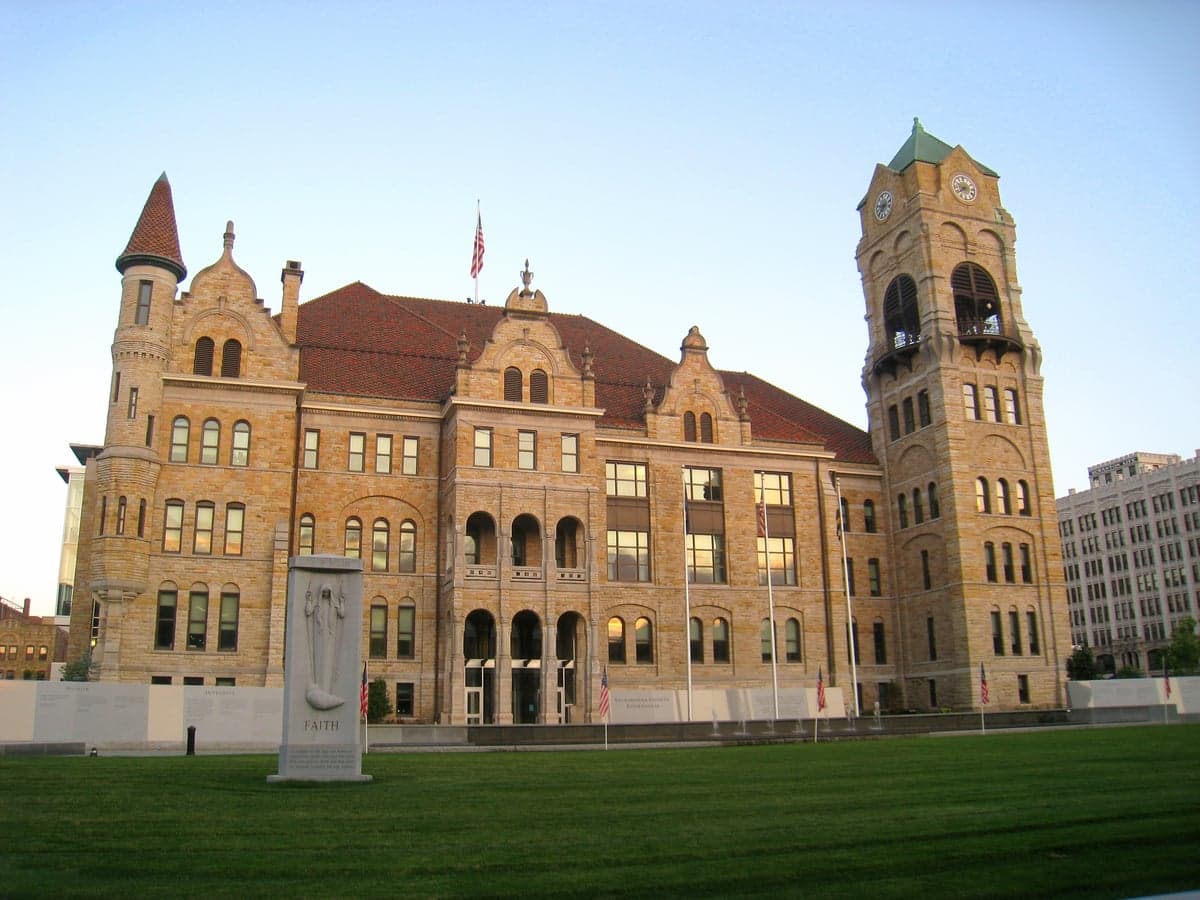
Photo: Wikipedia
Demographics of Lackawanna County
Affluence Level in Lackawanna County
A below-average socioeconomic profile. Incomes, home values, and educational attainment trail the U.S., with higher poverty and unemployment.
People of Lackawanna County
The people of Lackawanna County, Pennsylvania, today number 215,834, forming a predominantly white (81.1%) population with a distinctive working-class character rooted in its industrial past. The county’s identity is shaped by a deep history of European immigration, particularly from Ireland, Italy, and Eastern Europe, which built the anthracite coal and railroad industries that defined the region. While the population is less diverse than the national average, with a foreign-born share of just 2.8%, growing Hispanic (9.2%) and Indian (1.8%) communities are slowly reshaping the cultural landscape. This is a place where old ethnic neighborhoods persist, and the legacy of labor unions and Catholic parishes remains a powerful social force.
Settlement & growth (pre-1960)
Before European settlement, the Lackawanna Valley was part of the ancestral homeland of the Lenape people, who used the Lackawanna River as a travel corridor. The region was sparsely populated, with seasonal camps rather than permanent villages, as the dense forests and steep terrain made large-scale agriculture difficult. By the mid-18th century, the area was contested between the British and French, and after the American Revolution, the first permanent European settlers arrived—primarily Yankees from Connecticut and New England, who claimed land under the Susquehanna Company. These early settlers established small farming communities like Newton Township and Abington Township, but the real transformation began with the discovery of anthracite coal.
The 1820s through the 1850s saw the first major immigration wave: the Irish. Fleeing the Great Famine, Irish laborers poured into the region to dig coal mines and build the Delaware and Hudson Canal and later the railroads. They concentrated in Carbondale, the first major anthracite mining town, and in the city of Scranton, which grew from a small iron-making village into a booming industrial center. By 1860, the Irish made up roughly a third of Scranton’s population, and their presence is still felt in the city’s strong Catholic identity and the annual St. Patrick’s Day parade, one of the oldest in the nation.
The second major wave, from the 1880s to the 1920s, brought Southern and Eastern Europeans. Italians, primarily from the southern regions of Abruzzo and Sicily, arrived to work in the mines and railroads, settling in dense neighborhoods like South Scranton and Dunmore. Poles, Slovaks, and Ukrainians followed, establishing their own parishes and fraternal societies in Throop, Olyphant, and Old Forge. Old Forge, in particular, became known as the “Little Italy” of the region, famous for its unique style of thick-crust pizza. By 1930, Lackawanna County was one of the most ethnically diverse places in Pennsylvania outside of Philadelphia, with over 40% of its population foreign-born or of foreign parentage.
African Americans arrived in smaller numbers during the Great Migration (1910–1940), primarily from the Upper South, to work in the railroads and as domestic laborers. They formed a small but stable community concentrated in Scranton’s Green Ridge and West Side neighborhoods. The coal industry peaked around World War I, then entered a long decline. The Great Depression and the shift to other fuels caused massive job losses, and the county’s population peaked at 310,000 in 1930, then began a slow, steady decline that would last for decades.
Modern era (post-1965)
The 1965 Hart-Cellar Act had a muted immediate effect on Lackawanna County compared to major gateway cities, but its long-term impact is now visible. The county’s foreign-born population remains low at 2.8%, but the composition of that small share has shifted dramatically. The most notable change is the growth of the Indian community, now 1.8% of the population. This group is largely composed of professionals—doctors, engineers, and IT workers—attracted by employment at Geisinger Health System and the region’s growing healthcare sector. They are concentrated in Scranton’s Hill Section and the suburbs of Clarks Summit and Dickson City, where newer housing stock and good schools are draws.
East and Southeast Asian communities (1.2%) are smaller but growing, with a mix of Vietnamese, Korean, and Chinese families, many of whom run restaurants and small businesses in Scranton and Taylor. The Hispanic population, now 9.2%, is the fastest-growing demographic, driven primarily by Puerto Rican migration and, to a lesser extent, immigration from the Dominican Republic and Mexico. This community is concentrated in West Scranton and South Side, where older, affordable housing stock and existing social networks have created a vibrant enclave. The Hispanic population has more than doubled since 2000, reshaping the cultural and commercial life of these neighborhoods.
Domestic migration has been a story of loss and selective gain. The county lost population steadily from 1930 to 2010, as young people left for Sun Belt states and larger cities. However, since 2010, the decline has slowed to near-zero, and some towns are seeing modest growth. Suburbanization has pushed development north and east, with Moosic and Dickson City experiencing commercial and residential growth along the Interstate 81 corridor. The Black population (2.9%) has remained stable, with a small but established community in Scranton and Dunmore.
The future
Lackawanna County is slowly becoming more diverse, but the pace is gradual. The Hispanic and Indian populations are projected to continue growing, driven by both natural increase and continued migration for healthcare and service-sector jobs. The white population, while still the overwhelming majority, is aging and declining slightly, as younger white residents continue to leave for larger metros. The county’s overall population is expected to remain roughly flat or decline slightly over the next 20 years, barring a major economic shift.
The cultural identity of the county is evolving from a purely European-ethnic, Catholic, working-class identity toward a more pluralistic one. The old ethnic neighborhoods—Irish, Italian, Polish—are still recognizable, but they are increasingly multiethnic. Hispanic-owned businesses are becoming a fixture in West Scranton, and Indian cultural organizations are active in the suburbs. The region’s political leanings, historically Democratic but with a strong conservative streak on social issues, are shifting slightly rightward, reflecting national trends among working-class white voters. For a newcomer, Lackawanna County offers a low cost of living, strong community institutions, and a slower pace of life, but with a demographic profile that is still predominantly white and aging.
This is a region in transition, holding onto its industrial-era character while slowly absorbing new communities. For someone moving in now, the county offers affordable housing, a strong sense of place, and a chance to be part of a community that is quietly diversifying without losing its core identity. The future is likely to bring more Hispanic and Indian residents, a continued suburbanization of the I-81 corridor, and a gradual softening of the old ethnic boundaries that once defined the Lackawanna Valley.

* Values derived from national, state, county, city and local statistics and may differ in a specific area. Last updated: 2026-10-03T23:41:37.000Z
Narrative content on this page is AI-generated and may contain mistakes. Verify any details that matter before acting on them.
ReloMaps may earn a commission from affiliate links at no extra cost to you.

