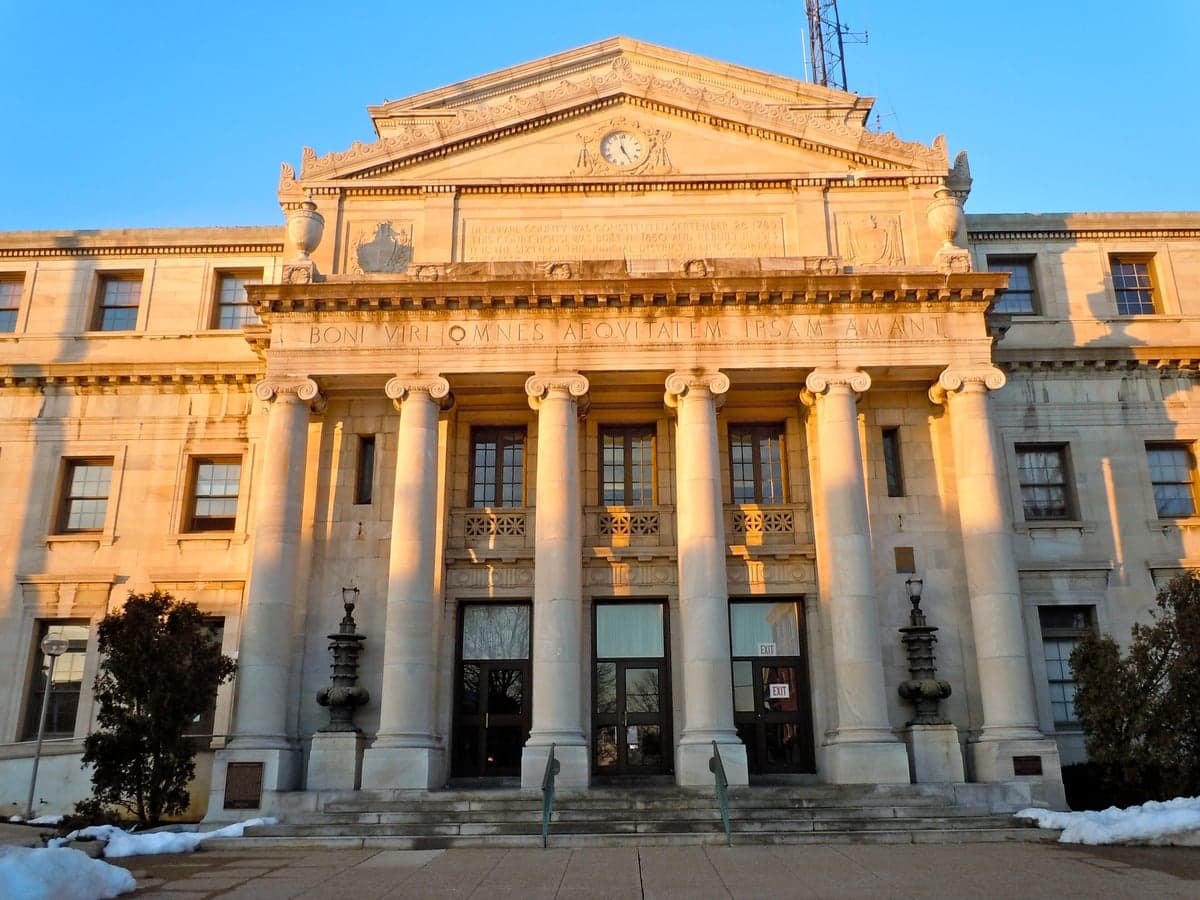
Photo: Wikipedia
Political ClimatePolitical Climate in Delaware County
Showing district-level results — no local-only data available.
Local Political AnalysisPolitical Analysis of Delaware County
Delaware County has undergone a dramatic political transformation over the past decade, shifting from a classic swing county to a solidly Democratic stronghold. The Cook Partisan Voting Index (PVI) now sits at D+15, meaning the county votes about 15 points more Democratic than the national average. This is a stark contrast to the state of Pennsylvania as a whole, which holds a Cook PVI of EVEN, reflecting its status as a true battleground. The shift is most visible in the county's inner-ring suburbs and former industrial towns, where Republican registration has plummeted and Democratic margins have swelled, particularly since the 2016 election.
How it compares
The gap between Delaware County and Pennsylvania is not just a number—it's a lived reality. While the state is evenly split, Delaware County is now one of the most reliably Democratic counties in the commonwealth. The change is most dramatic in places like Media, Swarthmore, and Ardmore, where college-educated voters and professionals have pushed the Democratic vote share well above 70% in recent presidential elections. Meanwhile, the county's Republican base has largely consolidated in the more rural and affluent western and northern edges, particularly in Newtown Square, Edgmont, and parts of Radnor and Haverford townships. These areas still vote Republican, but their margins are shrinking. The true swing precincts are now few and far between, but you can still find them in places like Upper Darby and Darby Borough, where working-class voters of diverse backgrounds can tip a local race. In 2020, Joe Biden won Delaware County by over 30 points, while Pennsylvania was decided by just over 1 point. That's the scale of the difference.
What this means for residents
For liberal residents, the political climate means their votes are rarely in doubt at the county level, and local government is reliably aligned with their priorities. Democratic candidates for county council, row offices, and the judiciary are essentially guaranteed wins in the general election. This has led to a focus on progressive policy initiatives, such as expanded public transit funding for SEPTA, affordable housing mandates in suburban townships, and environmental justice programs targeting legacy pollution in Chester and Marcus Hook. For conservative residents, the reality is more complex. They are a clear minority in countywide elections, but they still hold influence in local municipal races, school board contests, and in the Republican primaries that often decide who runs in the fall. Many conservative residents I know have shifted their focus to local issues—tax rates, zoning, and school curriculum—where their votes carry more weight. They also find common ground with liberals on issues like preserving open space and combating the opioid epidemic, which cuts across party lines.
Culturally, Delaware County is a study in contrasts. The county's Democratic lean is not a monolith; it's a coalition of urban liberals in Chester and Yeadon, suburban progressives in Wallingford and Broomall, and moderate-to-conservative Democrats in Springfield and Ridley. This means policy debates are often more pragmatic than ideological. For example, while the county government has pushed for sanctuary policies and criminal justice reform, it has also maintained a strong law-and-order posture in response to gun violence in Chester. The result is a political environment that feels less like a coastal liberal enclave and more like a working-to-middle-class suburb that has evolved with the times. If you're moving here, expect a place where your vote matters locally, but where the countywide direction is clearly blue—and likely to stay that way for the foreseeable future.

State Political ClimatePolitical Climate in Pennsylvania
State Political AnalysisPolitical Environment in the State
Pennsylvania is the ultimate swing state, with a Cook PVI of EVEN, meaning it votes almost exactly like the nation as a whole. Over the last 10-20 years, it has shifted from a reliably blue-leaning state in presidential races (voting for Democrats from 1992 to 2012) to a true battleground, flipping for Trump in 2016, Biden in 2020, and remaining a razor-thin margin in 2024. The dominant coalitions are a shrinking, union-heavy Democratic base in the southeast and Pittsburgh, balanced by a growing, populist-leaning Republican base across the vast rural and exurban interior. For a conservative relocator, this means your vote genuinely counts, but the state’s political direction is a constant tug-of-war.
Urban vs. rural divide
The political map of Pennsylvania is a textbook study in the urban-rural chasm. The two Democratic strongholds are Philadelphia (Philly) and Pittsburgh, along with their immediate suburbs. Philly alone delivers about 500,000 Democratic votes, and Allegheny County (Pittsburgh) adds another 250,000. These two metros essentially cancel out the entire rest of the state. The Republican base is anchored in the vast "T" of rural and exurban counties: Lancaster, York, Franklin, and Cumberland in the south-central region, plus the northern tier counties like Bradford and Tioga. A key battleground is the suburban ring around Philadelphia—places like Bucks County, Montgomery County, and Delaware County. These once-moderate Republican suburbs have trended sharply Democratic since 2016, driven by college-educated voters and professional-class migration. Meanwhile, the old industrial towns like Scranton and Erie have become true swing areas, often deciding statewide races by a few thousand votes. For a conservative moving in, you’ll find your political tribe in the exurbs and small cities, but you’ll be living in a state where the urban centers dominate the cultural and media narrative.
Policy environment
Pennsylvania’s policy environment is a mixed bag that reflects its purple status. On taxes, the state has a flat income tax of 3.07% and a sales tax of 6% (8% in Philly), with no tax on groceries or clothing. Property taxes are high, averaging about 1.5% of home value, and vary wildly by school district. The regulatory posture is moderate—not as business-friendly as Texas or Florida, but far less burdensome than New York or California. Education policy is a flashpoint: the state has a patchwork of 500 school districts, with a recent court ruling (2023) declaring the funding system unconstitutional, which could lead to major tax increases in the future. Healthcare is dominated by large systems like UPMC and Jefferson Health, and the state expanded Medicaid under the ACA. Election laws are relatively accessible: no-excuse mail-in voting was passed in 2019 (Act 77), but it remains controversial among conservatives. Voter ID is required for first-time voters only, not for regular voting. For a conservative, the tax structure is tolerable, but the property tax burden and the uncertainty around school funding are real concerns.
Recent policy direction
The recent policy direction under Governor Josh Shapiro (D) has been a mix of moderate pragmatism and left-leaning pushes. On gun and self-defense law, Pennsylvania is a "shall-issue" state for concealed carry, with no permit required for open carry (except in Philly). However, in 2024, Shapiro signed a bill expanding background checks for long guns, a move that angered gun rights groups. On parental and education rights, the state has seen fierce battles over school curriculum and library books, with several conservative school boards in York and Lancaster passing parental notification policies. On speech and privacy, there are no major state-level restrictions beyond federal law, but local ordinances in Philly and Pittsburgh have limited certain public protests. On medical and bodily autonomy, abortion remains legal up to 24 weeks, with no major restrictions passed since Roe fell—a stark contrast to neighboring Ohio and West Virginia. On property rights, the state has strong eminent domain protections, but zoning laws in urban areas can be restrictive. On taxation, there has been no major income tax cut, but the state did pass a modest reduction in the corporate net income tax (from 9.99% to 8.99%, with further cuts scheduled). On voting and ballot access, Act 77 (no-excuse mail-in) remains law, but there is ongoing litigation over signature verification and drop box rules. For a conservative relocator, the direction is a slow leftward drift on social issues, but with enough friction from the rural majority in the legislature to keep things from swinging too far.
Civil unrest & political movements
Pennsylvania has seen its share of political flashpoints. The 2020 election aftermath was particularly intense, with Trump’s campaign challenging the results in Philadelphia and Allegheny counties, leading to a statewide recount and a series of lawsuits. Election integrity remains a hot-button issue, with grassroots groups like "Audit the Vote PA" continuing to push for stricter rules. On the left, the Black Lives Matter protests in 2020 were large and sometimes violent in Philly and Pittsburgh, leading to property damage and a lasting debate over policing. Immigration politics are less visible here than in border states, but there are sanctuary city policies in Philly and Pittsburgh, which have drawn criticism from conservative lawmakers. There is no serious secession or nullification movement, but there is a strong "Second Amendment sanctuary" movement in over 30 counties, where local sheriffs have pledged not to enforce certain gun laws. For a new resident, you’ll notice the political divide most in the media you consume—Pittsburgh and Philly news are very different from the Lancaster or Erie papers. The state is not a place of daily unrest, but the tension is always just below the surface, especially during election cycles.
Projection
Over the next 5-10 years, Pennsylvania is likely to remain a swing state, but the demographic trends favor a slight rightward shift in the interior and a continued leftward shift in the suburbs. The key factor is in-migration: the state is losing population overall, but gaining in the exurbs of Lancaster and York as people flee high-cost states like New York and New Jersey. These new arrivals tend to be more conservative on taxes and crime, but more moderate on social issues. Meanwhile, the urban cores of Philly and Pittsburgh are aging and losing population, which could slowly erode the Democratic base. The wildcard is the state’s growing Hispanic population, concentrated in Allentown and Reading, which is politically mixed and could tip future elections. For a conservative moving in now, expect to see the state become more competitive at the local level, with more Republican wins in the legislature and possibly a flip in the governorship in 2026 or 2030. The policy environment will likely remain a stalemate on major issues, with incremental changes rather than dramatic shifts.
For a new resident, the bottom line is that Pennsylvania offers a genuine political battleground where your vote and voice matter. If you’re conservative, you’ll find strong communities in the exurbs and rural areas, but you’ll need to accept that the state’s urban centers will continue to drive cultural and policy debates. The tax burden is moderate, the gun laws are relatively permissive, and the school choice options are expanding. But you’ll also face high property taxes, a contentious education funding fight, and a state government that is often gridlocked. It’s not a place for someone who wants a uniform political environment—it’s for someone who wants to be in the fight, with all the friction and opportunity that entails.
* Values derived from national, state, county, city and local statistics and may differ in a specific area. Last updated: 2026-06-17T05:13:55.000Z
Narrative content on this page is AI-generated and may contain mistakes. Verify any details that matter before acting on them.
ReloMaps may earn a commission from affiliate links at no extra cost to you.

