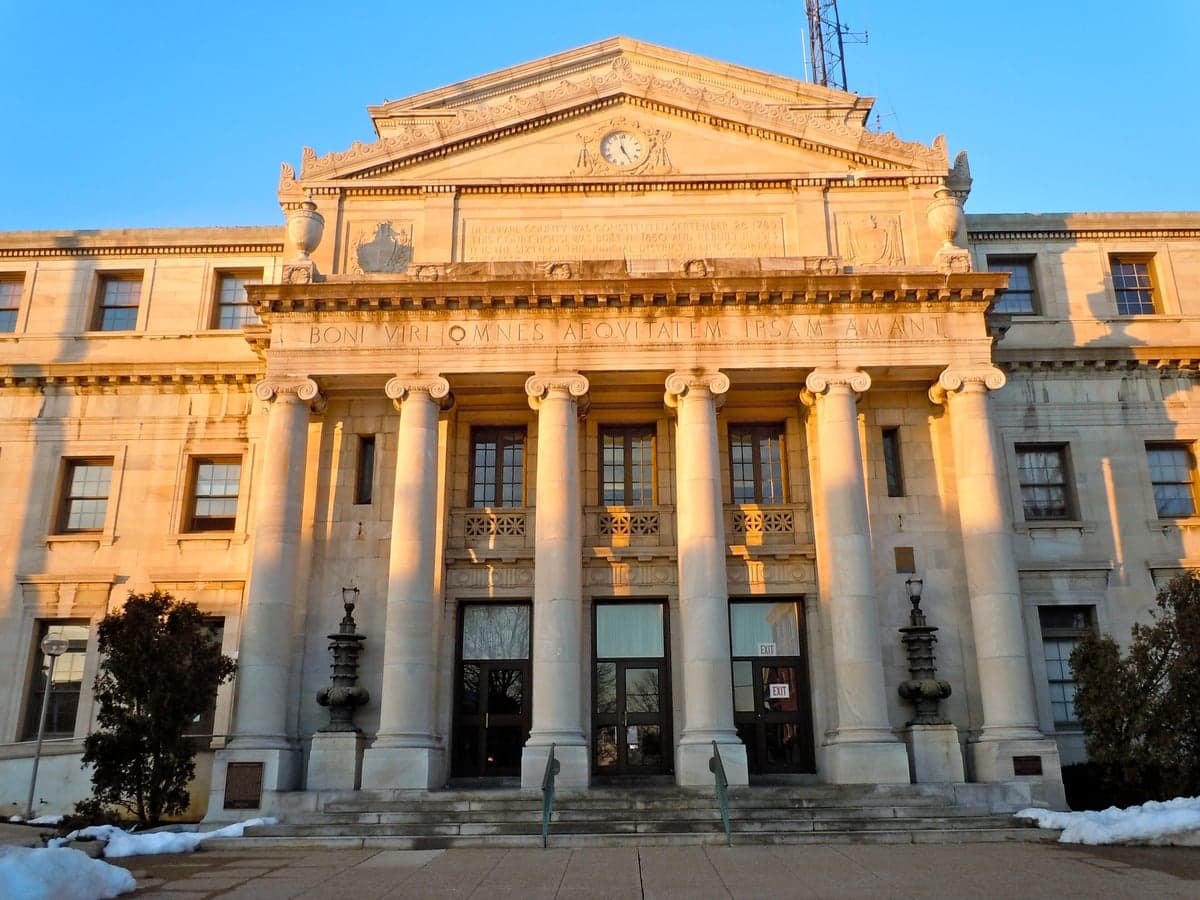
Photo: Wikipedia
Personal Sovereignty in Delaware County
Strong independent fundamentals that actively favor personal liberty and low regulation.
What does Personal Sovereignty tell us?
Personal Sovereignty measures your capacity for self-reliance and independence with minimal government friction. Higher scores mean fewer barriers between you and the way you want to live... but it assumes you have the space you need and good neighbors.
What does this tell us?
Personal Sovereignty measures your capacity for self-reliance and independence with minimal government friction. Higher scores mean fewer barriers between you and the way you want to live... but it assumes you have the space you need and good neighbors.
State Policy
Energy independence: Net exporter (150% of energy produced in-state)
Personal Liberty
Homesteading

Personal Liberty Analysis
Delaware County, Pennsylvania, presents a nuanced personal sovereignty environment that balances suburban order with meaningful individual freedoms, though it operates firmly within the commonwealth's broader regulatory framework. As a densely populated suburban county bordering Philadelphia, its autonomy landscape differs markedly from rural Pennsylvania counties, with local governance structures that can either amplify or constrain personal choice depending on the specific municipality. For conservative-leaning individuals and families weighing relocation, the county offers a mixed picture: strong property rights and parental autonomy coexist with higher tax burdens and more restrictive gun regulations than found in central or northern Pennsylvania.
Tax burden and regulatory posture: what residents actually pay and face
Delaware County's tax environment reflects its suburban character and proximity to Philadelphia, with a total tax burden that ranks among the higher in Pennsylvania. The county's real estate tax rate averages approximately 0.8% to 1.1% of assessed value, depending on the specific municipality, with an additional 1% county-wide sales tax on top of Pennsylvania's 6% state rate. Property assessments in Delaware County were controversially updated in 2024, causing some homeowners in Media, Swarthmore, and Radnor Township to see significant increases. The county imposes a 3.5% earned income tax (EIT) on residents, split between county and municipal governments, which is notably higher than the 1% common in many Pennsylvania counties. Regulatory posture varies sharply by municipality: Chester City and Upper Darby maintain more extensive zoning and business licensing requirements, while Concord Township and Chadds Ford lean toward lighter-touch regulation, particularly for home-based businesses. Pennsylvania's lack of statewide rent control and relatively permissive land-use laws at the county level give municipalities considerable latitude, but Delaware County's home-rule charter means local ordinances can be more restrictive than state minimums. For a family comparing tax burdens, Delaware County's combined state and local tax load is roughly 20-30% higher than in neighboring Chester County, though still below New Jersey suburbs across the river.
Self-defense and gun law specifics: what is and isn't allowed
Pennsylvania is a "shall-issue" state for concealed carry permits, and Delaware County's sheriff's office processes applications with typical turnaround times of 30-45 days as of 2026. The county does not impose additional waiting periods or magazine capacity limits beyond state law, meaning standard-capacity magazines and semi-automatic rifles remain legal for purchase and possession. However, Delaware County's proximity to Philadelphia has led to more assertive local enforcement of state firearm laws, particularly in Chester City and Darby Borough, where police have been known to stop and question individuals openly carrying firearms, despite state preemption of open carry for those with valid licenses. The county has no local gun registration or assault weapon bans, but municipalities like Swarthmore and Media have passed symbolic resolutions supporting state-level universal background checks, which carry no legal force but signal local sentiment. Stand-your-ground laws apply statewide, and Delaware County courts have generally upheld self-defense claims in home-invasion scenarios, though the county's district attorney's office has a reputation for scrutinizing such claims more closely than in rural counties. For gun owners, the practical reality is that Delaware County is legally permissive under state law but socially and administratively less gun-friendly than counties like York or Lancaster, with fewer gun ranges and firearms dealers per capita.
Self-reliance and homesteading viability: lot sizes, zoning, and off-grid feasibility
Homesteading and off-grid living in Delaware County face significant practical constraints due to its suburban density and municipal zoning codes. Minimum lot sizes in most residential zones range from 0.25 to 1 acre, with larger parcels (2-5 acres) available only in the county's western townships like Thornbury and Birmingham. Raising chickens is permitted in many municipalities but typically limited to 4-6 hens with no roosters, while goats and larger livestock are generally prohibited in areas zoned residential. Off-grid feasibility is low: all developed parcels must connect to public water and sewer in most municipalities, and solar panel installations require building permits and homeowner association approval in many subdivisions. Rainwater collection for outdoor use is legal under Pennsylvania law, but indoor potable use requires permits that are rarely granted in Delaware County. The county's agricultural zoning, concentrated in Chadds Ford and Concord Township, allows for more substantial homesteading activities, including small-scale farming and roadside stands, but these areas are also the most expensive for land acquisition, with raw acreage starting around $50,000 per acre. For families seeking true self-reliance, Delaware County is better suited as a base for weekend homesteading at a rural property within a 90-minute drive than for full-time off-grid living within its borders.
Personal liberties: parental rights, medical autonomy, speech, and property
Parental rights in Delaware County are generally respected within Pennsylvania's legal framework, which gives parents broad authority over their children's education and medical decisions. The county's school districts, including Radnor, Marple Newtown, and Wallingford-Swarthmore, have adopted policies that allow parents to opt children out of specific curriculum content, though the process varies by district. Homeschooling is legal and relatively straightforward, requiring a notarized affidavit and annual portfolio review, with Delaware County's intermediate unit providing oversight that is less intrusive than in some neighboring counties. Medical autonomy is more constrained: Pennsylvania's vaccine mandates for school attendance apply county-wide, and Delaware County's health department has been proactive in public health campaigns, though it does not enforce mask or vaccine mandates as of 2026. Free speech protections follow First Amendment standards, with no county-specific restrictions beyond standard noise ordinances and parade permit requirements in municipalities like Media and Lansdowne. Property rights are robust under Pennsylvania's constitution, but Delaware County's zoning boards have a reputation for denying variance requests more frequently than in less densely populated counties, particularly for accessory dwelling units and home occupations. The county's land bank program, active in Chester City and Yeadon, has been used to acquire and demolish blighted properties, which some property rights advocates view as an overreach of eminent domain authority.
Overall, Delaware County offers a moderate level of personal sovereignty that falls short of Pennsylvania's most liberty-friendly rural counties but exceeds the restrictions found in neighboring New Jersey or New York suburbs. For a conservative-leaning individual or family, the county's strongest autonomy features are its state-level gun laws, parental rights in education, and property ownership protections, while its weakest areas are high tax burdens, restrictive zoning for self-reliance activities, and a regulatory posture that varies unpredictably by municipality. Compared to areas like Franklin County or Tioga County, Delaware County trades significant personal sovereignty for proximity to Philadelphia's job market and cultural amenities. For those prioritizing maximum independence, the county's western townships offer the best balance of freedom and access, while the eastern and central municipalities lean toward a more managed suburban environment.

* Values derived from national, state, county, city and local statistics and may differ in a specific area. Last updated: 2026-06-17T05:13:55.000Z
Narrative content on this page is AI-generated and may contain mistakes. Verify any details that matter before acting on them.
ReloMaps may earn a commission from affiliate links at no extra cost to you.

