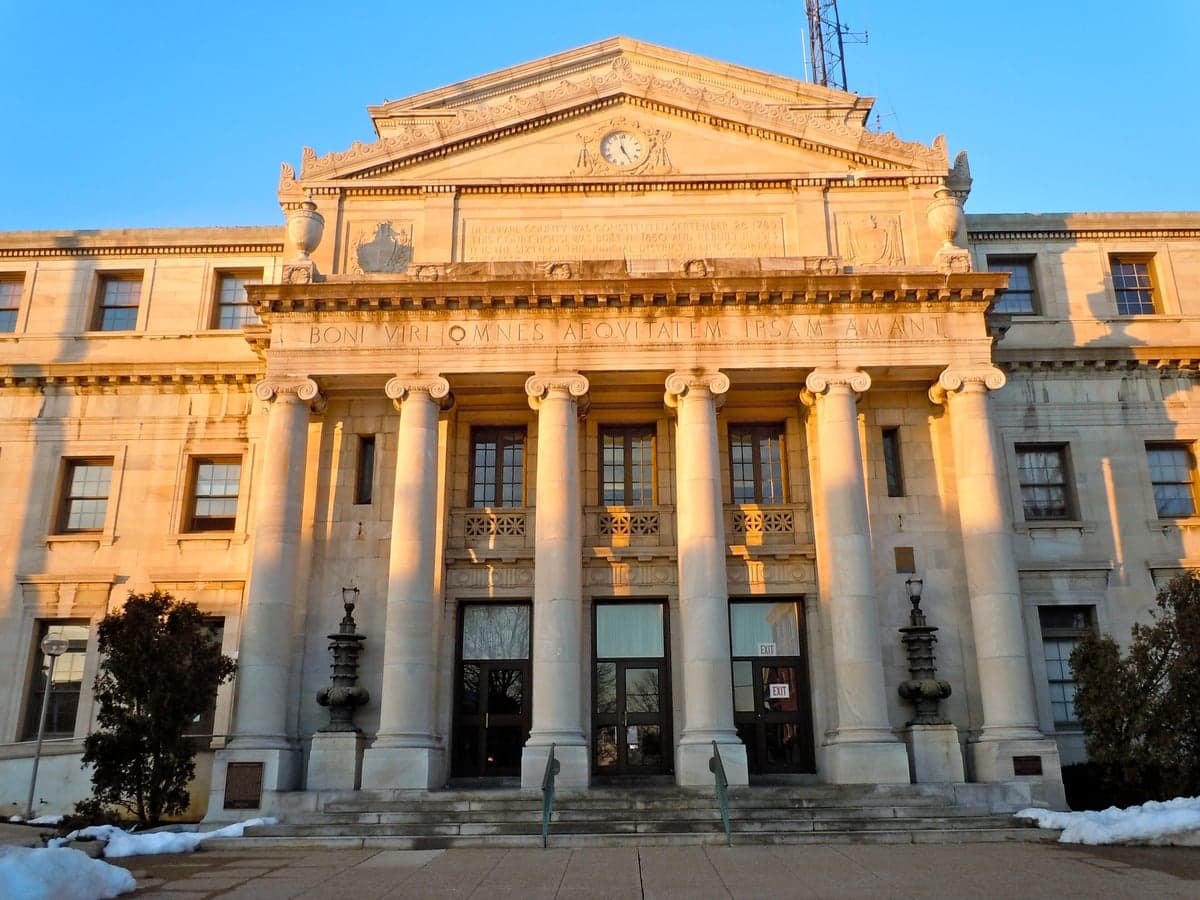
Photo: Wikipedia
Demographics of Delaware County
Affluence Level in Delaware County
A middle-class area roughly in line with national averages across income, home values, education, and employment.
People of Delaware County
Delaware County, Pennsylvania, is a densely settled suburban county of 576,195 residents that blends historic industrial roots with modern professional-class commuter life. Its population is 63.3% white, 21.7% Black, 4.8% Hispanic, 3.6% East and Southeast Asian, and 2.6% Indian (subcontinent), with a relatively low 4.3% foreign-born share. The county’s identity is shaped by its position as a first-ring suburb of Philadelphia, its deep Catholic and Protestant ethnic heritage, and a gradual diversification that has accelerated since the 1990s. Residents often describe the county as a place of stable, middle-to-upper-middle-class neighborhoods, strong public schools, and a political tilt that has shifted from reliably Republican to competitive in recent decades.
Settlement & growth (pre-1960)
Before European settlement, the land now called Delaware County was inhabited by the Lenape people, particularly the Unami and Unalachtigo bands, who lived in seasonal villages along the Delaware River and its tributaries. Swedish and Finnish colonists established the first European foothold in the 1640s, building log cabins and trading posts near present-day Chester and Upland, making this one of the oldest continuously settled European areas in Pennsylvania. The English took control in 1664, and William Penn’s 1681 charter brought a wave of English Quakers, Welsh Baptists, and Scots-Irish Presbyterians who farmed the rolling hills and founded villages like Media, Swarthmore, and Newtown Square.
The 19th century transformed the county’s population through industrialization. Chester, the county seat until 1851, became a major manufacturing and shipbuilding center, drawing Irish immigrants fleeing the Great Famine in the 1840s and 1850s. They settled in working-class neighborhoods like Chester’s South Ward and Eddystone, building the city’s Catholic parishes and labor unions. By the 1880s, Italian immigrants arrived to work in the textile mills, quarries, and railroad yards, establishing enclaves in Lansdowne and Darby. Polish and Ukrainian immigrants followed in the 1890s-1910s, clustering in Clifton Heights and Yeadon, where they founded Eastern Rite Catholic churches and fraternal societies. The county’s Black population, small before 1900, grew during the Great Migration (1915-1970) as African Americans from the rural South moved north for jobs in Chester’s shipyards, Sun Shipbuilding & Dry Dock Company, and the Baldwin Locomotive Works. By 1960, Chester was a majority-Black city, while the surrounding townships remained overwhelmingly white and ethnically European.
Suburbanization reshaped the county after World War II. The GI Bill and highway construction (especially I-95 and the Blue Route, I-476) enabled white ethnic families to leave Philadelphia and older industrial boroughs for new developments in Springfield, Havertown, and Broomall. These areas grew rapidly in the 1950s and 1960s, attracting second- and third-generation Irish, Italian, and Polish families seeking larger homes and better schools. The county’s population peaked at 603,000 in 1970, then began a slow decline as manufacturing jobs left Chester and the inner-ring suburbs aged.
Modern era (post-1965)
The 1965 Hart-Cellar Act had a modest direct impact on Delaware County compared to gateway cities, but its indirect effects reshaped the county’s demographics over time. The foreign-born share remains low at 4.3%, but the composition of that population has shifted. Since the 1990s, East and Southeast Asian immigrants—primarily from China, Korea, and Vietnam—have settled in the county’s more affluent western and central townships, particularly Radnor, Bryn Mawr, and Villanova, drawn by the area’s top-ranked public schools and proximity to Philadelphia’s universities and hospitals. Indian (subcontinent) families, many working in information technology, healthcare, and academia, have concentrated in Wayne, Newtown Square, and Glen Mills, where they now make up 2.6% of the county’s population. These groups are highly educated—41.6% of county adults hold a bachelor’s degree or higher—and have integrated into the professional-managerial class rather than forming visible ethnic enclaves.
Domestic migration has been more consequential. The county’s Black population, 21.7% today, is largely the legacy of the Great Migration, but its distribution has changed. Middle-class Black families have moved from Chester to older suburbs like Yeadon, Darby, and Lansdowne, which have become majority-Black or heavily diverse. Meanwhile, Chester has lost population—from 66,000 in 1950 to 32,000 today—as deindustrialization and disinvestment drove out many residents. The Hispanic population, 4.8%, is a newer and smaller wave, with Puerto Rican and Dominican families settling in Chester and Upper Darby, where they have joined a multiethnic working-class community. White flight from Chester and the inner ring has been offset by white in-migration to the county’s western half, where Media, Swarthmore, and Wallingford attract college-educated professionals who value walkable town centers and commuter rail access to Philadelphia.
Politically, the county has moved from a Republican stronghold (it voted for every GOP presidential nominee from 1968 to 1988) to a competitive swing county (it backed Obama in 2008 and 2012, then Trump in 2016 by a narrow margin, and Biden in 2020). This shift reflects the growing influence of college-educated white voters in the western suburbs, who have trended Democratic, while working-class white voters in the eastern industrial boroughs have moved toward the GOP.
The future
Delaware County’s population is projected to remain stable or grow slightly over the next decade, driven by infill development and the continued appeal of its western suburbs. The county is becoming more diverse, but slowly: the white share is declining (from 72% in 2010 to 63.3% today), while the East/Southeast Asian and Indian shares are rising, particularly in the higher-income townships. The Black population is likely to remain stable or grow modestly, as Chester’s decline is offset by suburbanization. The Hispanic share is expected to increase gradually, especially in Upper Darby and Chester, as new immigrants from Central America and the Caribbean arrive. The foreign-born share, while low, will likely rise as international students and professionals settle near the county’s universities and corporate campuses.
The county’s cultural identity is evolving from a collection of insular ethnic white suburbs into a more diverse, education-driven region. The old Irish-Italian-Polish Catholic character of places like Havertown and Springfield is fading as younger, more secular, and more racially mixed families move in. The county’s political competitiveness will likely persist, with the western suburbs solidifying as Democratic-leaning and the eastern industrial towns remaining Republican-leaning. For a new resident, Delaware County offers a mix of historic small-town character, strong public schools, and easy access to Philadelphia, but with a cost of living that has risen sharply in the western half. The county is not a destination for immigrants in the way that New York or Los Angeles is, but it is a stable, family-oriented place where the children of earlier immigrant waves are now being joined by a smaller, more selective stream of newcomers from Asia and Latin America.
For someone moving in now, Delaware County is a mature, well-established suburban region where the trade-offs are clear: excellent schools and safe neighborhoods in the west, more affordable but challenged communities in the east, and a population that is slowly diversifying but remains majority-white and native-born. The county’s future is one of gradual change rather than transformation—a place where the past is still visible in its ethnic parishes and rowhouse blocks, but where the next generation will be more educated, more diverse, and more connected to the global economy than the one before.

* Values derived from national, state, county, city and local statistics and may differ in a specific area. Last updated: 2026-06-17T05:13:55.000Z
Narrative content on this page is AI-generated and may contain mistakes. Verify any details that matter before acting on them.
ReloMaps may earn a commission from affiliate links at no extra cost to you.

