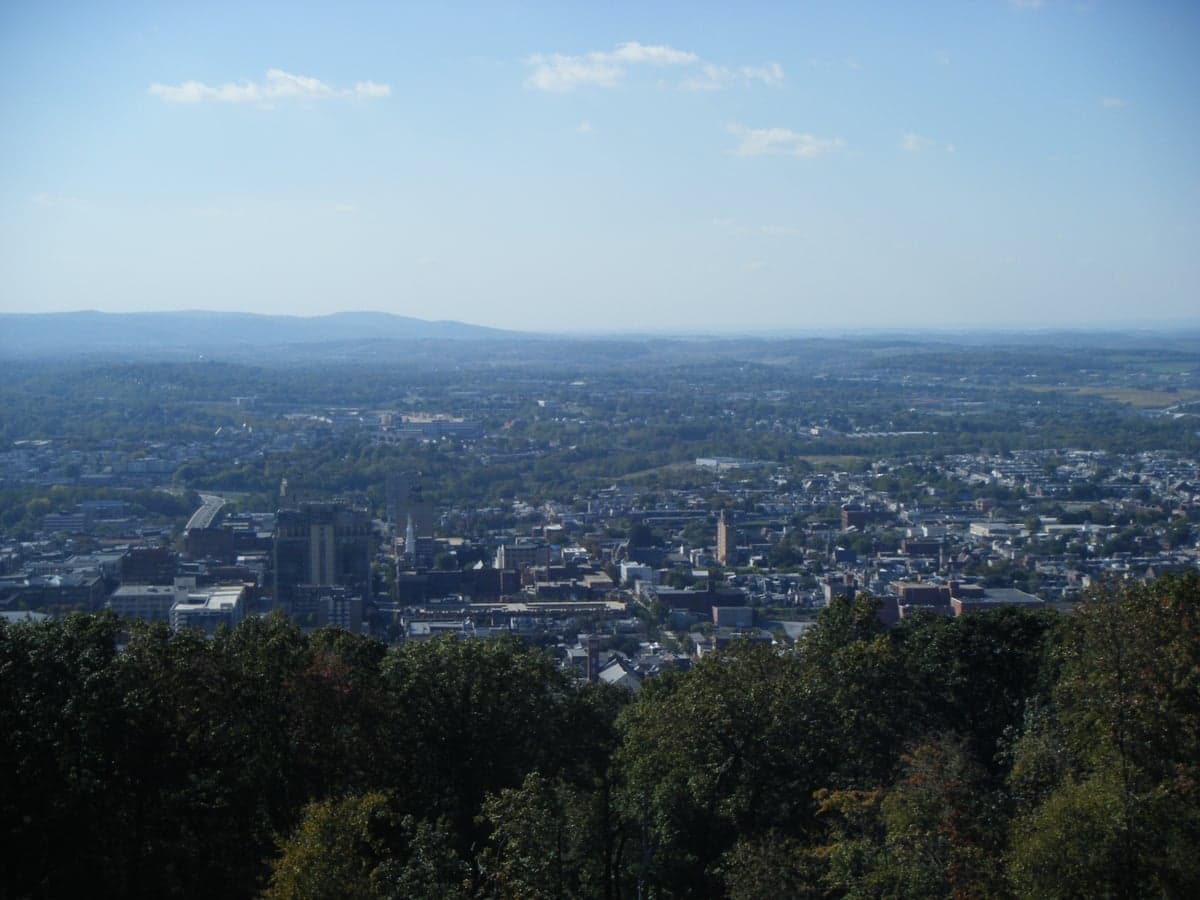
Photo: Wikipedia
Political ClimatePolitical Climate in Berks County
Showing district-level results — no local-only data available.
Local Political AnalysisPolitical Analysis of Berks County
Berks County has shifted from a classic bellwether to a solidly Democratic-leaning area, carrying a Cook PVI of D+8, while the state of Pennsylvania sits at EVEN. This isn't a sudden flip; it's a gradual realignment that's been building for two decades, driven largely by the growing influence of Reading and its suburbs. The county still has deep red pockets, but the blue vote in the urban core and along the Route 222 corridor now consistently outweighs the rural and exurban Republican turnout. If you're looking at a map, think of it as a blue crescent wrapping around a red heartland.
How it compares
Compared to the state as a whole, Berks is about 8 points more Democratic, which is a significant gap. Pennsylvania's EVEN rating means it's a pure toss-up, but Berks now functions as a reliable Democratic anchor in the southeastern part of the state. The contrast is stark when you drive from the city of Reading, where precincts can go 70-80% Democratic, to the northern townships like Hamburg or Kutztown, which are reliably Republican. The real swing territory is in the middle ring: places like Wyomissing and Spring Township are the key battlegrounds. Wyomissing, historically a GOP stronghold, has been trending purple as younger professionals and families move in, while Spring Township still leans red but with a shrinking margin. The rural areas north of the Blue Mountain, like Port Clinton and Strausstown, remain deeply conservative, but they don't have the population to offset the Reading vote.
What this means for residents
For a liberal resident, Berks County feels like a safe space. You can reliably expect Democratic representation at the county and state level, and local policies in Reading and its immediate suburbs reflect that. For a conservative resident, it means you're in a clear minority in countywide elections, but your voice is still loud in your local township and school board. The practical effect is that you'll see more progressive policies on things like housing and social services in the city, but you'll still find strong conservative values in the rural school districts. The county commissioners are often split, with two Democrats and one Republican, which forces compromise on budgets and land use. This isn't a place where one side steamrolls the other; it's a constant negotiation.
Culturally, the divide is visible in daily life. The city of Reading is a vibrant, majority-Latino hub with a strong immigrant community, while the northern townships are predominantly white, older, and more rooted in Pennsylvania Dutch traditions. You'll see this in the local news: debates over a new housing development in Exeter Township versus a community center in the city. The policy distinction that stands out is the county's approach to economic development. Berks has leaned into attracting warehouse and logistics centers along the I-78 and Route 222 corridors, which has brought jobs but also traffic and environmental concerns. This is a pragmatic, not ideological, choice that both sides have generally supported, even if they argue over the details. Looking ahead, the D+8 lean is likely to hold or even widen as Reading's population grows and the suburbs continue to diversify. The old swing county is gone, but the new one is a fascinating, complicated place to live.

State Political ClimatePolitical Climate in Pennsylvania
State Political AnalysisPolitical Environment in the State
Pennsylvania is the ultimate swing state, with a Cook PVI of EVEN that perfectly captures its knife-edge balance. Over the past 20 years, the state has shifted from a reliably blue-leaning battleground to a true toss-up, driven by the collapse of Democratic support in the rural west and north, the explosive growth of the Philadelphia suburbs, and the slow realignment of the old industrial towns. The dominant coalitions are a shrinking but still potent union-and-urban base in Philadelphia and Pittsburgh, versus a growing, energized conservative coalition in the exurbs, the central spine, and the northern tier. The 2024 presidential race saw the state decided by less than 2 points, continuing a pattern where no candidate has won by more than 2.5% since 2012.
Urban vs. rural divide
The political map of Pennsylvania is a story of three distinct regions. Philadelphia and its immediate suburbs (Bucks, Montgomery, Delaware, Chester counties) are the engine of the Democratic vote, delivering margins of 60-70% in the city and 55-60% in the inner ring. Pittsburgh and Allegheny County are similarly blue, though less intensely so. The real action is in the "collar counties" around Philly — places like Bucks County, which flipped from red to blue in the Trump era and now hosts some of the most competitive state legislative races in the country. Meanwhile, the vast rural expanse — from the Lackawanna Valley north of Scranton to the Allegheny National Forest region — votes 65-75% Republican. The I-81 corridor through central PA, anchored by Harrisburg and York, is a classic swing zone where working-class voters have moved sharply right. The Lehigh Valley (Allentown, Bethlehem, Easton) remains a true bellwether: it voted for Obama twice, then Trump, then Biden, then Trump again, and its mix of suburbanites, warehouse workers, and Hispanic immigrants makes it the state's most watched region.
Policy environment
Pennsylvania's policy landscape is a patchwork of divided government outcomes. The state has a flat income tax of 3.07%, one of the lowest in the Northeast, and a sales tax of 6% that exempts food and clothing. Property taxes are high — among the top 10 nationally — and vary wildly by district, a major concern for families. The regulatory posture is moderate: the state has its own environmental rules under the DEP that often exceed federal standards, particularly on fracking and water quality. Education policy is dominated by a long-running school funding lawsuit that the state supreme court ruled in 2023 was unconstitutional, forcing a major rewrite of the funding formula. Healthcare is a mixed bag: the state expanded Medicaid under the ACA, but the legislature has blocked any move toward a public option. Election laws are a perennial battleground: Act 77 of 2019 expanded no-excuse mail-in voting, but the legislature has since tightened rules around ballot drop boxes and signature verification, and the state supreme court has flip-flopped on whether undated ballots count. The result is a system that works smoothly in blue counties and faces constant litigation in red ones.
Recent policy direction
The last five years have seen Pennsylvania lurch in contradictory directions, reflecting its split government. On gun rights, the state has moved slightly pro-2A: in 2022, the legislature passed a preemption law that bars local governments from enacting their own gun ordinances, and Philadelphia's attempt to ban assault weapons was struck down. However, the state still requires a license to carry concealed (shall-issue) and has universal background checks for handguns. On parental rights and education, the 2023-24 session saw a fierce fight over library books and curriculum transparency, with several districts adopting "parental bill of rights" policies, but no statewide law passed. Medical and bodily autonomy is a flashpoint: abortion remains legal up to 24 weeks under a 2019 state supreme court ruling, but the legislature has passed a 24-hour waiting period and mandatory counseling. The state has no shield law for out-of-state abortion seekers. On property rights, the state's "Clean and Green" program offers tax breaks for agricultural land, but urban areas like Philadelphia have seen a surge in property tax appeals as assessments rise. Voting and ballot access is the most volatile area: the legislature has repeatedly tried to require voter ID for mail ballots, and the 2024 election saw a record number of provisional ballots in Luzerne County due to scanner malfunctions. The overall direction is toward more friction in the voting process, not less.
Civil unrest & political movements
Pennsylvania has a long history of political activism, and the last decade has been no exception. The 2020 election aftermath saw massive protests in Philadelphia and Harrisburg, with both left-wing (BLM) and right-wing (Stop the Steal) mobilizations. The state was a key battleground for the "audit" movement, with the Republican-controlled senate launching a review of the 2020 results that ultimately found no evidence of widespread fraud. Immigration politics are less visible than in border states, but Philadelphia's sanctuary city policy has been a recurring flashpoint, with the state legislature passing a bill in 2023 to withhold state funds from such cities (vetoed by the governor). The fracking debate in the Marcellus Shale region has produced its own activism: the northern tier counties (Bradford, Susquehanna) have seen both pro-energy rallies and environmental protests, with the state's severance tax among the lowest in the nation. Secessionist rhetoric is rare but not unheard of: in 2021, several rural counties passed resolutions calling for a "constitutional convention" to rebalance power between urban and rural areas. The most visible flashpoint for a new resident would be the constant presence of campaign signs and door-knockers — Pennsylvania is the most heavily targeted state in presidential elections, and the intensity never lets up.
Projection
Over the next 5-10 years, Pennsylvania is likely to remain a toss-up, but the demographic trends favor a slow rightward drift. The Philadelphia suburbs are becoming more diverse and more Democratic, but the growth is concentrated in the inner ring; the outer exurbs (like Berks County and Lancaster County) are growing faster and trending red. The Pittsburgh region is losing population, which hurts the Democratic base. The Hispanic population in the Lehigh Valley and Reading is growing rapidly, but this group is not uniformly Democratic — many Puerto Rican and Dominican voters in the region lean conservative on social issues. The in-migration from New York and New Jersey is a wild card: these newcomers tend to be moderate Republicans or independents who bring their high-tax sensibilities but also a desire for lower property taxes. The state's aging population (it has the third-oldest median age in the nation) means that the electorate will continue to skew older and whiter, which benefits Republicans. The most likely scenario is that Pennsylvania remains a purple state through 2032, with the governor's office and legislature flipping between parties as the national mood shifts. A new resident moving in now should expect to live in a state where every election is a nail-biter and where their vote genuinely matters.
For a conservative-leaning relocator, Pennsylvania offers a mixed bag: low income taxes and a strong gun rights framework, but high property taxes and a chaotic election system. The practical takeaway is that you can find a community that matches your politics — from the deep red Franklin County in the south-central region to the purple Erie on the lake — but you will never be far from the other side. The state's political climate is not for those who want ideological comfort; it's for those who want to be in the arena. If you move here, you will be canvassed, called, and courted every two years, and your vote will be one of the most consequential in the country. That's the price of living in the keystone of American politics.
* Values derived from national, state, county, city and local statistics and may differ in a specific area. Last updated: 2026-07-27T09:00:14.000Z
Narrative content on this page is AI-generated and may contain mistakes. Verify any details that matter before acting on them.
ReloMaps may earn a commission from affiliate links at no extra cost to you.

