Photo: Wikipedia
Demographics of Berks County
Affluence Level in Berks County
A middle-class area roughly in line with national averages across income, home values, education, and employment.
People of Berks County
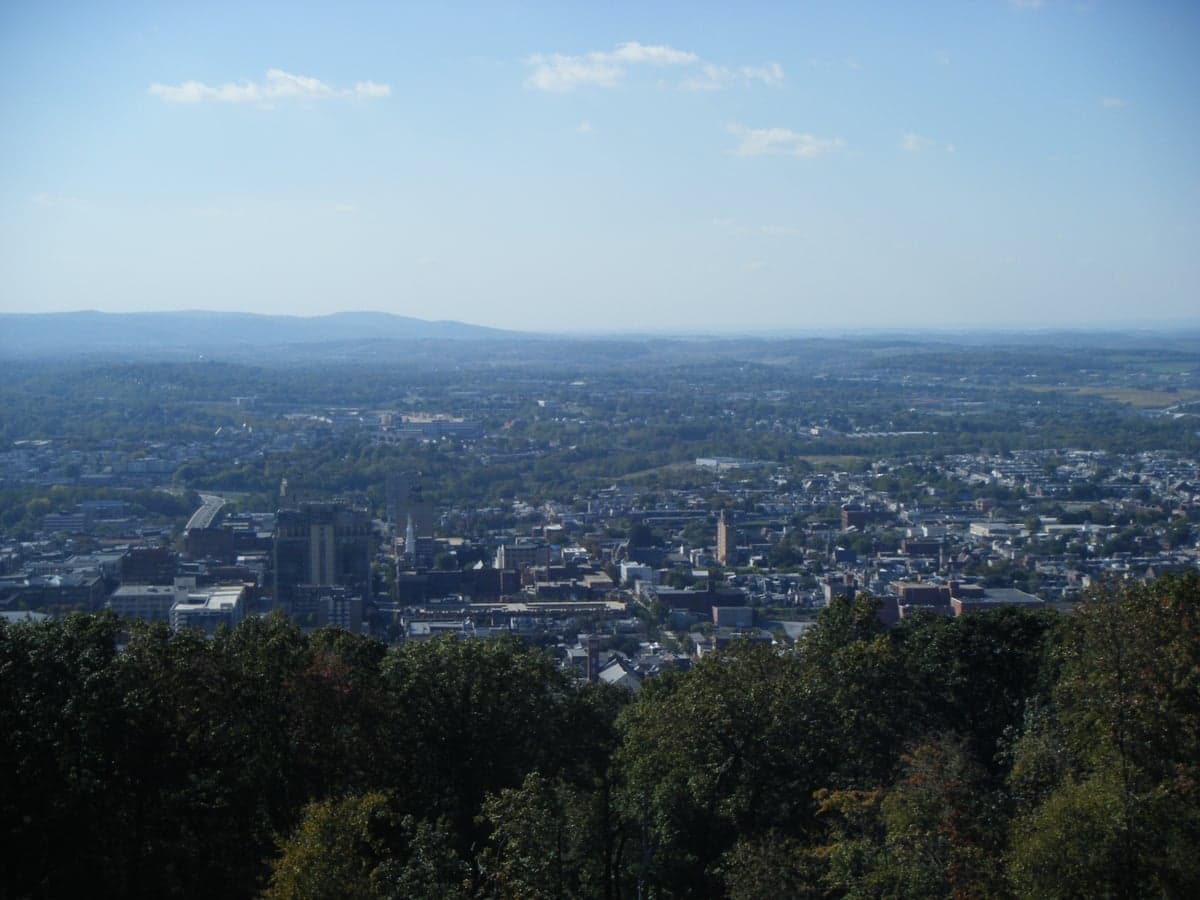
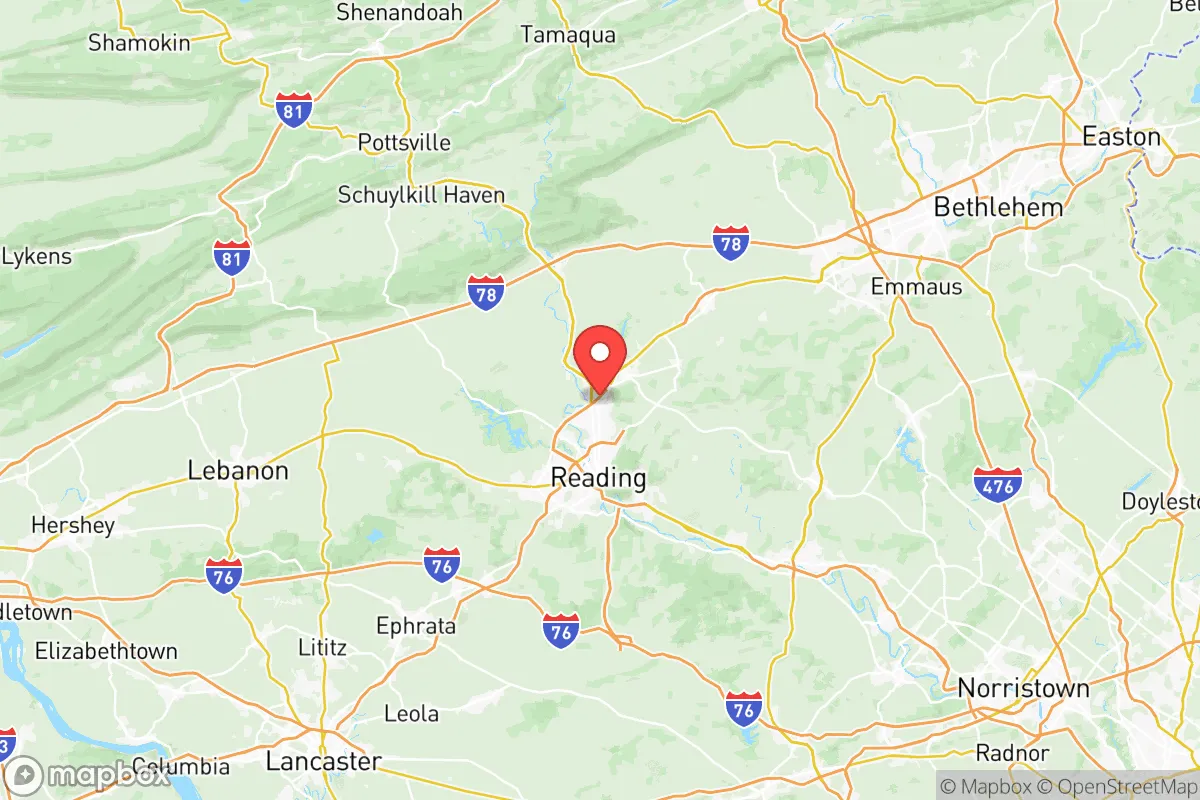
Today, Berks County is a community of roughly 430,000 residents defined by its deep Pennsylvania Dutch roots, a growing Hispanic population, and a character that remains distinctly more rural and family-oriented than the Philadelphia suburbs to its east. The county’s population is 67.8% White, 24.0% Hispanic, 4.0% Black, and 0.8% East/Southeast Asian, with a foreign-born share of just 4.0%—well below the national average. This is a place where the legacy of 18th-century German farmers still shapes the landscape, from the covered bridges of Kutztown to the bologna factories of Berne, even as a new wave of Puerto Rican and Dominican families reshapes neighborhoods in Reading and its inner-ring suburbs.
Settlement & growth (pre-1960)
Before European contact, the region that is now Berks County was the domain of the Lenape people, particularly the Unami-speaking bands who hunted and farmed along the Schuylkill River and its tributaries. The Lenape called the area Oley—meaning "hole" or "hollow"—a name that survives today in the township of Oley. By the 1730s, the Lenape had been pushed westward through a series of treaties and land purchases, most notably the Walking Purchase of 1737, which fraudulently claimed vast tracts of Lenape land for the Penn family.
The first European settlers were not English but German-speaking Protestants from the Palatinate region of what is now Germany. These "Pennsylvania Dutch" (a corruption of Deutsch) began arriving in the 1720s and 1730s, drawn by William Penn’s promise of religious toleration and cheap land. They settled in dense clusters along the fertile limestone valleys of the Schuylkill and Maiden Creek, founding towns like Reading (1748), Kutztown (1750s), and Womelsdorf (1762). By the time of the American Revolution, Berks County was overwhelmingly German-speaking, with a small admixture of English Quakers and Scots-Irish Presbyterians in the northern hill country around Hamburg and Strausstown.
The 19th century brought industrialization and a second wave of immigrants. The Schuylkill Canal (opened 1825) and later the Philadelphia and Reading Railroad turned Reading into a major industrial hub, especially for iron and steel. This drew Irish immigrants in the 1840s and 1850s, who settled in the "Furnace" neighborhoods of Reading and in the iron-mining villages of Birdsboro and Robesonia. A smaller wave of Italian immigrants arrived in the 1890s-1910s, concentrating in Reading’s northeast side and in the silk-mill town of Fleetwood. By 1900, Berks County was a patchwork of German farmers, Irish and Italian industrial workers, and a small but established Black community in Reading that had grown from the Underground Railroad era.
The Great Migration (1910-1970) brought a significant number of Black families from the rural South to Reading, drawn by jobs in the Reading Railroad yards, the Berkshire Knitting Mills, and the Bethlehem Steel plant in nearby Topton. This wave peaked in the 1940s and 1950s, when Reading’s Black population reached roughly 5% of the city total. Meanwhile, the county’s rural townships—Longswamp, Maxatawny, Richmond—remained overwhelmingly German-American, with many families still speaking Pennsylvania Dutch at home into the 1950s.
Modern era (post-1965)
The 1965 Hart-Cellar Act had a delayed but transformative effect on Berks County. Unlike coastal cities that saw immediate waves of Asian and Latin American immigration, Berks’s first post-1965 newcomers were Puerto Ricans, who are U.S. citizens and thus not subject to immigration quotas. They began arriving in Reading in the 1970s, drawn by low housing costs and entry-level jobs in the city’s remaining factories and warehouses. By 1990, Reading’s Hispanic population had reached 15%, and by 2000 it was over 30%.
The 1990s and 2000s saw a second, larger wave of Hispanic migration—this time from the Dominican Republic, Mexico, and Central America. These newcomers settled not only in Reading but also in the inner-ring suburbs of Wyomissing, West Reading, and Shillington, where they found work in mushroom farming, food processing, and construction. The Hispanic population of Berks County grew from 4.5% in 1990 to 24.0% in 2024, making it one of the fastest-growing Hispanic counties in Pennsylvania outside of Philadelphia.
Domestic migration during this period was more modest. Berks County did not experience the massive Sun Belt-style growth of Texas or Florida, but it did see a steady outflow of younger, college-educated Whites to Philadelphia, New York, and the booming suburbs of Lancaster and Chester counties. This "brain drain" was partially offset by an influx of retirees and second-home buyers from New Jersey and New York, who settled in the rural townships of Berne, Albany, and Greenwich, drawn by lower taxes and the bucolic Pennsylvania Dutch landscape.
The East/Southeast Asian population remains small at 0.8%, concentrated in a handful of families in Wyomissing and Reading, many of whom are connected to the engineering and healthcare sectors. The Indian-subcontinent population is even smaller at 0.5%, with no significant enclave. The Black population has held steady at 4.0%, with most families living in Reading and the older suburbs of Mount Penn and St. Lawrence.
The future
Berks County is becoming more diverse, but at a slower pace than the nation as a whole. The Hispanic share of the population is projected to reach 30-32% by 2040, driven by both continued migration and higher birth rates among Hispanic families. This growth is concentrated in Reading and its immediate suburbs, while the rural townships of northern and western Berks remain overwhelmingly White and aging. The county’s overall population is projected to grow only modestly—perhaps to 440,000 by 2030—as the White population declines slightly and the Hispanic population increases.
The cultural identity of Berks County is evolving in a way that is both contested and quietly pragmatic. The old Pennsylvania Dutch culture—the dialect, the food, the folk art—is fading in the rural areas, kept alive mainly by tourist attractions like the Kutztown Folk Festival and a handful of Amish families in the far north. In its place, a new Berks identity is emerging: a working-class, family-oriented mix of German-American and Hispanic traditions, with Reading as its increasingly bilingual hub. The county’s politics, once reliably Republican, have shifted to a competitive lean-Republican status, with the growing Hispanic vote in Reading making the city itself solidly Democratic.
For someone moving in now, Berks County offers a relatively affordable, low-crime alternative to the Philadelphia suburbs, with a strong sense of local identity and a slower pace of life. The trade-off is limited economic opportunity—the county’s college attainment rate is just 27.2%, and the job market is dominated by healthcare, logistics, and manufacturing—and a cultural landscape that is still adjusting to its new diversity. It is not a place of rapid change or cosmopolitan energy, but of steady, grounded evolution, where the old Pennsylvania Dutch barns stand alongside new bodegas and taquerias, and where the future looks more Hispanic, more suburban, and more like the rest of America than its past.

* Values derived from national, state, county, city and local statistics and may differ in a specific area. Last updated: 2026-07-27T09:00:14.000Z
Narrative content on this page is AI-generated and may contain mistakes. Verify any details that matter before acting on them.
ReloMaps may earn a commission from affiliate links at no extra cost to you.

