
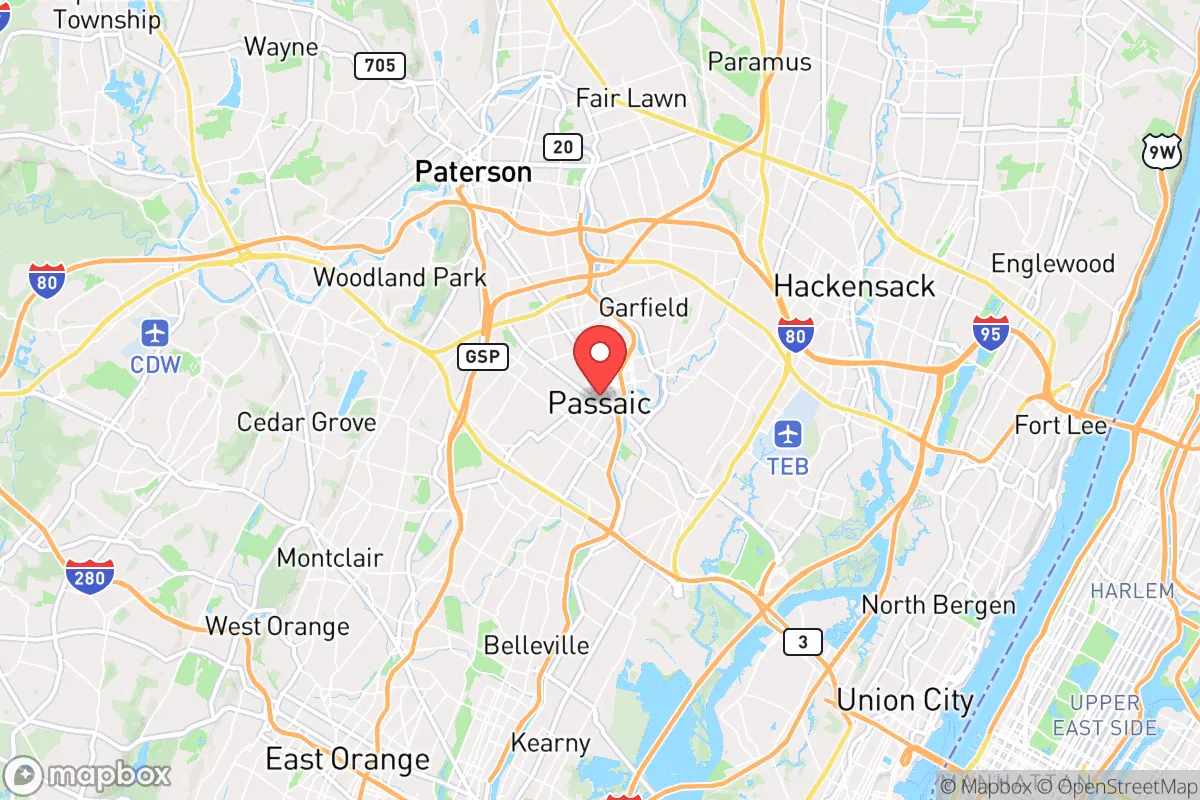
Photo: Wikipedia
Personal Sovereignty in Passaic, NJ
Viable for self-reliance. Generally workable, though some barriers may limit total independence.
What does Personal Sovereignty tell us?
Personal Sovereignty measures your capacity for self-reliance and independence with minimal government friction. Higher scores mean fewer barriers between you and the way you want to live... but it assumes you have the space you need and good neighbors.
What does this tell us?
Personal Sovereignty measures your capacity for self-reliance and independence with minimal government friction. Higher scores mean fewer barriers between you and the way you want to live... but it assumes you have the space you need and good neighbors.
State Policy
Energy independence: Importer (8% of energy produced in-state)
Personal Liberty
Homesteading

Personal Liberty Analysis
Passaic, New Jersey, operates within one of the densest regulatory and tax environments in the United States, which directly shapes the personal sovereignty available to its residents. For a single individual or family prioritizing autonomy, the city presents a landscape where state-level mandates heavily constrain local decision-making on self-defense, property use, and taxation, while offering limited but real opportunities for self-reliance within a highly urbanized setting. The trade-off is clear: residents gain access to robust public services and infrastructure but sacrifice significant latitude in how they live, work, and protect themselves.
Tax burden and regulatory posture: what residents pay and how it limits choice
New Jersey consistently ranks among the highest-taxed states in the nation, and Passaic residents feel this acutely. The state's combined state and local tax burden hovers around 12-13% of income, driven by high property taxes, a progressive income tax (top marginal rate of 10.75% as of 2026), and a 6.625% sales tax. For a family in Passaic, the effective property tax rate on a median-valued home—roughly $300,000 in the city—can exceed 2.5% annually, meaning annual tax bills of $7,500 or more. This heavy fiscal hand leaves less disposable income for personal savings, investments in self-reliance projects, or private schooling—all of which are hallmarks of personal sovereignty. The regulatory posture is similarly dense: New Jersey imposes strict environmental, building, and land-use codes that affect everything from home renovations to vehicle modifications. For example, the state's Uniform Construction Code requires permits and inspections for even minor electrical or plumbing work, limiting a homeowner's ability to make independent repairs without bureaucratic approval. While these rules aim for safety and uniformity, they reduce the scope of individual choice in managing one's own property.
Self-defense and gun law specifics: navigating a restrictive legal framework
Passaic residents face some of the most restrictive firearm laws in the country, which directly impact personal sovereignty in self-defense. New Jersey requires a Firearms Purchaser Identification Card (FPID) to buy any long gun or handgun, a process that involves fingerprinting, background checks, and a 30- to 90-day wait. Handgun purchases are further limited to one per 30-day period. Carrying a concealed weapon is a privilege, not a right, under the state's "justifiable need" standard, which was tightened after the Bruen decision—applicants must still demonstrate a specific threat, not just a general desire for protection. Open carry is effectively banned in all public places. Magazine capacity is capped at 10 rounds, and certain semi-automatic rifles are classified as "assault firearms" and prohibited. For a resident who views self-defense as a core personal liberty, these laws create a significant barrier: the time, cost, and legal risk of compliance are high, and the ability to respond to a threat with a firearm is heavily circumscribed. Non-lethal options like pepper spray are legal but subject to age and quantity restrictions. The practical effect is that Passaic's self-defense environment is one of limited individual agency, where reliance on law enforcement response—which can be delayed in a dense urban area—is the default.
Self-reliance and homesteading viability: lot sizes, zoning, and off-grid feasibility
Passaic's urban character—with a population density exceeding 20,000 people per square mile—makes traditional homesteading or off-grid living nearly impossible. The typical residential lot is a 25-foot-wide by 100-foot-deep city parcel, often with a multi-family home or a small single-family house. Zoning codes prohibit keeping livestock (chickens, goats, bees) in most residential districts, and any agricultural activity is limited to community gardens on city-approved lots. Off-grid systems like solar panels are legal but must connect to the grid under net metering rules; standalone battery storage is permitted but expensive. Rainwater harvesting is allowed only for non-potable uses and must comply with state plumbing codes. Composting toilets and greywater systems are not permitted for residential use without a variance, which is rarely granted. For a family seeking to reduce reliance on municipal utilities or grow their own food, Passaic offers little room. The city's dense layout and strict codes mean that self-reliance projects are confined to small-scale efforts: container gardening on a porch, energy-efficient appliances, or joining a local CSA. The broader environment is one where residents are structurally dependent on municipal water, sewer, electricity, and grocery supply chains, with limited legal pathways to opt out.
Personal liberties: parental rights, medical autonomy, speech, and property
New Jersey's legal framework provides strong protections for some personal liberties while tightly regulating others. On parental rights, the state mandates comprehensive sex education in public schools (including LGBTQ+ content) and requires parental notification for some health services but not for contraception or STI testing for minors over 13. Parents can homeschool, but must submit an annual "equivalent instruction" plan to the local superintendent and provide standardized test results or a portfolio review—a moderate regulatory burden compared to states with no oversight. Medical autonomy is mixed: New Jersey has broad vaccine mandates for school attendance (including COVID-19 for some periods) and a strict prescription drug monitoring program, but it also protects access to reproductive healthcare and medical marijuana (for qualifying conditions). Free speech is robustly protected under the state constitution, though local noise ordinances and public assembly permits can limit expressive activities in Passaic's dense neighborhoods. Property rights are the most constrained area: the state's eminent domain power is broad, and local zoning boards have significant authority over land use. A homeowner cannot, for example, operate a home business without a permit, rent out a room without registration, or build a fence over six feet without a variance. These restrictions mean that personal sovereignty in Passaic is exercised within a framework of extensive state and local oversight, where individual choices are often subject to bureaucratic approval.
Compared to other areas in the Northeast, Passaic's personal sovereignty environment is notably constrained. The tax burden is among the highest in the region, gun laws are among the strictest, and homesteading is effectively off the table. For a conservative-leaning reader who values low taxes, broad self-defense rights, and minimal government interference in daily life, Passaic would rank low on the autonomy spectrum. However, for someone who prioritizes strong public services, dense social infrastructure, and legal protections for certain personal liberties (like medical choice or speech), the trade-offs may be acceptable. The city's sovereignty profile is best understood as a managed autonomy—residents have significant freedom within a tightly regulated system, but the system itself leaves little room for independent deviation from the norm. For those seeking maximum personal sovereignty, rural areas of upstate New York or Pennsylvania would offer a lighter regulatory touch, while Passaic remains a place where collective governance heavily shapes individual choice.

* Values derived from national, state, county, city and local statistics and may differ in a specific area. Last updated: 2026-06-14T02:06:34.000Z
Narrative content on this page is AI-generated and may contain mistakes. Verify any details that matter before acting on them.
ReloMaps may earn a commission from affiliate links at no extra cost to you.

