Photo: Wikipedia
Political ClimatePolitical Climate in Owings Mills, MD
District shown is the primary district for this city’s centroid. Cities may span multiple districts.
Local Political AnalysisPolitical Analysis of Owings Mills, MD
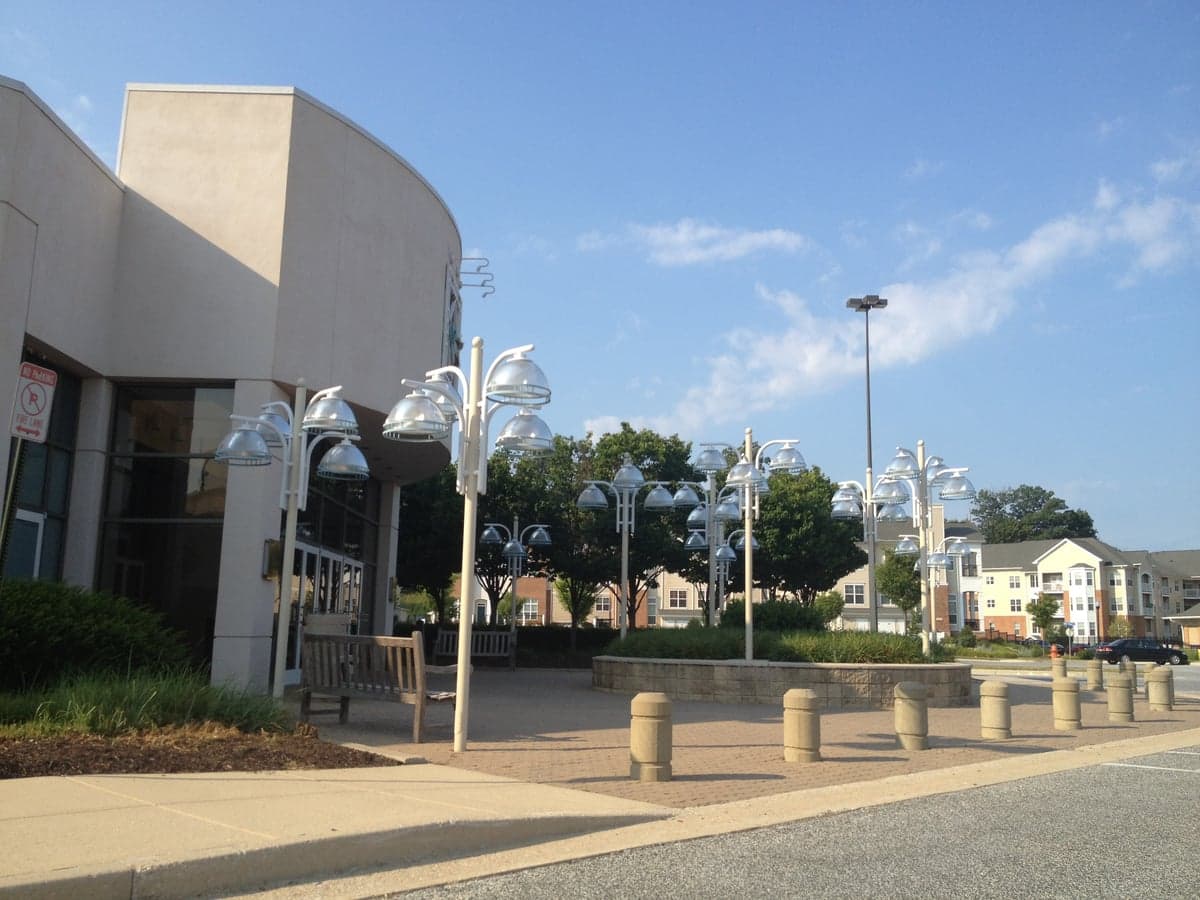
Owings Mills leans solidly Democratic, but it’s not quite the deep-blue stronghold you’ll find closer to Baltimore City. With a Cook PVI of D+10, this Baltimore County community votes Democratic by a comfortable double-digit margin, yet it sits noticeably to the right of Maryland’s statewide D+17 rating. That gap tells you a lot about the area’s character—it’s a suburb with real political diversity, where you’ll find plenty of moderate Democrats, independent-leaning voters, and a vocal Republican minority, especially in the surrounding neighborhoods and toward the county’s northern and western edges.
How it compares
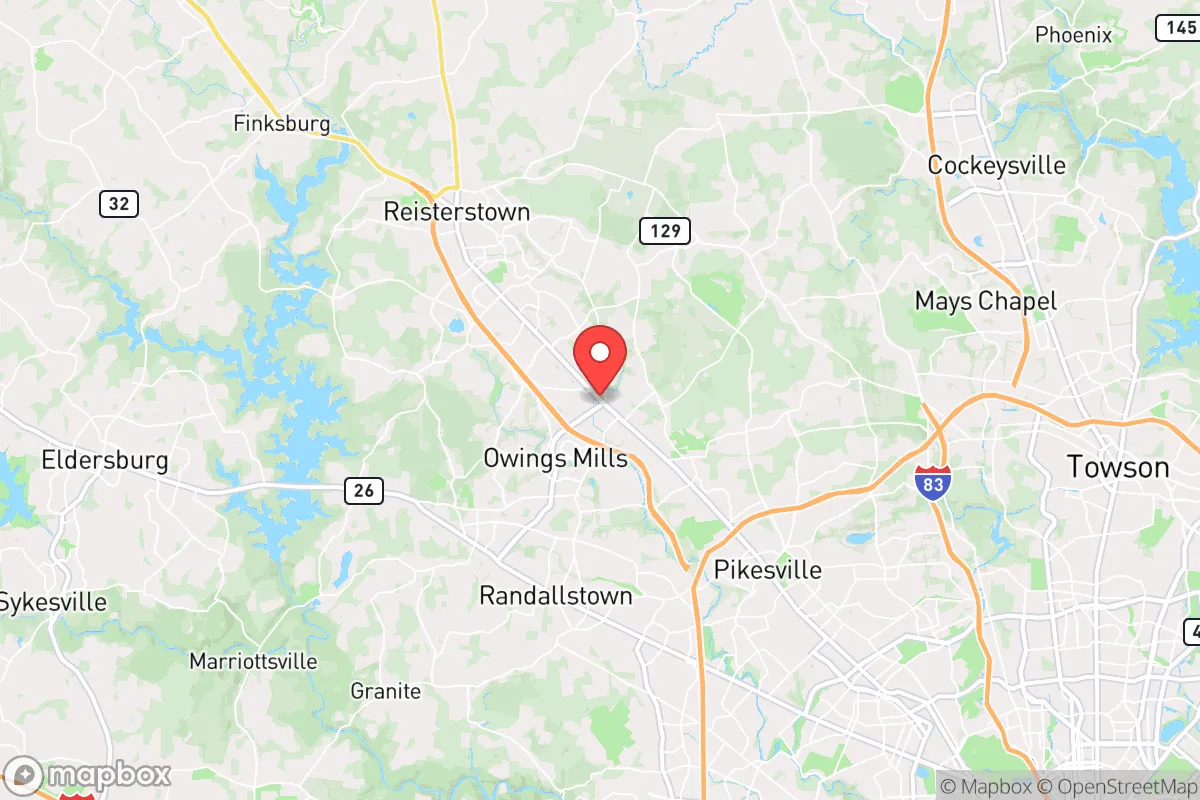
The D+10 vs. D+17 split is the whole story in miniature. Maryland as a whole is one of the most reliably Democratic states in the country, driven by the massive vote margins in Montgomery and Prince George’s counties and Baltimore City. Owings Mills, by contrast, sits in Baltimore County, which has historically been a bellwether—more working-class, more racially diverse, and less uniformly liberal than the D.C. suburbs. Drive 15 minutes south to Pikesville and you’ll find a heavily Jewish, strongly Democratic community; head north toward Reisterstown or west toward Carroll County, and the political temperature shifts dramatically. Carroll County is deep red, with a Republican tilt that can swing 20 to 30 points in a given election. So Owings Mills is genuinely a transitional zone: it’s blue, but it’s blue with a suburban pragmatism that doesn’t always match the statewide party line on taxes, crime, or education policy.
What this means for residents
For liberal residents, Owings Mills offers the comfort of living in a Democratic district without the intensity of a progressive stronghold. You’ll get Democratic representation at the county and state level—Baltimore County’s delegation is reliably blue—but you won’t see the kind of aggressive left-wing policy pushes you’d find in Takoma Park or Silver Spring. For conservative residents, the reality is more nuanced. You’re outnumbered in local elections, but you’re not isolated. The GOP is active in Baltimore County, and races for county executive and county council are often competitive in the northern districts. In practice, this means local politics tend toward moderation: infrastructure spending, school funding, and public safety get attention, while more ideological battles—like sanctuary city policies or sweeping zoning overhauls—tend to be tempered by the need to hold swing voters. The area’s trajectory is slowly shifting left, driven by an influx of younger professionals and D.C.-area transplants, but it’s a gradual change, not a wave.
Culturally, Owings Mills reflects its political middle-ground status. You’ll see yard signs for both parties during election season, and local civic groups tend to focus on quality-of-life issues rather than partisan flashpoints. The area’s diversity—a mix of Black, Jewish, and immigrant communities—creates a social fabric that values tolerance, but it’s a tolerance rooted in coexistence rather than activism. The big policy distinctions from the rest of Maryland show up in local zoning debates (Owings Mills has seen significant transit-oriented development around the Metro station) and in the county’s approach to policing, which is more community-oriented than Baltimore City’s but less reform-driven than Montgomery County’s. Looking ahead, expect Owings Mills to stay Democratic, but don’t be surprised if it remains a place where a moderate Republican can still win a local race—and where both sides have to actually talk to each other to get anything done.

State Political ClimatePolitical Climate in Maryland
State Political AnalysisPolitical Environment in the State
Maryland is one of the most reliably Democratic states in the country, with a Cook Partisan Voting Index of D+17, meaning it votes about 17 points more Democratic than the nation as a whole. The state hasn't voted for a Republican presidential candidate since George H.W. Bush in 1988, and Democrats hold every statewide office and a supermajority in the General Assembly. That said, the political reality on the ground is far more layered than the headline numbers suggest—the state is essentially a tale of two very different political universes split along the I-95 corridor, and the trajectory over the last two decades has been a slow but steady march leftward, driven almost entirely by the suburban counties surrounding Washington, D.C.
Urban vs. rural divide
The political map of Maryland is a stark study in geographic polarization. The western half of the state—places like Hagerstown, Cumberland, and the mountainous counties of Garrett and Allegany—votes solidly Republican, often by 30 to 40 points. The Eastern Shore, including towns like Easton and Chestertown, is also reliably red, with the notable exception of the more diverse areas around Salisbury. Central Maryland, however, is a Democratic fortress. Baltimore City is overwhelmingly Democratic, but the real engine of the state's leftward shift is the D.C. suburbs: Montgomery County and Prince George's County alone account for nearly a third of the state's vote, and they vote Democratic by margins of 60 to 80 points. Anne Arundel County, home to Annapolis, has been trending blue for a decade, while Howard County and Frederick County have flipped from purple to reliably Democratic in the last two cycles. The 2022 gubernatorial race told the story clearly: Democrat Wes Moore won statewide by 32 points, but he lost every county west of Frederick and most of the Eastern Shore. The divide isn't just urban versus rural—it's federal-government-adjacent versus everything else.
Policy environment
Maryland's policy environment is shaped by its proximity to the federal government and its status as one of the wealthiest states per capita in the nation. The state has a progressive income tax structure with rates ranging from 2% to 5.75%, plus local county taxes that push the effective top rate in places like Montgomery County to over 9%. Property taxes are moderate, but the state's regulatory posture is decidedly interventionist, particularly on environmental matters—the Chesapeake Bay cleanup drives land-use policy across the Eastern Shore and Southern Maryland. Education is a mixed bag: the state consistently ranks in the top five nationally for K-12 spending per pupil, but the Baltimore City and Prince George's County school systems struggle with chronic underperformance, while Howard County and Montgomery County schools are among the best in the nation. Healthcare is heavily regulated, with a state-based insurance exchange and strict certificate-of-need laws that limit hospital expansion. Election law is among the most liberal in the country: same-day voter registration, automatic voter registration via the DMV, no-excuse mail-in voting, and early voting are all standard. There is no statewide property tax cap, which is a frequent complaint among conservatives moving from states like Texas or Florida.
Recent policy direction
The last five years have seen Maryland's legislature push aggressively on a broad front, and the direction is unmistakably leftward. On gun policy, the state passed the Maryland Gun Safety Act of 2023, which bans the sale of many semiautomatic rifles, raises the purchasing age to 21, and requires a state police-issued license to purchase any firearm—one of the strictest regimes in the country. On education, the Blueprint for Maryland's Future is a multi-billion-dollar program that expands pre-K, raises teacher pay, and creates new career pathways, but it has also triggered debates about school choice and parental oversight. The legislature overrode Governor Larry Hogan's veto of the Kirwan Commission funding plan in 2021, and in 2023 it passed the Trans Health Equity Act, which requires Medicaid to cover gender-affirming surgeries. On crime, the state repealed life without parole for juveniles and passed the Juvenile Justice Reform Act in 2022, which raised the age of juvenile jurisdiction—a move that has frustrated conservatives in Baltimore and the suburbs who cite rising car thefts and violent crime. On energy, Maryland joined the Regional Greenhouse Gas Initiative and passed the Climate Solutions Now Act, mandating a 60% reduction in greenhouse gas emissions by 2031. Property rights are constrained by strict zoning in the counties surrounding D.C., and the state has no right-to-work law, with union density among the highest in the South. On privacy, Maryland passed one of the nation's first comprehensive data privacy laws in 2024, giving residents the right to access and delete personal data held by companies.
Civil unrest & political movements
Maryland has a visible and active protest culture, centered mostly in Baltimore and the D.C. suburbs. The 2015 death of Freddie Gray in police custody triggered days of riots in Baltimore, and the city has seen recurring protests over policing and public safety ever since. The Black Lives Matter movement has a strong organizational presence in Baltimore and Prince George's County, and the Poor People's Campaign holds regular actions in Annapolis. On the right, the Maryland Republican Party has struggled to find a winning message, but grassroots conservative groups are active in the rural counties, particularly around Second Amendment sanctuary resolutions—over 50 of Maryland's 157 municipalities have declared themselves Second Amendment sanctuaries, refusing to enforce certain state gun laws. Immigration is a flashpoint: Maryland is a sanctuary state, with laws prohibiting local police from inquiring about immigration status, and the CASA de Maryland organization is one of the most powerful immigrant advocacy groups in the country. Election integrity controversies have been relatively muted compared to other states, but the 2020 and 2022 cycles saw Republican complaints about the state's universal mail-in ballot expansion, which was made permanent in 2021. The most visible political flashpoint a new resident would notice is the sheer density of political signage and activism in the D.C. suburbs—yard signs, canvassers, and issue-based advocacy are constant, while the rural counties feel like a different country entirely.
Projection
Looking ahead five to ten years, Maryland's political trajectory is likely to continue leftward, but with some countervailing pressures. The D.C. suburbs are growing faster than the rest of the state, and in-migration from more liberal states like California and New York is reinforcing the Democratic majority. The 2024 election saw Montgomery County and Prince George's County turn out at record levels, and the state's Democratic supermajority in the legislature is unlikely to be seriously challenged before the next redistricting cycle in 2030. However, there are signs of a rural backlash: the western counties and the Eastern Shore are becoming more Republican as urban Democrats move in and push housing costs up, and the state's high tax burden is driving some retirees and remote workers to consider Virginia, Pennsylvania, or Delaware. The wildcard is the Blueprint for Maryland's Future—if it fails to deliver measurable improvements in Baltimore and Prince George's County, a moderate Republican could make inroads in the 2026 or 2030 gubernatorial races, much as Larry Hogan did in 2014 and 2018. But the structural math is daunting: a Republican would need to win the Baltimore suburbs and at least one of the D.C. suburban counties, and no GOP candidate has cracked that code in a presidential year since 1988.
For a new resident, the bottom line is this: if you're conservative, you'll find a welcoming community in the rural counties and the Eastern Shore, but you'll be living under a state government that is actively moving in the opposite direction on guns, taxes, education, and social policy. If you're liberal, you'll find Maryland to be one of the most aligned states in the country with your priorities, but you'll pay for it with some of the highest taxes and cost of living in the nation. The practical takeaway is to choose your county carefully—your experience of Maryland politics will be radically different depending on whether you land in Frederick or Rockville, Annapolis or Ocean City. The state is not a monolith, and the divide between the I-95 corridor and the rest of Maryland is as real as any political boundary in the country.
* Values derived from national, state, county, city and local statistics and may differ in a specific area. Last updated: 2026-11-03T19:57:22.000Z
Narrative content on this page is AI-generated and may contain mistakes. Verify any details that matter before acting on them.
ReloMaps may earn a commission from affiliate links at no extra cost to you.

