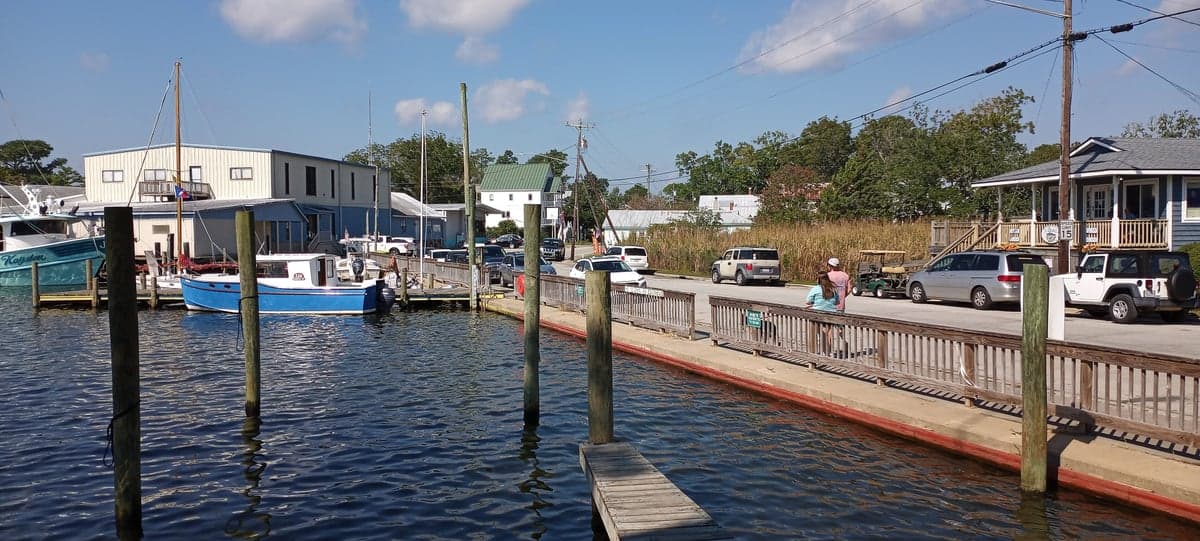
Photo: Wikipedia
Political ClimatePolitical Climate in Oriental, NC
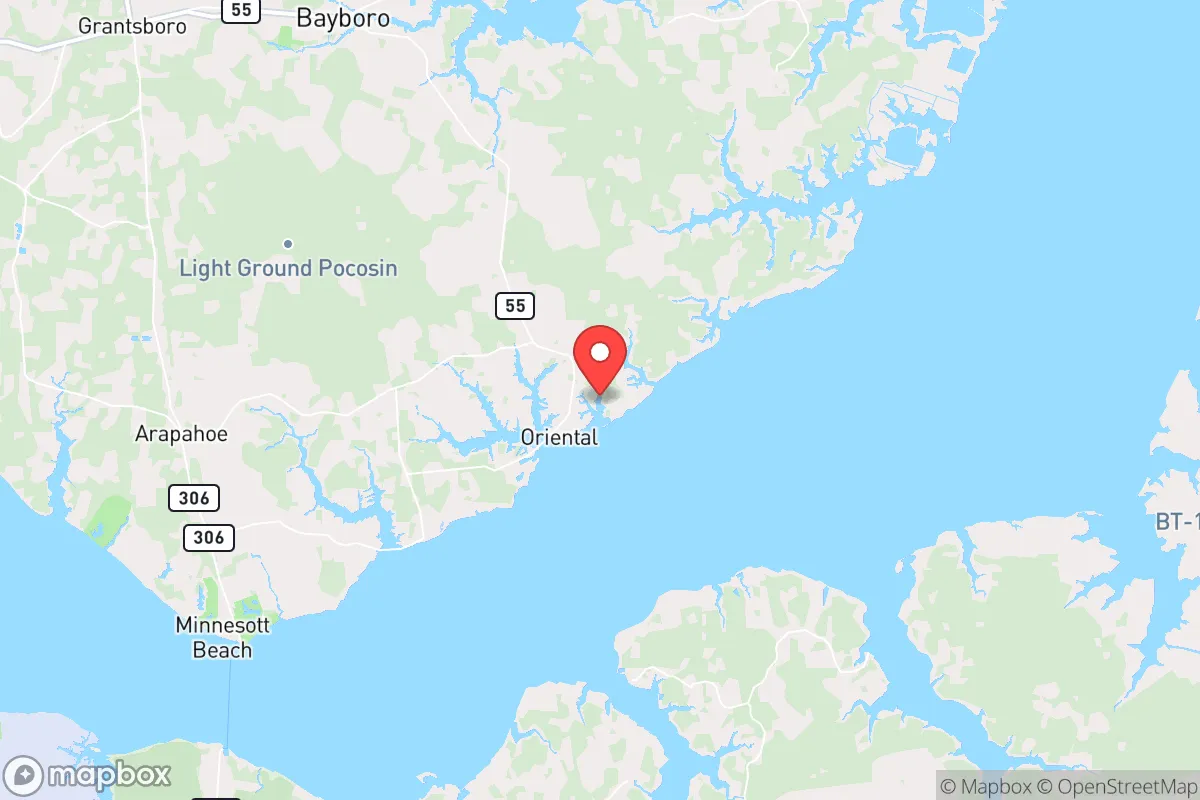
District shown is the primary district for this city’s centroid. Cities may span multiple districts.
Local Political AnalysisPolitical Analysis of Oriental, NC
Oriental, NC, leans slightly Republican, matching the state’s overall Cook PVI of R+1, but don’t let that single number fool you—this town’s politics are more about pragmatism and local character than party-line fervor. The area has been steadily shifting rightward over the past decade, driven by an influx of retirees and second-home owners from more conservative parts of the country, but it still retains a strong independent streak. In the 2024 presidential race, Pamlico County voted about 58% Republican, a few points redder than the state average, yet local elections often hinge on waterfront access, hurricane recovery, and school funding rather than national culture wars.
How it compares
Compared to the rest of North Carolina, Oriental is a microcosm of the state’s broader political tension—rural and coastal, but not as deeply red as inland counties like Craven or Jones. Drive 20 minutes west to New Bern, and you’ll find a more balanced mix, with a Cook PVI of R+2 and a stronger military influence that leans conservative. Head south to Morehead City, and the politics get noticeably redder, with Carteret County voting around 65% Republican in 2024. Oriental sits in the middle: it’s less polarized than the state’s urban centers like Raleigh or Charlotte, but more conservative than the Outer Banks communities to the north, where tourism and second-home owners have created a purple-to-blue pocket. The key difference is that Oriental’s politics are shaped by the water—fishing, boating, and storm resilience are the issues that actually get people to town hall meetings, not abortion or gun rights.
What this means for residents
For conservative residents, Oriental feels comfortable but not insulated—you’ll find plenty of Trump signs in yards during election season, but also a live-and-let-live attitude that keeps things civil. Liberal residents won’t feel isolated either, as the town’s small size (under 900 year-round residents) means everyone knows everyone, and political disagreements rarely get heated. The practical reality is that local government is nonpartisan in practice, focused on maintaining the harbor, managing short-term rentals, and keeping property taxes low (Pamlico County’s rate is around 0.55%, well below the state average). State-level politics matter more here than national ones, especially when it comes to coastal management and hurricane relief funding—both parties in Raleigh have been responsive to the region’s needs, so residents of all stripes feel heard on those fronts.
One cultural distinction that sets Oriental apart is its strong libertarian undercurrent—many residents moved here specifically to escape the regulatory and political density of larger cities. You’ll hear grumbling about both parties’ overreach, and local conversations often circle back to property rights and personal freedom. The town’s annual sailboat regattas and seafood festivals draw a politically diverse crowd, and the local coffee shop is as likely to host a discussion about boat maintenance as it is about the latest Supreme Court ruling. Looking ahead, the trajectory is toward a slow, steady reddening as more out-of-state buyers arrive, but Oriental’s identity as a working waterfront community will likely keep its politics grounded in local concerns rather than national polarization. For anyone moving here, the takeaway is simple: your vote matters less than your willingness to help a neighbor haul in a catch or sandbag during a storm.

State Political ClimatePolitical Climate in North Carolina
State Political AnalysisPolitical Environment in the State
North Carolina is a classic swing state with a slight Republican lean, currently rated R+1 by the Cook Political Report, but the real story is how fast it’s shifting. Over the last 20 years, the state has gone from reliably red to a purple battleground where statewide races are decided by razor-thin margins — in 2024, Donald Trump won the state by roughly 3 points, while down-ballot Republicans held the legislature and most council of state offices. The dominant coalition is a mix of rural and exurban conservatives, suburban moderates, and a rapidly growing urban liberal base, making it one of the most politically competitive states in the country.
Urban vs. rural divide
The political map of North Carolina is a textbook case of the urban-rural split. The major metros — Charlotte (Mecklenburg County), Raleigh-Durham (Wake and Durham Counties), and Greensboro-Winston-Salem (Guilford and Forsyth Counties) — are solidly Democratic, with Mecklenburg and Wake alone accounting for nearly a quarter of the state’s votes. These areas are driven by tech, finance, and university populations, and they’ve been trending bluer with each cycle. Meanwhile, the rural east and mountain west are deeply Republican: counties like Johnston (just outside Raleigh), Union (southeast of Charlotte), and Watauga (Boone area) are reliably red, with some rural precincts voting 70-80% Republican. The suburbs are the real battleground — places like Cary (Wake County) and Concord (Cabarrus County) have shifted left in recent years, while exurbs like Mooresville and Huntersville remain competitive. The net effect is a state that’s evenly split at the top of the ticket but where Republicans hold a structural advantage in the legislature thanks to district maps that concentrate Democratic voters in a handful of urban centers.
Policy environment
North Carolina’s policy environment is a mix of conservative governance and pragmatic moderation. The state has a flat income tax rate of 4.5% (down from 7% in 2013) with a scheduled phase-down to 3.99% by 2027, and no state tax on Social Security benefits. Sales tax is 4.75% state-level, with local add-ons that push it to 7-7.5% in most counties. The regulatory posture is business-friendly — the state is a right-to-work state and has seen a boom in corporate relocations, particularly in the Charlotte and Research Triangle areas. On education, the state has a robust charter school law and a voucher program (Opportunity Scholarship Program) that has expanded significantly under Republican leadership, though public school funding remains a perennial political fight. Healthcare is a mixed bag: the state did not expand Medicaid until 2023, making it one of the last to do so, and the expansion was paired with certificate-of-need reforms that pleased both hospitals and conservatives. Election laws are moderately restrictive — voter ID is required (passed in 2018, implemented in 2023), early voting is generous (17 days), and same-day registration is available during early voting. The state has also seen ongoing litigation over redistricting, with courts striking down maps as partisan gerrymanders in 2019 and 2022.
Recent policy direction
The last five years have seen North Carolina move decisively in a conservative direction on several fronts, while maintaining some moderate guardrails. On gun and self-defense law, the state passed permitless carry (constitutional carry) in 2023, allowing any legal gun owner to carry a concealed handgun without a permit — a major win for Second Amendment advocates. On parental and education rights, the legislature passed the Parents’ Bill of Rights in 2023, requiring schools to notify parents about instructional materials involving sexuality and to obtain parental consent before changing a student’s gender designation. On speech and privacy, the state has no broad privacy law, but it did pass a data privacy bill for health and genetic information in 2023. On medical and bodily autonomy, abortion is currently legal up to 12 weeks (with exceptions for rape, incest, and fetal anomalies up to 20 weeks, and no limit for life of the mother) — a compromise reached in 2023 after the Dobbs decision, which was a significant restriction from the previous 20-week ban but still more permissive than many Southern states. On property rights, the state has strong eminent domain protections and no statewide rent control preemption. On taxation, the trajectory is clearly toward lower rates, with the flat income tax scheduled to drop further. On voting and ballot access, the state has tightened rules — voter ID is now in effect, and the legislature has shortened the absentee ballot request window and banned private funding of election administration. The overall direction is a steady conservative drift, tempered by a Democratic governor (Roy Cooper through 2024, then Josh Stein starting 2025) who has vetoed several of the more aggressive bills, though the Republican supermajority in the legislature has overridden many of those vetoes.
Civil unrest & political movements
North Carolina has seen its share of political flashpoints, though it’s generally less volatile than some other swing states. The 2020 protests in Charlotte and Raleigh over George Floyd’s death were large but mostly peaceful, with some property damage in Charlotte’s Uptown area. The state has an active and organized conservative movement, particularly around election integrity — the 2020 election saw Trump’s campaign challenge results in the state (unsuccessfully), and the legislature has since passed multiple election security bills. Immigration politics are less heated than in border states, but Charlotte and Durham have sanctuary-city policies that have drawn legislative pushback; the state passed a ban on sanctuary cities in 2015 (HB 318), though enforcement has been uneven. There’s a small but vocal secession/nullification movement in the far western counties, but it’s fringe. The most visible political flashpoint in recent years has been the “bathroom bill” (HB 2) in 2016, which restricted transgender bathroom access and sparked a national boycott — it was partially repealed in 2017, but the controversy left a lasting impression on the state’s political culture. More recently, the 2023 abortion debate drew large protests on both sides at the state capitol in Raleigh, but the resulting compromise (12-week ban) has largely held. A new resident would notice that political signs and bumper stickers are common, but the state’s overall culture is more “Southern polite” than confrontational — people tend to avoid politics in casual conversation unless they know where you stand.
Projection
Over the next 5-10 years, North Carolina is likely to become more competitive, not less. The state is one of the fastest-growing in the country, and the in-migration is disproportionately from blue states (New York, New Jersey, California) and leans Democratic, particularly in the Charlotte and Raleigh metros. However, the growth is also bringing conservative-leaning retirees to the coast and mountains, so the net effect is a slow leftward drift at the presidential level — expect the state to be a true toss-up in 2028 and 2032. The legislature will remain Republican-controlled for the foreseeable future due to gerrymandering and the concentration of Democratic voters in cities, but the margins may narrow. The policy trajectory will likely continue its conservative drift on taxes and regulation, with some moderation on social issues as the electorate diversifies. A new resident moving in now should expect a state that’s politically divided but functional — you’ll have a governor and legislature of opposite parties for the foreseeable future, which means compromise is baked into the system. The practical effect is that neither side gets everything it wants, but the state avoids the extreme swings seen in fully controlled states.
For a new resident, the bottom line is that North Carolina offers a politically balanced environment where your experience depends heavily on where you live. If you’re conservative, you’ll feel at home in the suburbs and rural areas, with a legislature that reflects your values on taxes, guns, and education. If you’re liberal, you’ll find your community in the cities, with a governor who can block the most aggressive legislation and a growing population that’s slowly shifting the state’s direction. The key practical takeaway is to choose your county carefully — the difference between living in Cary and Clayton, or Charlotte and Concord, is the difference between living in a blue bubble and a red one, even though they’re 20 minutes apart. The state’s political future is uncertain, but its present is a fascinating, functional battleground that rewards engagement and punishes apathy.
* Values derived from national, state, county, city and local statistics and may differ in a specific area. Last updated: 2026-10-25T18:03:31.000Z
Narrative content on this page is AI-generated and may contain mistakes. Verify any details that matter before acting on them.
ReloMaps may earn a commission from affiliate links at no extra cost to you.

