Photo: Wikipedia
Political ClimatePolitical Climate in Coos County
Showing district-level results — no local-only data available.
Local Political AnalysisPolitical Analysis of Coos County
Coos County, Oregon, is a classic example of a place where the local political identity doesn't quite match the state's reputation. While Oregon as a whole carries a Cook PVI of D+8, Coos County sits at D+6, making it noticeably more conservative than the state average, though still technically in Democratic territory. This isn't a deep-blue bastion like Portland; it's a working-class coastal county where timber, fishing, and healthcare dominate the economy, and where many voters feel disconnected from the urban politics of the Willamette Valley. The county has been drifting rightward in recent cycles, with Trump improving his margins here in 2016 and 2020 compared to previous GOP candidates, even as the state as a whole moved left.
How it compares
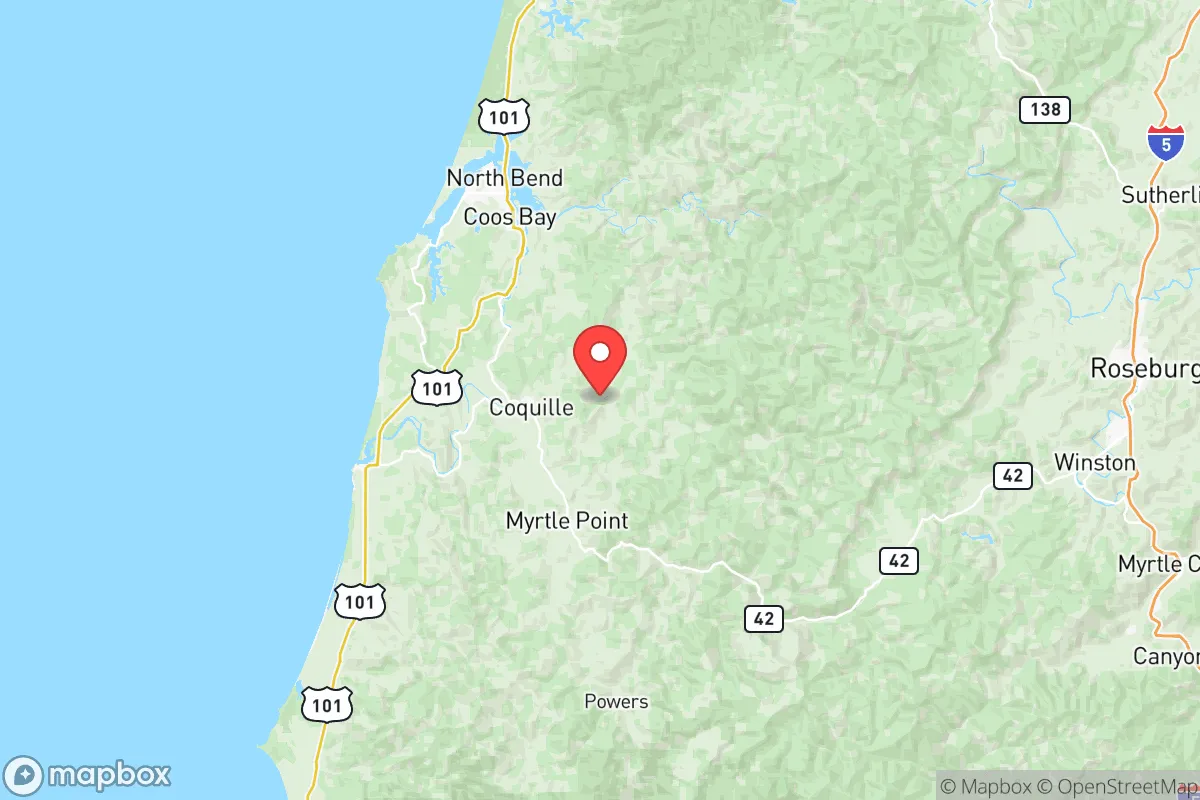
The D+6 rating masks a deeply divided county. The city of Coos Bay, the largest population center, leans Democratic but is far from a lock — its precincts around the waterfront and the hospital tend blue, while the more rural edges of the city and the neighboring town of North Bend are reliably red. The real conservative strongholds are the smaller inland communities like Myrtle Point and Powers, where Trump won by 30+ points in 2020. Meanwhile, the southern coastal town of Bandon is a genuine swing area, with its precincts flipping between parties depending on the race and turnout. The key difference from the state of Oregon is that Coos County lacks the massive urban Democratic margins that Portland, Eugene, and Salem provide statewide. In a typical election, Coos County votes about 5-8 points more Republican than the state as a whole, which is a significant gap in a state where the coast is often assumed to be uniformly liberal.
What this means for residents
For conservative residents, Coos County feels like a relative safe zone within a blue state. You can find plenty of neighbors who share your views on gun rights, land use, and taxes, and local elected offices — from the county commission to the sheriff — are often held by Republicans or conservative Democrats. For liberal residents, the county can feel isolating at times, but there's a strong activist core in Coos Bay and Bandon that keeps progressive issues on the table, particularly around environmental protection of the coast and local fisheries. The practical effect of the county's lean is that statewide ballot measures often see different results here than in Portland — for example, the county voted against Measure 110 (drug decriminalization) in 2020 while the state approved it, and it's consistently more skeptical of new taxes and land-use restrictions. That said, the county's Democratic registration advantage means that in low-turnout primaries, progressive candidates can still win local races, especially in the Coos Bay area.
Culturally, the biggest distinction between Coos County and the rest of Oregon is the relationship with the timber industry. While Portland has moved toward a post-industrial, tech-driven economy, Coos County still has active mills and logging operations, and the political debates here are grounded in the tension between resource extraction and conservation. The county's voters are more likely to prioritize economic stability over environmental regulation, which puts them at odds with the state's dominant political culture. At the same time, the county's strong fishing and tourism sectors create a natural constituency for clean water and coastal preservation, meaning the politics here aren't a simple red-blue split — they're shaped by the specific realities of life on the southern Oregon coast. If you're moving here, expect a place where party labels matter less than whether you understand the local economy and respect the land and water that everyone depends on.

State Political ClimatePolitical Climate in Oregon
State Political AnalysisPolitical Environment in the State
Oregon is a reliably Democratic state at the presidential level, with a Cook PVI of D+8, but that top-line number hides a deeply fractured political landscape. The state has shifted leftward over the past 20 years, driven by explosive growth in the Portland metro area, but that shift has been met with a fierce and organized conservative backlash in the rural interior and along the southern border. For a conservative relocator, the reality is that you’re moving to a state where the urban centers run the legislature, but where large swaths of the landmass vote like Idaho or Wyoming.
Urban vs. rural divide
The political map of Oregon is a study in stark contrast. The Willamette Valley corridor, anchored by Portland, Salem, and Eugene, generates the vast majority of the state’s Democratic votes. Multnomah County (Portland) alone delivered a 40-point margin for Biden in 2020, and Lane County (Eugene) and Benton County (Corvallis) are similarly solid blue. Meanwhile, the rest of the state is deeply red. Central Oregon, including Bend and Redmond, has become a political battleground as California transplants have moved in, but Deschutes County still leans Republican, and the rural counties east of the Cascades — like Lakeview and Burns — vote 70-80% Republican. The Rogue Valley, including Medford and Ashland, is a microcosm of the state: Ashland is a liberal college town, while Medford and Grants Pass are reliably conservative. The key takeaway: if you live in Portland or Eugene, you’re in a deep-blue bubble; if you live in most other places, you’re in a red or purple environment.
Policy environment
Oregon’s state-level policy is shaped by Democratic supermajorities in the legislature and a Democratic governor, which has produced a distinctly progressive regulatory and tax environment. The state has no sales tax, which is a major draw for many, but it has high income taxes — the top marginal rate is 9.9%, and it kicks in at a relatively low income threshold. Property taxes are moderate, but they are capped by Measure 5 and Measure 50, which limit annual increases. The regulatory posture is generally business-friendly in name but not in practice: land-use laws are strict, especially under the statewide Urban Growth Boundary system, which drives up housing costs. Education policy is progressive: Oregon has adopted ethnic studies standards and has a strong teachers’ union presence. Healthcare is heavily regulated, with a state-run insurance marketplace and expanded Medicaid under the Oregon Health Plan. Election laws are among the most accessible in the country: Oregon was the first state to conduct all elections by mail, and it has automatic voter registration, same-day registration, and no voter ID requirement at the polls. For a conservative, the policy environment is a mixed bag: low sales tax and property tax caps are appealing, but high income taxes and a regulatory-heavy approach to land use and business can be frustrating.
Recent policy direction
Oregon’s recent legislative sessions have been a whirlwind of progressive legislation, with a few notable flashpoints for conservatives. On gun and self-defense law, the state passed Measure 114 in 2022, which requires a permit to purchase a firearm and bans magazines over 10 rounds; it is currently tied up in court, but the direction is clear. On parental and education rights, the state has passed laws requiring schools to notify parents of curriculum changes and has expanded LGBTQ+ protections, but it has also seen a backlash with the rise of parental rights groups in suburban districts like West Linn and Lake Oswego. On speech and privacy, Oregon has strong privacy laws, including the Oregon Consumer Privacy Act, but it also has strict hate crime laws that some conservatives argue chill speech. On medical and bodily autonomy, Oregon was the first state to legalize assisted suicide (the Death with Dignity Act) and has codified abortion rights into state law. On property rights, the state’s land-use system is a constant source of tension, with rural landowners feeling their rights are trampled by the state’s planning framework. On taxation, the state has flirted with a gross receipts tax (the Corporate Activity Tax) to fund education, which has been unpopular with small businesses. On voting and ballot access, Oregon’s mail-in system is secure and widely trusted, but conservatives have raised concerns about ballot harvesting and the lack of voter ID. The overall direction is clearly leftward, but the pace is moderated by the state’s unique citizen initiative system, which allows voters to bypass the legislature on key issues.
Civil unrest & political movements
Oregon has a long history of political activism, from the 2020 Portland protests to the Malheur National Wildlife Refuge occupation in 2016. The 2020 protests in Portland were a national flashpoint, with months of nightly demonstrations and federal intervention, which left a deep scar on the state’s political psyche. Since then, organized activist movements on both sides have become more entrenched. On the left, groups like the Pacific Northwest Youth Liberation Front and the Portland Democratic Socialists of America remain active, particularly on housing and police reform. On the right, the Oregon Republican Party has become more populist and confrontational, with a strong base in rural counties and a growing presence in the suburbs. Immigration politics are a live issue: Oregon is a sanctuary state, with laws limiting local law enforcement’s cooperation with federal immigration authorities, which has led to tensions in border counties like Jackson County. Election integrity controversies have been relatively muted compared to other states, but there have been isolated incidents of ballot drop box fires and threats against election officials. The most visible flashpoint for a new resident would be the stark cultural divide between the urban and rural areas: driving from Portland to Bend or Medford feels like crossing a political border.
Projection
Over the next 5-10 years, Oregon is likely to continue its slow leftward drift at the state level, driven by in-migration from California and the natural growth of the Portland metro area. However, the rural backlash is not going away. The Oregon Republican Party is increasingly focused on local government and school board races, and they have had success in flipping some suburban seats in the Portland metro area. The demographic shifts are real: the Portland metro area is growing, but so are the smaller cities in Central Oregon and the Rogue Valley, which are attracting a mix of retirees, remote workers, and disaffected Californians. The wild card is housing: if the state fails to address the housing crisis, it could slow in-migration and shift the political calculus. A conservative moving in now should expect to live in a state where the legislature and governor are Democratic for the foreseeable future, but where local control in many counties and cities offers a meaningful counterbalance. The state’s initiative system also provides a check: voters have repeatedly rejected progressive tax increases and have passed conservative measures on property rights and sentencing.
For a new resident, the bottom line is that Oregon offers a unique political environment that rewards engagement at the local level. If you’re a conservative, you’ll find plenty of like-minded neighbors in most of the state outside the Willamette Valley, but you’ll need to accept that state-level policy will be progressive. The lack of a sales tax and the property tax caps are real financial benefits, but the high income tax and regulatory environment can be a shock. The best advice is to pick your location carefully: if you want a conservative community, look at Grants Pass, Redmond, or Lakeview; if you want a purple environment with amenities, Bend or Medford offer a mix; and if you want to be in the thick of progressive politics, Portland and Eugene are your options. Oregon is not a state where you can ignore politics — it’s a place where your vote matters at the local level, even if the state-level outcome is largely predetermined.
* Values derived from national, state, county, city and local statistics and may differ in a specific area. Last updated: 2026-06-16T23:33:58.000Z
Narrative content on this page is AI-generated and may contain mistakes. Verify any details that matter before acting on them.
ReloMaps may earn a commission from affiliate links at no extra cost to you.

