Photo: Wikipedia
Demographics of Coos County
Affluence Level in Coos County
A middle-class area roughly in line with national averages across income, home values, education, and employment.
People of Coos County
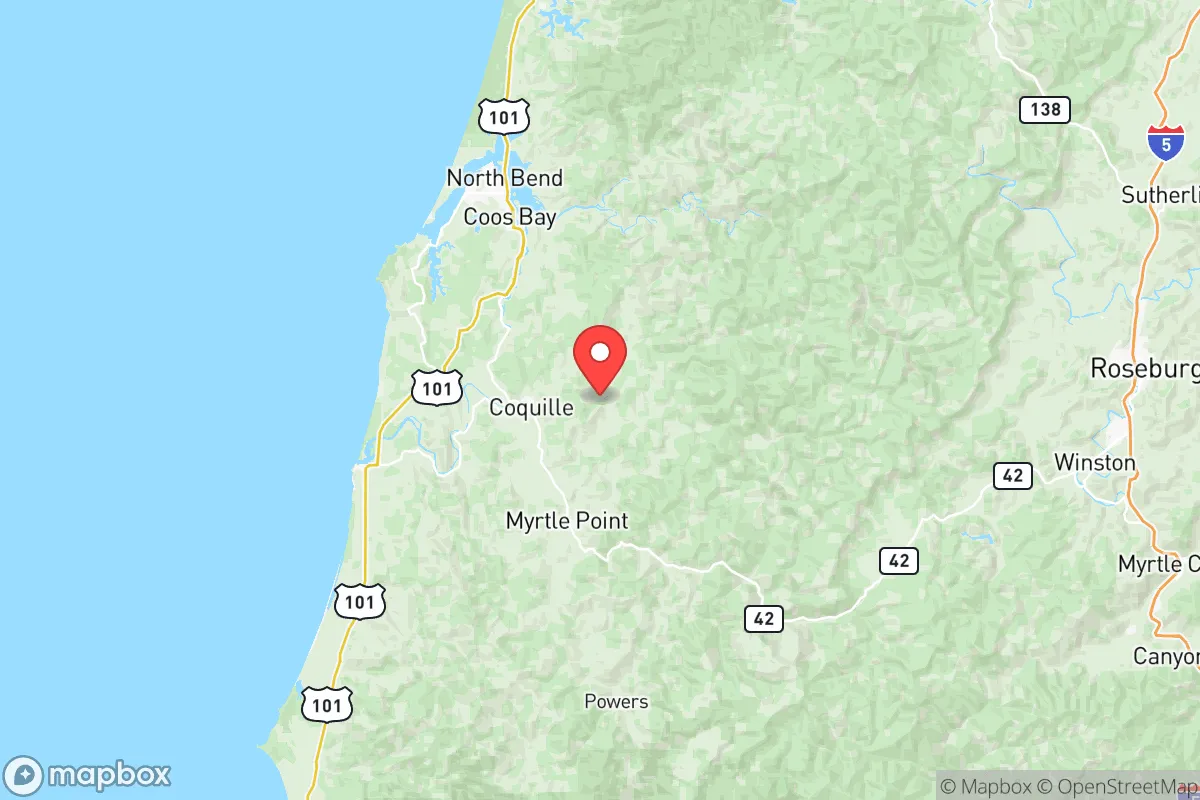
The people of Coos County, Oregon, today number 64,832, forming a predominantly white (83.0%) and older population with a distinct working-class and coastal identity. The county is one of the least ethnically diverse in Oregon, with a foreign-born share of just 1.7% and a Hispanic population of 7.0%, concentrated in the urban core of Coos Bay and North Bend. Residents are less college-educated than the state average (21.7% hold a bachelor's degree or higher), and the population is spread across a string of small cities and unincorporated communities along the coast and the Coquille River, including Coos Bay, North Bend, Bandon, Myrtle Point, and Powers.
Settlement & growth (pre-1960)
The original inhabitants of Coos County were the Coos, Lower Umpqua, and Siuslaw peoples, who lived in permanent villages along the coast and rivers for thousands of years before European contact. The first non-Native settlers were fur traders and explorers in the 1820s, but significant American settlement did not begin until the 1850s, following the Donation Land Claim Act of 1850 and the forced removal of Native tribes to the Siletz and Grand Ronde reservations. The first permanent American settlers were largely from the Midwest and Upper South, drawn by timber and the promise of cheap land.
The 1850s and 1860s saw the founding of the county's first towns: Empire City (now part of Coos Bay) in 1853, and Marshfield (the original name for Coos Bay) in 1854. These early settlers were overwhelmingly native-born whites of English, Scots-Irish, and German descent. The discovery of coal in the Coos Bay area briefly attracted a small number of Cornish and Welsh miners in the 1860s and 1870s, but the coal industry collapsed by the early 1900s. The real economic driver was timber: the vast coastal forests of Douglas fir and Sitka spruce drew loggers and mill workers from across the Pacific Northwest and the Upper Midwest, including a notable wave of Scandinavian immigrants (Swedes, Norwegians, and Finns) who settled in North Bend and Coos Bay between 1880 and 1910.
By 1900, Coos County's population had reached roughly 10,000, and the timber industry dominated every aspect of life. The Coos Bay Railroad, completed in 1916, connected the county to the Willamette Valley and opened new markets. Small towns like Bandon (founded 1873), Myrtle Point (1884), and Powers (1915) grew as logging and mill centers. The Great Depression and the Dust Bowl brought a small number of white migrants from Oklahoma and Arkansas in the 1930s, but the county remained overwhelmingly native-born and white. The post-World War II housing boom drove a final surge of timber employment, and the population peaked at around 55,000 by 1960.
Modern era (post-1965)
The 1965 Hart-Cellar Act had almost no effect on Coos County's demographics. The county's foreign-born population has never exceeded 3%, and the small immigrant communities that exist today are almost entirely Hispanic, concentrated in Coos Bay and North Bend. The modern era has been defined not by immigration but by domestic out-migration and economic decline. The timber industry collapsed in the 1980s and 1990s due to automation, federal logging restrictions, and the spotted owl controversy, leading to the loss of thousands of jobs. The county's population fell from a peak of 64,000 in 1980 to 62,000 in 2000, before recovering slightly to 64,832 by 2020.
Suburbanization has been minimal. Coos Bay and North Bend remain the only incorporated cities with more than 5,000 residents, and the county has no suburban sprawl comparable to the Portland metro area. The Hispanic population has grown from under 2% in 1990 to 7.0% today, driven by work in the remaining timber mills, fishing, and the growing tourism and healthcare sectors. The Asian population (1.1%) is small and consists mostly of Filipino and Vietnamese families in Coos Bay. The Black population (0.4%) and Indian subcontinent population (0.0%) are negligible. The county has also attracted a small number of retirees from California and the Willamette Valley, drawn by lower housing costs and the coastal lifestyle, but this inflow has not been large enough to reverse the overall aging trend.
The future
Coos County's population is projected to remain flat or decline slightly over the next 20 years. The county's birth rate is below replacement level, and the population is older than the state median (median age 47.5 vs. Oregon's 39.5). The Hispanic share is expected to continue rising slowly, possibly reaching 10-12% by 2040, but the county will remain overwhelmingly white and native-born. The completion of the Coos Bay Rail Link restoration in 2023 and the proposed Jordan Cove LNG terminal (if built) could bring a modest influx of construction and energy workers, but these are likely to be temporary and predominantly white and male.
The most significant demographic trend is the continued concentration of population in Coos Bay and North Bend, which together account for roughly 60% of the county's residents. Smaller towns like Bandon, Myrtle Point, and Powers are losing population as young people leave for urban areas and the timber economy continues to shrink. The county's cultural identity remains deeply tied to logging, fishing, and a rural, self-reliant ethos, with little sign of the rapid diversification seen in Oregon's larger metro areas.
For someone moving to Coos County today, the area offers a quiet, affordable coastal lifestyle with a tight-knit, predominantly white community. The population is stable but aging, and economic opportunities are limited outside of healthcare, education, and tourism. The county is not becoming more diverse in any meaningful way, and its future demographic trajectory is one of slow decline and gradual Hispanic growth, rather than the rapid transformation seen in other parts of Oregon.

* Values derived from national, state, county, city and local statistics and may differ in a specific area. Last updated: 2026-06-16T23:33:58.000Z
Narrative content on this page is AI-generated and may contain mistakes. Verify any details that matter before acting on them.
ReloMaps may earn a commission from affiliate links at no extra cost to you.

