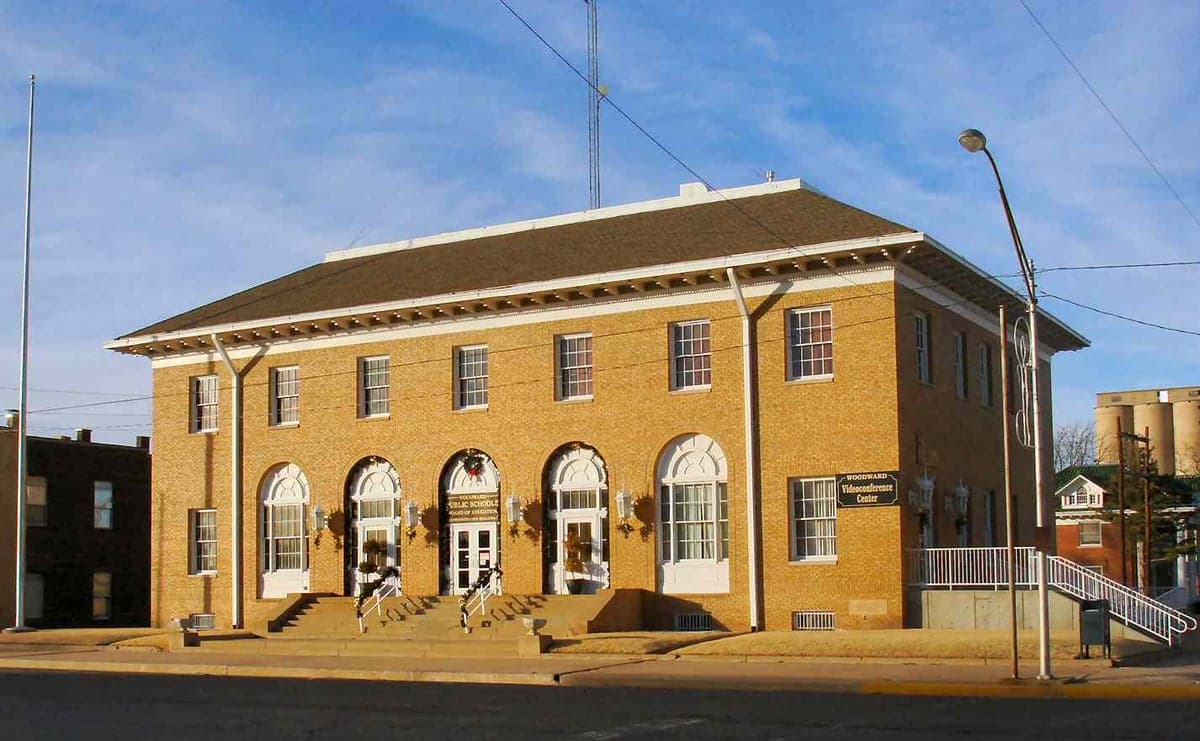
Photo: Wikipedia
Political ClimatePolitical Climate in Woodward County
Showing district-level results — no local-only data available.
Local Political AnalysisPolitical Analysis of Woodward County
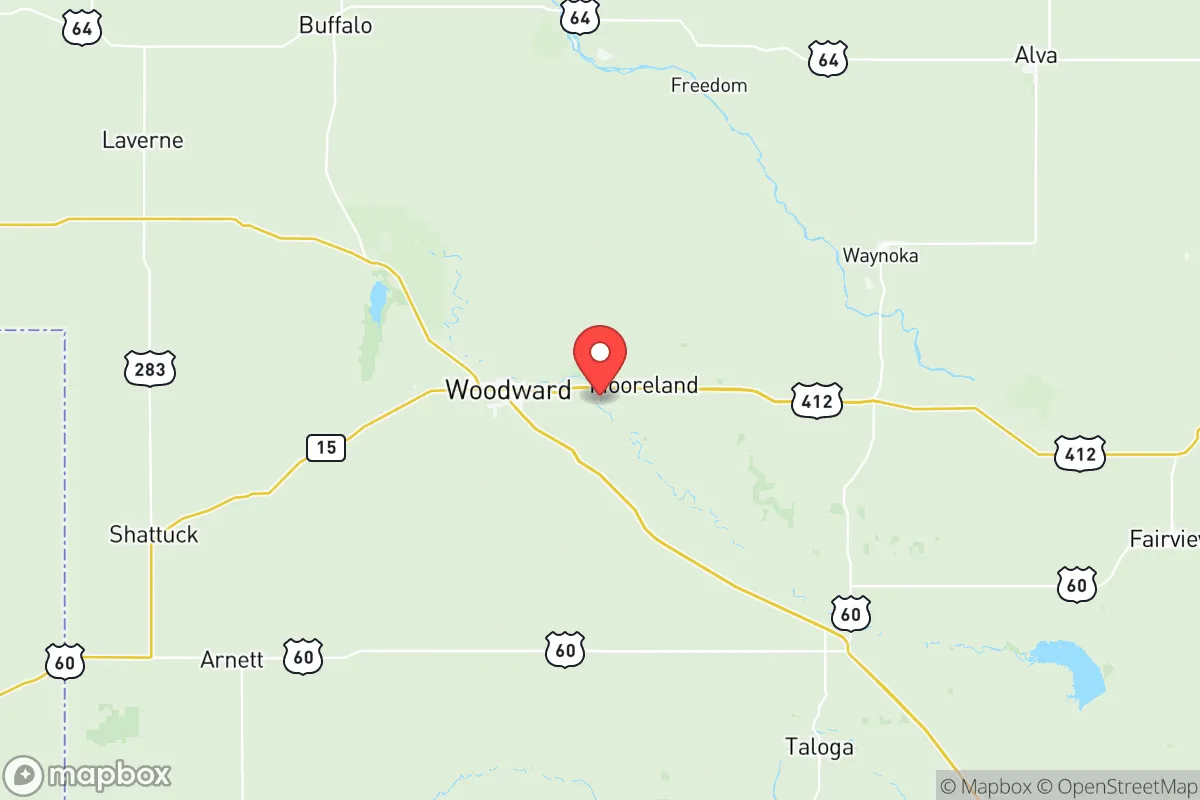
Woodward County is one of the most reliably Republican areas in Oklahoma, carrying a Cook Partisan Voting Index (PVI) of R+23, which is five points more conservative than the state's overall R+18 rating. This isn't a new development — the county has voted for the GOP presidential candidate by wide margins in every election since 2000, and the trend has actually accelerated in recent cycles. The shift is most visible in the county's smaller communities; while Woodward city itself has a few precincts that occasionally split tickets, towns like Mooreland, Mutual, and Sharon routinely deliver 80%+ Republican margins. The only real variation comes from a handful of precincts around Fort Supply, where state employees and a small academic population at the Northwestern Oklahoma State University satellite campus sometimes produce slightly more competitive races, but even those areas haven't gone blue in a general election in over a decade.
How it compares
The gap between Woodward County and the rest of Oklahoma is meaningful but not dramatic. The state's R+18 PVI already places it among the most Republican states in the country, so Woodward's R+23 puts it in the top tier of conservative counties alongside places like Texas County and Beaver County in the Panhandle. What sets Woodward apart from the state average is the absence of any significant Democratic-leaning population centers. Oklahoma's R+18 rating is pulled slightly left by urban counties like Oklahoma (Oklahoma City) and Tulsa, which have PVI scores closer to R+12 or R+13. Woodward County has no such counterweight — the city of Woodward, with about 13,000 residents, is still solidly red, and the rural precincts are among the most conservative in the state. In the 2024 presidential primary, for example, Woodward County gave Donald Trump a higher percentage of the vote than all but a handful of counties statewide.
What this means for residents
For conservative residents, the political climate is largely affirming. Local offices — from county commissioners to school board members — are almost uniformly Republican, and policy debates tend to focus on tax cuts, energy development (particularly oil and gas), and agricultural issues. There's little pressure to moderate positions, and conservative candidates rarely face serious primary challenges from the left. For liberal or moderate residents, the reality is more isolating. There are no organized Democratic Party structures in the county, and progressive viewpoints are rarely represented in local media or public forums. That said, the county's small size means most political disagreements are handled personally rather than ideologically — neighbors might disagree on national politics but still cooperate on a school bond issue or a county road project. The practical effect is that national politics feel more distant here than in suburban or urban parts of Oklahoma, where partisan divides are sharper and more visible in daily life.
Culturally, Woodward County's politics are deeply tied to its economy and geography. The area's reliance on oil and gas extraction means energy policy is a kitchen-table issue, and residents tend to view federal regulations on drilling or land use with skepticism. There's also a strong libertarian streak — many voters here are more suspicious of government overreach than they are enthusiastic about any particular party platform. This manifests in local policy preferences like opposition to zoning laws and support for minimal business regulation. Compared to the rest of Oklahoma, Woodward County is less influenced by the evangelical Christian right than some eastern counties; the political culture here is more pragmatic and resource-focused, shaped by the realities of farming, ranching, and energy work rather than by cultural war issues. That doesn't make it less conservative — just conservative in a way that prioritizes economic freedom and local control over social messaging.

State Political ClimatePolitical Climate in Oklahoma
State Political AnalysisPolitical Environment in the State
Oklahoma is one of the most reliably Republican states in the country, with a Cook Partisan Voting Index of R+18, meaning it votes about 18 points more Republican than the national average. The state hasn't voted for a Democratic presidential candidate since Lyndon B. Johnson in 1964, and every statewide elected office is held by a Republican. Over the last 10-20 years, the shift has been dramatic — Oklahoma was already conservative, but the realignment of rural voters and the collapse of the old Democratic machine in places like southeastern Oklahoma has turned the state into a deep red stronghold. The dominant coalition is a mix of evangelical Christians, rural conservatives, and oil-and-gas interests, with the GOP holding supermajorities in both chambers of the legislature.
Urban vs. rural divide
The political map of Oklahoma is defined by a sharp urban-rural split, though even the cities are more conservative than their counterparts in states like Texas or Colorado. Oklahoma City and its suburbs, including Edmond and Yukon, lean Republican overall, though the urban core of OKC has become more competitive in recent cycles — President Biden won Oklahoma County in 2020 by about 7 points, a flip from 2016 when Trump carried it. Tulsa is similar: the city itself is a purple-to-blue island in a sea of red, with Tulsa County going for Trump by just 3 points in 2020. The real Republican firepower comes from the rural and exurban areas — places like Enid, Stillwater, and the vast stretches of western and southern Oklahoma where margins are routinely 70-80% GOP. The southeastern part of the state, historically a Democratic stronghold known as "Little Dixie," has flipped hard to the right over the past two decades, driven by cultural conservatism and opposition to national Democratic positions on guns and abortion. Norman, home to the University of Oklahoma, is the most reliably liberal city in the state, regularly electing Democrats to local office and the state legislature.
Policy environment
Oklahoma's policy environment is among the most conservative in the nation. The state has a flat income tax rate of 4.75%, with ongoing efforts to phase it out entirely, and no estate tax. Sales taxes are high — often over 10% in cities like Tulsa and Oklahoma City when local rates are added — because the state relies heavily on consumption taxes. The regulatory posture is business-friendly, particularly for energy, agriculture, and aerospace. Education policy has been a flashpoint: the state has one of the lowest teacher pay levels in the country, leading to the 2018 teacher walkout that shut down schools for weeks. Since then, lawmakers have passed multiple pay raises, but per-pupil spending remains below the national average. School choice is a major priority — Oklahoma has a robust charter school sector and expanded the Lindsey Nicole Henry Scholarship Program for students with disabilities. In 2023, the state created the nation's first publicly funded religious charter school, a decision that is being challenged in court. Healthcare policy is limited: Oklahoma did not expand Medicaid until 2021 via a ballot initiative (State Question 802), overriding years of legislative resistance. Election laws have tightened: voter ID is required, and in 2022 the legislature passed restrictions on absentee ballot drop boxes and shortened the absentee application window.
Recent policy direction
The last few years have seen Oklahoma push aggressively into culture-war legislation, particularly around guns, abortion, and education. In 2019, the state passed constitutional carry — permitless carry of firearms — making it one of the most gun-friendly states in the country. Abortion is effectively banned after a 2022 trigger law took effect following the Dobbs decision, with no exceptions for rape or incest, only to save the mother's life. On education, the 2022 "Save Women's Sports Act" bans transgender girls from participating in female school sports, and the 2023 "Students' Right to Know Act" requires school libraries to catalog materials and allows parents to challenge books. Parental rights have been strengthened through multiple bills giving parents more control over curriculum and medical decisions. On privacy and surveillance, Oklahoma has been cautious — it passed a law in 2023 restricting the use of facial recognition by law enforcement without a warrant. Property rights are strongly protected, with the state having one of the nation's strictest eminent domain laws after a 2005 reform. Tax policy continues to trend downward: the 2024 legislative session saw another income tax cut proposal, though it stalled. Voting access has narrowed slightly but remains relatively straightforward — same-day registration is not allowed, but early voting is available. The overall direction is toward maximum individual liberty on guns and property, combined with heavy state intervention on social and cultural issues.
Civil unrest & political movements
Oklahoma has seen its share of political activism, though large-scale civil unrest is rare. The 2018 teacher walkout was the most significant protest movement in recent memory, drawing tens of thousands to the state capitol and forcing a funding increase. On the right, the "Tenther" movement — asserting state sovereignty under the Tenth Amendment — has a long history here, with resolutions passed in the legislature challenging federal authority on healthcare and gun control. Immigration politics are less heated than in border states, but Oklahoma has taken a hard line: in 2024, the legislature passed a bill making illegal entry a state crime, modeled on Texas's SB 4. There are no sanctuary cities in Oklahoma; in fact, several municipalities have passed ordinances requiring cooperation with federal immigration enforcement. Election integrity has been a recurring theme since 2020, with the state conducting a forensic audit of the 2020 election in one county (which found no evidence of fraud) and passing laws to tighten ballot security. The most visible political flashpoint for newcomers might be the ubiquitous "Don't Tread on Me" flags and pro-gun signage in rural areas, alongside occasional protests at the capitol over abortion or transgender rights. Overall, political movements here are organized and active but rarely spill into the kind of street-level conflict seen in larger states.
Projection
Over the next 5-10 years, Oklahoma is likely to remain deeply Republican, but the margins may narrow slightly as Oklahoma City and Tulsa continue to grow and diversify. In-migration is modest compared to Texas or Florida, but the people coming in tend to be conservative-leaning retirees and remote workers drawn by low cost of living and gun-friendly laws. The rural population is aging and shrinking, which will slowly shift the balance of power toward the suburbs. The Democratic Party has a small but active base in Norman and the urban cores, but statewide prospects are dim without a major national realignment. The biggest wild card is education: if the state continues to underfund public schools, it could accelerate a brain drain that hollows out the middle class. On the other hand, if the income tax is phased out and school choice expands further, Oklahoma could become a magnet for conservative families looking to escape higher-cost states. Expect continued legislative action on cultural issues — abortion, transgender rights, and school curriculum — as the GOP base demands it. The religious charter school case will be one to watch; if it survives legal challenges, it could reshape education nationwide.
For someone moving to Oklahoma, the bottom line is this: if you're conservative, you'll find a state that largely aligns with your values on taxes, guns, and cultural issues, with a government that is responsive to the GOP base. If you're liberal, you'll be in a clear minority, but you'll find like-minded communities in Norman, the Paseo District in Oklahoma City, and the Pearl District in Tulsa. The cost of living is low, the people are generally friendly, and the political climate is stable — but it's also intensely partisan, and the culture war battles that play out in the legislature are not abstract. You'll see the effects in your kids' schools, your doctor's office, and your local government. Come for the affordability and the wide-open spaces, but know exactly what you're signing up for politically.
* Values derived from national, state, county, city and local statistics and may differ in a specific area. Last updated: 2026-07-02T18:07:18.000Z
Narrative content on this page is AI-generated and may contain mistakes. Verify any details that matter before acting on them.
ReloMaps may earn a commission from affiliate links at no extra cost to you.

