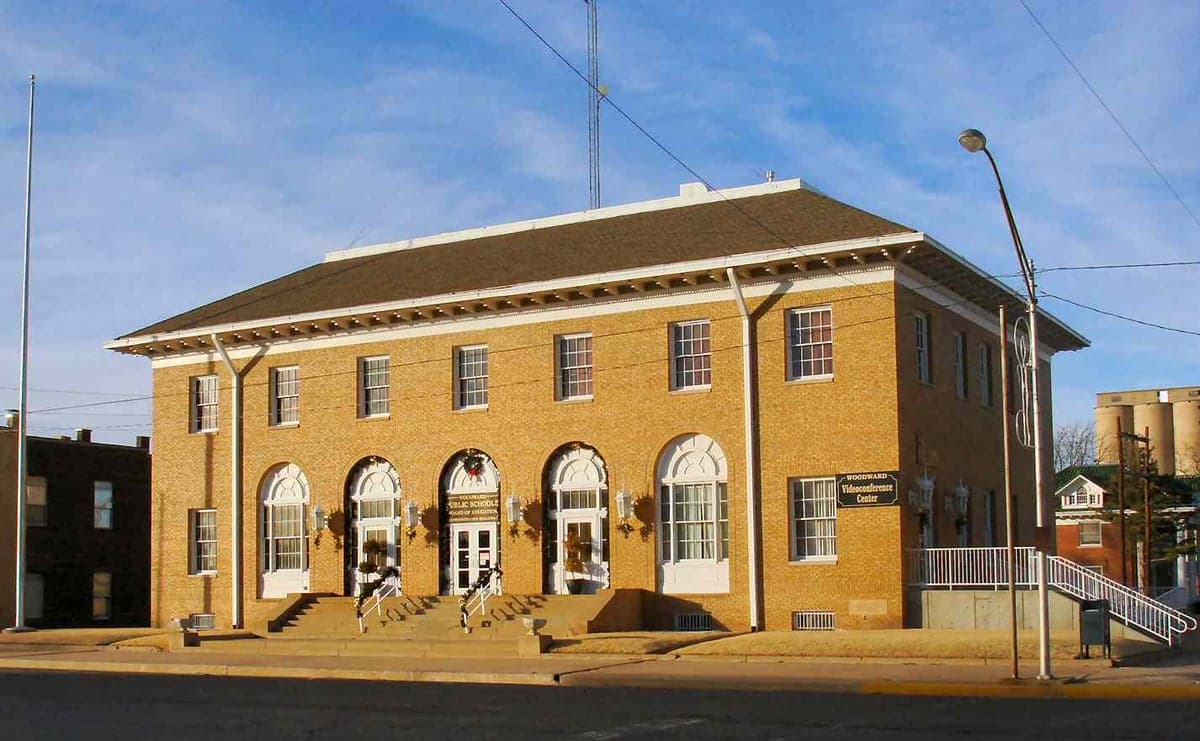
Photo: Wikipedia
Demographics of Woodward County
Affluence Level in Woodward County
A middle-class area roughly in line with national averages across income, home values, education, and employment.
People of Woodward County
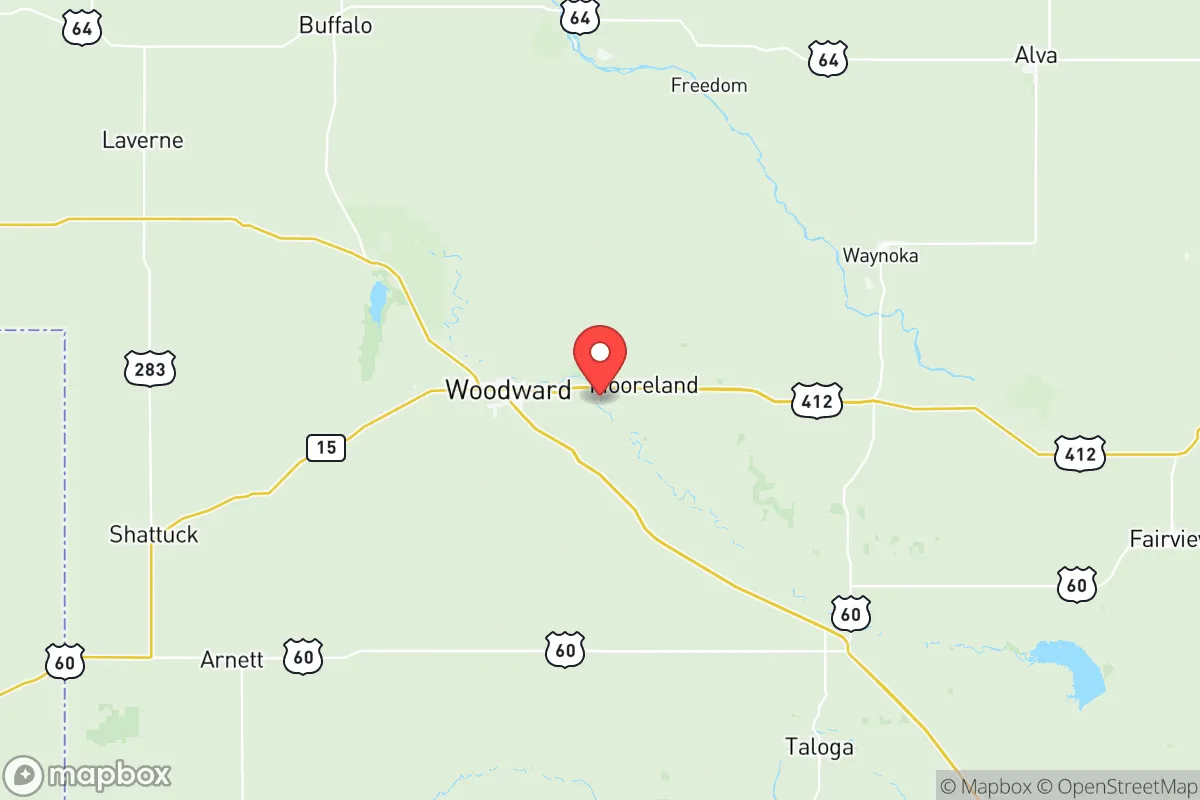
The people of Woodward County, Oklahoma today number 20,260, forming a predominantly white (76.6%) and politically conservative community spread across a rural landscape anchored by the county seat of Woodward and smaller towns like Fort Supply, Mooreland, and Sharon. With a foreign-born population of just 3.2% and a Hispanic share of 14.9% that represents the county's most significant recent demographic shift, Woodward County retains a distinctly Oklahoman character shaped by its ranching and energy economy. The population is notably less diverse than the national average, with a college attainment rate of 21.6% that reflects the area's blue-collar heritage, and the county's identity remains strongly tied to its agricultural roots and the frontier spirit of the Southern Plains.
Settlement & growth (pre-1960)
Before American settlement, the area that became Woodward County was part of the traditional territory of the Plains Apache, Comanche, and Kiowa nations, who followed bison herds across the vast shortgrass prairie. The region was formally part of the Spanish Empire until 1821 and then Mexican territory, though neither power established permanent settlements here. The land was acquired by the United States through the Louisiana Purchase of 1803, but it remained largely untouched by Euro-American settlers for decades, serving as a buffer zone between Indian Territory and the expanding frontier.
The first permanent American settlement began in earnest after the Civil War, when the U.S. government forced the Southern Cheyenne and Arapaho onto a reservation that covered much of present-day Woodward County. The establishment of Fort Supply in 1868 near the Canadian River created the county's first non-Native population center, as soldiers, traders, and camp followers gathered around the military outpost. The fort's presence attracted early ranchers who saw the rich grasslands as ideal for cattle operations, and by the 1880s, large ranches like the Turkey Track and the LX Ranch were running thousands of head of cattle across the open range.
The defining event for Woodward County's population came with the Cherokee Outlet Opening of September 16, 1893, when the U.S. government threw open nearly 6 million acres of former Cherokee and Osage land to homesteaders in the largest land run in American history. Tens of thousands of settlers surged into the region, staking claims on 160-acre parcels that would become the foundation of the county's agricultural economy. The town of Woodward was founded that same year as a railroad stop on the Southern Kansas Railway, quickly becoming the commercial hub for the surrounding homesteads. Other communities sprang up overnight: Mooreland (1893), Sharon (1893), Fort Supply (revived as a civilian town after the fort closed in 1894), and Quinlan (1893), each serving as a trading center for the newly settled farm families.
The homesteaders who claimed land in the 1893 run were overwhelmingly native-born white Americans from the Midwest and Upper South, particularly from Kansas, Nebraska, Iowa, Missouri, and Illinois. These were experienced farmers and ranchers drawn by the promise of free land under the Homestead Act, and they brought with them a culture of self-reliance, Protestant evangelicalism, and Republican political loyalties that would define the county for generations. A smaller number of German immigrants and German-Russians from the Great Plains also settled in the area, particularly around Vici and Mutual, bringing their wheat-farming expertise and distinct community traditions. The county's black population was minimal from the start, as Oklahoma's segregation laws and the expense of establishing a farm discouraged most African American settlers from the former Confederacy.
The early decades of the 20th century saw Woodward County's population peak at around 22,000 residents in 1910, as the initial homestead boom gave way to a stable agricultural economy based on wheat, cattle, and cotton. The discovery of oil in the 1920s brought a new wave of workers to the region, with Woodward experiencing a modest boom as an oilfield supply center. The Dust Bowl of the 1930s hit the county hard, driving many families off the land and contributing to a gradual population decline that would continue for decades. The post-World War II period saw the mechanization of agriculture reduce the need for farm labor, and young people increasingly left for urban centers in Oklahoma City and the Texas Panhandle, a pattern that persisted through the 1950s.
Modern era (post-1965)
The 1965 Hart-Cellar Act had minimal direct impact on Woodward County, as the region's economy and culture offered few attractions for the new waves of immigrants from Asia and Latin America who transformed coastal and urban America. Instead, the county's demographic story since the 1960s has been one of slow decline and gradual diversification through domestic migration. The population fell from roughly 18,000 in 1970 to a low of around 16,000 in 1990, as farm consolidation and the decline of small-town retail pushed residents toward larger cities. The most significant change has been the growth of the Hispanic population, which rose from negligible levels in 1980 to 14.9% of the county's population today, driven primarily by Mexican immigrants and their descendants who arrived to work in the region's agricultural and meatpacking industries.
The Hispanic community in Woodward County is concentrated in Woodward itself, where many families have settled in the city's older neighborhoods and mobile home parks, and in Fort Supply, where the William S. Key Correctional Center provides employment. These residents are predominantly Mexican-American, with smaller numbers from Central America, and they have established Spanish-language churches, tiendas, and a growing presence in the local construction and service industries. The county's black population remains tiny at 1.2%, concentrated almost entirely in Woodward and largely consisting of families who arrived during the oil boom of the 1970s or who work in the corrections system. The East/Southeast Asian population is negligible at 0.4%, and there is no measurable Indian-subcontinent community, reflecting the county's limited draw for professional-class immigrants.
The most significant domestic migration trend since 2000 has been the return of former residents and the arrival of retirees drawn by low housing costs and a slower pace of life. The county's population has stabilized and even grown slightly, reaching 20,260 in the 2020 census, as the oil and gas boom of the 2010s brought workers back to the region. The expansion of the H.E. Bailey Turnpike and improvements to U.S. Highway 270 have made Woodward more accessible to commuters and travelers, though the county remains firmly rural. The prison system, particularly the William S. Key Correctional Center and the nearby minimum-security facility, has become a major employer, drawing corrections workers from across the state and contributing to a modest influx of new residents.
The future
Woodward County's population is projected to remain relatively stable over the next decade, with modest growth driven by the energy sector and the continued appeal of low-cost living for retirees and remote workers. The Hispanic share of the population is expected to continue rising, potentially reaching 20-25% by 2040, as younger Hispanic families have higher birth rates and as agricultural and service-sector jobs continue to attract immigrant labor. This diversification is likely to be concentrated in Woodward and Mooreland, where existing Hispanic communities provide social networks and employment opportunities, while the smaller towns like Sharon, Vici, and Mutual are expected to remain overwhelmingly white and continue their slow population decline.
The county's white population is aging, with a median age above the state average, and the outmigration of young adults to Oklahoma City and the Texas cities is likely to continue unless the local economy diversifies beyond agriculture and corrections. The growth of wind energy in the region, with several large wind farms operating in Woodward County and surrounding areas, has brought some new jobs and tax revenue but has not yet triggered a significant population influx. The county's cultural identity is likely to remain conservative and rural, with the Hispanic community gradually integrating into the social fabric while maintaining distinct cultural institutions. For someone moving in now, Woodward County offers a stable, affordable, and safe environment with strong community ties, but with limited economic opportunity and demographic diversity compared to urban Oklahoma.
Woodward County is becoming a slightly more diverse version of its historical self, with the Hispanic community growing into a visible minority while the white population ages and the county's overall numbers hold steady. The region's future lies in balancing its agricultural and energy heritage with the need to attract and retain younger residents, and the success of that effort will determine whether the county continues its slow stabilization or resumes the decline that characterized much of the 20th century. For the prospective resident, Woodward County represents a genuine slice of rural Oklahoma life, where community connections run deep, the cost of living is low, and the pace of change is measured in decades rather than years.

* Values derived from national, state, county, city and local statistics and may differ in a specific area. Last updated: 2026-07-02T18:07:18.000Z
Narrative content on this page is AI-generated and may contain mistakes. Verify any details that matter before acting on them.
ReloMaps may earn a commission from affiliate links at no extra cost to you.

