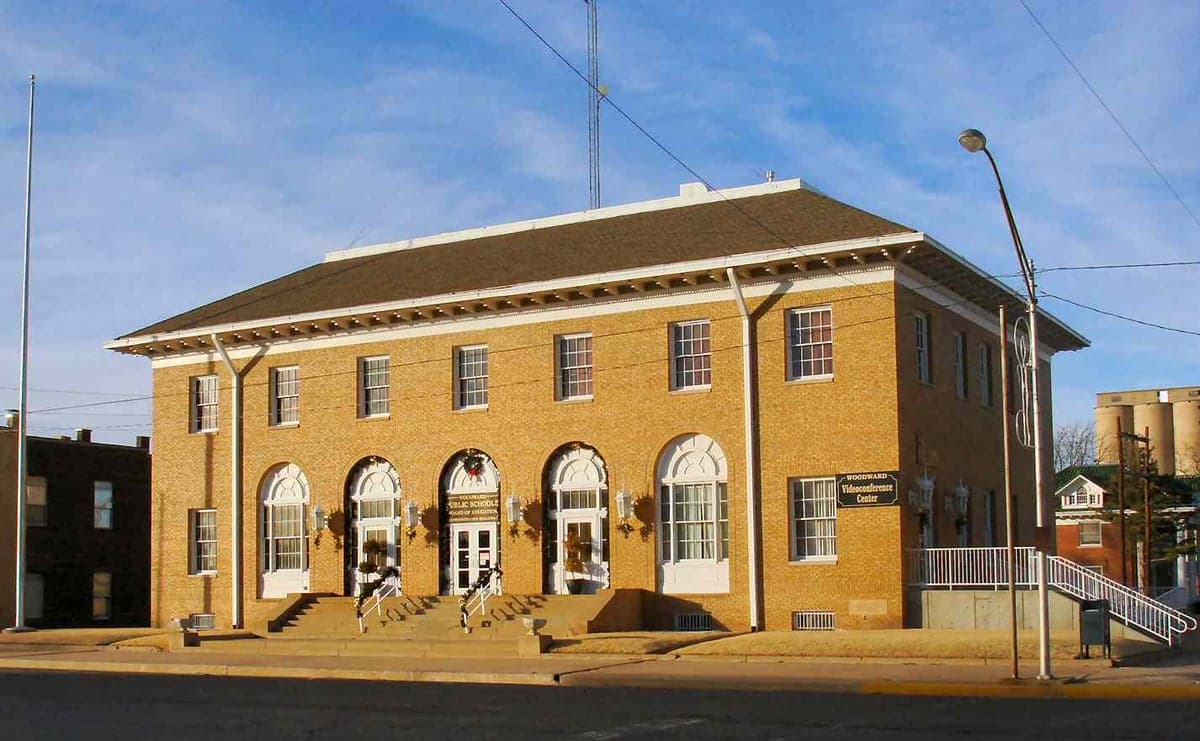
Photo: Wikipedia
Personal Sovereignty in Woodward County
Viable for self-reliance. Generally workable, though some barriers may limit total independence.
What does Personal Sovereignty tell us?
Personal Sovereignty measures your capacity for self-reliance and independence with minimal government friction. Higher scores mean fewer barriers between you and the way you want to live... but it assumes you have the space you need and good neighbors.
What does this tell us?
Personal Sovereignty measures your capacity for self-reliance and independence with minimal government friction. Higher scores mean fewer barriers between you and the way you want to live... but it assumes you have the space you need and good neighbors.
State Policy
Energy independence: Net exporter (180% of energy produced in-state)
Personal Liberty
Homesteading

Personal Liberty Analysis
Woodward County, Oklahoma, offers a notably high degree of personal sovereignty, anchored in Oklahoma’s strong constitutional protections for gun rights, property use, and limited government. The county’s regulatory environment is light-touch, particularly outside the city limits of Woodward, the county seat, and the smaller towns of Mooreland, Fort Supply, Sharon, and Mutual. For individuals and families who prioritize autonomy—whether in self-defense, homeschooling, or building a self-sufficient homestead—Woodward County presents a legal and cultural landscape that is far more permissive than many urban or coastal areas, though with specific local nuances to navigate.
Tax burden and regulatory posture in Woodward County
Oklahoma’s state-level tax burden is among the lowest in the nation, and Woodward County reflects that. There is no state property tax; local property taxes in the county average roughly 0.8% to 1.0% of assessed value, which is competitive even within the state. The state income tax is a flat 4.75%, and sales tax in Woodward city is 8.75% (4.5% state, 4.25% local), while smaller towns like Mooreland and Fort Supply have slightly lower combined rates. Business licensing is minimal—no general business license is required at the county level, though city-specific permits may apply for certain trades. Zoning is virtually nonexistent in unincorporated areas, meaning a landowner in rural sections near Sharon or Mutual can build a workshop, keep livestock, or operate a small repair business without navigating a thicket of county approvals. The regulatory posture is best described as permissive: the county’s planning and zoning department is small, and enforcement is complaint-driven rather than proactive.
Self-defense and gun law specifics in Woodward County
Oklahoma is a constitutional carry state, and Woodward County fully embraces that framework. Any law-abiding adult 21 or older may carry a firearm openly or concealed without a permit. For those who want reciprocity with other states, a concealed carry license is available through the Oklahoma State Bureau of Investigation, but it is not required for in-state carry. The county sheriff’s office in Woodward processes applications for firearm silencers and short-barreled rifles under the National Firearms Act without additional local restrictions. Stand-your-ground laws apply statewide, meaning there is no duty to retreat before using deadly force in self-defense. The gun culture is deeply embedded: the Woodward Gun Club hosts regular matches, and sporting goods stores in Woodward and Mooreland stock a full range of firearms and ammunition. No local ordinances in any Woodward County municipality restrict magazine capacity, firearm types, or storage requirements.
Self-reliance and homesteading viability in Woodward County
Woodward County is one of the more viable areas in Oklahoma for off-grid and self-reliant living, especially compared to the increasingly restrictive suburbs of Oklahoma City or Tulsa. In unincorporated areas, there are no county-level building codes, no mandatory inspections for owner-built structures, and no zoning restrictions on keeping chickens, goats, or cattle. Minimum lot sizes vary: in the rural areas around Fort Supply and Mutual, parcels as small as 1 to 5 acres are common for small homesteads, while larger tracts of 20 to 160 acres are available through the Bureau of Land Management and private sellers. Off-grid utilities are feasible—solar panels, rainwater catchment, and composting toilets are all legal, though a well permit from the Oklahoma Water Resources Board is required for groundwater extraction. The city of Woodward itself has more conventional building codes and requires connection to municipal water and sewer within city limits, so homesteaders typically look to the outskirts or the smaller towns of Sharon and Mooreland, where regulations are looser. The county’s agricultural extension office in Woodward offers soil testing and livestock guidance, supporting the self-reliance ethos.
Personal liberties in Woodward County: parental rights, medical autonomy, speech, and property
Oklahoma law provides strong protections for parental rights, including the right to direct a child’s education, medical care, and religious upbringing. Homeschooling is legal with minimal regulation—parents must file a notice of intent with the local school district (Woodward Public Schools or Mooreland Public Schools) but are not required to follow a state-approved curriculum or submit to standardized testing. Medical autonomy is less codified: Oklahoma does not have a broad medical freedom statute, but there are no state mandates for COVID-19 or other adult vaccinations, and the state legislature has passed laws prohibiting vaccine passports and mask mandates in public schools. Free speech is protected under the First Amendment, and there are no local ordinances restricting political signage, leafleting, or public assembly. Property rights are robust: Oklahoma’s “right to farm” law limits nuisance lawsuits against agricultural operations, and the state’s eminent domain protections are stronger than in many states, requiring a public purpose and just compensation. In Woodward County, property disputes are rare and typically resolved through the county district court, which has a reputation for favoring landowners over government entities.
Overall, Woodward County ranks among the top tiers of Oklahoma counties for personal sovereignty, comparable to the Panhandle counties but with better access to services in Woodward city. The combination of low taxes, minimal zoning, constitutional carry, and strong parental rights creates an environment where individuals and families can exercise a high degree of control over their lives. For those coming from high-regulation states like California or New York, the shift in autonomy is dramatic—especially in the rural areas around Fort Supply, Sharon, and Mutual, where neighbors are few and government oversight is lighter. The trade-off is that self-reliance is not just permitted but expected: emergency services are slower in remote areas, and the county’s small population means fewer advocacy groups or legal aid resources. For the freedom-minded, however, that is precisely the point.

* Values derived from national, state, county, city and local statistics and may differ in a specific area. Last updated: 2026-07-02T18:07:18.000Z
Narrative content on this page is AI-generated and may contain mistakes. Verify any details that matter before acting on them.
ReloMaps may earn a commission from affiliate links at no extra cost to you.

