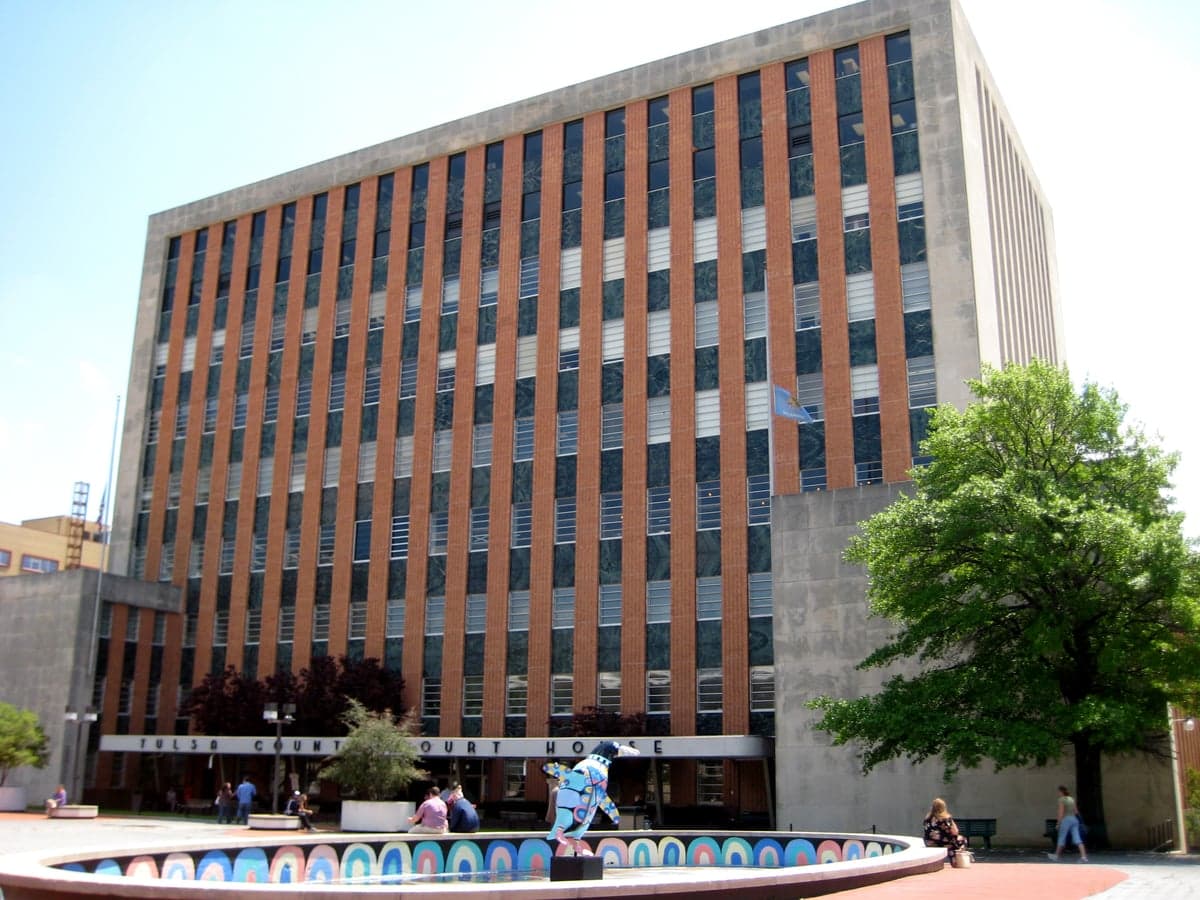
Photo: Wikipedia
Political ClimatePolitical Climate in Tulsa County
Showing district-level results — no local-only data available.
Local Political AnalysisPolitical Analysis of Tulsa County
Tulsa County is the blue dot in a deep red state, and that's been the reality for a generation. While the rest of Oklahoma votes like a R+18 fortress, Tulsa County itself carries a Cook PVI of R+11, making it noticeably more competitive and, in many ways, politically distinct from the surrounding region. The county hasn't voted for a Democratic presidential candidate since 1948, but the margins have tightened significantly in recent cycles, driven by a growing urban core and a suburban shift that's more nuanced than the state's rural strongholds.
How it compares
The gap between Tulsa County's R+11 and Oklahoma's R+18 is the single biggest political story in the state. That seven-point difference is almost entirely driven by the city of Tulsa itself, particularly the areas inside the IDL (Inner Dispersal Loop) and the midtown neighborhoods around Brookside and Cherry Street. These precincts have trended blue in every election since 2016, with some precincts in the Kendall-Whittier and Pearl District flipping outright. Meanwhile, the suburban and exurban towns that ring the county tell a different story. Jenks, Bixby, and Owasso are reliably deep red, often voting 65-70% Republican in down-ballot races. Broken Arrow, the state's fourth-largest city, is a bellwether — it's conservative overall, but its newer developments near the Creek County line have shown signs of softening, especially among college-educated women. The swing precincts in Tulsa County aren't in the city or the suburbs; they're in the unincorporated areas between Sand Springs and Sapulpa, where oil and gas workers live alongside commuters to Tinker Air Force Base. Those precincts decide countywide races, and they've been trending slightly left since 2020, though not enough to flip the county board.
What this means for residents
For conservative residents, Tulsa County is still a comfortable place to live and vote. Republicans hold every countywide office, the sheriff's department is conservative, and the county commission has a solid GOP majority. The practical effect of the R+11 lean is that primaries are where most local races are decided, and the more conservative candidate usually wins. For liberal residents, the picture is more complicated. You can win city council seats in Tulsa proper — the city's nonpartisan elections have produced a progressive majority on the council in recent years — but county-level races are an uphill climb. The real friction point is policy: the city of Tulsa has passed nondiscrimination ordinances and pursued criminal justice reform, while the county government has pushed back on both. That tension between a blue-leaning city and a red-leaning county is the defining political dynamic of the area.
Culturally, Tulsa County feels like two different places depending on where you stand. Inside the city limits, you'll find a thriving arts scene, a growing brewery culture, and a visible LGBTQ+ community — things that are rarer in the surrounding counties. Drive 15 minutes south to Jenks or Bixby, and the landscape shifts to megachurches, high school football as a religion, and a more traditional family-oriented lifestyle. The county's political divide is really a cultural and geographic one, with the Arkansas River acting as a rough boundary between the urban core and the suburban south. Long-term, the trajectory points toward Tulsa County continuing to drift left while the state stays firmly red, which means the gap between city and county policy will likely widen, not narrow.

State Political ClimatePolitical Climate in Oklahoma
State Political AnalysisPolitical Environment in the State
Oklahoma is one of the most reliably Republican states in the country, with a Cook Partisan Voting Index of R+18, meaning it votes about 18 points more Republican than the national average. The state hasn't voted for a Democratic presidential candidate since 1964, and every statewide elected office is held by a Republican. Over the last 20 years, the shift has been dramatic — Oklahoma was already conservative, but the realignment of rural and exurban voters, combined with the collapse of the old Democratic machine in eastern Oklahoma, has pushed the state from lean-Republican to deep-red territory. For a relocator, this means the political culture is overwhelmingly conservative, but the intensity and flavor of that conservatism varies a lot depending on where you land.
Urban vs. rural divide
The political map of Oklahoma is a classic story of a few blue islands in a sea of red. Oklahoma City and Tulsa are the two major population centers, and while both counties (Oklahoma and Tulsa) have trended more competitive in recent cycles, they still lean Republican overall — Oklahoma County voted for Trump by about 8 points in 2024, while Tulsa County was closer to 12 points. The real Democratic strongholds are Norman, home to the University of Oklahoma, and Stillwater, home to Oklahoma State — both college towns that reliably vote blue in a state where that's increasingly rare. Outside those pockets, the rural landscape is deeply conservative. Counties like Texas County in the Panhandle and Bryan County in the southeast routinely vote 80%+ Republican. The old Democratic tradition in southeastern Oklahoma, once rooted in unionized mining and timber communities, has all but evaporated; those voters now reliably back Republicans. The suburbs around OKC and Tulsa — places like Edmond, Broken Arrow, and Yukon — are among the most reliably Republican areas in the state, often voting 70% or higher for GOP candidates.
Policy environment
Oklahoma's policy environment reflects its deep-red lean. The state has a flat income tax rate of 4.75%, with ongoing legislative efforts to reduce it further, and no estate tax. Sales taxes are relatively high, often pushing 9-10% in cities when local rates are added. The regulatory posture is business-friendly, with few environmental or labor regulations compared to coastal states. Education policy has been a flashpoint: the state has one of the lowest per-pupil spending levels in the country, and teacher walkouts in 2018 and 2019 were among the largest in U.S. history. In response, the legislature passed significant teacher pay raises, but funding remains a concern. On healthcare, Oklahoma did not expand Medicaid until 2021, when voters approved State Question 802 via ballot initiative, overriding years of legislative resistance. Election laws have tightened: the state requires a government-issued photo ID to vote, and absentee ballot application deadlines are strict. Early voting is available but limited to a few days before the election.
Recent policy direction
Over the last five years, Oklahoma has moved aggressively on several fronts that relocators should weigh carefully. On gun rights, the state enacted permitless carry in 2019, allowing any adult who can legally possess a firearm to carry it openly or concealed without a license. On abortion, Oklahoma passed one of the nation's strictest bans in 2022, effectively prohibiting the procedure from conception with narrow exceptions for rape, incest, and medical emergencies — and enforcement is left to private civil suits. On education, the state launched a universal school voucher program in 2023, allowing any family to use public funds for private or homeschool expenses. On parental rights, Oklahoma passed a law requiring schools to notify parents of any curriculum involving sexual orientation or gender identity, and it was one of the first states to ban transgender girls from school sports. On property rights, the state has strong eminent domain protections and a right-to-farm law that limits nuisance lawsuits against agricultural operations. On voting, the state has resisted no-excuse absentee voting and maintains a strict voter ID law. On privacy and surveillance, Oklahoma has no comprehensive data privacy law, but it does have a law restricting the use of license plate readers by law enforcement. The overall direction is toward expanding individual liberties on gun, education, and property issues while restricting them on abortion and transgender rights.
Civil unrest & political movements
Oklahoma has seen its share of political activism, though large-scale civil unrest is rare. The 2018 teacher walkout, known as #OklaEd, brought tens of thousands of educators to the state capitol for two weeks, making national headlines and forcing a legislative response on pay and funding. On the right, the state has been a hotbed of Second Amendment activism and anti-abortion organizing, with groups like Oklahomans for Life maintaining significant influence. Immigration politics are less visible than in border states, but Oklahoma has passed laws requiring local law enforcement to cooperate with federal immigration authorities and banning sanctuary city policies. There is no serious secession or nullification movement in Oklahoma, though the state has joined multi-state lawsuits challenging federal environmental and healthcare regulations. Election integrity has been a recurring theme: after the 2020 election, Oklahoma's Republican leadership quickly certified results but passed additional voting restrictions in 2021, including a ban on private funding for election administration. A new resident would notice that political signs and bumper stickers are common, especially in rural areas, and that political conversations in public settings tend to assume a conservative baseline.
Projection
Over the next 5-10 years, Oklahoma is likely to remain deeply Republican, but the nature of that conservatism may shift. In-migration is modest compared to Texas or Florida, but the state is attracting some relocators from California and the Northeast, drawn by low housing costs and a conservative policy environment. These newcomers tend to be more culturally conservative than the state's existing population, which could reinforce the rightward trend. However, the urban counties — Oklahoma, Tulsa, and Cleveland (Norman) — are slowly becoming more competitive as younger, more diverse populations grow. The state's Democratic Party remains weak, but if national trends shift, these areas could become swing districts. The bigger wildcard is the state's fiscal health: Oklahoma relies heavily on oil and gas revenue, and a sustained downturn in energy prices could force difficult budget choices that test the state's low-tax, low-service model. For a relocator, the realistic expectation is that Oklahoma will be as conservative in 2035 as it is today, with perhaps slightly more competitive urban areas and continued cultural battles over education and social policy.
For someone moving to Oklahoma, the practical takeaway is straightforward: if you align with conservative values on taxes, gun rights, education choice, and limited government, you'll find a state that is actively moving in your direction. If you lean liberal, you'll find a few welcoming enclaves in Norman, Stillwater, and parts of OKC and Tulsa, but you should expect to be in the political minority in most everyday settings. The state's politics are stable, predictable, and deeply rooted — not a place of rapid change or surprise, but one where the direction of travel is clear and has been for a generation.
* Values derived from national, state, county, city and local statistics and may differ in a specific area. Last updated: 2026-06-22T14:10:49.000Z
Narrative content on this page is AI-generated and may contain mistakes. Verify any details that matter before acting on them.
ReloMaps may earn a commission from affiliate links at no extra cost to you.

