Photo: Wikipedia
Political ClimatePolitical Climate in Stephens County
Showing district-level results — no local-only data available.
Local Political AnalysisPolitical Analysis of Stephens County
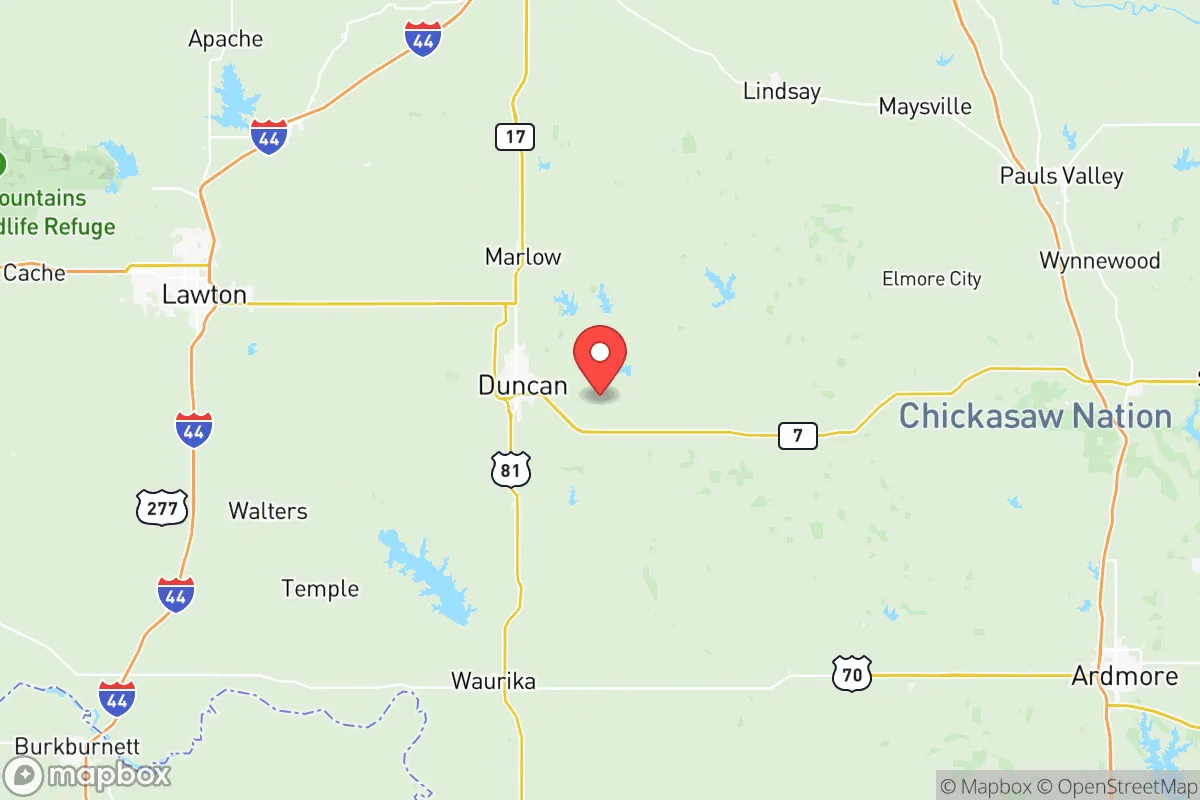
Stephens County, Oklahoma, is a reliably conservative area, but it’s not quite as deep red as the state as a whole. The Cook Partisan Voting Index (PVI) for the county is R+17, meaning it votes about 17 points more Republican than the national average. That’s a solid red lean, but it’s actually one point *less* Republican than Oklahoma’s statewide PVI of R+18. This small gap reflects a subtle but real political diversity within the county, driven largely by the presence of Duncan, the county seat and an oil-and-gas hub, and a handful of smaller towns that vote differently. Over the last decade, the county has held steady in its Republican tilt, with no major swing toward the center or further right, though local races can be more competitive than the presidential numbers suggest.
How it compares
The R+17 vs. R+18 difference might seem trivial, but it matters on the ground. In Oklahoma, the most reliably red counties (like Texas County at R+30 or Beaver County at R+28) are rural, agricultural, and overwhelmingly white. Stephens County, with its mix of small industry, ranching, and the city of Duncan (population ~22,000), has a slightly more varied electorate. Duncan itself is the county’s most moderate area—its precincts near the hospital and the university (Cameron University’s Duncan campus) occasionally vote within 5-10 points of the national average, especially in midterm elections. By contrast, the towns of Comanche and Marlow lean hard red, often voting R+25 or higher, while the rural precincts around Velma and Loco are reliably R+30+. The swing precincts—the ones that can decide a tight county commission race—are in Duncan’s older neighborhoods and the area around the Stephens County Fairgrounds, where a mix of retirees, oil workers, and small-business owners create a more pragmatic conservative vote.
What this means for residents
For conservative residents, Stephens County is a comfortable place to live politically. Republican candidates win every countywide office, and the local GOP is well-organized, with active precinct meetings and a strong presence at the county fair. Conservative voters can expect their views on taxes, gun rights, and energy policy to be the default in local government and school board meetings. For liberal or moderate residents, the reality is more nuanced. You won’t find many overtly progressive spaces, but Duncan does have a small but visible Democratic-leaning community, centered around the arts scene and the university. The county’s slightly less red PVI means that a moderate Democrat can sometimes win a city council seat in Duncan (as happened in 2022) or get a respectful hearing on issues like road funding or senior services. The key is that local politics here is less about national culture wars and more about practical concerns—water rights, school funding, and the health of the oil patch. Most residents, regardless of party, agree on keeping taxes low and supporting the local energy industry.
Culturally, Stephens County stands apart from the state’s more rural, evangelical-dominated regions. Duncan’s identity is tied to the oil boom of the early 20th century, which gave it a more working-class, union-friendly history than much of Oklahoma. You still see that in the local politics: the county has a stronger tradition of supporting infrastructure spending and public schools than, say, the Panhandle. Policy-wise, the county commission tends to be pragmatic—they’ll approve a sales tax for a new jail or a road bond without the ideological battles you see in other parts of the state. For anyone moving here, the takeaway is simple: Stephens County is red, but it’s a practical, live-and-let-live kind of red, not a fire-breathing one. That’s likely to hold for the near future, as long as the oil economy stays stable and Duncan’s moderate influence holds.

State Political ClimatePolitical Climate in Oklahoma
State Political AnalysisPolitical Environment in the State
Oklahoma is one of the most reliably Republican states in the country, with a Cook Partisan Voting Index of R+18, meaning it votes about 18 points more Republican than the national average. Over the past 20 years, the state has shifted from a competitive conservative-leaning state to a deep-red stronghold, driven by the collapse of the old Democratic coalition in rural areas and the rapid growth of conservative suburbs around Oklahoma City and Tulsa. While Democrats once held a majority of statewide offices as recently as the early 2000s, Republicans now hold every statewide elected office, supermajorities in both legislative chambers, and all five of the state’s U.S. House seats.
Urban vs. rural divide
Oklahoma’s political map is defined by a stark urban-rural split, though even the urban centers are more conservative than their counterparts in states like Texas or Colorado. Oklahoma City and Tulsa are the two major Democratic-leaning population centers, but neither is reliably blue — Oklahoma County (Oklahoma City) voted for Donald Trump in 2020, while Tulsa County has been competitive but leans Republican. The real Democratic base is concentrated in the state’s small number of majority-minority precincts, particularly in northeastern Oklahoma City and north Tulsa, alongside the college town of Norman, home to the University of Oklahoma. Outside of these pockets, the state is overwhelmingly Republican. Rural counties like Beaver, Texas, and Grant in the Panhandle routinely vote 85-90% Republican, while the southeastern corner — once a Democratic stronghold known as “Little Dixie” — has flipped hard red over the past two decades. Suburbs like Edmond, Broken Arrow, and Moore are deeply conservative and growing fast, reinforcing the state’s rightward tilt.
Policy environment
Oklahoma’s policy environment reflects its conservative supermajority. The state has a flat income tax rate of 4.75%, which has been gradually reduced from nearly 7% in the early 2000s, and there is active discussion of further cuts or full elimination. Sales taxes are high, often exceeding 10% in some municipalities when local rates are added, making the tax burden regressive. The state is a right-to-work state with weak labor unions and minimal business regulation. Education policy has been a flashpoint: Oklahoma has one of the lowest teacher pay levels in the region, leading to a historic nine-day teacher walkout in 2018, though pay has since been increased by several thousand dollars. The state has also expanded school choice significantly, including a 2023 universal private school tax credit program. On healthcare, Oklahoma has not expanded Medicaid under the Affordable Care Act, though voters approved a Medicaid expansion ballot initiative in 2020 that was later implemented after legal challenges. Election laws have been tightened in recent years, including voter ID requirements and restrictions on absentee ballot drop boxes.
Recent policy direction
Oklahoma’s recent legislative sessions have pushed the state further to the right across multiple fronts. On gun rights, Oklahoma became a permitless carry state in 2019, allowing any adult who can legally possess a firearm to carry it openly or concealed without a license. On education and parental rights, the state passed a 2022 law requiring schools to notify parents of any curriculum involving sexual orientation or gender identity, and in 2023 enacted a near-total ban on gender-affirming care for minors. On abortion, Oklahoma has one of the strictest bans in the nation, effectively prohibiting the procedure from conception with no exceptions for rape or incest, enforced through a civil enforcement mechanism modeled on Texas’s SB 8. On property rights, the state has strong eminent domain protections and has resisted local zoning reforms that would allow denser housing. On privacy and surveillance, Oklahoma has banned TikTok on state government devices and considered broader data privacy legislation, but has not passed a comprehensive consumer privacy law. On voting access, the state has shortened early voting windows and requires a government-issued photo ID to vote. On speech and religious liberty, the state has passed laws protecting religious expression in public schools and requiring the display of the Ten Commandments in public school classrooms, a policy that is currently tied up in litigation.
Civil unrest & political movements
Oklahoma has seen relatively low levels of civil unrest compared to coastal states, but there have been notable flashpoints. The 2018 teacher walkout was the largest labor action in the state’s history, drawing tens of thousands of educators to the Capitol and forcing a legislative pay raise. On the right, the state has been a hub for the “constitutional sheriff” movement, with several rural sheriffs publicly refusing to enforce certain state or federal gun laws. Immigration politics are less heated than in border states, but Oklahoma has passed laws penalizing “sanctuary city” policies and requiring law enforcement to cooperate with federal immigration authorities. There is no serious secessionist movement, though some rural counties have passed symbolic resolutions asserting local control over federal lands. Election integrity has been a recurring theme, with the state legislature creating a special election integrity unit within the Oklahoma State Bureau of Investigation in 2022, though no widespread fraud has been documented. A new resident would notice that political polarization is visible in daily life — bumper stickers, yard signs, and church affiliations often signal political alignment — but public discourse remains generally civil compared to more contentious states.
Projection
Over the next 5-10 years, Oklahoma is likely to remain deeply Republican, but the nature of that conservatism may shift. In-migration is modest compared to Texas or Florida, but the state is attracting new residents from California and the Northeast, many of whom are conservative-leaning but may bring different priorities around school choice, tax policy, and property rights. The growth of the Oklahoma City and Tulsa suburbs will continue to drive the state’s politics, while rural areas will slowly lose population and political weight. The Democratic Party will remain weak, but could become more competitive in a few state legislative districts around Norman and midtown Oklahoma City if turnout among younger and minority voters increases. The biggest wild card is the state’s budget: if oil and gas revenues decline, the state may face pressure to raise taxes or cut services, which could fracture the Republican supermajority. For now, the trajectory is steady — more of the same, with incremental moves to the right on cultural issues and gradual tax cuts.
For a new resident, the bottom line is straightforward: if you are conservative, Oklahoma offers a policy environment that aligns closely with your values, with low taxes, strong gun rights, and a culture that respects religious liberty and parental authority. If you are liberal, you will find yourself in a clear minority, but you will also find livable communities in Norman, parts of Oklahoma City, and Tulsa where your views are shared and respected. The state is politically stable, with little risk of sudden shifts, and the practical impact of its lean is most visible in the low cost of living, the absence of state-level bureaucracy, and the ease of navigating daily life without encountering political friction. Choose your neighborhood carefully, and you will find Oklahoma to be a place where politics is present but not overwhelming.
* Values derived from national, state, county, city and local statistics and may differ in a specific area. Last updated: 2026-06-16T21:47:32.000Z
Narrative content on this page is AI-generated and may contain mistakes. Verify any details that matter before acting on them.
ReloMaps may earn a commission from affiliate links at no extra cost to you.

