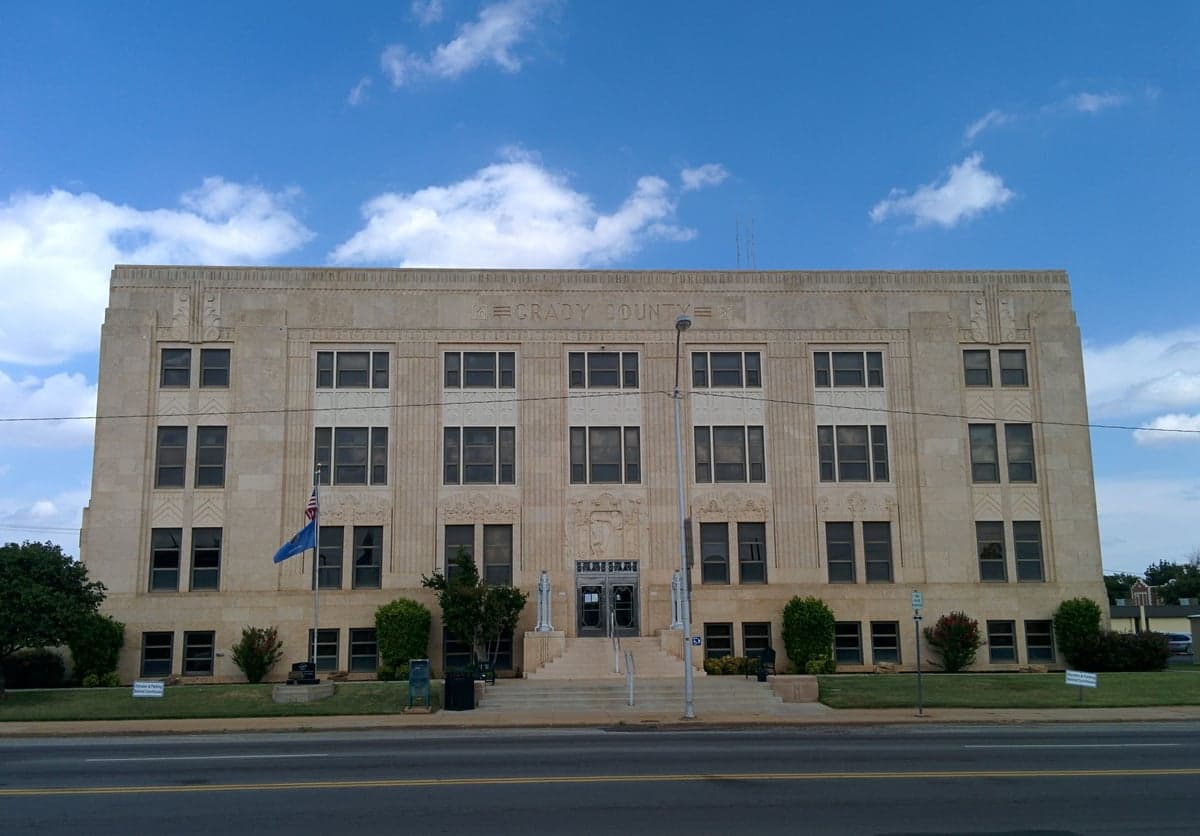
Photo: Wikipedia
Political ClimatePolitical Climate in Grady County
Showing district-level results — no local-only data available.
Local Political AnalysisPolitical Analysis of Grady County
Grady County is a reliably Republican stronghold with a Cook PVI of R+17, making it slightly less conservative than Oklahoma as a whole (R+18) but still deeply red by national standards. The county has voted for the GOP presidential candidate by margins of 30 to 40 points in recent cycles, though local precincts show meaningful variation — Chickasha, the county seat and home to the University of Science and Arts of Oklahoma, has a handful of precincts that lean blue or are genuinely competitive, while towns like Tuttle, Minco, and Blanchard are among the most Republican in the state. The overall trajectory is steady: Grady County has been getting redder over the past decade, mirroring the broader rural Oklahoma trend, but the college-town influence in Chickasha keeps the county from being quite as monolithically conservative as its neighbors to the west and south.
How it compares
Oklahoma’s statewide PVI of R+18 places it among the five most Republican states in the country, and Grady County’s R+17 puts it right in the mainstream of that landscape. The difference is small enough that it’s mostly academic — both the county and the state are safely red in presidential and Senate races. The more interesting comparison is internal: Grady County is noticeably more moderate than Caddo County to the west (R+22) or Stephens County to the south (R+21), but it’s also less conservative than Canadian County to the north (R+19), which has been pulled rightward by explosive suburban growth around Yukon and Mustang. Within the county, the swing precincts are concentrated in Chickasha’s central and east-side neighborhoods near the university campus, where Democratic candidates can pull 45-48% of the vote in a good year. By contrast, Tuttle precincts routinely deliver 80%+ Republican margins, and Minco and Blanchard are not far behind.
What this means for residents
For conservative residents, the political climate is comfortable and affirming — local offices are dominated by Republicans, policy debates tend to center on tax cuts, Second Amendment rights, and school choice, and there’s little pressure to moderate positions. For liberal residents, the reality is more isolating but not hopeless: Chickasha provides a small blue island where progressive candidates can win city council seats and where the university community creates space for different viewpoints, but driving ten minutes outside town means entering deep-red territory where Democratic bumper stickers are rare. Practical consequences include limited access to reproductive health services (the nearest Planned Parenthood is in Oklahoma City, about 40 minutes north) and a local political culture that strongly favors gun rights and low taxes over expanded public services. The county commission and school board elections are usually decided in the Republican primary, meaning the general election is often a formality.
Culturally, Grady County is more rural and agricultural than its northern neighbor Canadian County, but less dominated by oil and gas than the counties to the south. The biggest policy distinction from the state average is the county’s relatively moderate stance on local economic development — Chickasha has pursued tax increment financing and public-private partnerships more aggressively than most Oklahoma towns its size, reflecting a pragmatic streak that sometimes cuts against the county’s otherwise conservative orthodoxy. The university’s presence also means the county has a slightly higher tolerance for arts funding and historic preservation than neighboring rural counties. Long-term, expect the county to stay R+15 to R+18 for the foreseeable future, with Chickasha’s blue precincts holding steady but not expanding, and the suburban-style growth along the I-44 corridor near Tuttle and Newcastle gradually pulling the county’s overall lean even further right.

State Political ClimatePolitical Climate in Oklahoma
State Political AnalysisPolitical Environment in the State
Oklahoma is one of the most reliably Republican states in the country, with a Cook PVI of R+18 that has only deepened over the past two decades. The state hasn't voted for a Democratic presidential candidate since 1964, and every statewide elected office is held by a Republican. But the political reality here is more layered than a simple red-state label — it’s a place where rural populism, evangelical conservatism, and a growing suburban professional class coexist, often uneasily. Over the last 10-20 years, the shift has been dramatic: Democrats once held a majority in the state House as recently as 2004, but now Republicans hold supermajorities in both chambers, and the party has moved steadily rightward on social and fiscal issues.
Urban vs. rural divide
The political map of Oklahoma is a textbook study in urban-rural polarization. Oklahoma City and Tulsa are the two major population centers, and they lean more moderate — Oklahoma County (OKC) has been competitive in recent cycles, with Democrats making gains in the 2020 and 2022 elections, though it still votes Republican in statewide races. Tulsa County is more reliably red but has a liberal core in the city’s midtown and arts districts. The real engine of Republican dominance is the vast rural and exurban expanse: counties like Texas County in the Panhandle, Canadian County (a fast-growing OKC suburb), and Rogers County near Tulsa routinely deliver 75-80% of the vote for GOP candidates. The state’s few Democratic strongholds are limited to Payne County (home to Oklahoma State University in Stillwater) and Cleveland County (Norman, home to the University of Oklahoma), where college-town dynamics produce a more liberal tilt. But these islands of blue are surrounded by a sea of red, and their influence is diluted by low turnout in off-year elections.
Policy environment
Oklahoma’s policy environment is shaped by a deep commitment to low taxes, limited regulation, and cultural conservatism. The state has a flat income tax of 4.75%, with ongoing efforts to phase it out entirely — a top priority for Governor Kevin Stitt and legislative leadership. Sales taxes are high, often exceeding 10% in some municipalities when local levies are added, which shifts the burden onto consumption. Property taxes are among the lowest in the nation, a major draw for relocating families. Education policy is a flashpoint: the state has embraced school choice aggressively, with the 2023 Oklahoma Parental Choice Tax Credit Act providing up to $7,500 per student for private school expenses, and a robust charter school sector. However, public school funding remains a perennial issue, with teacher pay raises in recent years failing to keep pace with inflation. On healthcare, Oklahoma has not expanded Medicaid under the Affordable Care Act, though voters approved a ballot measure in 2020 to do so — implementation has been slow and contentious. Election laws have tightened: voter ID is required, and the state passed restrictions on absentee ballot drop boxes and mail-in voting after 2020. Gun laws are among the most permissive in the country: permitless carry was enacted in 2019, and the state has a strong preemption law preventing local gun ordinances.
Recent policy direction
The last few years have seen Oklahoma move aggressively on a range of liberty-related fronts. Gun and self-defense law: the 2019 permitless carry law (SB 1212) was followed by a 2023 measure allowing firearms in certain government buildings and on public transportation. Parental and education rights: the 2022 "Save Women's Sports Act" (HB 4243) bans transgender athletes from female school sports, and a 2023 law (SB 613) requires school libraries to remove materials deemed "pornographic" or "harmful to minors," with criminal penalties for librarians. Speech and privacy: the state passed a 2022 law (HB 1775) restricting how race and gender can be taught in public schools, and a 2023 law (SB 110) prohibits social media companies from deplatforming users based on political viewpoints. Medical and bodily autonomy: Oklahoma has one of the strictest abortion bans in the nation, with no exceptions for rape or incest, enacted via HB 4327 in 2022. Property rights: the state has strong eminent domain protections and a 2023 law (HB 2663) limiting homeowners' association authority. Taxation: the flat income tax rate was cut from 5% to 4.75% in 2022, with a trigger mechanism for further reductions as revenue grows. Voting and ballot access: a 2021 law (SB 440) shortened the absentee ballot application window and required notarization or a copy of ID, though a federal court later struck down the notarization requirement. The overall direction is toward expanding individual choice in education and firearms while restricting it on reproductive rights and certain speech-related issues.
Civil unrest & political movements
Oklahoma has seen its share of political flashpoints, though large-scale civil unrest is rare. The most visible recent movement was the 2018 teacher walkout, which shut down schools for two weeks and drew national attention — it resulted in a pay raise but not the funding increases activists sought. On the right, the "Ten Commandments" movement has been persistent: a 2024 law (SB 1350) requires the display of the Ten Commandments in all public school classrooms, which is already facing legal challenges. Immigration politics are less heated than in border states, but Oklahoma City and Tulsa have seen protests over federal immigration enforcement, and the state passed a 2023 law (HB 4156) requiring law enforcement to cooperate with ICE. There is no sanctuary city movement of note. Election integrity remains a live issue: after the 2020 election, the state auditor conducted a forensic audit of voting machines in Canadian County, which found no irregularities but fueled ongoing distrust among some conservatives. Nullification rhetoric surfaces occasionally — a 2023 resolution (HJR 1021) asserted Oklahoma's right to ignore federal gun laws — but has not led to concrete action. A new resident would notice the prevalence of political signage, especially in rural areas, and the strong presence of evangelical churches in public life.
Projection
Over the next 5-10 years, Oklahoma’s political trajectory points further right, but with potential complications. In-migration is accelerating, particularly to the Oklahoma City suburbs like Edmond and Yukon, and to the Tulsa exurbs like Broken Arrow and Bixby. These newcomers are often conservative-leaning families from California, Texas, and Colorado, drawn by low housing costs and the state’s policy environment — they tend to reinforce the existing political direction rather than moderate it. The Democratic Party is increasingly confined to the urban cores and college towns, with little prospect of statewide competitiveness. The biggest wildcard is the state’s fiscal health: the push to eliminate the income tax could strain funding for roads, schools, and healthcare, potentially sparking a backlash if services visibly deteriorate. On social issues, expect continued battles over education and abortion, with the legislature likely to push further on school choice and restrictions on LGBTQ+ rights. The state’s growing Hispanic population, concentrated in Oklahoma City and the Panhandle, could shift the electorate over a longer horizon, but for now, it remains a reliably Republican voting bloc. Someone moving in now should expect a state that is deeply conservative, increasingly assertive in its policy experiments, and unlikely to change course in the next decade.
For a new resident, the bottom line is straightforward: Oklahoma offers a low-tax, low-regulation environment with strong protections for gun rights and school choice, but also a restrictive approach to abortion and a public education system that is underfunded by national standards. Conservatives will find a state that aligns closely with their values and is actively pushing the envelope on policy. Liberals will find a state where their vote carries little weight in statewide elections, but where local politics in Norman, Stillwater, or midtown Tulsa can still feel vibrant and engaged. The key is knowing which Oklahoma you’re moving to — the urban, the suburban, or the rural — because the political experience varies dramatically across the state.
* Values derived from national, state, county, city and local statistics and may differ in a specific area. Last updated: 2026-06-27T01:05:13.000Z
Narrative content on this page is AI-generated and may contain mistakes. Verify any details that matter before acting on them.
ReloMaps may earn a commission from affiliate links at no extra cost to you.

