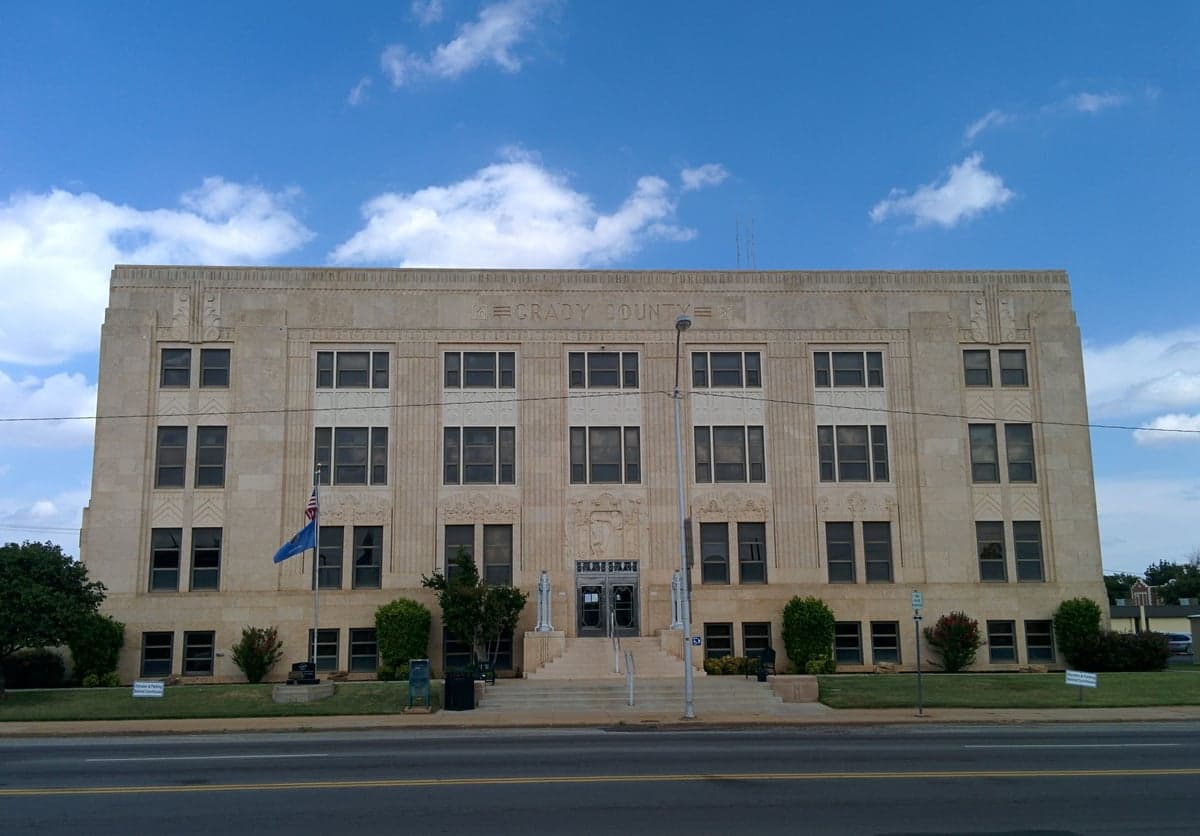
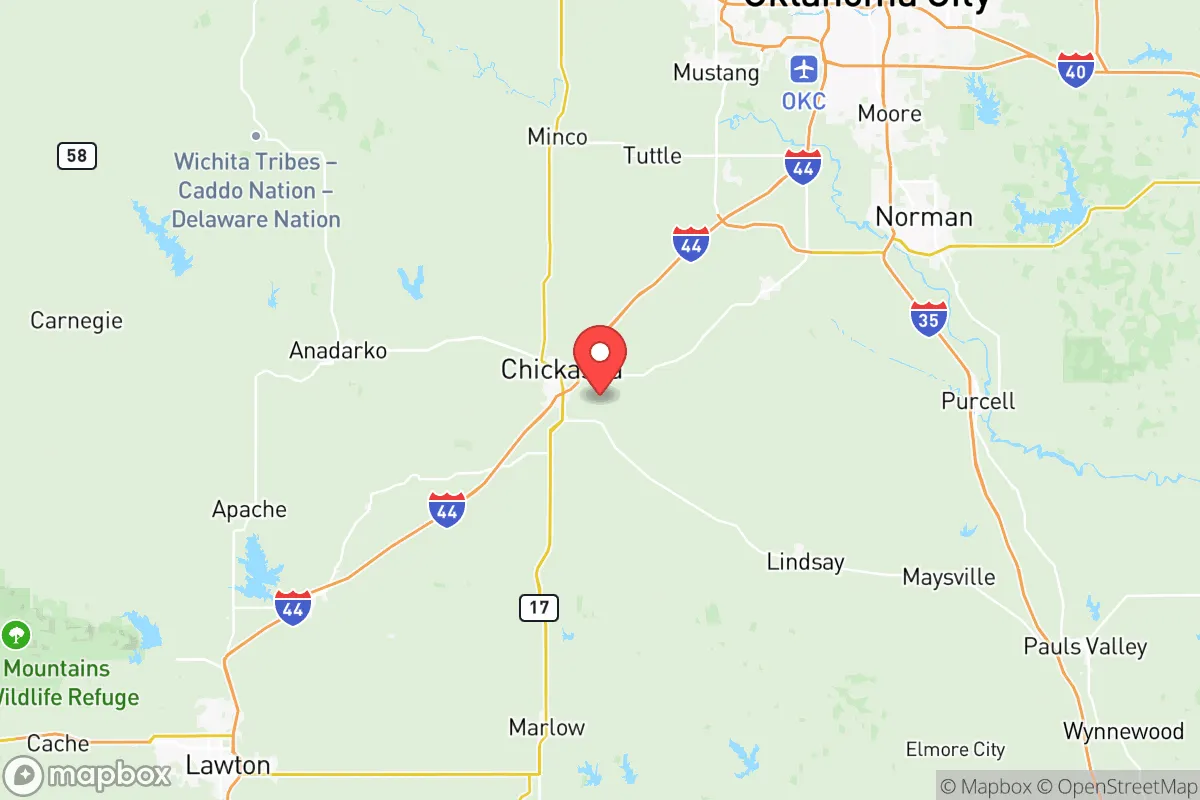
Photo: Wikipedia
Demographics of Grady County
Affluence Level in Grady County
A middle-class area roughly in line with national averages across income, home values, education, and employment.
People of Grady County
Grady County, Oklahoma, is home to roughly 55,868 residents, a population that remains predominantly white (79.3%) with a small but growing Hispanic community (6.8%) and a very low foreign-born rate of just 1.2%. The county’s character is shaped by its agricultural roots and small-town identity, anchored by the county seat of Chickasha and the historic communities of Tuttle, Minco, and Rush Springs. With a college-educated rate of 21.9%—below the national average—the population leans toward blue-collar and service-sector employment, reflecting a region that has seen steady, modest growth rather than explosive change.
Settlement & growth (pre-1960)
Before American settlement, the area that is now Grady County was part of the traditional lands of the Plains Apache, Comanche, and Wichita peoples. The region was later designated part of the Kiowa-Comanche-Apache Reservation under the Medicine Lodge Treaty of 1867, and it remained largely Native-controlled until the land runs of the late 19th century. Spanish and French explorers passed through but left no permanent settlements; the first sustained non-Native presence came with the opening of Indian Territory to white settlement.
The defining event for Grady County’s population was the Land Run of 1889, which opened the Unassigned Lands to homesteaders. The town of Chickasha was founded in 1892 as a railroad hub on the Chicago, Rock Island and Pacific line, drawing settlers from the Midwest and Upper South. These early arrivals were overwhelmingly of English, Scots-Irish, and German stock, many migrating from Kansas, Missouri, and Illinois. The promise of cheap land and the expansion of the railroad drove the initial wave, and by 1900 the county’s population had already reached roughly 18,000.
Agriculture—especially cotton, wheat, and cattle—dominated the economy through the early 20th century. Towns like Minco (founded 1890) and Tuttle (founded 1901) grew as farming and trade centers. The discovery of oil in the 1910s and 1920s brought a second wave of settlers, including workers from Texas, Kansas, and the oil fields of Pennsylvania. Rush Springs became a focal point for the oil boom, and its population swelled temporarily before stabilizing. The Dust Bowl of the 1930s hit Grady County hard, causing out-migration, but the county’s population recovered slowly through the 1940s and 1950s as mechanized farming and the expansion of Chickasha’s industrial base—including a meatpacking plant and a cottonseed oil mill—provided steady employment.
Notably, Grady County did not experience significant immigration from Southern or Eastern Europe, nor did it attract large numbers of freed slaves during Reconstruction. The Black population has always been small, hovering around 2-3% since the early 1900s, concentrated mainly in Chickasha. The county’s pre-1960 character was thus overwhelmingly white, native-born, and Protestant, with a strong rural and small-town ethos.
Modern era (post-1965)
The 1965 Hart-Cellar Act had minimal direct impact on Grady County, as the foreign-born population remains just 1.2%—far below the national average. Unlike metropolitan Oklahoma City or the Texas Panhandle, Grady County did not attract significant numbers of immigrants from Latin America, Asia, or the Indian subcontinent. The small Hispanic population (6.8%) is largely composed of Mexican-American families who arrived in the 1990s and 2000s, drawn by agricultural labor and meatpacking jobs in Chickasha and Ninnekah. These families have concentrated in Chickasha’s south side and in rural areas near the Grady County Fairgrounds, but no formal ethnic enclave has formed.
Domestic migration has been the more significant driver of change. The post-1965 period saw a slow but steady suburbanization of the county’s eastern edge, particularly in Tuttle and Amber, as families moved outward from Oklahoma City seeking lower housing costs and larger lots. Tuttle’s population grew from roughly 1,500 in 1970 to over 7,000 by 2020, making it the county’s fastest-growing community. This wave has been overwhelmingly white and middle-class, with a mix of commuters and remote workers. Meanwhile, Chickasha has experienced slower growth, its population rising only modestly from 14,000 in 1970 to about 16,000 today, as the decline of traditional agriculture and manufacturing has limited job creation.
The Asian population (0.5%) and Indian subcontinent population (0.0%) are negligible, reflecting the county’s lack of high-tech or professional-service employers that attract skilled immigrants. The Black population (2.1%) has remained stable, concentrated in Chickasha’s historic east side. Overall, Grady County has become slightly more diverse since 1965—Hispanic share rose from under 2% in 1990 to 6.8% today—but it remains one of Oklahoma’s least diverse counties outside the major metropolitan areas.
The future
Grady County’s population is projected to grow modestly, reaching roughly 60,000 by 2040, driven almost entirely by suburban expansion from Oklahoma City. The eastern towns of Tuttle and Amber will continue to absorb commuters, while Chickasha may see modest infill development as the University of Science and Arts of Oklahoma (USAO) and the Grady County Memorial Hospital anchor the local economy. The Hispanic share is likely to rise to 10-12% by 2040, as younger families move in for agricultural and service jobs, but the county will remain predominantly white and native-born.
The county’s cultural identity is evolving slowly. The old agricultural and oil-boom character is giving way to a bedroom-community identity in the east, while the western half—including Rush Springs and Minco—remains deeply rural. The lack of significant immigration means that ethnic diversity will increase only gradually, and the county will likely retain its conservative, Protestant, small-town ethos for the foreseeable future. New residents will find a place where change is incremental, community ties are strong, and the cost of living remains low.
For someone moving in now, Grady County offers a stable, affordable, and safe environment with a clear sense of place—but little of the cultural or demographic dynamism found in larger cities. It is a place where the past is still present, and where the future will look much like the present, only slightly more suburban and slightly more diverse.

* Values derived from national, state, county, city and local statistics and may differ in a specific area. Last updated: 2026-06-27T01:05:13.000Z
Narrative content on this page is AI-generated and may contain mistakes. Verify any details that matter before acting on them.
ReloMaps may earn a commission from affiliate links at no extra cost to you.

