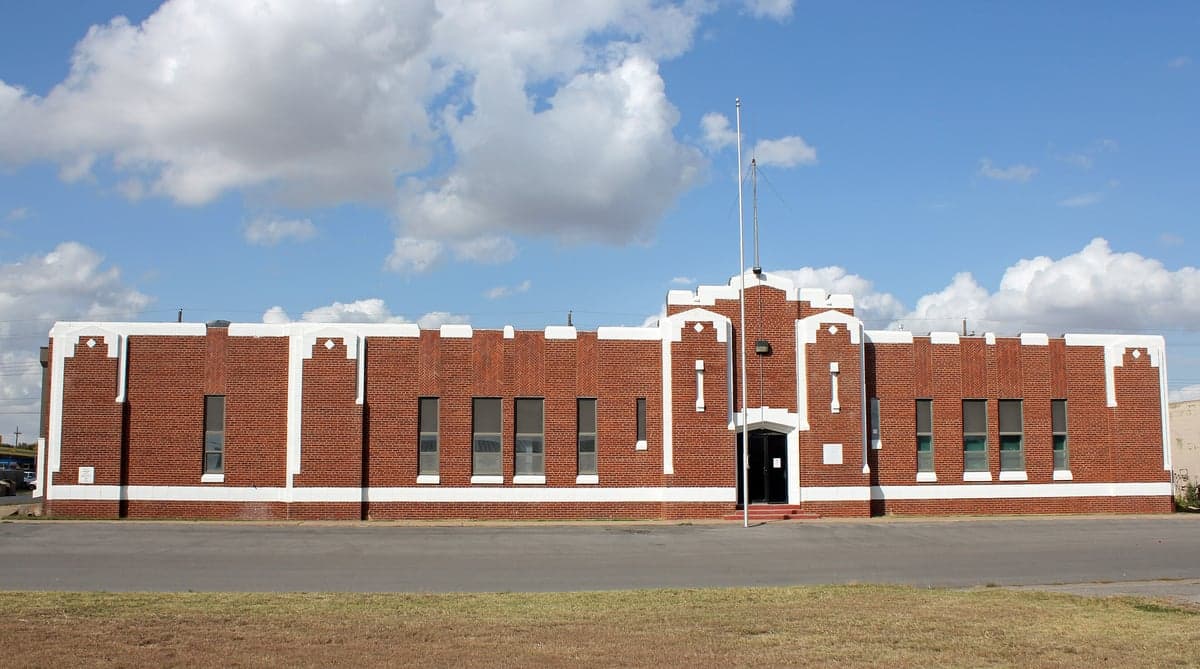
Photo: Wikipedia
Political ClimatePolitical Climate in Custer County
Showing district-level results — no local-only data available.
Local Political AnalysisPolitical Analysis of Custer County
Custer County, Oklahoma, is a reliably Republican stronghold with a Cook PVI of R+23, making it significantly more conservative than the state of Oklahoma as a whole, which sits at R+18. This isn't just a number; it reflects a deep-rooted cultural and political identity that has held steady for decades, with little sign of shifting. The county's politics are driven by a mix of agricultural interests, energy sector employment, and a strong evangelical Christian presence, creating a cohesive conservative bloc that dominates local elections.
How it compares
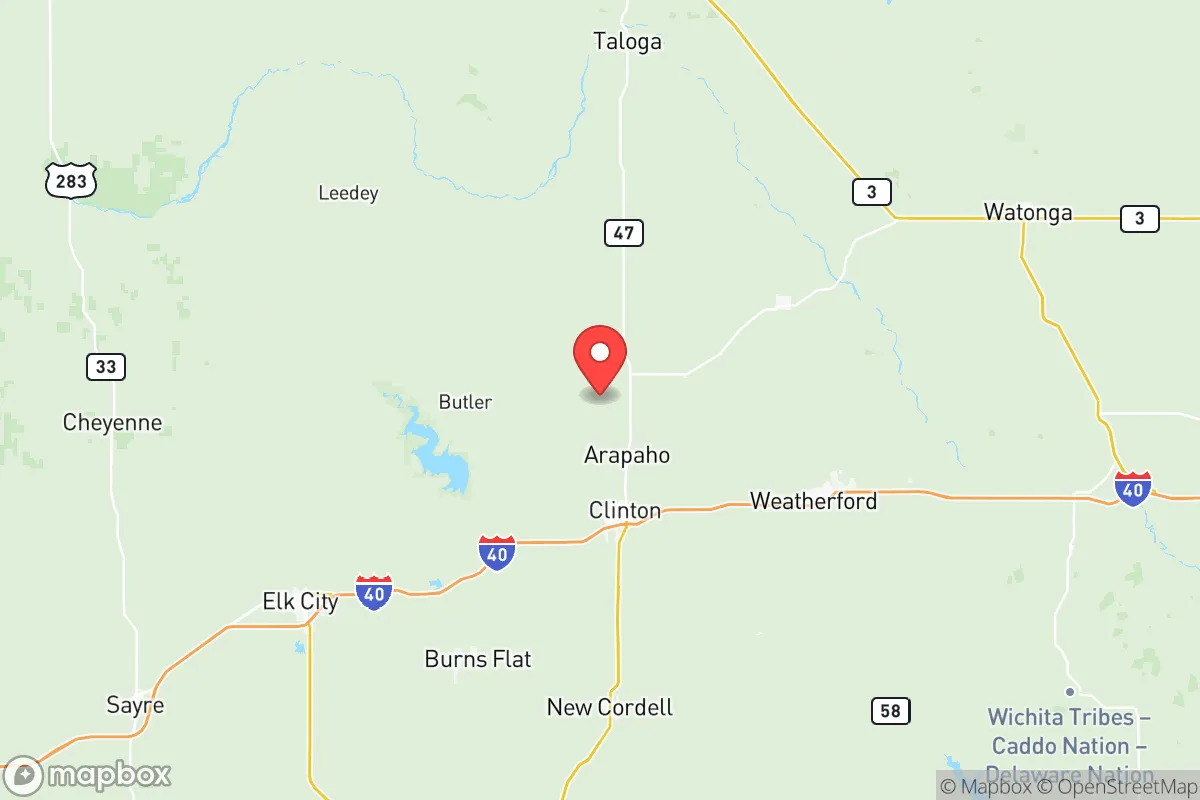
The five-point gap between Custer County (R+23) and Oklahoma's statewide R+18 is substantial in practical terms. In the 2024 presidential election, for example, Custer County likely delivered margins of 70-75% for the Republican candidate, while the state as a whole hovered around 65%. This difference is most visible in the county's rural precincts, particularly around Butler and Hammon, where Republican turnout regularly exceeds 80%. The county seat, Arapaho, mirrors this trend, though its small population means its impact is muted. The only real political variation comes from Weatherford, home to Southwestern Oklahoma State University. Here, you'll find a handful of precincts that lean slightly more moderate, occasionally dipping into the 60-65% Republican range, driven by faculty and younger voters. Still, even these areas are far from competitive for Democrats. The county's trajectory is stable—there's no suburbanization or influx of out-of-state transplants that might shift the balance, unlike parts of the Oklahoma City metro.
What this means for residents
For conservative residents, the political climate is a comfortable fit. Local policies reflect their values: the county commission is reliably Republican, school board meetings rarely feature contentious debates over curriculum, and tax rates remain low. Gun rights are broadly supported, and the county sheriff's office is known for a pro-Second Amendment stance. For liberal residents, life here requires a degree of accommodation. While they aren't ostracized, they'll find few like-minded neighbors in public office or community leadership. Social issues like abortion or LGBTQ+ rights are non-starters in local discourse, and progressive candidates rarely appear on the ballot. The practical effect is that political conversations are often avoided in mixed company, and those with dissenting views tend to keep them private or engage through online communities rather than local activism.
Culturally, Custer County's politics are intertwined with its identity as part of the "Bible Belt" and the "Oil Patch." The county's strong support for the energy industry means that environmental regulations are viewed skeptically, and the local economy's reliance on agriculture and oil production reinforces a libertarian-leaning conservatism. There's a palpable sense of self-reliance, with residents often expressing distrust of federal intervention, whether in land management or education. This isn't a place of political drama; it's a place where the political reality is as steady as the plains wind, and most folks are just fine with that. For anyone moving here, understanding that this is a deeply conservative community where change comes slowly—if at all—is key to settling in comfortably.

State Political ClimatePolitical Climate in Oklahoma
State Political AnalysisPolitical Environment in the State
Oklahoma is one of the most reliably Republican states in the country, with a Cook Partisan Voting Index of R+18, meaning it votes about 18 points more Republican than the national average in presidential elections. The dominant coalition is a blend of rural conservatives, evangelical Christians, and energy-sector workers, with Democrats largely confined to a few urban pockets and the state’s historically Black and Native communities. Over the past 20 years, the state has shifted sharply rightward — in 2004, George W. Bush won it by 31 points, but by 2020, Donald Trump carried it by 33 points, and the state legislature has become a supermajority Republican body since 2010, with no signs of a Democratic comeback.
Urban vs. rural divide
The political map of Oklahoma is a study in stark contrasts. The two major metros — Oklahoma City and Tulsa — are the only places where Democrats can compete. Oklahoma County (Oklahoma City) has trended purple in recent cycles: Joe Biden won 48% of the vote there in 2020, up from Hillary Clinton’s 44% in 2016. Tulsa County is more conservative but still has a Democratic-leaning core in the city of Tulsa itself, where the Greenwood District and midtown neighborhoods reliably vote blue. Outside these two islands, the state is deeply red. Norman, home to the University of Oklahoma, is a notable blue dot within Cleveland County, but the county as a whole still leans Republican. Stillwater (Oklahoma State) and Edmond (a wealthy Oklahoma City suburb) are reliably conservative, with Edmond voting about 60% Republican in recent cycles. The rural panhandle counties like Texas County and Beaver County routinely vote 85%+ Republican. The only other Democratic-leaning areas are the tribal nations — particularly Cherokee County (Tahlequah) and Adair County — where Native voters and a small progressive base push the needle left, though these counties still vote Republican in statewide races.
Policy environment
Oklahoma’s policy environment is aggressively conservative across the board. The state has a flat income tax of 4.75% (down from 5% in 2022, with further cuts planned), no estate tax, and a relatively low property tax burden thanks to a constitutional cap. Sales taxes are high, often exceeding 10% in cities like Oklahoma City and Tulsa when local levies are added. The regulatory posture is business-friendly, with few zoning restrictions outside major metros and a right-to-work law that limits union power. Education policy is a flashpoint: the state has a robust school voucher program (the Oklahoma Parental Choice Tax Credit Act, passed in 2023) that provides up to $7,500 per student for private school tuition, and it has one of the most permissive charter school laws in the region. Healthcare is a mixed bag — Oklahoma expanded Medicaid under the Affordable Care Act via a 2020 ballot initiative (State Question 802), but the state has some of the strictest abortion laws in the nation, banning the procedure at fertilization with no exceptions for rape or incest (SB 612, 2022). Election laws are restrictive: voter ID is required, absentee ballot drop boxes are banned, and early voting is limited to a few days. The state also has a “stand your ground” self-defense law and permitless carry for firearms (SB 1080, 2019).
Recent policy direction
Over the past five years, Oklahoma has moved decisively toward a maximalist conservative agenda. On gun rights, the state passed constitutional carry in 2019 and in 2024 enacted a law (HB 4156) prohibiting local governments from enforcing federal gun regulations, effectively creating a state-level nullification posture. On education, the 2023 voucher law was followed by a 2024 bill (SB 1234) requiring all public schools to display the Ten Commandments and teach the Bible as a historical text — a move that is already facing legal challenges. On bodily autonomy, the state’s near-total abortion ban (SB 612) has no exceptions for rape or incest, and a 2024 law (HB 1017) criminalizes transporting a minor across state lines for an abortion. On parental rights, the state passed the “Parents’ Bill of Rights” (HB 1440) in 2022, requiring schools to notify parents of any changes to a student’s health or well-being. On property rights, Oklahoma has a strong eminent domain protection law (HB 2833, 2021) that limits the use of eminent domain for private economic development. On voting, the state passed a 2021 law (SB 440) that shortened the absentee ballot request window and required notarization for absentee ballots — a move that was challenged in court but upheld. On privacy and surveillance, the state has no comprehensive data privacy law, but it did pass a 2023 bill (HB 2960) banning the use of facial recognition technology by law enforcement without a warrant. On speech, the state has a 2023 law (SB 1147) that prohibits “critical race theory” in public schools and universities, though enforcement has been uneven.
Civil unrest & political movements
Oklahoma has seen its share of political flashpoints. The 2020 racial justice protests in Tulsa — the site of the 1921 Tulsa Race Massacre — were among the largest in the state’s history, with thousands marching in the Greenwood District. The protests were met with a heavy police presence and some property damage, but no widespread violence. On the right, the “Oklahoma Freedom Caucus” has become a powerful force in the state legislature, pushing for further tax cuts, school choice expansion, and anti-LGBTQ legislation. The state has also been a battleground for election integrity: in 2022, the Oklahoma State Election Board investigated and debunked claims of widespread voter fraud, but the issue remains a rallying cry for conservative activists. Immigration politics are less heated than in border states, but in 2024, the legislature passed a bill (HB 4156) requiring local law enforcement to cooperate with federal immigration authorities, and some counties — particularly Texas County in the panhandle, which has a large Hispanic population — have seen tensions over immigration enforcement. There is no serious secessionist movement in Oklahoma, though some rural counties have passed symbolic “Second Amendment sanctuary” resolutions. A new resident would notice the prevalence of political signage (especially in rural areas) and the active presence of church-based political organizing, particularly around abortion and school choice.
Projection
Over the next 5-10 years, Oklahoma is likely to become even more Republican, but the nature of that conservatism may shift. The state is experiencing modest in-migration from California and Texas, driven by lower housing costs and a business-friendly climate — but these newcomers tend to be conservative-leaning themselves, not liberals seeking a blue haven. The urban cores of Oklahoma City and Tulsa will continue to trend left, but the suburbs — Edmond, Broken Arrow, Owasso — are solidifying as Republican strongholds. The biggest wildcard is the tribal nations: the Cherokee, Choctaw, and Chickasaw nations are increasingly asserting political and economic power, and their voters are more Democratic-leaning than the state average. If tribal turnout increases, it could shift a few state legislative seats in eastern Oklahoma. But the overall trajectory is clear: further tax cuts, continued school choice expansion, and a hardening of the state’s social conservative policies. A relocator moving in now should expect a state that is deeply Republican, with a policy environment that rewards conservative values and offers little room for progressive alternatives.
For a new resident, the bottom line is this: Oklahoma is a place where conservative policies are the norm, not the exception. If you align with that, you’ll find low taxes, strong gun rights, and a government that prioritizes parental control and religious freedom. If you don’t, you’ll face a political environment that is actively hostile to your views — with limited access to abortion, a school system that is being reshaped by vouchers and religious instruction, and a legislature that is unlikely to moderate anytime soon. The state is stable, affordable, and politically predictable, but it offers little in the way of political diversity or compromise. Choose accordingly.
* Values derived from national, state, county, city and local statistics and may differ in a specific area. Last updated: 2026-07-26T06:22:10.000Z
Narrative content on this page is AI-generated and may contain mistakes. Verify any details that matter before acting on them.
ReloMaps may earn a commission from affiliate links at no extra cost to you.

