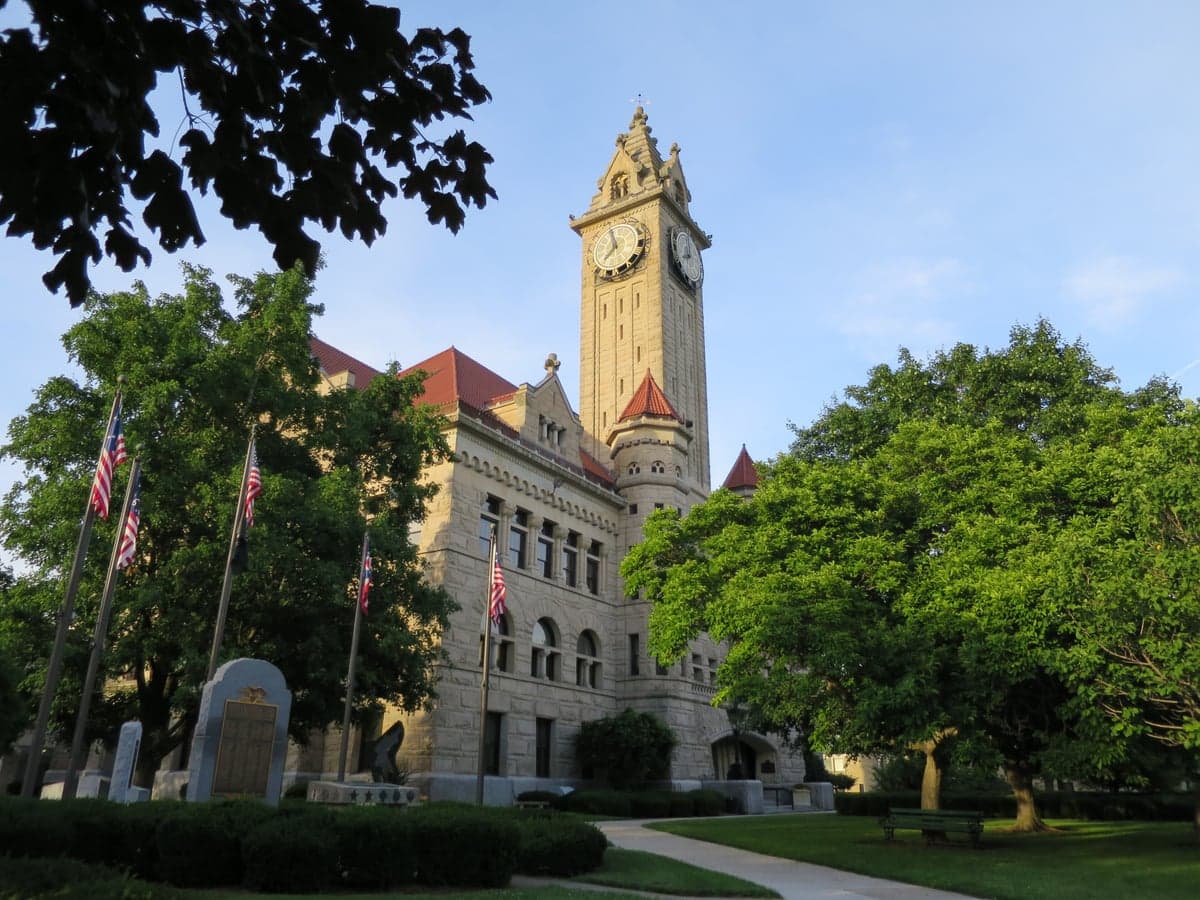
Photo: Wikipedia
Political ClimatePolitical Climate in Wood County
Showing district-level results — no local-only data available.
Local Political AnalysisPolitical Analysis of Wood County
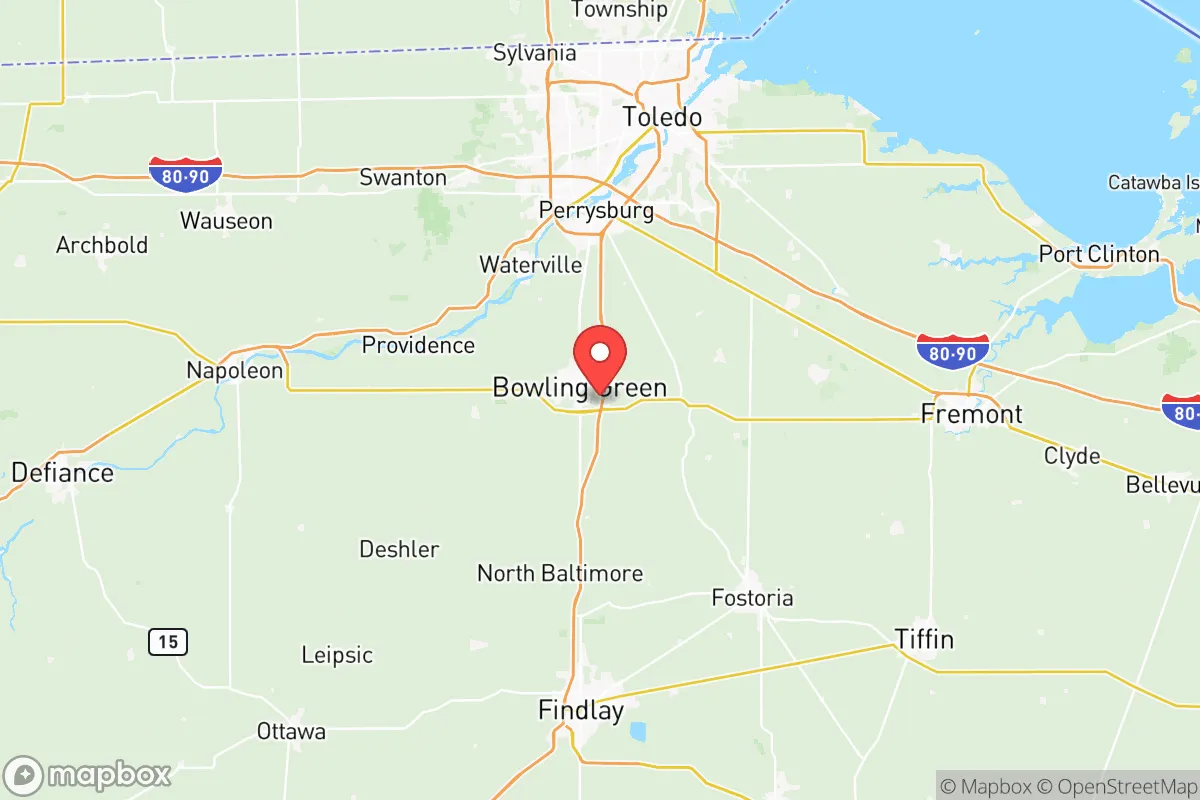
If you've been around Wood County long enough, you've watched the political ground shift under your feet, but not as dramatically as in some parts of Ohio. The county posts a Cook PVI of R+14, meaning it votes about 14 points more Republican than the national average. That’s a solid red tilt, but it’s not a monolith by any means. **Bowling Green**, home to Bowling Green State University, consistently delivers Democratic margins — precincts around campus often go 60-70% blue. Meanwhile, **Perrysburg** and **Rossford** are classic swing territory; these suburbs have trended right over the past decade but still elect Democrats to local office now and then. The rural towns — **Pemberville**, **North Baltimore**, **Bloomdale** — lean hard red, often pushing 70-75% Republican. The overall trajectory, if you look back to the 2000s, is a slow steady drift rightward, but the presence of a major university keeps Wood County more purple than its PVI suggests.
How it compares
Compared to Ohio as a whole (PVI R+5), Wood County is roughly 9 points more Republican — a meaningful difference that shows up in election results year after year. In 2024, the county gave about 58% to the Republican presidential candidate, while the state hovered around 53%. That gap is mostly driven by the rural and exurban precincts. **Perrysburg Township** and **Lake Township** are where the real action is: these are fast-growing, tax-sensitive areas that flipped from purple to reliably red around 2016. **Bowling Green** remains the clear outlier, a Democratic island surrounded by red geography. For a state like Ohio, which is already right-of-center, Wood County lands squarely in the "more conservative than average" column, but it's not nearly as deep red as neighboring **Hancock County** (R+26) or **Henry County** (R+22). It sits right in the middle of northwest Ohio's political spectrum — red enough to feel safe for most Republicans, but with enough blue pockets to keep local Democrats active and organized.
What this means for residents
For conservative residents, life in Wood County generally feels politically comfortable. County commissioner seats, the sheriff's office, and most township boards are held by Republicans. Tax levies and local zoning measures tend to reflect a pro-business, low-regulation bent. Liberal residents, especially in Bowling Green, find a robust community with campus-based activism, progressive city council members, and a lively arts scene. But outside that bubble, a progressive can feel like an outsider — bumper stickers and yard signs can draw quiet friction, and school board races in rural towns often turn on culture-war issues. For everyday life, the political lean means that public discourse in most of the county leans center-right, and local government moves cautiously on anything that could raise taxes or increase regulation. The practical effect: both conservatives and liberals can find their niche, but they'll need to know which towns to live in to feel fully at home.
Culturally, the county wears its rural-agricultural heritage on its sleeve except in the Bowling Green bubble. **Wood County** is where strong local feelings about property rights, hunting, and school funding mix with a pragmatic streak — people here take pride in self-sufficiency and tend to distrust top-down solutions from Columbus or Washington. That's why you'll see a mix of "No on Issue 1" and "Support our Schools" signs on the same front lawn. The real dividing line isn't Democrat vs. Republican as much as it is "don't tell me what to do" vs. "let's solve this together." Over the next decade, the growth of Perrysburg and the expansion of solar farms in the rural townships will likely sharpen those divides — but the county's political culture will remain deeply rooted in local control, no matter which party happens to hold the majority.

State Political ClimatePolitical Climate in Ohio
State Political AnalysisPolitical Environment in the State
Ohio has shifted from a quintessential swing state to a solidly Republican-leaning one, carrying a Cook Partisan Voting Index of R+5. Over the past 20 years, the state has moved from narrowly backing George W. Bush in 2004 to consistently voting for Donald Trump by margins of 8 to 10 points in 2016, 2020, and 2024. This rightward drift is driven by a collapse of Democratic support in rural and exurban areas, particularly in the southeastern Appalachian counties and the northwestern farm belt, while the three major metropolitan hubs—Cleveland, Columbus, and Cincinnati—remain Democratic strongholds but have lost enough working-class white voters to tip the statewide balance.
Urban vs. rural divide
The political map of Ohio is a textbook study in the urban-rural chasm. The I-71 corridor connecting Cincinnati, Columbus, and Cleveland is the Democratic spine, with Franklin County (Columbus) delivering over 60% of its vote to Democrats and Cuyahoga County (Cleveland) pushing 65%+. Hamilton County (Cincinnati) has trended blue in recent cycles, flipping from red to purple to light blue as the city’s core gentrifies. Meanwhile, the rural southeast—counties like Meigs, Vinton, and Monroe—routinely vote 75-80% Republican, driven by cultural conservatism and economic anxiety over coal and manufacturing decline. The northwest (Mercer, Auglaize, Van Wert) is equally red, anchored by deep Catholic and agrarian roots. A notable suburban shift: Delaware County (north of Columbus) was once a GOP fortress but is now trending purple as young families and professionals move in, while Warren County (north of Cincinnati) remains deeply red, a stronghold of the Tea Party and evangelical voters.
Policy environment
Ohio’s policy landscape reflects its R+5 lean, but with notable moderation on certain economic and social issues. The state has a flat income tax of 3.5% (as of 2025, down from 4.99% in 2020), with a phase-out to 2.75% by 2027, making it competitive for high earners. Sales tax is 5.75% state-level, with local add-ons pushing it to 7-8% in cities. Property taxes are moderate, averaging about 1.5% of assessed value, though school levies vary wildly. Right-to-work was repealed by voters in 2011, but the state remains a low-union-density state outside of the auto and steel sectors. Education policy is a flashpoint: the state funds private school vouchers (EdChoice) heavily, with over 100,000 students using them in 2024, while public school funding has been ruled unconstitutional four times by the Ohio Supreme Court. Election laws are moderately restrictive: voter ID is required (photo ID only, no student IDs accepted), early voting is 28 days, and drop boxes are limited to one per county. No-excuse absentee voting is allowed.
Recent policy direction
The last five years have seen a sharp conservative turn on several fronts. Gun law: In 2022, Ohio passed constitutional carry (HB 227), allowing permitless concealed carry for adults 21 and older. Stand-your-ground is already law. Abortion: In 2023, voters passed Issue 1, enshrining abortion rights up to fetal viability in the state constitution, overriding a 2019 heartbeat bill. This was a major defeat for the GOP supermajority, which has since tried to chip away via regulation (e.g., 24-hour waiting periods, ultrasound requirements). Parental rights: The Parents Bill of Rights (HB 8, 2023) requires schools to notify parents of any health or mental health services sought by a minor, and bans instruction on sexual orientation and gender identity in K-3. Transgender care: In 2024, Ohio banned gender-affirming care for minors (HB 68), overriding a governor veto. Property rights: The state has strong eminent domain protections, but oil and gas leasing (fracking) is aggressively permitted, with surface owners having limited say. Surveillance: No statewide ban on facial recognition or license plate readers; local police use them widely. Voting access: In 2023, the GOP passed SB 92, tightening voter ID rules and shortening the cure period for absentee ballots, though early voting hours were expanded slightly.
Civil unrest & political movements
Ohio has seen its share of political flashpoints. The 2020 George Floyd protests in Columbus and Cincinnati were large but largely peaceful, though looting in Columbus led to a heavy National Guard presence. The 2023 Issue 1 abortion vote saw massive grassroots organizing on both sides, with over 700,000 signatures collected for the ballot initiative. Immigration politics are less heated than in border states, but the 2024 Springfield, Ohio controversy—where Haitian migrants were falsely accused of eating pets—became a national story, stoking local tensions. Election integrity remains a live issue: the 2020 and 2022 elections saw Trump-aligned activists challenging results in counties like Stark and Butler, though no widespread fraud was found. Secession/nullification rhetoric is minimal, but there is a small "State of Jefferson" movement in the southeast. The Ohio Liberty Coalition (right) and ProgressOhio (left) are active, with the former pushing school board takeovers and the latter focusing on voting rights.
Projection
Over the next 5-10 years, Ohio will likely remain R+5 to R+7, but the margin could narrow as Columbus continues to grow (adding 50,000+ residents per year) and Cincinnati gentrifies. The suburban shift in Delaware and Licking counties may accelerate, while rural areas continue to depopulate. The 2026 gubernatorial race will be a bellwether: if a moderate Republican wins, expect incremental policy changes; if a hardliner wins, expect further restrictions on abortion (via regulation) and expanded school choice. Demographic trends favor Democrats in the long run—younger voters are more liberal, and the state is diversifying slowly—but the GOP’s structural advantage in the legislature (gerrymandered maps) and the rural tilt of the state will keep it red for at least another decade. A new resident moving in now should expect a state that is culturally conservative in rural areas, purple in the suburbs, and blue in the cities, with policy battles fought mainly over education, abortion, and voting access.
For a new resident, the bottom line is this: Ohio offers a low-tax, moderate-regulation environment with strong gun rights and a growing school choice system, but you’ll need to navigate a patchwork of local cultures. If you’re conservative, you’ll feel at home in most of the state outside the urban cores. If you’re liberal, you’ll find your community in the cities and inner suburbs, but you’ll face a state government that is consistently hostile to your priorities. The political climate is stable but polarized, with no signs of a dramatic flip in either direction—just a slow, grinding contest between a shrinking rural base and a growing urban one.
* Values derived from national, state, county, city and local statistics and may differ in a specific area. Last updated: 2026-06-16T00:06:46.000Z
Narrative content on this page is AI-generated and may contain mistakes. Verify any details that matter before acting on them.
ReloMaps may earn a commission from affiliate links at no extra cost to you.

