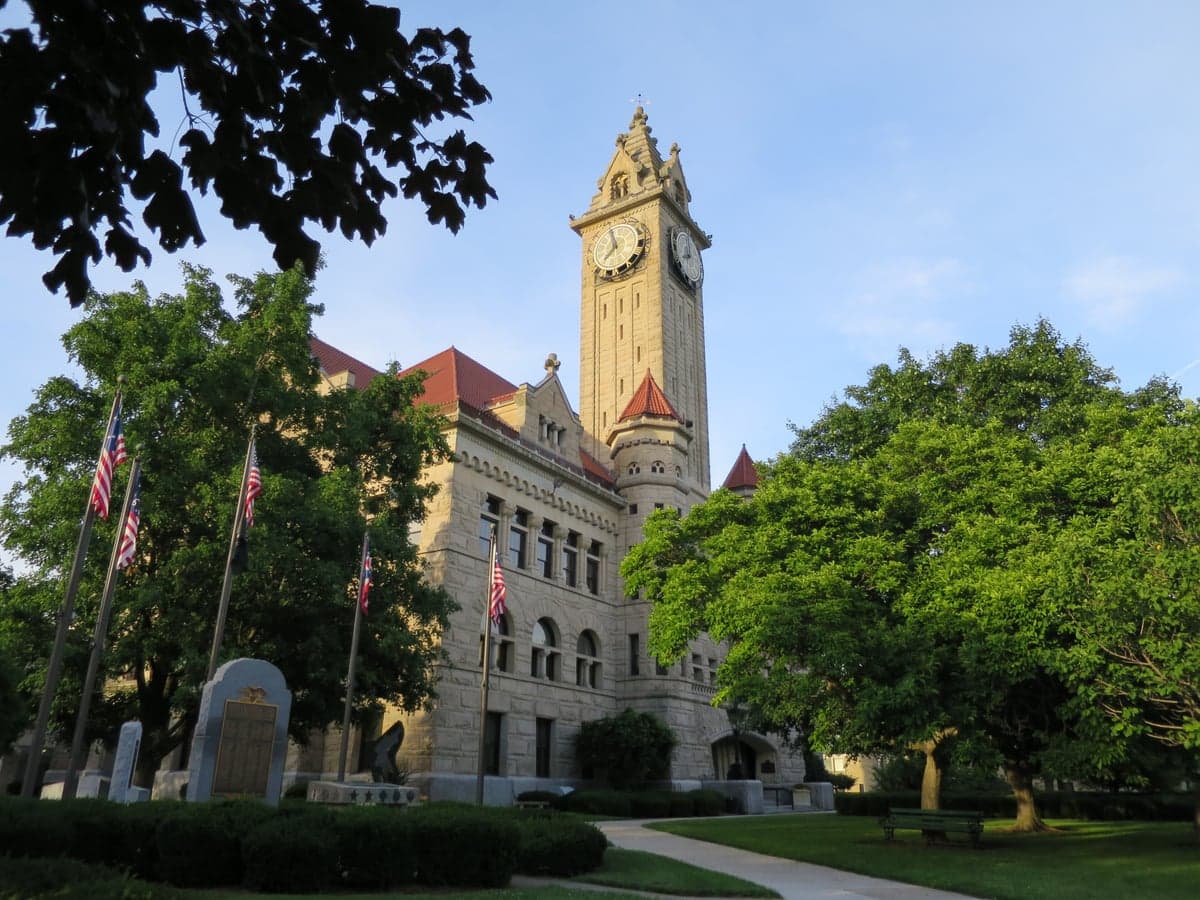
Photo: Wikipedia
Demographics of Wood County
Affluence Level in Wood County
A middle-class area roughly in line with national averages across income, home values, education, and employment.
People of Wood County
Wood County's population today is predominantly white, native-born, and rooted in a Midwestern agricultural tradition, with a distinctive character shaped by Bowling Green State University and a suburban corridor along the Maumee River. With 131,795 residents, the county remains moderately dense, blending rural townships with growing suburbs like Perrysburg and Rossford. Its identity is largely defined by a stable, family-oriented culture, a low foreign-born share of 1.5%, and a college-educated rate of 37.4% — a figure lifted significantly by the university presence in Bowling Green. The area maintains a slightly conservative tilt in its rural precincts, while the university and suburban hubs introduce a moderate, pragmatic counterbalance.
Settlement & growth (pre-1960)
Before American settlement, Wood County was part of the Great Black Swamp, a vast wetlands region inhabited by the Miami, Ottawa, and Wyandot nations. French traders and Jesuit missionaries passed through along the Maumee River as early as the 1600s, but no permanent European colonies took hold. The area was ceded to the United States in the Treaty of Greenville (1795) and later became part of the Connecticut Western Reserve, a land grant that drew New England settlers after the War of 1812.
The first major American wave arrived in the 1820s-1840s, primarily from New York, Massachusetts, and Connecticut. These Yankees sought fertile farmland once the Black Swamp was drained through a series of ditches and tile systems. They founded the county seat of Bowling Green (originally called "Portage" or "Gilead") and smaller hamlets like Perrysburg, which served as an early port on the Maumee River. Perrysburg's location made it a natural hub for trade and milling, and many of its early homes and churches still reflect that New England architectural influence.
German immigrants formed the next substantial wave, arriving from the 1840s through the 1880s. They were drawn by affordable land and the expanding railroad network, settling heavily in Pemberville, Weston, and Haskins — towns where German remained a spoken language in churches and schools well into the early 1900s. These families established dairy farms, grain operations, and small businesses, and their descendants remain a visible presence in the county's rural townships today.
A smaller but significant wave of Polish and Hungarian immigrants arrived between 1890 and 1910, pulled by jobs in the growing glass and manufacturing industries along the Maumee River. They concentrated in Rossford and Northwood, where the Libbey-Owens-Ford glass works offered steady industrial employment. Catholic parishes in Rossford still host annual Polish and Hungarian festivals that trace directly to these founding families. Meanwhile, the town of Bowling Green grew steadily as the educational and commercial center, with the establishment of Bowling Green State University in 1910 (then a normal school) anchoring a middle-class professional class that was distinct from the surrounding farm economy.
Through the mid-20th century, the county's population remained overwhelmingly white, native-born, and rural-to-small-town in character. The Great Migration of African Americans from the South largely bypassed Wood County — Black residents never exceeded 2% of the population, concentrated in a few dozen families in Bowling Green and Perrysburg. The Dust Bowl and Okie migration of the 1930s also had minimal impact. By 1960, Wood County had stabilized at roughly 89,000 people, a slow-growing agricultural and educational community with a homogeneous demographic profile.
Modern era (post-1965)
The 1965 Hart-Cellar Act had a muted effect on Wood County compared to urban Ohio or the Sun Belt. The foreign-born share today stands at just 1.5%, among the lowest in Ohio's metropolitan counties. However, modest diversification has occurred through two channels: immigration tied to Bowling Green State University and Hispanic labor migration into agriculture and manufacturing.
The most visible demographic shift since the 1970s has been the growth of the Hispanic population, now at 6.4%. This wave began in the 1980s and 1990s as Mexican and Central American workers arrived for seasonal agricultural work in the county's tomato, corn, and soybean fields, as well as for factory jobs in Perrysburg and Rossford. Many of these families settled permanently, forming small but established clusters in Bowling Green — particularly on the city's south side — and in the older industrial neighborhoods of Rossford and Northwood. Evangelical and Catholic churches in these communities now offer Spanish-language services, and Hispanic-owned businesses have appeared along Main Street in Rossford and East Wooster Street in Bowling Green.
East and Southeast Asian communities (1.0%) and Indian-subcontinent residents (1.0%) arrived primarily after 1990, overwhelmingly through the university. Bowling Green State University's international programs recruited students and faculty from China, South Korea, Vietnam, and India, and many of these individuals stayed after graduation for employment at nearby hospitals, tech firms, and the university itself. These populations are highly concentrated in Bowling Green, with smaller numbers in Perrysbury and Rossford. No distinct ethnic enclaves formed, but the university area around East Wooster Street and North Enterprise Street has a visible international student presence that shapes the local restaurant and retail scene.
Domestic migration since 1965 has been shaped by suburban spillover from Toledo and by the expansion of the I-75 corridor. Perrysburg has transformed from a small river town into the county's primary bedroom community, attracting professionals and families seeking newer housing, better schools, and a lower tax burden than Lucas County. Rossford has seen similar, if more modest, growth. Meanwhile, the rural townships — Grand Rapids, Haskins, Tontogany, and Luckey — have seen only slow growth or slight population declines as younger residents move toward the corridor. The African American share remains low at 1.9%, with most black residents living in Bowling Green or Perrysburg.
The future
Wood County is likely to continue slow, steady diversification over the next two decades, but its demographic character will remain predominantly white and native-born for the foreseeable future. The Hispanic population, growing at roughly 1% per decade, is the primary engine of change; it is projected to reach 8-10% of the county by 2040, with most growth occurring in the I-75 corridor from Perrysburg north to Rossford, rather than in the rural townships. The foreign-born share may edge above 2% as university-linked immigration continues, but Wood County lacks the job base in technology or logistics that drives larger immigrant inflows in Franklin or Hamilton counties.
The most consequential demographic trend may be the aging of the rural population alongside the continued growth of the suburban corridor. Towns like Grand Rapids and Weston are seeing their median age rise as younger adults leave for college towns and cities, while Perrysburg and Rossford attract families with school-age children. This split — younger and slightly more diverse along the corridor, older and overwhelmingly white in the townships — will likely deepen. Bowling Green will remain the exception: a relatively young, educated, moderately diverse college town that anchors the county's cultural and economic life.
For the conservative-leaning families and individuals who form the target audience for relocation, this trajectory means Wood County will remain a stable, predictable environment. The pace of change is slow enough to preserve the county's agricultural character and small-town values, while the growth of Perrysburg and Bowling Green provides access to modern amenities, good schools, and a modest but growing diversity of neighbors. The county is not becoming cosmopolitan or highly diverse; it is becoming a slightly more varied version of what it has always been — a safe, family-oriented piece of the Midwest with a university mind and a farming heart.

* Values derived from national, state, county, city and local statistics and may differ in a specific area. Last updated: 2026-06-16T00:06:46.000Z
Narrative content on this page is AI-generated and may contain mistakes. Verify any details that matter before acting on them.
ReloMaps may earn a commission from affiliate links at no extra cost to you.

