
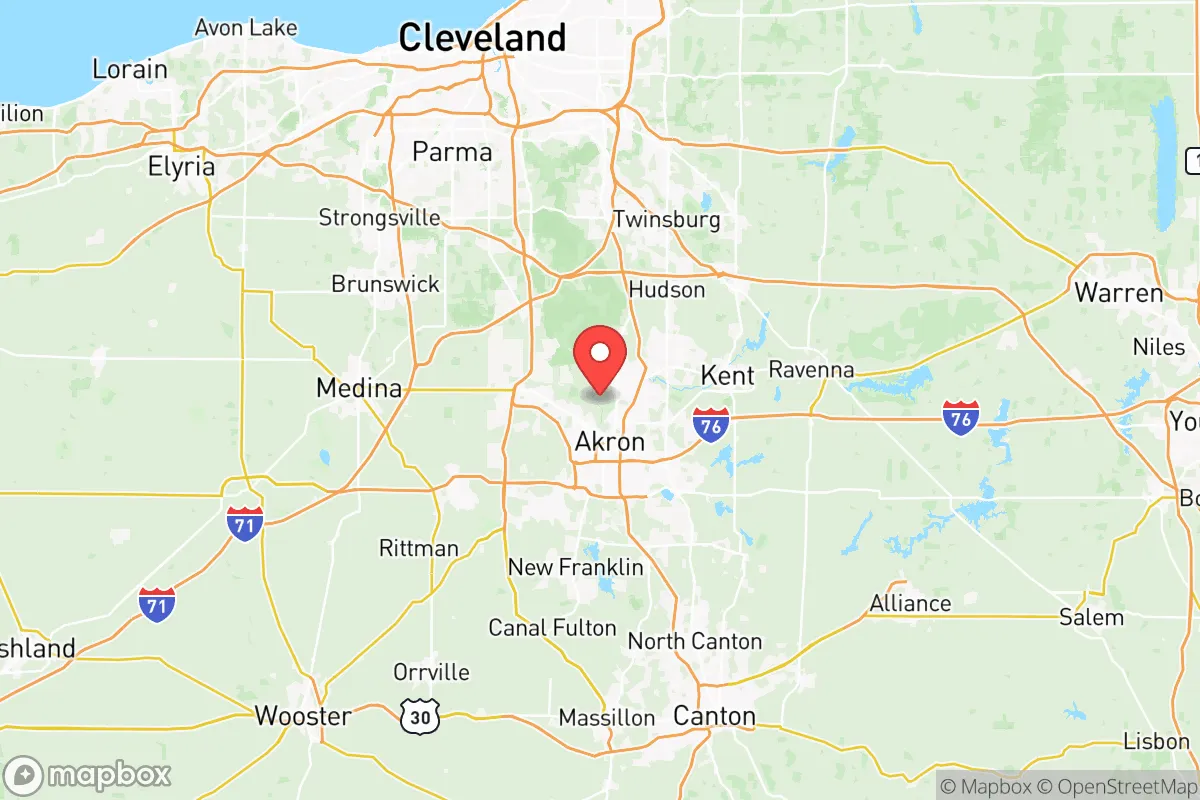
Photo: Wikipedia
Political ClimatePolitical Climate in Summit County
Showing district-level results — no local-only data available.
Local Political AnalysisPolitical Analysis of Summit County
Summit County, Ohio, sits as a genuine political battleground in a state that has shifted decisively red in recent cycles. With a Cook Partisan Voting Index (PVI) of EVEN, the county is perfectly balanced between Democratic and Republican performance, a stark contrast to Ohio’s statewide PVI of R+5. This means that while Ohio as a whole leans reliably Republican in statewide races, Summit County remains a true swing jurisdiction—one that can flip from blue to red depending on the candidate and turnout. The county’s trajectory over the past decade has been a slow drift rightward, but it has not followed the state’s sharp red shift, making it one of the few remaining competitive counties in Ohio.
How it compares
The gap between Summit County’s EVEN PVI and Ohio’s R+5 PVI is significant. In practical terms, a Democrat running statewide needs to win Summit County by a comfortable margin to offset losses in rural and exurban areas. For example, in the 2020 presidential election, Summit County voted for Joe Biden by about 4 points, while Ohio went for Donald Trump by 8 points—a 12-point gap. This divergence is driven by the county’s urban core: Akron, the county seat, is a Democratic stronghold, consistently delivering 60-65% of its vote to Democratic candidates. However, the county’s suburbs and exurbs tell a different story. Stow, Cuyahoga Falls, and Hudson lean more moderate-to-conservative, often splitting tickets or favoring Republicans in down-ballot races. The swing precincts are concentrated in places like Green and Uniontown, where independent and suburban voters decide close races. Meanwhile, rural townships like Bath and Richfield have shifted rightward, mirroring the state’s broader trend. This internal variation means Summit County is not a monolith; it’s a microcosm of the national political divide.
What this means for residents
For conservative residents, Summit County offers a more competitive environment than deep-blue counties like Cuyahoga or Franklin. Republican candidates can win local offices—the county has a Republican sheriff and several GOP township trustees—and conservative voters can feel their votes matter in statewide races, as the county is often a target for both parties. For liberal residents, the county provides a reliable base of Democratic support in Akron and the inner-ring suburbs, but they cannot take victory for granted. The county’s EVEN PVI means that every election cycle brings intense campaigning, with both parties pouring resources into mailers, door-knocking, and local ads. This can feel exhausting, but it also means residents have genuine choices and their votes carry weight. In practice, the county’s political balance fosters a culture of negotiation and coalition-building in local government, rather than the one-party dominance seen in many Ohio counties.
One cultural distinction that sets Summit County apart from the rest of Ohio is its strong labor union presence, particularly in Akron, which has historically been a rubber and manufacturing hub. This gives the county a working-class Democratic tradition that is more moderate than the progressive activism seen in Columbus or Cleveland. On the other hand, the growing suburban and exurban population has brought more fiscal conservatism and social moderation, creating a political climate that is less polarized than the state average. For example, while Ohio has passed strict abortion restrictions and expanded gun rights, Summit County’s elected officials—especially at the county level—tend to take more pragmatic, less ideological stances. The result is a place where a Republican and a Democrat can still find common ground on issues like infrastructure, education, and economic development, even as national politics grows more divisive. If you’re moving here, expect a political environment that feels like a throwback to an earlier era of Ohio politics—competitive, grounded in local issues, and not easily caricatured.

State Political ClimatePolitical Climate in Ohio
State Political AnalysisPolitical Environment in the State
Ohio is a classic swing state that has shifted decisively rightward over the past decade, now carrying a Cook PVI of R+5. The state voted for Donald Trump by 8 points in both 2016 and 2020, and by an even wider 11 points in 2024, cementing a trajectory that began with the collapse of the old industrial coalition. The dominant coalition today is a mix of ex-urban and rural conservatives, working-class voters who have abandoned the Democratic Party over cultural and trade issues, and a shrinking but still potent base of union Democrats concentrated in the major cities. The 10-20 year arc is clear: Ohio is no longer a purple state but a solidly red one at the presidential level, even as it retains pockets of deep blue strength in its urban cores.
Urban vs. rural divide
The political map of Ohio is a textbook study in geographic polarization. The three major metros—Cleveland, Columbus, and Cincinnati—are the Democratic strongholds, with Cuyahoga County (Cleveland) delivering a 66% vote share for Biden in 2020 and Franklin County (Columbus) hitting 62%. But the rest of the state is overwhelmingly red. The rural counties of southeast Ohio, like Meigs and Vinton, routinely vote 75-80% Republican. The real story is the exurban and small-city shift: counties like Delaware (north of Columbus) and Warren (north of Cincinnati) have moved from competitive to reliably red as suburbanites have grown more conservative. The Mahoning Valley around Youngstown, once a Democratic stronghold, flipped hard for Trump in 2016 and has stayed red, driven by deindustrialization and cultural backlash. Meanwhile, Athens County, home to Ohio University, remains a tiny blue island in the southeast, voting 60% Democratic.
Policy environment
Ohio’s policy environment is broadly conservative but with notable exceptions. The state has a flat income tax rate of 3.5% as of 2025, down from a top rate of nearly 5% a decade ago, and sales tax is 5.75% plus local add-ons. Property taxes are moderate, though school levies vary wildly by district. The regulatory posture is business-friendly, with right-to-work laws not on the books (a 2011 law was repealed by referendum in 2011), but the state has a strong tort reform environment. Education policy is a battleground: the state has a robust school voucher program (EdChoice) that now covers most families, and charter schools are widespread. Healthcare is mixed—Medicaid expansion was adopted under Governor John Kasich in 2013 and remains in place, but the state has a conservative approach to abortion and transgender care. Election laws have tightened: voter ID is now required (a 2023 law), and early voting is limited to 28 days, with no-excuse absentee voting still allowed. The state also has a Republican supermajority in the legislature that has overridden numerous gubernatorial vetoes.
Recent policy direction
The last five years have seen a sharp conservative turn in Ohio law. On gun and self-defense law, the state passed permitless carry (constitutional carry) in 2022, allowing any adult who can legally possess a firearm to carry it concealed without a license. Stand-your-ground laws have been on the books since 2008. On parental and education rights, the 2023 "Parents Bill of Rights" (HB 8) requires schools to notify parents of any changes to a student’s health or well-being, and bans transgender girls from female sports. On speech, the state has no major prior restraint laws, but campus speech policies vary by university. Privacy and surveillance is a mixed bag: Ohio has no comprehensive data privacy law, but it does have a biometric privacy law (similar to Illinois’s) that has spawned class-action lawsuits. On medical and bodily autonomy, abortion is banned after six weeks (the "Heartbeat Bill" took effect in 2022 after the Dobbs decision), though a 2023 ballot initiative enshrined a right to abortion up to viability in the state constitution—a major exception to the conservative trend. Property rights are strong, with no statewide rent control and limited eminent domain abuse. Taxation is trending downward: the flat income tax is scheduled to drop to 2.75% by 2027. Voting and ballot access has tightened with the 2023 voter ID law, but early voting and absentee voting remain accessible.
Civil unrest & political movements
Ohio has seen its share of political flashpoints. The 2020 protests in Columbus and Cincinnati over George Floyd’s murder were large but largely peaceful, though there were isolated incidents of property damage. The state has a strong anti-abortion movement that holds annual rallies at the Statehouse, and the 2023 abortion rights ballot initiative saw massive turnout from both sides. Immigration politics are less visible than in border states, but the 2023 influx of Haitian migrants in Springfield became a national story after false claims about pet-eating circulated online, leading to bomb threats and a heavy police presence. Election integrity controversies have been muted compared to other swing states, though the 2020 election saw Trump’s team challenge results in Mahoning County without success. There is no serious secession or nullification movement, but the "Ohio is a red state" identity is now a point of pride for many conservatives. A new resident would notice the prevalence of Trump flags and "Let’s Go Brandon" signs in rural areas, while urban neighborhoods display Black Lives Matter and Pride flags.
Projection
Over the next 5-10 years, Ohio is likely to become even more Republican at the state level, but the 2023 abortion rights vote shows that ballot initiatives can still produce liberal outcomes. Demographic trends favor the GOP: the state’s population is aging and growing slowly, with the fastest growth in exurban counties like Delaware and Union (both deep red), while urban counties like Cuyahoga and Mahoning are losing population. In-migration is modest, but the people moving in tend to be retirees or remote workers seeking lower taxes, which reinforces the conservative tilt. The Democratic Party’s base is increasingly confined to Columbus, Cleveland, and Cincinnati, with little hope of recapturing the rural and exurban voters who have left. The wild card is the state’s growing Hispanic population, concentrated in Lorain County and parts of Columbus, which could shift the calculus if they turn out reliably. For a new resident, expect a state where state government is reliably conservative, but local politics vary wildly—you can live in a blue bubble in a city or a red one in the suburbs, and the state’s policies will reflect the rural and exurban majority.
For a relocator, the bottom line is this: Ohio offers a conservative policy environment on taxes, guns, and education, with a notable exception on abortion rights due to the 2023 ballot measure. You’ll find a strong sense of local community and relatively low cost of living, but the political divide is real and visible—your neighbors in the suburbs will likely share your values, while the cities will feel like a different country. If you’re conservative, you’ll feel at home in most of the state; if you’re liberal, you’ll want to stick to the urban cores or college towns like Athens. Either way, the state’s trajectory is clear: redder, older, and more polarized, but with enough diversity to keep things interesting.
* Values derived from national, state, county, city and local statistics and may differ in a specific area. Last updated: 2026-07-15T10:39:59.000Z
Narrative content on this page is AI-generated and may contain mistakes. Verify any details that matter before acting on them.
ReloMaps may earn a commission from affiliate links at no extra cost to you.

