
Photo: Wikipedia
Demographics of Summit County
Affluence Level in Summit County
A middle-class area roughly in line with national averages across income, home values, education, and employment.
People of Summit County
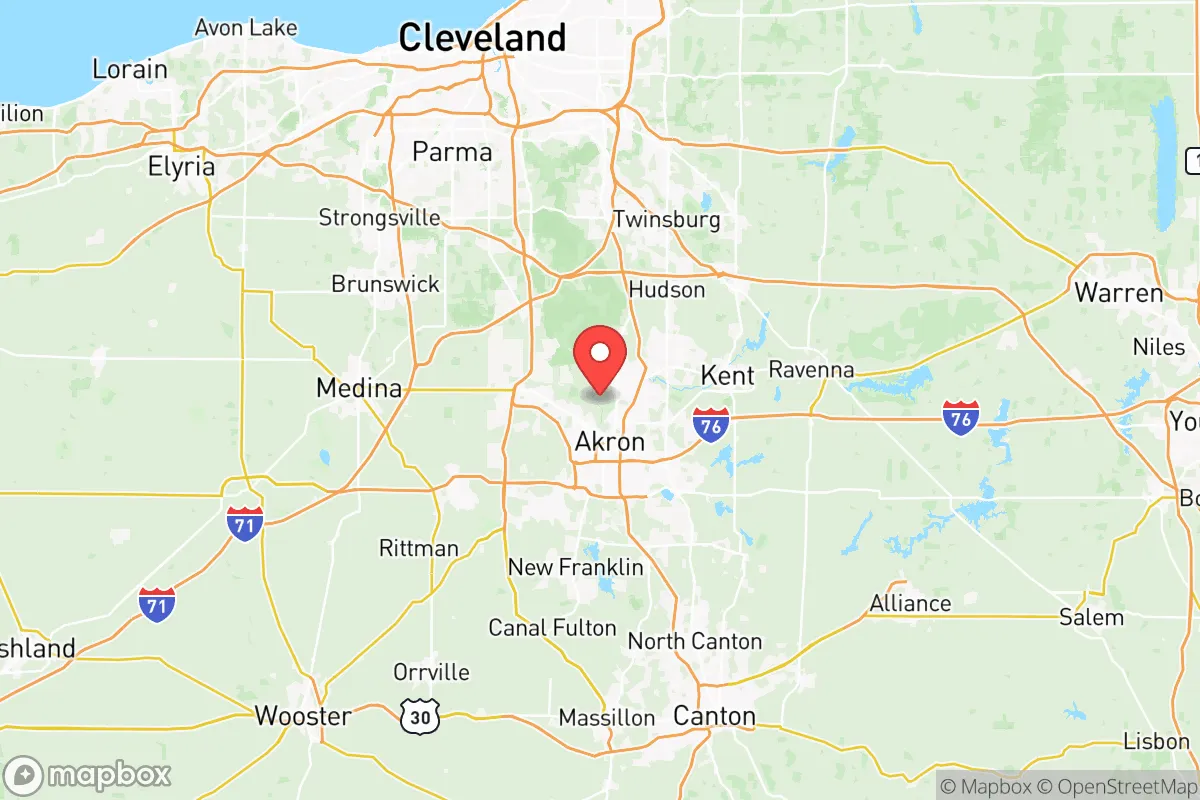
Summit County, Ohio, is a historically industrial and culturally Midwestern region of 538,087 residents, anchored by the city of Akron and characterized by a predominantly white population (74.2%) with a significant Black minority (13.8%) and small but growing Asian (2.1%) and Indian (2.0%) communities. The county’s identity is shaped by its legacy as a rubber-manufacturing powerhouse, a history of European immigration, and a more recent stabilization after decades of population decline. For a conservative-leaning audience, Summit County offers a mix of established suburban communities, modest cost of living, and a slower pace of change compared to coastal metros, though its political and demographic landscape is gradually diversifying.
Settlement & growth (pre-1960)
Before American settlement, the area now known as Summit County was inhabited by the Erie and later the Seneca and other Iroquoian peoples, who used the Cuyahoga River and Portage Path as a vital canoe portage between the Great Lakes and the Ohio River. The region was part of the Connecticut Western Reserve, and the first permanent white settlers arrived in the early 1800s, primarily from New England and New York. These Yankee settlers founded the towns of Hudson (1799), Tallmadge (1807), and Stow (1804), bringing with them Congregationalist traditions, a focus on education, and a strong sense of civic order.
The completion of the Ohio & Erie Canal in 1832 transformed the county, turning Akron into a bustling canal town and attracting a wave of Irish immigrants who dug the canal and later settled in neighborhoods like North Hill. German immigrants followed in the 1840s and 1850s, establishing farms and businesses in Barberton and Cuyahoga Falls, and their influence remains visible in local Lutheran churches and breweries. By the late 19th century, the discovery of natural gas and the rise of the rubber industry—pioneered by companies like Goodyear, Firestone, and Goodrich—drew a massive influx of European immigrants. Akron became a boomtown, and between 1880 and 1920, its population exploded from 16,000 to over 200,000. The new arrivals were overwhelmingly Southern and Eastern European: Italians, Poles, Slovaks, Slovenes, and Hungarians clustered in ethnic enclaves like Akron’s Kenmore and Ellet neighborhoods, working in rubber factories and building Catholic parishes and fraternal organizations that still anchor community life.
The Great Migration brought a significant Black population to Summit County, particularly between 1910 and 1950, as African Americans left the Jim Crow South for industrial jobs in Akron’s rubber plants. They settled primarily in Akron’s West Side and the South Akron neighborhoods, forming a vibrant community centered on churches and small businesses. By 1960, Summit County was overwhelmingly white (over 90%) but had a substantial and growing Black minority, concentrated in the city of Akron. The county’s population peaked at around 553,000 in 1960, reflecting the full maturation of its industrial economy.
Modern era (post-1965)
The 1965 Hart-Cellar Act, combined with the decline of the rubber industry in the 1970s and 1980s, reshaped Summit County’s demographics. The county’s population fell from its 1960 peak to a low of 524,000 in 1990, as manufacturing jobs disappeared and many white families moved to outlying suburbs or left the region entirely. The Black population, however, grew as a share of the total, rising from roughly 10% in 1970 to 13.8% today, as African Americans remained in Akron while white flight accelerated. Today, Akron itself is 48% white and 40% Black, making it one of Ohio’s most racially diverse cities, while the surrounding suburbs—Green, Uniontown, Bath Township—remain overwhelmingly white and more conservative.
Post-1965 immigration to Summit County has been modest compared to coastal regions, with a foreign-born population of just 2.5%. The largest new immigrant groups are East/Southeast Asian communities (2.1% of the county), including Vietnamese, Chinese, and Korean families who arrived from the 1980s onward, many drawn to professional and medical jobs at Akron Children’s Hospital and Summa Health. They have concentrated in Fairlawn and Cuyahoga Falls, where Asian-owned restaurants and small businesses have grown. The Indian subcontinent community (2.0%) is similarly small but visible, with many professionals working in healthcare, engineering, and information technology; they are dispersed across Hudson and Stow, with no single ethnic enclave but a growing cultural presence through Hindu temples and Indian grocery stores. Hispanic residents (2.6%) are a smaller but growing group, with many of Mexican and Puerto Rican heritage settling in Barberton and Akron’s North Hill, where they have revitalized older commercial corridors.
Domestic migration has been a net negative for Summit County since the 1970s, as residents moved to the Sun Belt or to Ohio’s growing Columbus and Cincinnati metros. However, the county has stabilized in the last decade, with population holding steady around 538,000. Suburbanization has been the dominant trend: families have moved from Akron to Green, Hudson, and Twinsburg, seeking better schools and lower crime rates, while the city itself has struggled with poverty and disinvestment. The county’s college-educated share (35.3%) is above the national average, driven by the presence of the University of Akron and a growing healthcare and tech sector, but the overall population is older and less mobile than the national average.
The future
Summit County’s population is projected to remain relatively flat over the next 10-20 years, with modest growth in the suburbs and continued decline in Akron’s core. The county is becoming slightly more diverse, driven by the slow growth of Hispanic, Asian, and Indian communities, but the pace is far slower than in the Sun Belt or major coastal metros. The white population is aging and declining in share, while the Black population is stable, and the foreign-born share is expected to rise slowly from its current 2.5% to perhaps 4-5% by 2040. New immigrant communities are likely to continue dispersing across the suburbs rather than forming dense ethnic enclaves, as the county lacks the economic pull to attract large-scale migration.
The cultural identity of Summit County is evolving from its blue-collar, union-heavy roots toward a more professional, service-oriented character, with healthcare and education replacing manufacturing as the dominant employers. For a conservative-leaning mover, the county offers a relatively stable, family-oriented environment with good schools in suburbs like Hudson and Green, a lower cost of living than the national average, and a slower pace of demographic change than many other parts of the country. The political landscape is mixed: Akron is reliably Democratic, but the surrounding townships and suburbs lean Republican, giving the county a purple hue in statewide elections.
Summit County is becoming a quieter, more suburban version of its industrial past—less diverse and dynamic than the fastest-growing metros, but also less expensive and less chaotic. For someone moving in now, the county offers a solid, predictable middle-American lifestyle with access to outdoor recreation along the Cuyahoga Valley National Park and a modest but stable job market, but it is not a place of rapid growth or dramatic cultural transformation. The people of Summit County are, in many ways, the people who stayed—and the new arrivals are likely to be those seeking stability rather than reinvention.

* Values derived from national, state, county, city and local statistics and may differ in a specific area. Last updated: 2026-07-15T10:39:59.000Z
Narrative content on this page is AI-generated and may contain mistakes. Verify any details that matter before acting on them.
ReloMaps may earn a commission from affiliate links at no extra cost to you.

