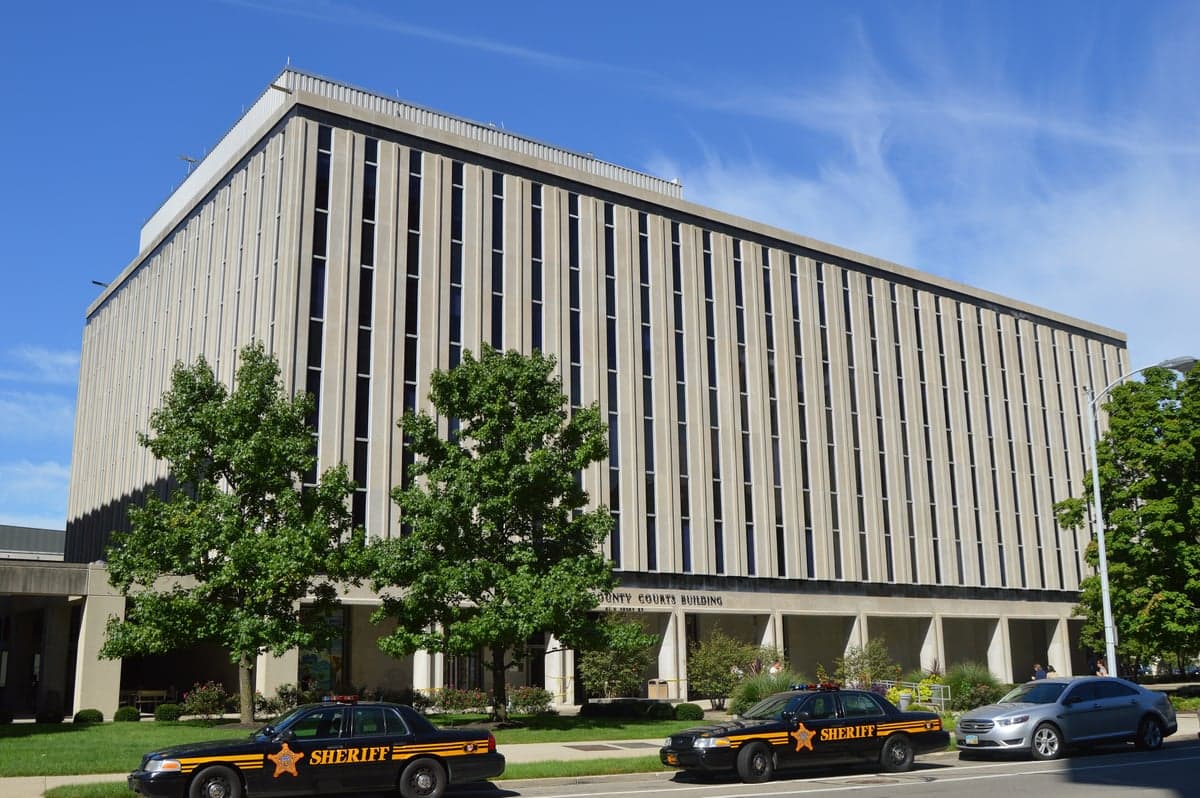
Photo: Wikipedia
Political ClimatePolitical Climate in Montgomery County
Showing district-level results — no local-only data available.
Local Political AnalysisPolitical Analysis of Montgomery County
Montgomery County, Ohio, is a classic swing county in a state that’s shifted right, but its own trajectory tells a more nuanced story. The county’s Cook Partisan Voting Index (PVI) of R+3 means it leans slightly Republican overall, but that’s a full two points more Democratic than Ohio’s statewide R+5 rating. In practice, this makes Montgomery County a genuine battleground within a redder state, where the outcome of local races often hinges on turnout in Dayton and its inner-ring suburbs versus the more conservative outer townships.
How it compares
Montgomery County’s R+3 PVI puts it to the left of Ohio’s R+5, but that gap masks deep internal divides. The city of Dayton itself is a Democratic stronghold, routinely delivering 60-70% of its vote to Democratic candidates, powered by union households, Wright-Patterson Air Force Base workers, and a significant African American population. Drive 15 minutes north to Vandalia or Englewood, and you’ll find precincts that vote 55-60% Republican, fueled by suburban homeowners and manufacturing retirees. The real action is in the swing precincts of Centerville and Washington Township in the south, where college-educated professionals and tech workers from the Dayton Innovation Hub have made these areas more competitive. In 2020, Centerville’s precincts split almost evenly, a shift from its reliably red past. Meanwhile, Miamisburg and West Carrollton lean red but with a growing Democratic minority, reflecting the county’s slow leftward drift among younger voters. Statewide, Ohio’s R+5 is driven by deep-red rural counties and exurbs, but Montgomery County’s mix of urban, suburban, and small-town voters keeps it from following that trend entirely.
What this means for residents
For conservative residents, the R+3 lean means they can still win countywide races—the county commission often has a Republican majority—but they have to work for it. Republican candidates here tend to be more moderate on social issues, focusing on economic development and infrastructure, because a hardline stance can lose the Centerville swing vote. For liberal residents, the county is a blue island in a red state: they can reliably elect Democrats to the state legislature from Dayton-based districts, but statewide races (governor, Senate) are uphill battles. The practical effect is that policy debates in Montgomery County are less polarized than in the rest of Ohio. Local issues like funding for public transit (the RTA bus system) and affordable housing get bipartisan support, while cultural flashpoints like abortion or gun rights are more muted at the county level than in Columbus or Cincinnati.
Culturally, Montgomery County stands apart from much of Ohio in its embrace of regional cooperation. The Dayton Development Coalition is a rare example of business, labor, and local government working together across party lines, largely because Wright-Patterson Air Force Base—the state’s largest single-site employer—creates a shared economic interest that transcends partisan bickering. You won’t see the same kind of county-versus-city hostility here that you do in, say, Hamilton County. The long-term trajectory suggests Montgomery County will remain a purple county, with its PVI inching toward even as Ohio reddens, because the base’s influence and the growth of the tech sector in Dayton are attracting a more diverse, college-educated population. For anyone moving here, the takeaway is simple: your vote will matter more here than almost anywhere else in Ohio, and your neighbors will expect you to care about local issues, not just national ones.

State Political ClimatePolitical Climate in Ohio
State Political AnalysisPolitical Environment in the State
Ohio is a classic swing state that has shifted decisively rightward over the past decade, now carrying a Cook Partisan Voting Index of R+5. The state voted for Donald Trump by 8 points in both 2016 and 2020, and by a wider 11-point margin in 2024, cementing a trajectory that began with the collapse of union-heavy Democratic strongholds in the Mahoning Valley and along the Lake Erie industrial belt. While the state still elects Democrats like Senator Sherrod Brown (who won in 2024 by a narrow 2 points), the legislature and statewide offices are firmly under Republican control, and the political center of gravity has moved from the old factory towns to the exurbs and small cities of southwest and central Ohio.
Urban vs. rural divide
The political map of Ohio is a textbook study in the urban-rural split. The three big C's — Cleveland, Columbus, and Cincinnati — are deep blue islands, with Cuyahoga County (Cleveland) delivering a 35-point margin for Democrats in 2024 and Franklin County (Columbus) coming in around 25 points blue. But these metros are surrounded by a sea of red that has grown redder. The real story is the collapse of Democratic margins in once-reliable blue-collar strongholds like Youngstown (Mahoning County) and Steubenville (Jefferson County), which flipped from Obama-won to Trump-won by 20+ points. Meanwhile, the fast-growing exurbs of Delaware County (north of Columbus) and Warren County (north of Cincinnati) are among the most Republican counties in the nation, routinely voting 65-70% GOP. The rural Appalachian counties in the southeast and the farm counties in the northwest are solidly red, while the only other blue pockets are college towns like Athens (home to Ohio University) and Oberlin.
Policy environment
Ohio's policy environment is broadly conservative but with some notable wrinkles. The state has a flat income tax rate of 3.5% (down from a top rate of nearly 5% a few years ago), and the legislature is actively working to phase it out entirely. Sales tax is 5.75% at the state level, with local add-ons that can push it to 8% in some cities. Property taxes are moderate but vary widely by district, and a 2023 law capped annual increases at 3.5% for homeowners. On education, Ohio has a robust school choice system: the EdChoice voucher program allows students in low-performing districts to attend private schools, and the state has one of the largest charter school sectors in the country. Higher education is dominated by Ohio State University, but the legislature has been increasingly assertive in regulating university governance, including a 2024 law banning DEI offices and mandatory diversity training at public universities. Healthcare is a mixed bag: Ohio expanded Medicaid under the Affordable Care Act, but the state also passed a 2023 law banning gender-affirming care for minors and restricting transgender athletes in school sports. Election laws have tightened: a 2023 law requires photo ID for voting, limits drop boxes to one per county, and shortens the absentee ballot application window.
Recent policy direction
The last three years have seen a flurry of legislation that signals where Ohio is headed. On gun rights, Ohio became a permitless carry state in 2022, allowing any adult who can legally possess a firearm to carry it concealed without a license. The same year, the "Stand Your Ground" law was expanded to remove the duty to retreat in any place where a person is lawfully present. On parental rights and education, the 2023 "Parents Bill of Rights" requires schools to notify parents of any changes to a student's health or well-being and bans instruction on sexual orientation and gender identity in grades K-3. On speech and privacy, a 2024 law restricts social media platforms from censoring political speech and requires age verification for adult content websites. On medical and bodily autonomy, abortion is currently legal up to 22 weeks under a 2024 court ruling, but a 2023 constitutional amendment (Issue 1) enshrined abortion rights in the state constitution with 57% of the vote, overriding the legislature's previous six-week ban. Property rights saw a boost with a 2023 law limiting eminent domain for economic development. On voting, the 2023 law also eliminated the "golden week" period where voters could register and vote on the same day, and reduced early voting days from 28 to 21.
Civil unrest & political movements
Ohio has a history of political activism that runs deep. The 2023 abortion rights amendment drew massive grassroots organizing on both sides, with over 700,000 signatures collected by the coalition supporting Issue 1. The state has also been a flashpoint for immigration politics: in 2024, the small city of Springfield became a national story when Haitian migrants were accused (without evidence) of eating pets, leading to bomb threats and a heavy police presence. The state has no sanctuary cities, and a 2024 law requires local law enforcement to cooperate with federal immigration authorities. Election integrity remains a live issue: the 2020 election in Ohio was widely considered smooth, but the 2023 law tightening voter ID and drop box rules was driven by persistent Republican concerns about fraud. On the left, the Ohio Student Association and the Ohio Organizing Collaborative have been active in pushing for criminal justice reform and voting rights. On the right, the Buckeye Firearms Association and Ohio Right to Life are major lobbying forces. The state has seen occasional protests over police shootings (Columbus in 2020) and labor disputes (the 2023 UAW strike against the Big Three automakers had a major presence in Toledo and Lordstown).
Projection
Over the next 5-10 years, Ohio is likely to continue its rightward drift, but the pace may slow. The state is losing population in the rural northeast and Appalachian southeast while gaining in the Columbus and Cincinnati suburbs, which are more moderate Republican than the deep-red rural counties. The Democratic base is increasingly concentrated in the three big metros, which are growing but not fast enough to offset rural losses. The 2024 election showed that Trump's coalition of working-class whites and rural voters is holding, but the party's challenge will be retaining suburban moderates who may be turned off by cultural wars. The abortion rights amendment's passage suggests that on some social issues, Ohio voters are more centrist than the legislature. In-migration is modest compared to Sun Belt states, but the Columbus area is attracting tech and logistics jobs, which could bring a more diverse and potentially more Democratic population. Expect continued battles over school funding (the Ohio Supreme Court has found the system unconstitutional multiple times), further tax cuts, and ongoing fights over transgender rights and abortion access at the margins.
For a new resident, the bottom line is this: Ohio is a state where conservative policies dominate at the state level, but local control means your daily experience varies dramatically by where you live. If you settle in a Columbus suburb like Dublin or Westerville, you'll find a purple environment with good schools and a mix of political views. If you choose a rural county like Mercer or Holmes, you'll be in deep red territory with low taxes and strong community ties. The state's political trajectory is rightward, but the 2023 abortion amendment showed that voters will push back on issues where they feel the legislature has gone too far. For conservatives, Ohio offers a friendly policy environment with room to grow. For liberals, the cities provide a comfortable blue bubble, but state-level politics will be an uphill battle for the foreseeable future.
* Values derived from national, state, county, city and local statistics and may differ in a specific area. Last updated: 2026-07-22T18:43:22.000Z
Narrative content on this page is AI-generated and may contain mistakes. Verify any details that matter before acting on them.
ReloMaps may earn a commission from affiliate links at no extra cost to you.

