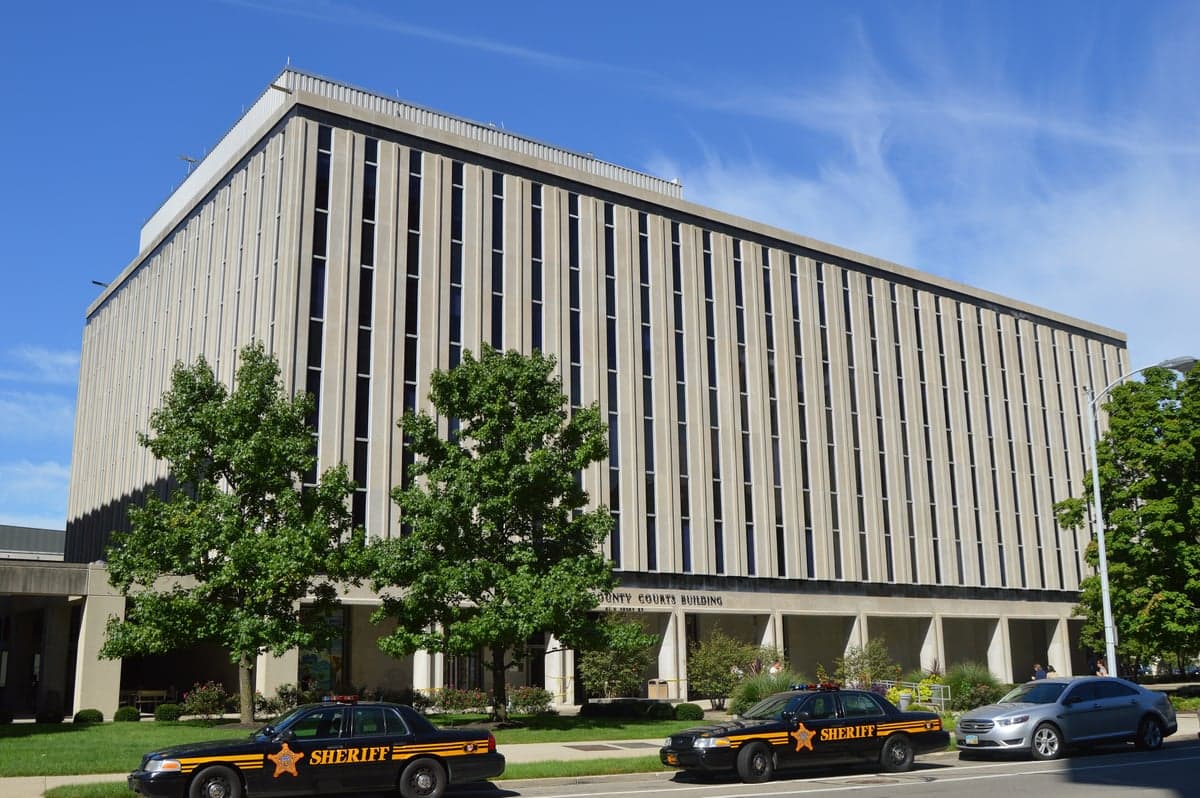
Photo: Wikipedia
Demographics of Montgomery County
Affluence Level in Montgomery County
A middle-class area roughly in line with national averages across income, home values, education, and employment.
People of Montgomery County
Montgomery County, Ohio, is home to 535,528 residents who reflect a Midwestern industrial legacy reshaped by decades of economic transition and suburban expansion. The population is predominantly White (68.3%) with a significant Black community (20.4%), a small but growing Hispanic population (4.1%), and modest East/Southeast Asian (1.4%) and Indian subcontinent (0.8%) communities. With only 2.4% foreign-born, the county remains one of Ohio's less internationally diverse urban centers, yet its character is defined by the layered histories of Appalachian migrants, Southern Black families, and European industrial workers who built Dayton and its surrounding towns.
Settlement & growth (pre-1960)
Before American settlement, the Miami Valley was home to the Shawnee and Miami nations, who used the confluence of the Great Miami and Mad Rivers as a trading and hunting ground. European encroachment accelerated after the 1795 Treaty of Greenville, and the first permanent American settlers—primarily of English and Scots-Irish stock—arrived from Kentucky, Virginia, and Pennsylvania in the late 1790s. They founded Dayton in 1796 at the site of a former Shawnee village, naming it after Jonathan Dayton, a New Jersey land speculator. Early settlers also established Germantown (1804) and Miamisburg (1818), both of which grew as farming and milling centers along the Miami River.
The completion of the Miami and Erie Canal in the 1830s transformed Dayton from a frontier outpost into a manufacturing hub. German immigrants arrived in significant numbers during the 1840s and 1850s, settling in Dayton's developing industrial neighborhoods and in the canal towns of Miamisburg and West Carrollton. These Germans brought skilled trades—carpentry, brewing, and metalworking—that would later underpin the region's machine-tool and manufacturing economy. A smaller wave of Irish immigrants came during the same period, working on canal construction and settling in Dayton's Oregon District and along the river bottoms.
The post-Civil War decades saw the county's industrial base explode. The invention of the cash register by John H. Patterson in 1884 led to the founding of National Cash Register (NCR) in Dayton, which drew thousands of workers from across the Midwest and Appalachia. By 1900, Dayton's population had surged past 85,000, and the city became a magnet for European immigrants from Poland, Italy, and Hungary, who clustered in neighborhoods like the Polish enclave around St. John the Baptist Church and the Italian community in the Huffman District. These groups arrived roughly between 1880 and 1914, pulled by factory jobs at NCR, Dayton Malleable Iron, and the Barney & Smith Car Company.
The Great Migration brought the county's first substantial Black population. Between 1910 and 1940, African American families from the Deep South—particularly Alabama, Mississippi, and Georgia—moved to Dayton for industrial work, settling in the West Dayton neighborhoods along West Third Street and Germantown Pike. By 1950, Black residents made up roughly 12% of Dayton's population, concentrated in a segregated corridor west of the Great Miami River. Meanwhile, the Wright-Patterson Air Force Base, established in 1917 and expanded during World War II, drew engineers and military personnel from across the country, settling in Riverside and Fairborn (the latter straddling the Greene County line).
The post-World War II boom reshaped settlement patterns. The 1950s saw massive suburbanization as white families left Dayton for new subdivisions in Kettering, Centerville, and Huber Heights. Kettering, incorporated in 1955, grew from farmland into a bedroom community of 54,000 by 1960, fueled by the expansion of NCR, General Motors' Delco Products division, and Wright-Patterson. This suburban exodus, combined with highway construction (I-75 and I-70), set the stage for the demographic shifts of the modern era.
Modern era (post-1965)
The 1965 Hart-Cellar Act had a muted effect on Montgomery County compared to coastal regions. The county's foreign-born population remains low at 2.4%, but the composition shifted after 1970. The most notable change was the arrival of East/Southeast Asian communities, particularly Vietnamese and Laotian refugees who resettled in Dayton after the Vietnam War ended in 1975. These families concentrated in Dayton's eastern neighborhoods and in Huber Heights, where they established small businesses and Buddhist temples. A smaller Indian subcontinent community, primarily of Gujarati and Malayali origin, grew after 1990, drawn by engineering and medical jobs at Wright-Patterson and the region's hospitals; they cluster in Centerville and Beavercreek (the latter just over the Greene County line).
Domestic migration reshaped the county more dramatically than international immigration. The decline of manufacturing after 1970 hit Dayton hard: NCR, once the city's largest employer, shed thousands of jobs, and General Motors closed its Delco Moraine plant in 1995. White flight accelerated, with families moving to Springboro (in Warren County) and Bellbrook (Greene County), both outside Montgomery County's borders. The Black population, which had been concentrated in West Dayton, began dispersing into inner-ring suburbs like Huber Heights and Trotwood during the 1980s and 1990s. Trotwood, once nearly all-white, became majority Black by 2010.
The Hispanic population, while still small at 4.1%, grew steadily after 1990, driven by Mexican and Central American immigrants who found work in construction, landscaping, and food processing. They settled primarily in Dayton's Old North Dayton neighborhood and in Miamisburg, where a small but visible Hispanic commercial corridor developed along South Main Street. The county's Asian population remains modest but professional: East/Southeast Asian residents (1.4%) are concentrated near Wright-Patterson and the University of Dayton, while Indian subcontinent residents (0.8%) are heavily clustered in the higher-income suburbs of Centerville and Washington Township.
Suburbanization continued through the 2000s and 2010s, but with a twist: Dayton's urban core, after decades of population loss, began to stabilize. The Oregon District and downtown Dayton saw reinvestment, attracting younger professionals and empty-nesters. However, the county's overall population declined from a peak of 571,697 in 1970 to 535,528 in 2020, reflecting ongoing outmigration of working-age families to adjacent counties and Sun Belt states.
The future
Montgomery County is slowly becoming more diverse, but the pace is glacial compared to national trends. The White share of the population is projected to continue declining, falling from 68.3% toward the low 60s by 2040, driven by an aging white population and outmigration of younger families. The Black share is likely to remain stable or grow modestly, as suburbanization within the county continues and West Dayton's population stabilizes. The Hispanic share is the fastest-growing segment, projected to reach 6-7% by 2040, with growth concentrated in Dayton's North Side and Miamisburg. The East/Southeast Asian and Indian subcontinent populations will likely grow slowly, tied to Wright-Patterson's continued role as a regional employer and the expansion of healthcare at Premier Health and Kettering Health Network.
The county's cultural identity is evolving from a blue-collar manufacturing base to a more diversified economy anchored by aerospace, healthcare, and logistics. This shift is attracting a slightly more educated and professional population—30.5% of adults now hold a bachelor's degree or higher—but the county still lags Ohio's suburban averages. The most significant demographic pressure is not immigration but domestic outmigration: young adults continue to leave for Columbus, Cincinnati, and out-of-state metros, a trend that will keep population growth flat or negative for the foreseeable future.
For someone moving in now, Montgomery County offers a relatively affordable, stable Midwestern environment with a modest but real diversity that is concentrated in specific neighborhoods and suburbs. The county is not becoming a melting pot in the manner of a Sun Belt boomtown; rather, it is slowly diversifying within the framework of a shrinking Rust Belt city. New residents will find established Black and Appalachian communities, a small but growing Hispanic presence, and professional Asian enclaves in the suburbs—all layered over a landscape still shaped by the industrial and canal-era settlements of the 19th century.

* Values derived from national, state, county, city and local statistics and may differ in a specific area. Last updated: 2026-07-22T18:43:22.000Z
Narrative content on this page is AI-generated and may contain mistakes. Verify any details that matter before acting on them.
ReloMaps may earn a commission from affiliate links at no extra cost to you.

