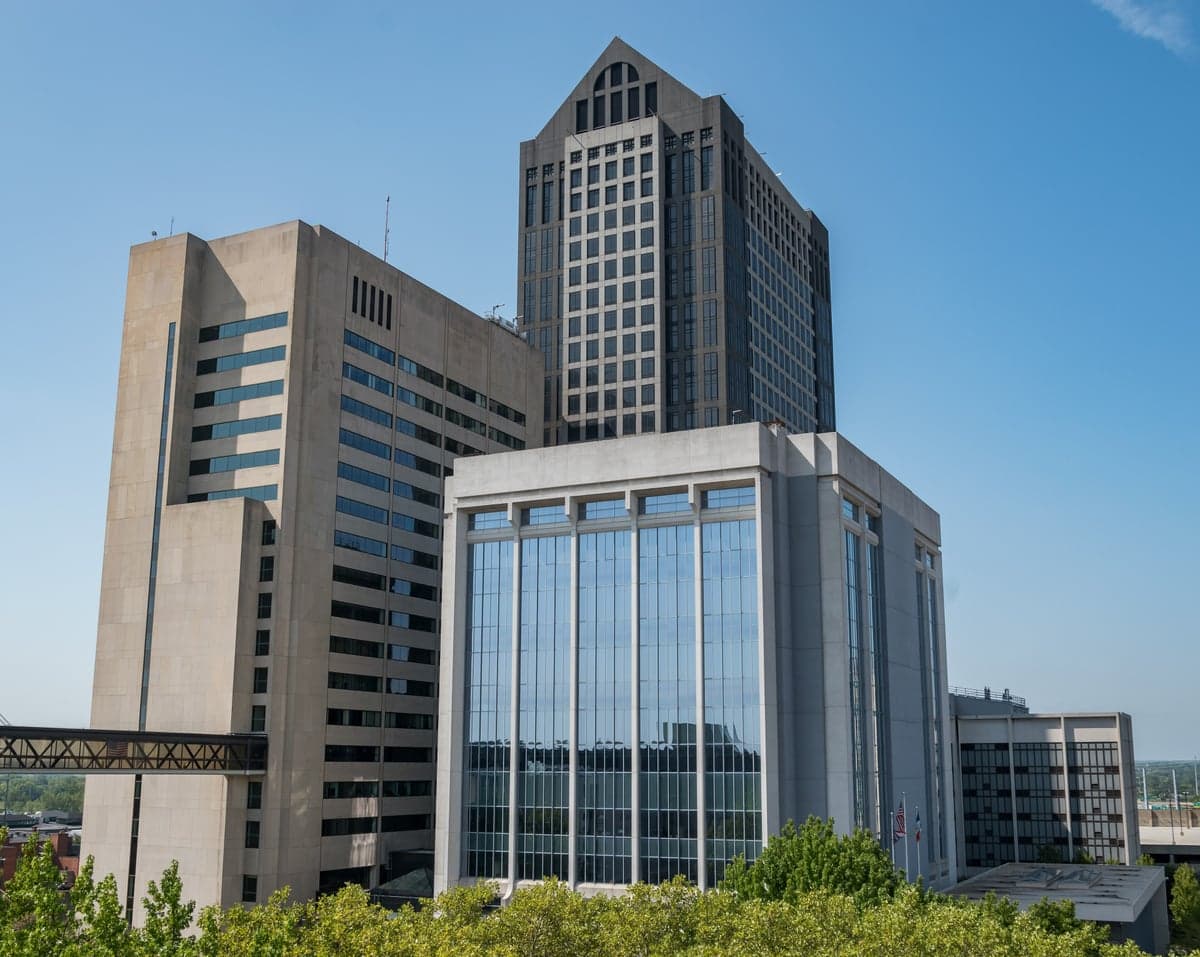
Photo: Wikipedia
Political ClimatePolitical Climate in Franklin County
Showing district-level results — no local-only data available.
Local Political AnalysisPolitical Analysis of Franklin County
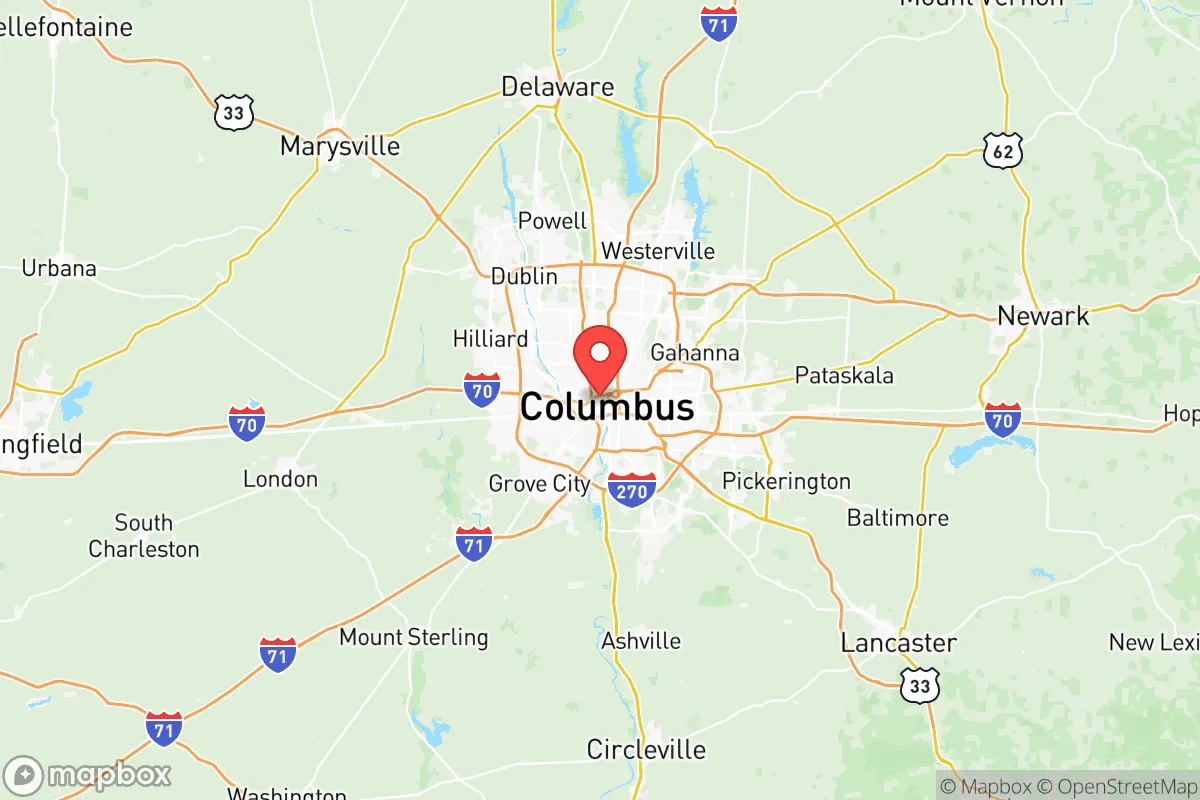
Franklin County, Ohio, is a classic bellwether that has shifted from a swing county to a solidly Democratic stronghold in presidential elections, even as the state around it has moved right. The county’s Cook Partisan Voting Index (PVI) of R+4 might seem to suggest a competitive tilt, but that number is a bit of a historical artifact; in practice, Franklin County has voted for the Democratic presidential candidate in every election since 2008, often by double digits. The R+4 rating reflects the county’s overall partisan balance when factoring in state and local races, but the presidential trend is unmistakably blue, driven by the explosive growth of Columbus and its inner suburbs. Meanwhile, the state of Ohio as a whole carries a PVI of R+5, meaning Franklin County is now significantly more Democratic than the state average, a reversal from just two decades ago when it was a key swing county.
How it compares
The political geography within Franklin County is stark. The city of Columbus and its inner-ring suburbs like Bexley, Upper Arlington, and Clintonville are heavily Democratic, often delivering margins of 70% or more for Democratic candidates. In contrast, the outer-ring suburbs and exurbs—places like Dublin, Powell, and New Albany—are more competitive, with Dublin and Powell leaning Republican in local races but showing signs of trending left, especially among younger and more educated voters. The rural and small-town areas in the northern and western parts of the county, such as parts of Worthington and Hilliard, still have Republican-leaning precincts, but they are shrinking. Compared to the rest of Ohio, Franklin County is an outlier: the state’s other major urban counties (Cuyahoga, Hamilton, Montgomery) are also Democratic, but Franklin’s growth rate and demographic shifts make it the most dynamic political battleground within the state. The county’s R+4 PVI is a compromise between the deep-blue city and the redder exurbs, but the trajectory is clearly toward a more Democratic lean over time.
What this means for residents
For conservative residents, living in Franklin County means being part of a shrinking but still influential minority. They can still win local races in the outer suburbs and have a strong voice in countywide Republican primaries, but they face an uphill battle in countywide general elections. For liberal residents, the county is a safe haven where Democratic policies are generally supported, but they must contend with a state government that is increasingly conservative and often at odds with the county’s values. This dynamic creates a constant tension: local ordinances on issues like minimum wage, paid leave, and policing are often more progressive than state law, leading to preemption battles. The practical effect is that residents experience a patchwork of policies—liberal in Columbus and its inner suburbs, more conservative in the exurbs—which can be confusing for newcomers. The county’s political climate also influences daily life: public discourse is more polarized than in the past, but the sheer size and diversity of the county means most people can find a community that matches their political comfort zone.
Culturally, Franklin County is distinct from much of the rest of Ohio. Columbus is a major university town (Ohio State University) and a hub for tech, insurance, and finance, which attracts a younger, more diverse, and more educated population than the state average. This translates into a more cosmopolitan feel, with a vibrant arts scene, a strong LGBTQ+ community, and a food culture that rivals much larger cities. Policy-wise, the county has been a leader in areas like criminal justice reform (e.g., bail reform, diversion programs) and environmental sustainability (e.g., renewable energy goals for county buildings), often pushing against state-level resistance. For residents, this means that while state politics can feel frustratingly conservative, the county itself offers a progressive oasis where many national debates are being played out at the local level. The key takeaway is that Franklin County is not just a blue dot in a red state; it’s a dynamic, growing region that is increasingly shaping the political and cultural identity of Ohio, even as it remains at odds with the state’s broader conservative trend.

State Political ClimatePolitical Climate in Ohio
State Political AnalysisPolitical Environment in the State
Ohio is a classic bellwether state with a solid Republican lean at the state level, carrying a Cook PVI of R+5, but its political reality is far more nuanced than a simple red-state label. Over the past 20 years, the state has shifted from a true purple battleground—where it decided the 2004 presidential election—to a reliably GOP stronghold in statewide races, driven largely by the collapse of Democratic support in rural and exurban areas. However, the state’s major metros, particularly Columbus and Cleveland, have become deeply blue, creating a sharp urban-rural divide that defines every election cycle and policy debate.
Urban vs. rural divide
The political map of Ohio is a study in contrasts. The three major metropolitan areas—Cleveland, Columbus, and Cincinnati—anchor the Democratic vote, with Cuyahoga County (Cleveland) delivering margins of 60-70% for Democratic candidates. Columbus, the state capital and fastest-growing major city, has become a Democratic stronghold as its tech and education sectors boom, while Hamilton County (Cincinnati) has trended left in recent cycles, flipping from red to purple. Meanwhile, the rest of the state is overwhelmingly Republican. Rural counties like Mercer and Auglaize in the west routinely vote 75-80% GOP, while the Appalachian southeast—places like Meigs and Vinton counties—have shifted hard right after decades of Democratic loyalty. The suburbs tell a mixed story: Delaware County (north of Columbus) remains reliably red, but Lake County (east of Cleveland) has trended blue, reflecting the national pattern of college-educated suburbanites drifting away from the GOP. The net effect is a state where Republicans dominate legislative and statewide races by running up huge margins in rural and exurban areas, while Democrats are increasingly concentrated in a few urban cores.
Policy environment
Ohio’s policy environment reflects its conservative lean, but with notable exceptions that make it a mixed bag for relocators. The state has a flat income tax rate of 3.5% as of 2025, down from a progressive structure a decade ago, and sales tax rates vary by county but average around 7.25%. Property taxes are moderate, though local levies can push them higher in suburban districts. The regulatory posture is business-friendly, with right-to-work laws not on the books but a generally low regulatory burden. On education, Ohio has a robust school choice system, including a statewide voucher program (the EdChoice Scholarship) that allows students in low-performing districts to attend private schools, and a growing charter school sector. Healthcare policy is a patchwork: the state expanded Medicaid under the Affordable Care Act in 2014, but the legislature has since imposed work requirements for able-bodied adults, a policy that is currently tied up in court. Election laws have tightened in recent years: voter ID requirements were strengthened in 2023, and early voting hours were standardized, though absentee voting remains widely available. For a conservative relocator, the tax and school choice environment is a clear draw; for a liberal one, the healthcare and voting access landscape may feel restrictive.
Recent policy direction
The last five years have seen Ohio’s legislature push a distinctly conservative agenda across multiple fronts. On gun rights, the state enacted permitless carry (constitutional carry) in 2022, allowing any adult who can legally possess a firearm to carry it concealed without a license. On education and parental rights, the 2023 budget included a ban on transgender athletes in girls’ sports and restricted gender-affirming care for minors, while also expanding the EdChoice voucher program to near-universal eligibility. On speech and privacy, the state passed a law in 2024 requiring age verification for adult content websites, a move framed as child safety but criticized as a speech restriction. Medical and bodily autonomy is a flashpoint: abortion is banned after six weeks (with no exceptions for rape or incest) under a 2019 law that took effect after the Dobbs decision, though a 2023 ballot initiative enshrined abortion rights in the state constitution, creating ongoing legal tension. Property rights are generally strong, with no statewide rent control and limited eminent domain abuse. On taxation, the trend is toward lower rates: the income tax was cut from 3.99% to 3.5% in 2023, with further cuts planned. Voting access has tightened, as noted, with stricter ID laws and reduced early voting days. For a relocator weighing liberties, the picture is complex: gun rights and school choice are expansive, but abortion access is legally contested, and voting rules are more restrictive than in neighboring Michigan or Pennsylvania.
Civil unrest & political movements
Ohio has seen its share of political flashpoints in recent years. The 2020 protests in Columbus and Cincinnati following George Floyd’s murder were large but largely peaceful, though property damage occurred in downtown Columbus. The state has a visible activist presence on both sides: progressive groups like the Ohio Organizing Collaborative push for voting rights and criminal justice reform, while conservative groups like the Buckeye Firearms Association and Ohio Right to Life are highly organized and influential in the legislature. Immigration politics are less heated than in border states, but the 2023 controversy over a proposed rail project in Springfield that would have brought Haitian migrants drew national attention and local backlash. Election integrity remains a live issue: the 2020 election in Ohio ran smoothly by most accounts, but Republican Secretary of State Frank LaRose has pursued aggressive voter roll maintenance and fraud investigations, which Democrats argue suppress turnout. There is no serious secession or nullification movement, but rural counties have occasionally floated the idea of joining neighboring states over cultural grievances. A new resident would notice the political divide most in yard signs and local news coverage, but actual civil unrest is rare outside of isolated protests.
Projection
Over the next 5-10 years, Ohio is likely to remain a solidly Republican state at the statewide level, but demographic shifts could narrow the gap. The growth of Columbus—driven by tech, finance, and Intel’s massive new semiconductor plants—is bringing in younger, more diverse, and more liberal voters, which could make the state more competitive in presidential races by the early 2030s. However, the rural exodus continues, and the GOP’s structural advantages in the legislature (thanks to gerrymandering) are unlikely to be undone. The policy direction will probably continue on its current trajectory: more tax cuts, expanded school choice, and further restrictions on abortion access unless the courts or a future ballot initiative intervene. In-migration patterns are mixed: Ohio is gaining from the Northeast and Midwest but losing some population to the Sun Belt, so the net effect is a slow demographic churn. Someone moving in now should expect a state that is politically stable but polarized, where the urban-rural divide will only deepen, and where the policy environment will remain conservative but with periodic fights over ballot initiatives and court rulings.
For a new resident, the bottom line is that Ohio offers a genuinely conservative policy environment on taxes, guns, and education, but with a legal landscape that is actively contested on abortion and voting rights. If you lean right, you’ll find a state where your values are reflected in law and where the legislature is reliably aligned with your priorities. If you lean left, you’ll find strong communities in the cities and suburbs, but you’ll be swimming against the current in statewide politics. Either way, the state’s affordability and economic opportunities—especially in Columbus and Cincinnati—make it a practical choice, as long as you’re comfortable with the political trade-offs.
* Values derived from national, state, county, city and local statistics and may differ in a specific area. Last updated: 2026-07-12T14:38:37.000Z
Narrative content on this page is AI-generated and may contain mistakes. Verify any details that matter before acting on them.
ReloMaps may earn a commission from affiliate links at no extra cost to you.

