Photo: Wikipedia
Political ClimatePolitical Climate in Oakhurst, CA
District shown is the primary district for this city’s centroid. Cities may span multiple districts.
Local Political AnalysisPolitical Analysis of Oakhurst, CA
Oakhurst leans solidly Republican, with a Cook PVI of R+8, making it one of the more conservative pockets in California’s Central Sierra. The town and surrounding Madera County have voted for the GOP presidential candidate by double-digit margins in every election since 2000, and the 2024 race saw the county go +18 for Trump. This isn’t a recent shift—Oakhurst has been a conservative stronghold for decades, rooted in its rural, mountain-town identity and a population heavy on retirees, small business owners, and outdoor recreationists who value limited government and property rights. The trajectory is stable: there’s no sign of a blue wave cresting over the Sierra foothills, though the influx of remote workers from the Bay Area since 2020 has nudged the local electorate slightly more purple in precincts closest to the highway.
How it compares
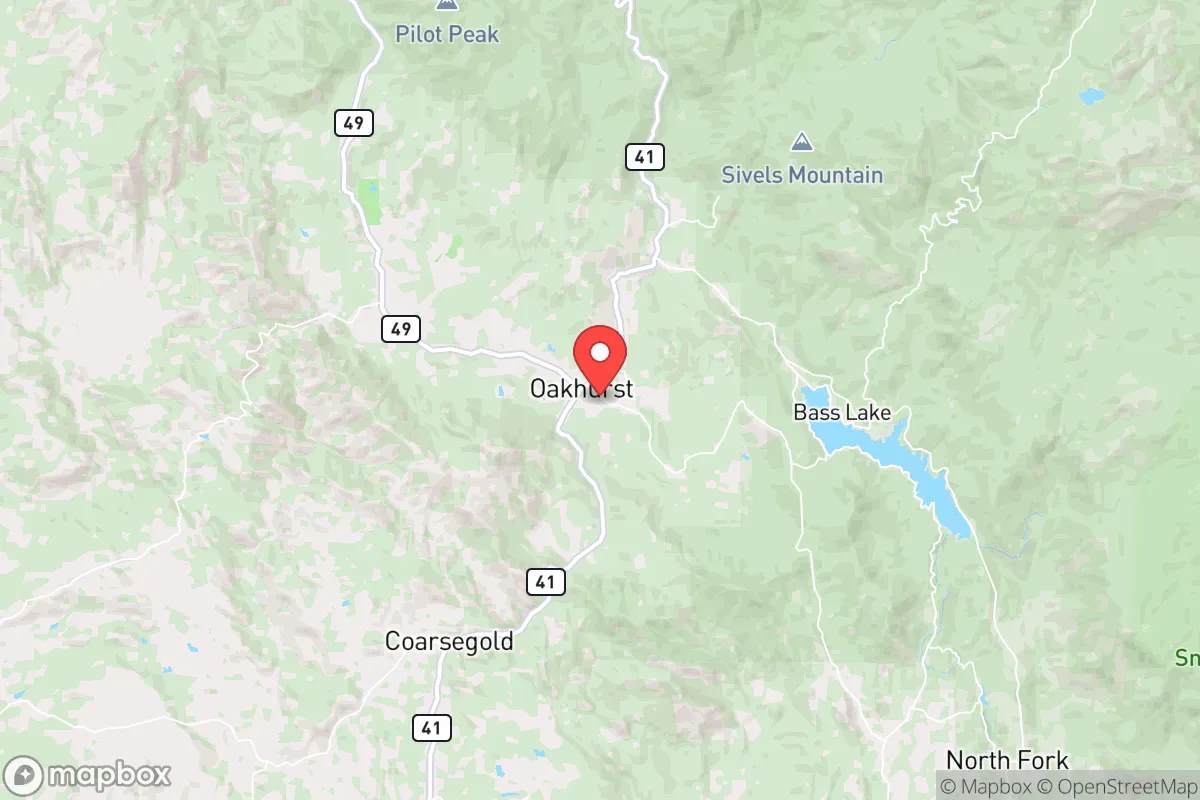
Compared to California as a whole—where Democrats hold every statewide office and the legislature has a supermajority—Oakhurst is a political outlier. The contrast is stark when you look at nearby towns: Mariposa (30 minutes north) is R+6, still red but less so, while Coarsegold (10 minutes south) is R+12, even more conservative. The biggest cultural gap is with Fresno (45 minutes west), a blue-leaning city where the county went +8 for Biden in 2020. In Oakhurst, you’ll see Trump signs on lawns year-round; in Fresno, you’ll see Harris-Walz banners. The state’s overall Cook PVI is D+13, meaning Oakhurst is about 21 points more Republican than California’s average district. That gap has widened slightly since 2016, as rural areas like this one have moved right while urban and suburban California moved left.
What this means for residents
For conservative residents, Oakhurst feels like a refuge. Local government is reliably GOP—the Madera County Board of Supervisors is 4-1 Republican—and you’ll find gun shops, churches, and a Chamber of Commerce that openly supports conservative candidates. Taxes are lower than the state average (property taxes capped by Prop 13, no local sales tax surcharge), and there’s little appetite for new regulations on short-term rentals or building permits. For liberal residents, life is more of a balancing act. You’ll encounter political disagreement at the grocery store or the post office, but it’s rarely hostile—Oakhurst is a small town where people know each other. The nearest Democratic club meets in Fresno, and progressive candidates rarely bother campaigning here. That said, state-level policies still apply: California’s gun laws, environmental regulations, and housing mandates are the law of the land, regardless of local sentiment. The practical effect is that conservatives grumble about Sacramento while liberals appreciate the safety net, but both groups share a common frustration with wildfire management and highway maintenance—issues that transcend party lines.
Culturally, Oakhurst is more “mountain town” than “red county.” The local paper, the Sierra Star, covers county politics but also devotes space to Yosemite tourism, fishing reports, and high school sports. There’s no MAGA rally every weekend—just a steady, low-key conservatism that shows up at the ballot box. The biggest policy distinction from coastal California is land use: Oakhurst residents fiercely oppose high-density housing and favor septic systems over sewer hookups, which keeps development slow and property values stable. If you’re moving here, expect a place where your neighbor might fly a Gadsden flag but will also lend you a chainsaw during fire season. That’s the Oakhurst way—politically red, but practically neighborly.

State Political ClimatePolitical Climate in California
State Political AnalysisPolitical Environment in the State
California is one of the most reliably Democratic states in the nation, with a partisan lean of roughly D+20 in statewide races, but that headline number hides a deeply fractured political geography. Over the last two decades, the state has shifted from a competitive purple giant — where Arnold Schwarzenegger won the 2003 recall and 2006 re-election — to a solidly blue bastion, driven by the Bay Area and Los Angeles metros while the Central Valley and inland counties have moved sharply right. The trajectory is not toward moderation; it is toward a widening urban-rural chasm that makes California feel like two or three different states sharing one flag.
Urban vs. rural divide
The political map of California is essentially a story of coastal metros versus the interior. The Bay Area — San Francisco, Oakland, San Jose — and Los Angeles County are the engine rooms of the Democratic majority, producing roughly 60% of the state's votes. These regions have grown more liberal over the past decade, with San Francisco and Oakland pushing further left on housing, policing, and homelessness policy. Meanwhile, the Central Valley cities of Bakersfield, Fresno, and Modesto have become reliably Republican strongholds, with Bakersfield voting +20 R in 2024 and Fresno County flipping from blue to red in the 2022 midterms. The Inland Empire — Riverside and San Bernardino counties — is the state's true battleground, where working-class Latino and white voters have drifted right on crime and cost-of-living issues, though they still lean Democratic in most cycles. Orange County, once the heart of California conservatism, has completed its transformation into a suburban Democratic anchor, with Irvine and Anaheim now sending Democrats to Congress. The rural north — places like Redding, Chico, and the Sierra foothills — is deeply red, with some counties voting +40 R, but their population is too small to offset the coastal majority.
Policy environment
California's policy environment is defined by high taxes, heavy regulation, and expansive state government. The state has a progressive income tax with a top marginal rate of 13.3% — the highest in the nation — and a 7.25% sales tax that local jurisdictions routinely push above 10%. Property taxes are capped at 1% of assessed value under Proposition 13, which keeps longtime homeowners' bills low but creates a massive disparity with new buyers. The regulatory posture is the most interventionist in the country: California has its own environmental review process under CEQA that can delay any construction project for years, and the state's energy policies have driven gasoline prices to the highest in the nation, often $1.50 to $2.00 above the national average. Education policy is centralized in Sacramento, with the state's teachers union wielding enormous influence; per-pupil spending is above the national average, but outcomes in urban districts like Los Angeles Unified and Oakland Unified remain poor. Healthcare is heavily regulated, with the state operating its own insurance exchange (Covered California) and moving toward universal coverage models. Election law is among the most permissive in the country — universal mail-in voting, same-day registration, and no voter ID requirement — which conservatives frequently criticize as insecure, though the state's own audits have found no significant fraud.
Recent policy direction
The last five years have seen California double down on progressive governance across nearly every liberty axis a relocator might weigh. On gun law, the state has some of the strictest restrictions in the nation — a 10-day waiting period, a ban on most semiautomatic rifles, and a 2023 law (SB 2) that effectively bans carrying firearms in most public places, currently tied up in federal litigation. On parental and education rights, the state passed AB 1955 in 2024, which prohibits schools from notifying parents when a child changes their gender identity, making California the first state to mandate secrecy from parents. On speech, the state has enacted AB 2655, which requires large social media platforms to label or remove "election misinformation," a law critics argue chills protected speech. Privacy and surveillance are a mixed bag: the California Consumer Privacy Act (CCPA) gives residents strong data rights, but the state has also expanded automated license plate reader networks and facial recognition use in law enforcement. Medical and bodily autonomy is firmly protected — abortion and gender-affirming care are codified as fundamental rights, and the state has positioned itself as a sanctuary for out-of-state patients seeking those procedures. Property rights are weak: rent control was expanded by statewide ballot measure in 2024, and the state's housing mandates force cities to upzone single-family neighborhoods. On taxation, the 2022 "wealth tax" proposal failed, but a 2024 ballot measure to raise the corporate tax rate passed, and the state continues to explore new levies on high earners.
Civil unrest & political movements
California is the epicenter of organized political activism on both ends of the spectrum, and the flashpoints are visible to any new resident. The 2020 George Floyd protests in Los Angeles and Oakland were among the largest and most destructive in the nation, with billions in property damage and a subsequent movement to defund police that has since partially reversed. The state's sanctuary policies — codified by SB 54 in 2017 — prohibit local law enforcement from cooperating with federal immigration authorities, making California the most aggressive sanctuary state in the country. This has created ongoing tension with the federal government, and ICE operations in cities like San Jose and Sacramento remain a recurring news cycle. On the right, the state has seen a significant rural secession movement — the "State of Jefferson" proposal, which has support in Siskiyou, Modoc, and Lassen counties, though it remains a symbolic protest rather than a viable political project. The 2021 recall election against Governor Gavin Newsom, which failed by a 62-38 margin, was the most visible right-wing mobilization in a decade, and it revealed that while Republicans can rally their base, they cannot break the Democratic coalition. Election integrity controversies have been persistent: the state's universal mail-in voting system has been the subject of repeated conservative lawsuits, and the 2024 election saw a spike in ballot drop-box monitoring by armed activists in Orange County and the Central Valley.
Projection
Over the next five to ten years, California's political trajectory points toward continued Democratic dominance, but with growing internal friction. Demographic trends favor the left: the state's Latino population, which votes Democratic by roughly 65-35, continues to grow, and the white college-educated suburban vote in places like Orange County and San Diego has moved decisively blue. In-migration patterns are the wild card — California has lost net population every year since 2020, with roughly 500,000 more people leaving than arriving, and the leavers skew conservative and middle-class, heading to Texas, Arizona, and Idaho. This self-selection is making the state bluer by subtraction, not just addition. The practical reality for a new resident is that the state will likely remain under one-party Democratic control for the foreseeable future, with Republicans holding at most a third of the legislature and no realistic path to statewide office. The more interesting dynamic is internal: the urban-rural divide is likely to sharpen, with the Central Valley and Inland Empire potentially becoming more competitive as their populations grow, while the coastal metros push further left on housing, crime, and education policy.
For a new resident, the bottom line is that California offers a predictable political environment — if you align with progressive governance on taxes, regulation, and social policy, you will find a state that delivers on those priorities. If you lean conservative, you will be in a permanent minority, but you will also find well-organized communities in places like Bakersfield, Redding, and Temecula where your views are the local norm. The state's high cost of living and tax burden are not going anywhere, and the political culture will continue to reward organized advocacy over individual preference. The best advice is to choose your city carefully — the political reality of living in San Francisco is fundamentally different from living in Fresno, and the state's one-size-fits-all policies will feel very different depending on which California you choose to call home.
* Values derived from national, state, county, city and local statistics and may differ in a specific area. Last updated: 2026-10-21T10:39:02.000Z
Narrative content on this page is AI-generated and may contain mistakes. Verify any details that matter before acting on them.
ReloMaps may earn a commission from affiliate links at no extra cost to you.

