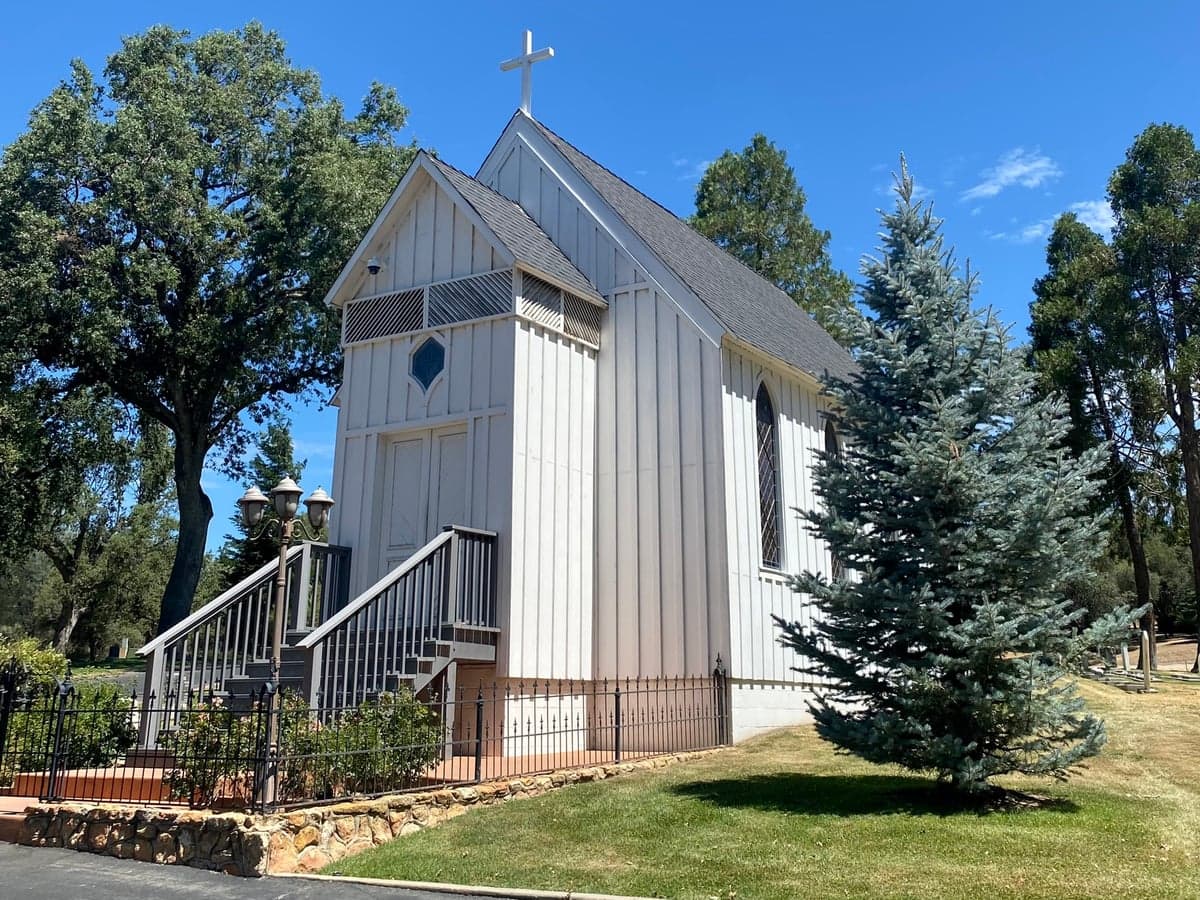
Photo: Wikipedia
Strategic Assessment of Oakhurst, CA
Workable tactical position. Some exposure to population density or targets, but generally defensible in a crisis.
What does the Strategic Assessment tell us?
Our Strategic Assessment grades tactical survivability of an area. Major population centers, military targets, fallout zones, natural disasters, and border exposure all drive risk — lower exposure means a more defensible position in a crisis.
This is heavily inspired by Joel Skousen's Strategic Relocation book. Highly recommended you checkout the book ($)What does this tell us?
Our Strategic Assessment grades tactical survivability of an area. Major population centers, military targets, fallout zones, natural disasters, and border exposure all drive risk — lower exposure means a more defensible position in a crisis.
This is heavily inspired by Joel Skousen's Strategic Relocation book. Highly recommended you checkout the book ($)Strategic Pillars
Key Distances
Regional Safe Places
Below is our recommended "safe zones" in California and the surrounding area based on our strategic heuristics. For most people, it's unrealistic to live in a “safe zone” full-time due to work, family or other personal reasons. They tend to be more rural. However, many of these areas are perfect for second homes and retreat properties that double as a vacation home or even a short-term rental.

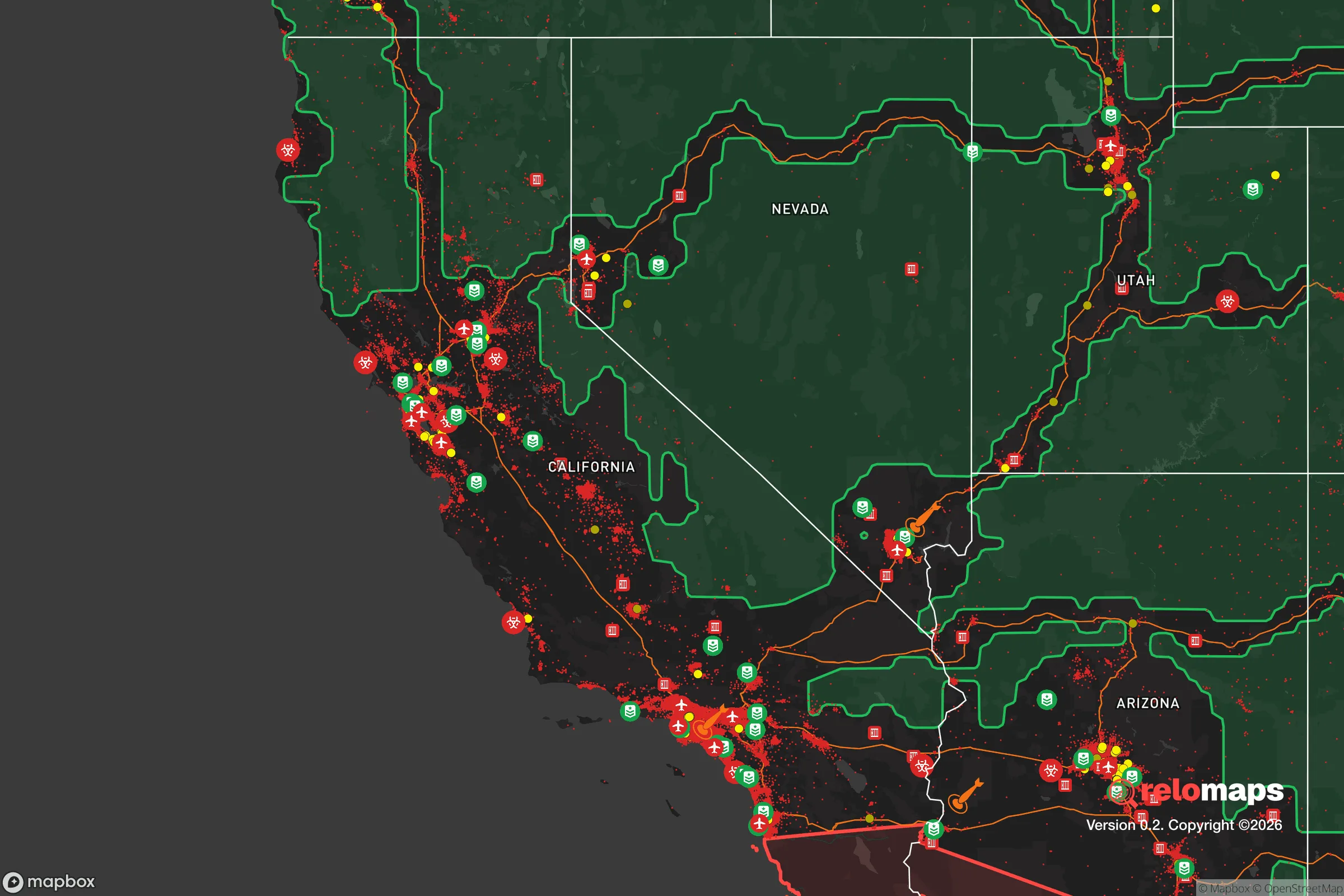


Important Note: For informational purposes only. This does not mean nothing bad ever happens in the green zones. Please use common sense. This is based on public data and modeled with AI. We tried to take a conservative approach but mistakes happen. We update this regularly as new information becomes available.
Solar Generator Recommendations
Backup power matters more here than in safer locations. We've picked three solar generators across budgets and capacity tiers — start with the budget unit if you only need a few essentials, or step up if you want to run a fridge and HVAC for days at a time.

Jackery Portable Power Station Explorer 300
Budget OptionPower on the Go: Weighing only 11 lbs, it's convenient to set up and store with book-sized foldable solar panels

BLUETTI Portable Power Station AC180
Designed for both indoor and outdoor scenarios, AC180 is highly capable as it has a robost capacity and continuous output power.

EF ECOFLOW DELTA Pro Ultra Power Station
Upgraded PickEcoFlow DELTA Pro Ultra is a whole-home energy system designed to grow with your family. Integrated with the Smart Home Panel 2, it scales to meet your evolving energy needs — keeping your home powered, intelligent, and secure through every stage of life.
We earn a commission, at no additional cost to you.
Strategic Assessment Analysis
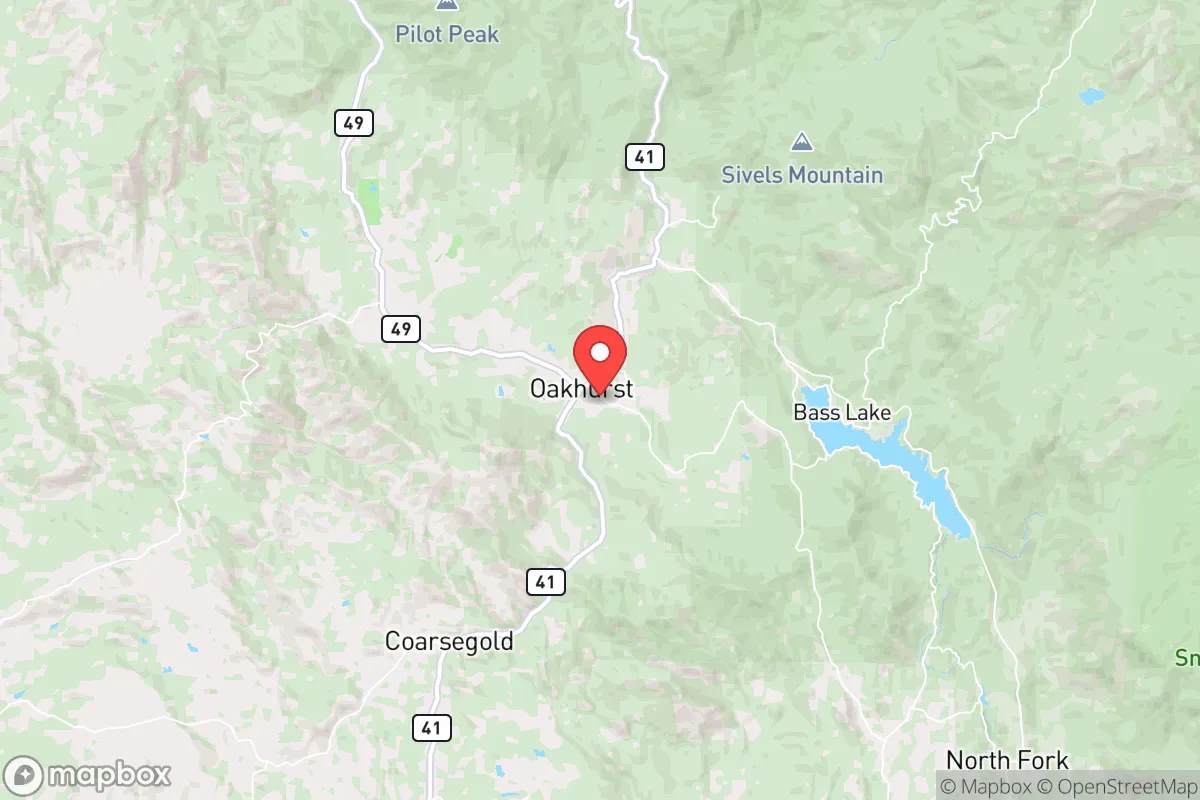
Oakhurst, California, positioned at the gateway to Yosemite National Park along Highway 41, offers a strategic blend of remote mountain living with surprisingly practical access to the Central Valley. For a relocator prioritizing disaster readiness and self-sufficiency, this unincorporated community in Madera County presents a compelling case: it sits high enough (around 2,300 feet) to avoid the worst of Central Valley summer heat and some valley fever risks, yet low enough to maintain year-round road access that many higher Sierra towns lose. The area’s resilience profile is defined by its position as a transition zone between the Sierra Nevada foothills and the high country, offering natural defensibility without the extreme isolation that can become a liability during emergencies.
Geographic position and natural advantages for self-sufficiency
Oakhurst’s location provides several structural advantages for long-term resilience. The town sits on a granite base that offers stable building foundations and reduces landslide risks compared to the decomposed granite slopes common elsewhere in the foothills. Its elevation places it above the dense Tule fog and inversion layers that plague the San Joaquin Valley for months each winter, meaning better air quality and more consistent solar exposure for off-grid energy systems. The surrounding Sierra National Forest provides a massive buffer zone—hundreds of thousands of acres of public land that create natural separation from urban corridors. Water availability is a genuine asset here: the area sits near the headwaters of the Fresno River, and groundwater in the fractured granite aquifers, while not unlimited, is generally more reliable than in the over-drafted Central Valley basins. Multiple small creeks and springs exist on private parcels, and the region’s average 30-40 inches of annual precipitation (mostly snowpack that releases slowly) supports rain catchment systems better than most of Southern California. The terrain itself offers defensibility: the narrow, winding nature of Highway 41 and the limited number of access roads (primarily 41 north to Yosemite, 41 south to Fresno, and 49 west to Mariposa) create natural chokepoints that would slow any large-scale movement, whether from fire, civil disruption, or other cascading events.
Risks, exposures, and proximity to fallout-relevant landmarks
The primary risk in Oakhurst is wildfire, and it is not theoretical. The 2020 Creek Fire came within a few miles of the town’s western edge, and the 2022 Washburn Fire threatened the southern approach. The area sits in a high-fire-severity zone, with the Sierra National Forest’s overgrown timber and dense brush creating continuous fuel loads. Evacuation routes are limited: Highway 41 south to Fresno is the primary egress, and it can become gridlocked during major incidents—the 2020 fire saw traffic backed up for hours. Highway 49 west to Mariposa is a secondary route but narrow and winding. For a relocator, this means defensible space, fire-hardened construction, and a personal evacuation plan are non-negotiable, not optional. Earthquake risk is moderate—the area is not on a major fault line like the San Andreas, but the Sierra Nevada block itself experiences occasional moderate tremors (typically 4.0-5.0 magnitude), and the granite bedrock transmits shaking efficiently. Regarding man-made risks, Oakhurst’s distance from major targets is a net positive. The nearest large city is Fresno (about 50 miles south), which has no major military installations, nuclear facilities, or high-value industrial targets. The Diablo Canyon nuclear plant is over 150 miles away. The San Joaquin Valley’s oil refineries and chemical plants are concentrated near Bakersfield and Richmond, both well outside any plausible fallout zone. The primary concern would be the potential for a cascading failure in Fresno’s infrastructure—if the city’s water or power grid collapsed, Oakhurst would see refugee movement up Highway 41, straining local resources. The town’s own infrastructure is modest: one major grocery store, a small hospital (Adventist Health Oakhurst), and a limited police presence (Madera County Sheriff’s substation). A determined relocator should not rely on these systems in a prolonged crisis.
Practical resilience for a relocator: food, water, energy, and defensibility
For someone serious about self-sufficiency, Oakhurst offers a realistic foundation but requires deliberate preparation. Water is the strongest asset: properties with wells tapping into the Sierra granite aquifers generally produce reliable yields, and the seasonal snowpack provides a natural reservoir. Rainwater catchment is viable for non-potable uses, though storage must account for dry summers (June-September typically see minimal precipitation). The Fresno River runs through town but is seasonal and heavily diverted; don’t count on it as a primary source. Food production is feasible but limited by growing season: the 2,300-foot elevation means a shorter season than the Central Valley (last frost typically mid-April, first frost mid-October), but cold-hardy crops, fruit trees (apples, pears, plums), and berries do well. The surrounding national forest offers hunting (deer, bear, wild pig) and foraging (mushrooms, acorns, pine nuts), but these require skill and are not reliable primary food sources. Local agriculture is limited—there’s no significant farming community nearby, so bulk food storage and supply chains from Fresno are the practical baseline. Energy resilience is achievable: Oakhurst gets over 260 sunny days per year, and the granite slopes provide excellent solar exposure for panels. PG&E is the utility provider, and grid reliability is poor—power outages from winter storms, fire shutoffs, and equipment failures are frequent (often 5-10 times per year, sometimes lasting days). A solar-plus-battery system is almost mandatory for anyone wanting true resilience. Propane is widely available for heating and cooking, and wood stoves are common. Defensibility is mixed: the terrain provides natural chokepoints, but the town itself is spread out along Highway 41 with many homes visible from the road. Properties set back on private roads or at the end of dead-end forest service roads offer far better security. The community is small (about 5,000 year-round residents) and relatively tight-knit, which can be an asset for mutual aid but also means everyone knows everyone—privacy is limited. The nearest significant law enforcement backup is in Madera (45 minutes away), so personal security and community networks matter more than official response.
The overall strategic picture for Oakhurst is one of moderate-to-high resilience with clear trade-offs. It avoids the worst risks of both the urban corridor and the high Sierra: no major target proximity, no extreme winter isolation, no valley heat or air quality issues. The water availability and defensible terrain are genuine advantages that few California foothill towns can match at this price point. But the wildfire risk is real and escalating, the evacuation routes are fragile, and the local infrastructure is thin. For a relocator who is willing to invest in fire-hardening, off-grid energy, and water storage, and who values a community that is politically moderate (Madera County leans conservative but Oakhurst itself is mixed) and oriented toward outdoor self-reliance, this is one of the more viable options in the Sierra foothills. It is not a bug-out location—it is a real town with real vulnerabilities—but for someone building a resilient life rather than just a bunker, Oakhurst offers a solid base camp.

* Values derived from national, state, county, city and local statistics and may differ in a specific area. Last updated: 2026-10-21T10:39:02.000Z
Narrative content on this page is AI-generated and may contain mistakes. Verify any details that matter before acting on them.
ReloMaps may earn a commission from affiliate links at no extra cost to you.

