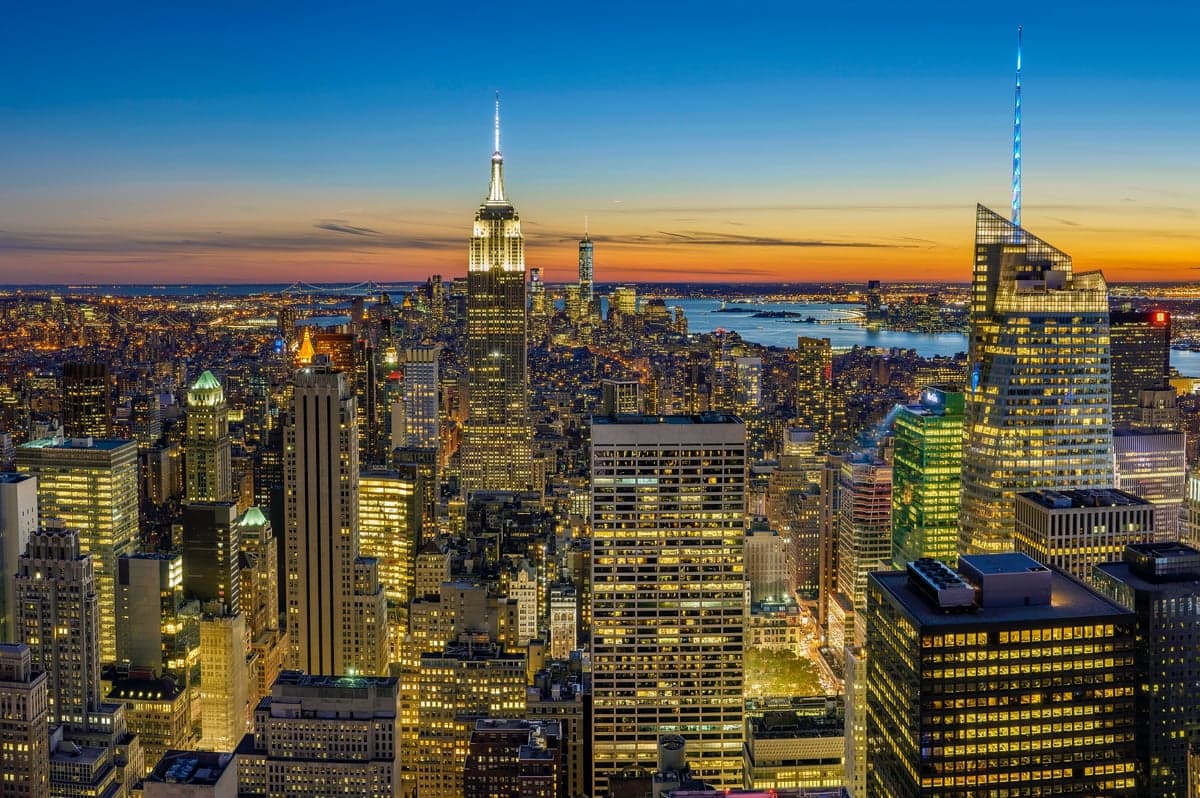
Photo: Wikipedia
Political ClimatePolitical Climate in NYC, NY
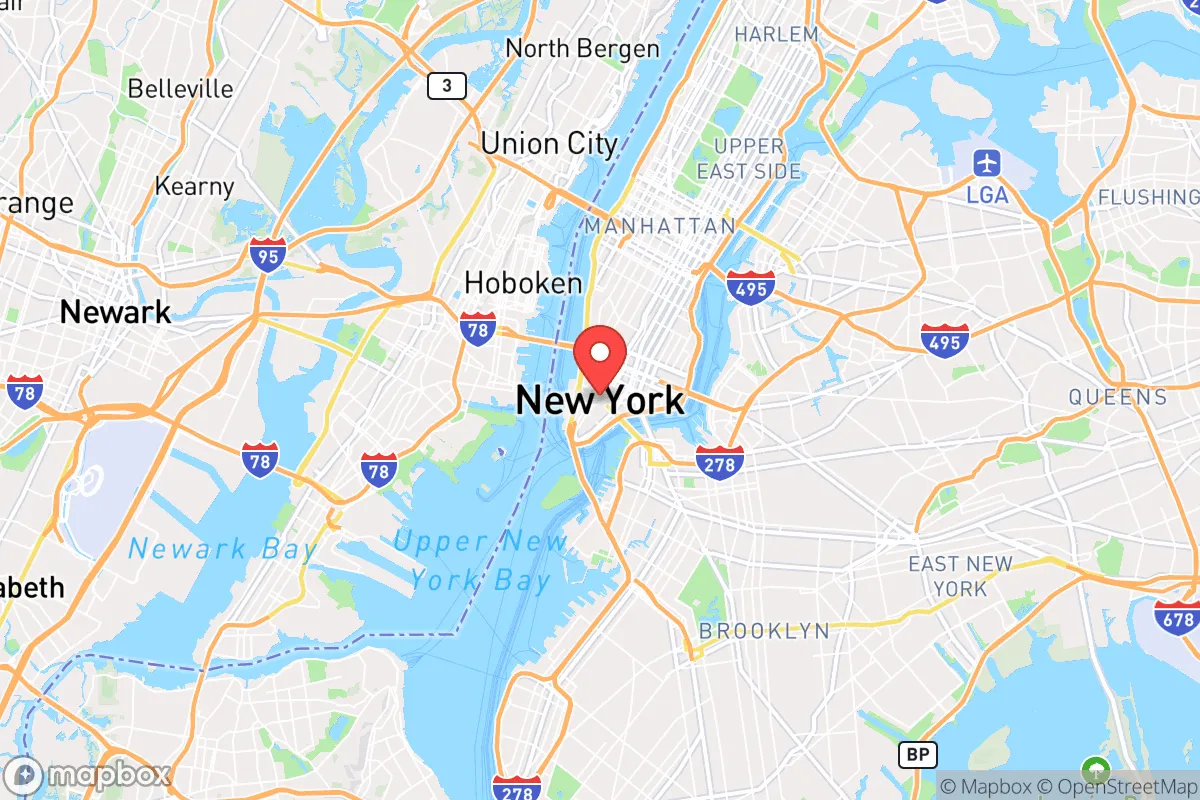
District shown is the primary district for this city’s centroid. Cities may span multiple districts.
Local Political AnalysisPolitical Analysis of NYC, NY
New York City is one of the most reliably Democratic major metros in the country, with a Cook Partisan Voting Index of D+32 — meaning the city votes about 32 points more Democratic than the national average. That’s not just blue; it’s deep indigo. In the 2024 presidential election, the five boroughs delivered roughly 68% of their vote to the Democratic candidate, a share that has held steady for decades. The real story, though, is the widening gap between NYC and the rest of New York State. While the city itself has only gotten more liberal since 2020, the surrounding suburbs and upstate regions have shifted rightward, creating a political landscape that feels increasingly like two different states sharing a border.
How it compares
Comparing NYC to “New York, NY” is a bit of a trick — they’re the same place on paper, but in practice, the city’s political gravity is so strong that it defines the entire state’s electoral map. The rest of New York State, from Long Island’s Nassau County to the Hudson Valley’s Dutchess County, has a Cook PVI that’s effectively unknown because the state’s overall lean is so heavily skewed by the city’s D+32 anchor. For context, Staten Island is the most conservative borough, often voting within 5-10 points of the national average, while Manhattan’s Upper East Side and Brooklyn’s Park Slope are among the most liberal neighborhoods in America. Nearby cities like Yonkers and New Rochelle lean Democratic but are more moderate, while towns like Middletown and Orange County have flipped Republican in recent cycles. The contrast is stark: you can drive 30 minutes north of the Bronx and find yourself in a district that voted for Trump by double digits.
What this means for residents
For liberal residents, NYC’s political climate means policies that align with their values — strong tenant protections, universal pre-K, a $15 minimum wage that predated the state’s, and some of the nation’s most progressive criminal justice reforms. But it also means high taxes and a cost of living that’s among the highest in the country, driven partly by the city’s generous social safety net. For conservative residents, living in NYC can feel like being in a permanent minority. You’ll find few Republican elected officials above the city council level, and local media and cultural institutions lean heavily left. That said, conservative neighborhoods like Staten Island’s South Shore and parts of Queens’ Howard Beach have strong community networks and local GOP clubs. The practical trade-off is clear: you get world-class amenities and a vibrant, diverse urban life, but you’re paying for it with your vote and your wallet. The trajectory suggests this divide will only deepen — the city’s progressive wing is gaining influence, while the suburbs and upstate areas are hardening their opposition.
Culturally, NYC’s political identity is inseparable from its role as a global immigrant gateway and financial capital. The city’s policy debates — over congestion pricing, housing density, and public school admissions — are often more progressive than the rest of the state’s, and they’re fought out in a media ecosystem that amplifies every council hearing. One distinction that surprises newcomers: while the city votes overwhelmingly Democratic, its mayoral elections often produce centrists like Eric Adams, who ran on a public safety platform that appealed to moderate voters. That’s the NYC paradox — a D+32 electorate that still elects pragmatists to run the subway and the schools. If you’re moving here, expect the politics to be loud, messy, and deeply local, with a trajectory that’s likely to stay blue but with plenty of internal friction over how far left to go.

State Political ClimatePolitical Climate in New York
State Political AnalysisPolitical Environment in the State
New York State has been a solidly Democratic stronghold for decades, but the political reality on the ground is far more nuanced than the state’s overall “blue” label suggests. The state’s partisan lean is overwhelmingly driven by New York City and its immediate suburbs, which together account for roughly 40% of the state’s population and deliver massive Democratic margins. Outside the five boroughs and the downstate suburbs, much of upstate New York—from the Hudson Valley north to the Canadian border and west to Lake Erie—is politically competitive or outright Republican. Over the past 10-20 years, the state has moved leftward on social and fiscal policy, but the urban-rural divide has widened dramatically, with rural counties like Wyoming, Orleans, and Allegany voting Republican by 30-40 point margins while Manhattan and Brooklyn deliver 80-90% Democratic votes. For a conservative-leaning relocator, the key takeaway is that your experience will vary enormously depending on whether you settle in a deep-blue metro or a red-leaning small town.
Urban vs. rural divide
The political map of New York is essentially two states in one. The downstate region—New York City, Long Island (Nassau and Suffolk counties), and the lower Hudson Valley (Westchester, Rockland, and Putnam counties)—is the engine of Democratic dominance. In 2024, Manhattan voted roughly 87% Democratic, while Brooklyn and Queens were close behind. These areas are dense, diverse, and heavily influenced by public-sector unions, progressive activist networks, and a media ecosystem that leans hard left. In contrast, upstate New York is a patchwork of red and purple territory. The Buffalo-Rochester-Syracuse corridor is historically Democratic but has shifted rightward as manufacturing jobs declined; Erie County (Buffalo) still votes Democratic, but by shrinking margins. The Southern Tier—counties like Steuben, Chemung, and Chautauqua—is reliably Republican, as is the North Country (Jefferson, St. Lawrence counties) and the Finger Lakes region outside the college towns. The Capital District around Albany is a Democratic stronghold due to state government employment, but its rural outskirts lean red. Suburbs like Clarence (outside Buffalo) and Pittsford (outside Rochester) are politically moderate to conservative, while New Paltz and Ithaca are progressive enclaves. The divide is not just about party ID—it’s about culture, economics, and attitudes toward government, with upstate residents often feeling ignored or overruled by downstate voters.
Policy environment
New York’s policy environment is among the most progressive in the nation, with consequences that directly affect relocators. The state has a progressive income tax with rates up to 10.9% on high earners, plus some of the highest property taxes in the country—median effective rates around 1.7%, but exceeding 2.5% in many upstate counties like Monroe and Onondaga. Sales tax is moderate (4% state plus local add-ons, typically totaling 8-9%). The regulatory posture is heavy: New York has strict rent control laws in NYC, a statewide ban on natural gas hookups in new construction (effective 2026), and some of the nation’s toughest environmental regulations. Education policy is dominated by the state’s powerful teachers’ unions; school funding is high but outcomes vary wildly, with suburban districts like Jericho and Scarsdale ranking among the nation’s best while many upstate rural districts struggle. Healthcare is heavily regulated, with a state-run health insurance exchange and Medicaid expansion. Election laws are relatively liberal: no-excuse absentee voting, early voting, and automatic voter registration are all in place. For a conservative relocator, the policy environment means higher taxes and more bureaucracy, but also robust public services—good roads, well-funded schools, and strong environmental protections.
Recent policy direction
Over the past five years, New York has moved decisively leftward on a range of issues that matter to relocators. On gun and self-defense law, the state passed the Concealed Carry Improvement Act (CCIA) in 2022 after the Bruen Supreme Court decision, requiring “good moral character” for permits and banning firearms in “sensitive locations” like Times Square and public transit. The law is being challenged in court, but for now, carrying a firearm is heavily restricted. On parental and education rights, the state has expanded LGBTQ+ curriculum mandates and banned conversion therapy for minors, while also passing a “parental bill of rights” in 2023 that requires school districts to notify parents of changes to a child’s mental health services—a compromise that satisfied few on either side. On speech and privacy, New York has a strong shield law for journalists and passed the “Right to Know” data privacy law in 2024, but also expanded surveillance powers for the NYPD under the “Clean Sweep” anti-crime initiative. On medical and bodily autonomy, the state has codified abortion rights into law (the Reproductive Health Act of 2019) and expanded Medicaid coverage for gender-affirming care. On property rights, the state has tightened rent regulations and expanded “good cause” eviction protections statewide in 2024. On taxation, the trend has been upward: the top income tax rate was raised to 10.9% in 2021, and a new “mansion tax” on properties over $5 million was enacted. On voting and ballot access, the state has expanded early voting and no-excuse absentee voting, but also passed a voter ID law in 2023 that requires photo ID for in-person voting—a move that pleased conservatives but angered progressives. The overall direction is toward more regulation, higher taxes, and expanded social services, with a strong emphasis on individual rights in healthcare and education.
Civil unrest & political movements
New York has a long history of political activism, and recent years have seen both left- and right-wing movements gain visibility. The Black Lives Matter protests in summer 2020 were massive, particularly in NYC, Buffalo, and Rochester, with some demonstrations turning violent and leading to property damage. The state responded with police reform legislation, including the repeal of 50-a (which had shielded police disciplinary records) and a ban on chokeholds. On the right, the “Second Amendment Sanctuary” movement has gained traction in upstate counties; at least 30 counties have passed resolutions declaring themselves “sanctuary counties” for gun rights, though these are symbolic. The “New York State of Mind” secession movement—which proposes splitting the state into two (downstate and upstate)—has gained some grassroots support but no legislative traction. Immigration politics are a flashpoint: New York is a sanctuary state, and NYC’s “right to shelter” law has been strained by the arrival of over 200,000 migrants since 2022, leading to tensions in working-class neighborhoods in Queens and the Bronx. Election integrity controversies have been relatively muted compared to swing states, but the 2020 and 2022 elections saw disputes over absentee ballot counting and the state’s new voter ID law. Visible flashpoints for a new resident include the “Migrant Crisis” in NYC, which has dominated local news, and the ongoing debate over bail reform—the state’s 2019 law eliminating cash bail for most non-violent offenses was partially rolled back in 2023 after a spike in crime. For a conservative relocator, these issues are front and center in daily life, especially in downstate areas.
Projection
Over the next 5-10 years, New York’s political trajectory points toward continued Democratic dominance at the state level, but with growing internal friction. Demographic trends are working against the left: the state is losing population (down about 5% since 2020), with most out-migration going to Florida, Texas, and the Carolinas. Those leaving tend to be higher-income and more conservative-leaning, which could accelerate the state’s leftward shift as the remaining population becomes more dependent on government services. In-migration is largely from international immigrants, who tend to vote Democratic, and from younger people moving to NYC for jobs. The upstate-downstate divide will likely widen, with upstate counties becoming more Republican as they lose population and economic clout. The state’s fiscal situation is precarious: the budget relies heavily on high-income taxpayers, and if out-migration continues, the state may face a “tax base death spiral” that forces either spending cuts or tax increases. For a relocator moving in now, expect to see more progressive policies on housing (rent control expansion), energy (offshore wind and solar mandates), and social services, but also more political gridlock as upstate Republicans fight back. The most likely scenario is that New York remains a deep-blue state for the foreseeable future, but with a growing rural conservative counterculture that feels increasingly alienated from Albany.
For a conservative-leaning individual or family, the bottom line is that New York offers a high-cost, high-regulation environment with strong public services and a vibrant economy in the downstate area, but also a growing political and cultural divide between the urban core and the rest of the state. If you choose to live in a red-leaning upstate town like Geneseo or Skaneateles, you’ll find a community that shares your values on many issues, but you’ll still be subject to state-level policies on taxes, guns, and education that you may disagree with. If you settle in a blue suburb like White Plains or Huntington, you’ll have access to top-tier schools and jobs, but you’ll be surrounded by a political culture that is likely more progressive than your own. The key is to choose your location carefully and understand that state politics will shape your life regardless of where you live. New York is not a state for someone who wants low taxes, minimal regulation, or a homogeneous political environment—but for those who value economic opportunity, cultural diversity, and strong public institutions, it can still be a rewarding place to call home.
* Values derived from national, state, county, city and local statistics and may differ in a specific area. Last updated: 2026-09-29T17:18:47.000Z
Narrative content on this page is AI-generated and may contain mistakes. Verify any details that matter before acting on them.
ReloMaps may earn a commission from affiliate links at no extra cost to you.

