Photo: Wikipedia
Political ClimatePolitical Climate in North Fork, CA
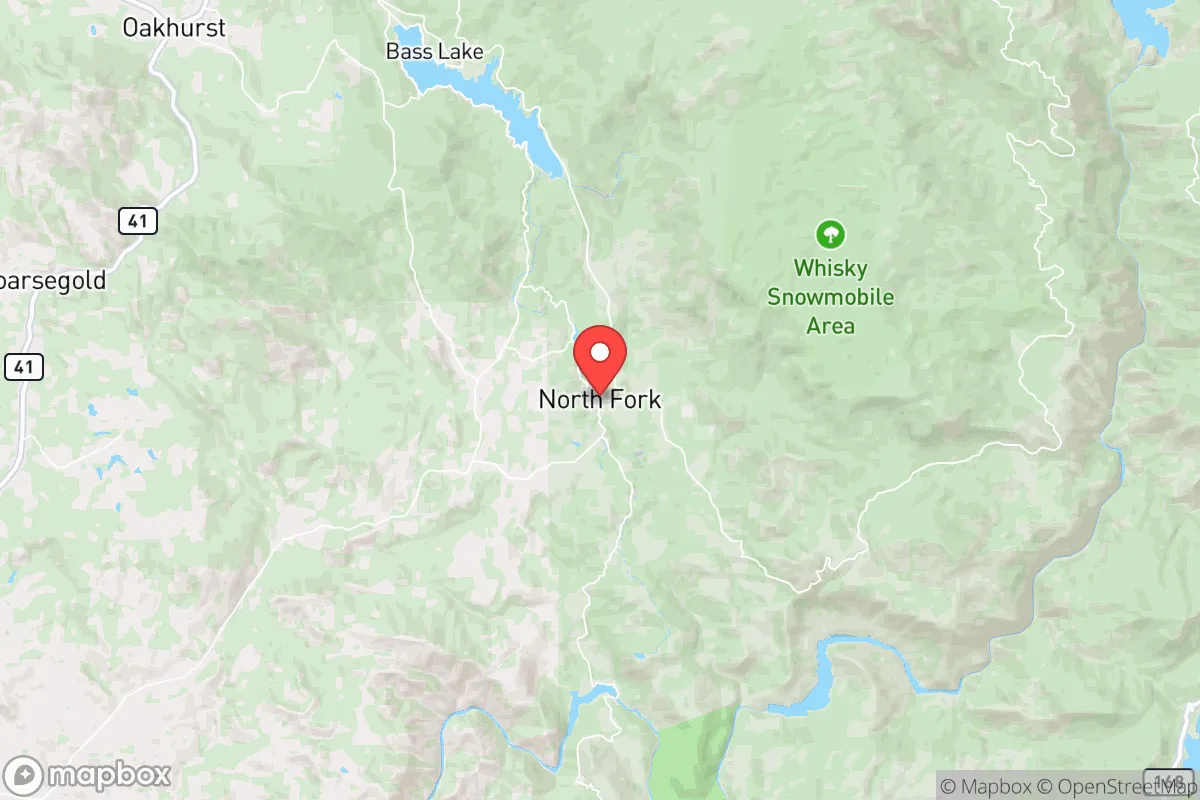
District shown is the primary district for this city’s centroid. Cities may span multiple districts.
Local Political AnalysisPolitical Analysis of North Fork, CA
North Fork, California, is a solidly conservative pocket in the Sierra foothills, carrying a Cook Political Report Partisan Voting Index of R+8. That means the area votes roughly eight points more Republican than the national average, a stark contrast to the state of California as a whole, which leans heavily Democratic. The political trajectory here has been remarkably stable over the past decade, with registered Republicans maintaining a consistent edge over Democrats in Madera County precincts, though the area has seen a slight uptick in "No Party Preference" voters since 2020 without fundamentally shifting the balance of power.
How it compares
The gap between North Fork and the rest of California is not just a matter of party registration—it's a lived reality. While the state legislature in Sacramento pushes progressive policies on housing, energy, and criminal justice, North Fork voters consistently elect officials who prioritize property rights, water access, and timber industry protections. The contrast is sharpest when you look at nearby towns: Bass Lake and Oakhurst lean Republican but are more moderate, while a drive west to Fresno reveals a politically divided city with a strong Democratic base. North Fork sits at the eastern edge of Madera County, where the rural character and the absence of major urban centers reinforce its conservative identity. In the 2022 gubernatorial race, the precinct voted for the Republican challenger by a margin closer to 20 points, even as the state handed Gavin Newsom a landslide victory.
What this means for residents
For conservative residents, the local political climate means their votes carry weight in county-level races—sheriff, supervisor, and district attorney—where Republican candidates rarely face serious Democratic opposition. It also means local schools and fire districts operate with a leaner, more pragmatic approach to budgeting than their coastal counterparts. For liberal residents, the reality is more isolating. They are a clear minority, and national issues like abortion access or gun control rarely get a sympathetic hearing at local town halls. However, the small population (roughly 1,400 in the immediate community) means politics is less anonymous than in a city; neighbors tend to get along regardless of party, and the local general store and diner are spaces where political differences are often set aside for practical community concerns like road maintenance and wildfire preparedness.
Cultural and policy distinctions
The cultural texture of North Fork is defined less by partisan activism and more by a shared frontier pragmatism. The area has a significant Native American presence—the North Fork Rancheria of Mono Indians operates the Chukchansi Gold Resort & Casino nearby—and tribal sovereignty issues often cross party lines. Gun ownership is near-universal, and the Second Amendment is treated as a cultural given rather than a talking point. On environmental policy, residents are skeptical of state-level land-use restrictions, but they are also fiercely protective of the Sierra National Forest that surrounds them, creating a nuanced position that defies simple red-state/blue-state labels. Looking forward, the political lean is unlikely to shift dramatically, though an influx of remote workers from the Bay Area since 2020 has introduced a small but growing cohort of progressive-leaning newcomers. If that trend accelerates, North Fork could see its R+8 rating soften to something closer to R+5 over the next decade—still conservative, but less monolithically so.

State Political ClimatePolitical Climate in California
State Political AnalysisPolitical Environment in the State
California is a solidly Democratic state, with Democrats holding every statewide office and commanding supermajorities in both legislative chambers, but the reality on the ground is far more textured than the headline numbers suggest. The state’s 20-point Democratic advantage in the 2024 presidential race (58.5% to 38.2%) masks a deep geographic and cultural chasm between the coastal metros and the vast interior. Over the last two decades, the state has drifted leftward on social issues while a significant, organized conservative minority has consolidated in specific regions, creating a political landscape that feels like two different countries sharing one flag.
Urban vs. rural divide
The political map of California is essentially a story of three distinct zones. The Bay Area — San Francisco, Oakland, and San Jose — is the engine of the state’s progressive movement, routinely delivering 75-85% of its vote to Democrats. Los Angeles County, with its 10 million residents, is the other pillar, though its internal dynamics are shifting; the city of Los Angeles remains deeply blue, but the suburban San Fernando Valley and the exurbs of Santa Clarita and Palmdale have shown surprising Republican resilience in local races. The Central Valley — from Bakersfield up through Fresno and Modesto to Redding — is the state’s conservative heartland, where voters feel economically and culturally disconnected from Sacramento. Bakersfield, the largest city in Kern County, is a Republican stronghold that hasn’t voted for a Democratic presidential candidate since 1936. The Inland Empire (Riverside and San Bernardino counties) is the true battleground; these fast-growing suburbs flipped from red to blue in the 2018 wave but remain competitive, with Republican candidates winning local races in places like Temecula and Murrieta. Orange County, once the national symbol of suburban conservatism, has completed its transformation into a purple-to-blue county, though the cities of Huntington Beach and Yorba Linda remain defiantly conservative outposts.
Policy environment
California’s policy environment is defined by its status as a high-tax, high-regulation state. The state income tax tops out at 13.3% — the highest in the nation — and applies to incomes over $1 million, while the sales tax base rate is 7.25% but balloons past 10% in many cities once local add-ons are included. Proposition 13, passed in 1978, still caps property tax increases at 2% annually, which means longtime homeowners pay a fraction of what new buyers pay — a system that creates a powerful incentive to never move. The regulatory posture is aggressive: the California Environmental Quality Act (CEQA) gives citizens and interest groups broad standing to sue and delay virtually any development project, which is a major reason housing costs are so high. On education, the state has moved decisively toward progressive positions, including a 2024 law (AB 1955) that prohibits schools from requiring staff to notify parents if a student identifies as transgender. Healthcare is heavily regulated, with the state running its own insurance exchange (Covered California) and expanding Medi-Cal to cover all low-income adults regardless of immigration status. Election law is among the most accessible in the country: every registered voter receives a mail-in ballot automatically, same-day registration is available, and felons on parole can vote.
Recent policy direction
The last five years have seen California double down on its progressive identity while also showing flashes of pragmatism. On gun policy, the state has some of the strictest laws in the nation — a 2023 law (SB 2) banned carrying firearms in 26 categories of "sensitive places" including parks, stadiums, and public transit, and a 2024 measure (Prop 36) partially rolled back earlier criminal justice reforms by reclassifying certain theft and drug offenses as felonies. On parental rights, the state has moved decisively in the opposite direction of states like Florida, with laws protecting transgender students' privacy from their own parents. On property rights, the state has begun to crack down on short-term rentals and is experimenting with rent control, though a 2020 ballot measure to expand rent control (Prop 21) failed. On taxation, the state passed a "wealth tax" proposal in 2024 that would tax unrealized capital gains on billionaires, though it faces legal challenges. On voting access, California has expanded mail-in voting and automatic voter registration, making it one of the easiest states to vote in — a stark contrast to the voter ID laws passed in Texas and Florida.
Civil unrest & political movements
California has a long history of political activism that shapes its current climate. The state’s sanctuary state status, codified in 2017’s SB 54, prohibits local law enforcement from cooperating with federal immigration authorities in most circumstances — a policy that has made cities like Los Angeles and San Francisco flashpoints in the national immigration debate. The 2020 George Floyd protests were particularly intense in Portland, Seattle, and Los Angeles, with the latter seeing significant property damage and a subsequent backlash that helped fuel a 2022 recall attempt against District Attorney George Gascón (which failed to gather enough signatures). On the right, the secessionist movement — "Calexit" — has fizzled since its 2016 peak, but rural counties have floated "State of Jefferson" proposals for decades, with the most recent push in 2023 gaining traction in Siskiyou and Modoc counties. The state has also been a battleground for school board politics, particularly in Orange County’s Huntington Beach, which passed a 2023 ordinance banning transgender athletes from competing in girls’ sports at city facilities — a direct challenge to state law. The homelessness crisis is the most visible political flashpoint; San Francisco’s tent encampments and the 2024 Supreme Court ruling in Grants Pass v. Johnson (which allowed cities to ban camping) have forced local governments to take a harder line, with Sacramento and Los Angeles both ramping up enforcement.
Projection
Over the next 5-10 years, California’s political trajectory is likely to remain firmly Democratic at the statewide level, but the margins will tighten in specific regions. The state’s population has declined for three consecutive years (losing roughly 500,000 residents since 2020), with the biggest out-migration coming from the Bay Area and Los Angeles — many of those leavers are moderate and conservative families relocating to Texas, Arizona, and Idaho. However, the state continues to attract international immigrants and young professionals, which replenishes the Democratic base. The Inland Empire will be the key battleground; if Republicans can make inroads there, they could flip a few congressional seats, but the state’s gerrymandered districts (drawn by an independent commission) make a statewide Republican comeback unlikely. The housing crisis will dominate politics; expect more state preemption of local zoning laws, which could shift some suburban voters toward Republicans who promise to protect single-family neighborhoods. The fiscal picture is the wildcard — the state faces a projected $68 billion budget deficit in 2025, which will force painful cuts and could erode public support for the progressive agenda.
For a new resident, the bottom line is this: California offers a world-class economy, stunning geography, and a dynamic culture, but you will pay for it — in taxes, in housing costs, and in a political environment that is unapologetically progressive. If you lean conservative, you can find your people in Bakersfield, Temecula, or Huntington Beach, but you will be a permanent minority in state politics, and your vote will rarely change the outcome of statewide races. If you lean liberal, you will find California a comfortable and affirming place, but you should be prepared for the state’s fiscal instability and the visible consequences of its homelessness and housing policies. Either way, the state’s trajectory is clear: it will remain a progressive laboratory, and the question is not whether it will change course, but how the rest of the country reacts to what it produces.
* Values derived from national, state, county, city and local statistics and may differ in a specific area. Last updated: 2026-10-21T10:02:19.000Z
Narrative content on this page is AI-generated and may contain mistakes. Verify any details that matter before acting on them.
ReloMaps may earn a commission from affiliate links at no extra cost to you.

