Photo: Wikipedia
Demographics of Williams County
Affluence Level in Williams County
A middle-class area roughly in line with national averages across income, home values, education, and employment.
People of Williams County
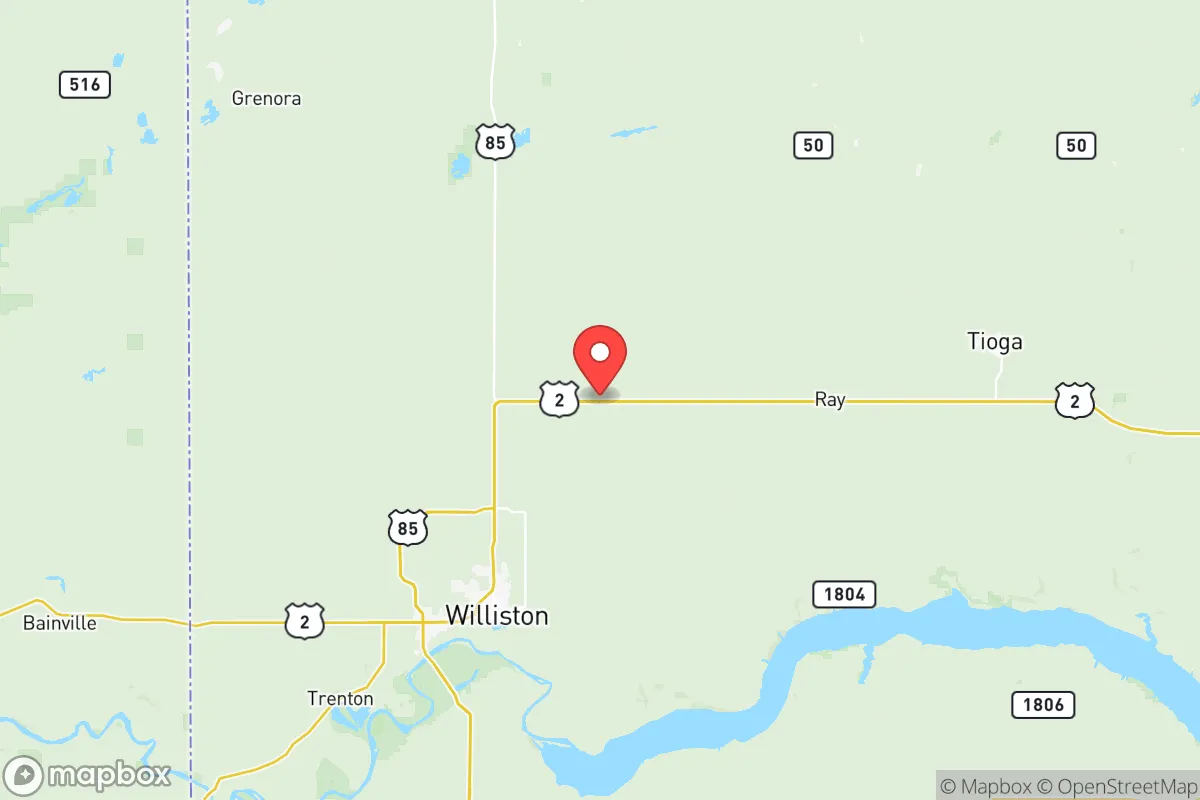
The people of Williams County, North Dakota today number roughly 39,400, a population that is predominantly white (76.7%) but notably more diverse than the state average, with a significant Hispanic community (9.7%) and a growing Black population (5.2%). The county’s character is shaped by its dual identity as both a historic agricultural hub and a modern energy boomtown, centered on the city of Williston and extending into smaller communities like Tioga, Ray, and Wildrose. Residents tend to be younger and more transient than the rest of the state, with a median age in the low 30s, reflecting the labor-driven in-migration of the past two decades. The county’s foreign-born population stands at 4.2%, a figure that has risen sharply since 2000, and its college-educated share is 23.7%, slightly below the national average.
Settlement & growth (pre-1960)
Before European settlement, the area that is now Williams County was part of the traditional territory of the Mandan, Hidatsa, and Arikara (Three Affiliated Tribes), who lived in semi-permanent earth-lodge villages along the Missouri River to the south. The nomadic Lakota Sioux also ranged through the region. The first European presence was sparse: French fur traders and British explorers passed through in the 18th and early 19th centuries, but no permanent non-Native settlement occurred until after the 1862 Homestead Act and the 1887 Dawes Act opened the land to white homesteaders.
The first major wave of settlers arrived in the 1880s and 1890s, drawn by the promise of 160-acre homesteads under the Homestead Act and the extension of the Great Northern Railway. These were overwhelmingly Northern European immigrants: Norwegians, Swedes, and Germans from Russia (ethnic Germans who had lived in the Volga region of Russia for generations). They established the county’s first towns—Williston (founded 1887 as a railroad stop), Tioga (settled by Norwegian farmers in the 1890s), and Ray (a farming community platted in 1906). The land was flat, fertile, and treeless, ideal for wheat farming, and the settlers built a network of grain elevators and small trading posts.
A second wave came during the 1910s and 1920s, as the federal Enlarged Homestead Act of 1909 doubled the land grant to 320 acres in semi-arid regions. This attracted more homesteaders, including a notable number of Canadian immigrants from Manitoba and Saskatchewan, who crossed the border seeking cheaper land. The county’s population peaked at around 16,000 in 1930, then collapsed during the Dust Bowl and Great Depression. Severe drought and falling wheat prices drove thousands off the land; by 1940, the population had fallen to 12,000. Many of those who left were the so-called “Okies” of the northern Plains, moving to the Pacific Northwest or California.
The post-World War II period brought modest recovery. The discovery of oil in the Williston Basin in 1951 triggered a small boom, but it was limited by technology and infrastructure. Williston grew as a service center, while Grenora and Wildrose remained agricultural hamlets. The county’s population hovered around 14,000 through the 1950s and 1960s, sustained by a mix of wheat farming, ranching, and oil-field support jobs.
Modern era (post-1965)
The 1965 Hart-Cellar Act had little immediate effect on Williams County, as the region remained overwhelmingly white and rural through the 1990s. The real demographic transformation began after 2000, driven not by immigration but by a massive domestic energy boom. The development of horizontal drilling and hydraulic fracturing in the Bakken shale formation turned Williams County into the epicenter of the largest oil boom in U.S. history. Between 2000 and 2015, the county’s population more than doubled, from 19,000 to over 40,000.
This boom attracted a new population unlike the county’s historic settlers. The majority were domestic migrants from other states—Texas, Oklahoma, Colorado, and Louisiana—bringing oil-field skills and a more culturally conservative, evangelical Christian character. A significant number also came from the Hispanic Southwest, particularly from New Mexico and Texas, drawn by high wages in construction and oil services. This wave concentrated in Williston and the new “man camps” (temporary worker housing) on the outskirts, but also spilled into Tioga and Ray, where housing shortages drove rents to among the highest in the nation.
The Hispanic population grew from under 2% in 2000 to 9.7% today, making it the largest minority group. Many are of Mexican-American descent, with smaller numbers from Central America. They have established a visible presence in Williston’s service sector and construction trades, and a small but growing number have opened businesses, including Mexican restaurants and grocery stores. The Black population, now 5.2%, is largely composed of African-American workers from the Gulf Coast and the Southeast, who arrived during the peak boom years (2010–2015) and have remained, forming a small but stable community centered in Williston’s rental neighborhoods.
The East/Southeast Asian population (1.1%) is small but notable, consisting primarily of Filipino and Vietnamese workers in healthcare and oil-field support roles. The Indian subcontinent population is negligible (0.0%). The foreign-born share (4.2%) is lower than the national average but represents a significant increase from near-zero in 1990, driven by temporary workers on H-2B visas and a small number of permanent residents.
Suburbanization has been limited by the county’s rural character. The only real suburban-style development is in the northern and eastern edges of Williston, where new subdivisions of single-family homes have been built since 2010. Most of the county’s smaller towns—Grenora, Wildrose, Alamo—have seen population decline as young people move to Williston or leave the region entirely.
The future
Williams County’s population is likely to stabilize or decline slightly over the next decade, as the Bakken boom matures and automation reduces the need for manual labor in the oil fields. The county’s population peaked at around 41,000 in 2015 and has since fallen to 39,368, a trend that is expected to continue. The Hispanic and Black populations are likely to remain stable or grow slowly, as families put down roots and second-generation children enter the workforce. The white population, which is older and more likely to leave for retirement, will probably shrink as a share of the total.
The county is becoming slightly more diverse, but it will remain a predominantly white, conservative, working-class region. The cultural identity is shifting from a historic Scandinavian-German farming ethos to a more generic “oil-patch” culture, with influences from Texas and the Mountain West. New residents are concentrating in Williston and, to a lesser extent, Tioga, while the outlying towns continue to depopulate. The next 10–20 years will likely see a slow consolidation of population into Williston, with the county’s rural character preserved but its economic dependence on oil remaining high.
For someone moving in now, Williams County offers a place where hard work in the energy sector can still yield high wages, but where the social fabric is still being shaped by the boom’s aftermath. It is a community in transition—less isolated than it was in 1990, but still far from the diversity of the nation’s major metros. The people are pragmatic, politically conservative, and accustomed to rapid change, making it a viable choice for those seeking economic opportunity in a small-town setting.

* Values derived from national, state, county, city and local statistics and may differ in a specific area. Last updated: 2026-10-21T23:32:38.000Z
Narrative content on this page is AI-generated and may contain mistakes. Verify any details that matter before acting on them.
ReloMaps may earn a commission from affiliate links at no extra cost to you.

