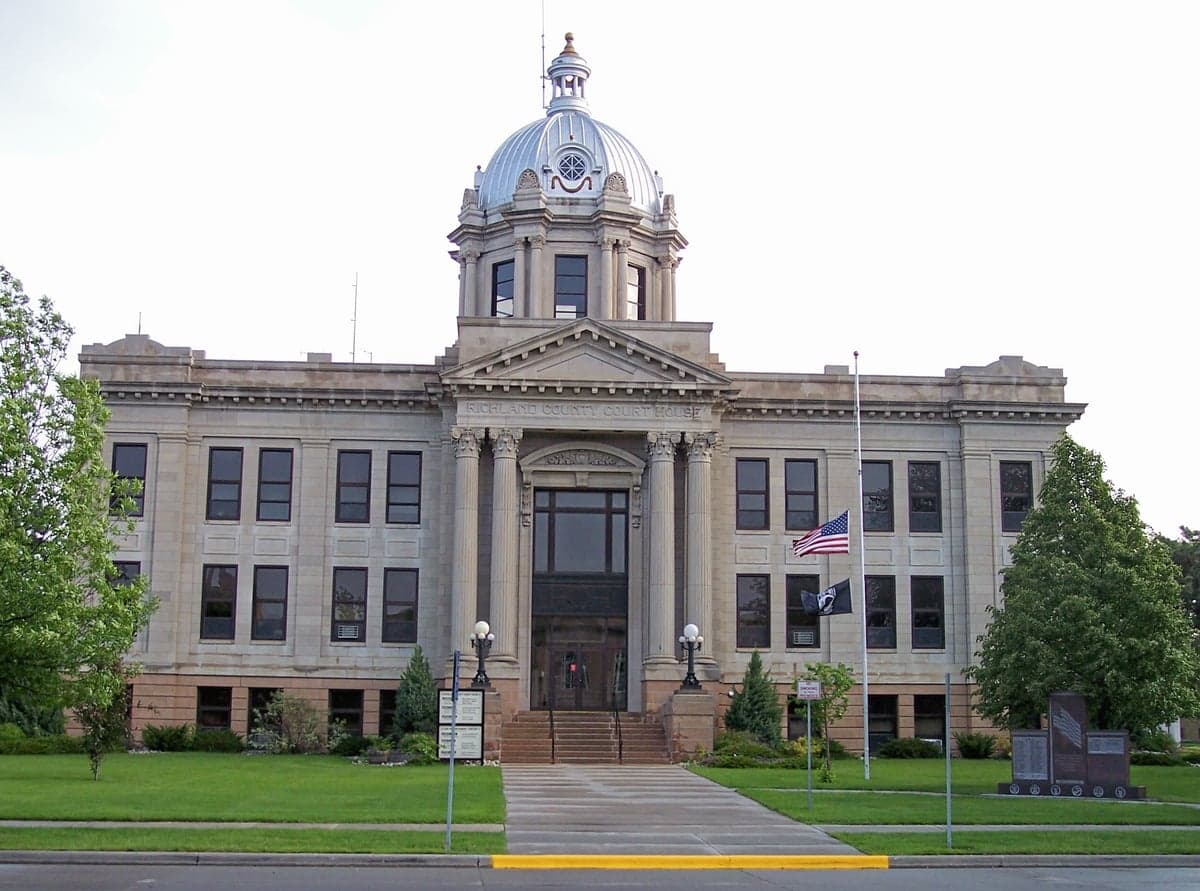
Photo: Wikipedia
Political ClimatePolitical Climate in Richland County
Showing state-level results — no local-only data available.
Local Political AnalysisPolitical Analysis of Richland County
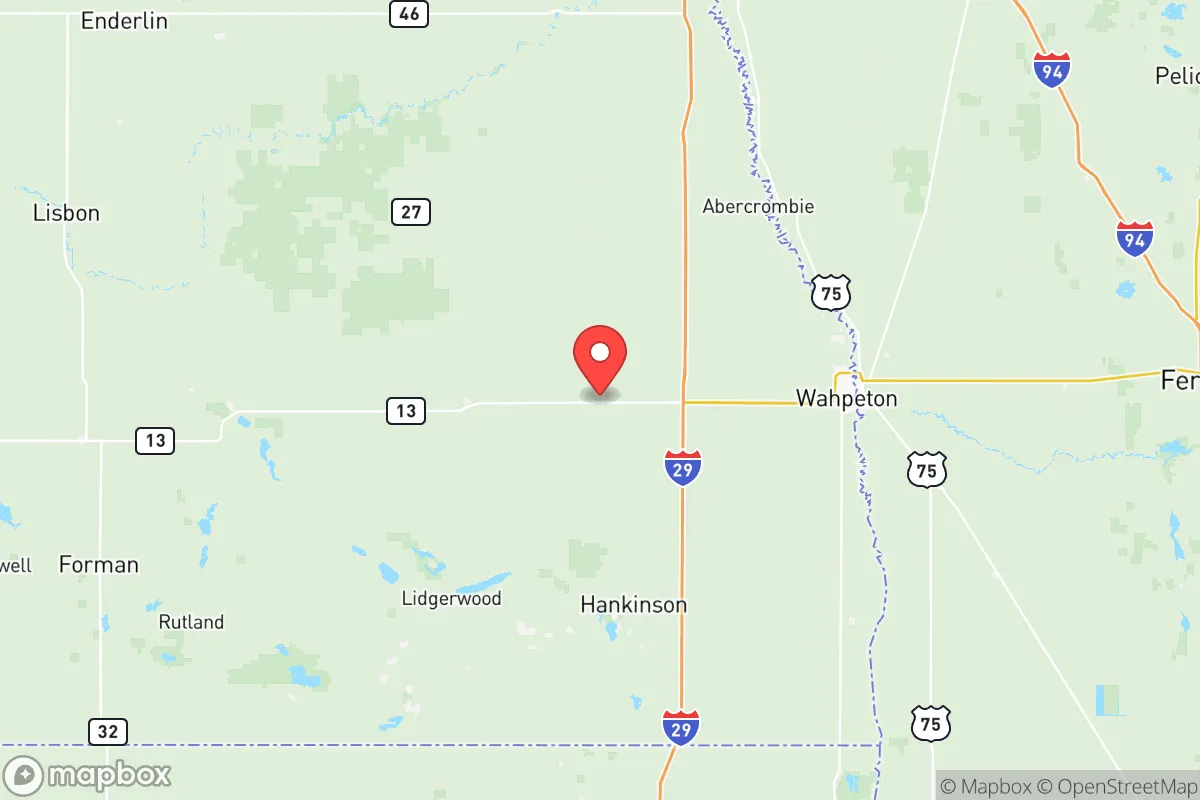
Richland County, North Dakota, is a reliably Republican stronghold with a Cook Partisan Voting Index (PVI) of R+18, meaning it votes about 18 points more Republican than the national average. This isn't a new development; the county has been solidly red for decades, though the margins have tightened slightly in presidential elections since 2016 as the rural-urban divide has sharpened. The county seat, Wahpeton, is the political and economic hub, and while it still leans Republican, it's the most moderate part of the county—precincts around the North Dakota State College of Science and the hospital tend to be the least conservative. In contrast, the smaller towns like Lidgerwood, Hankinson, and Wyndmere are deeply red, often voting 70-80% Republican in statewide races. The only real blue outliers are a few precincts in the far southeastern corner, near the Minnesota border, where some farm families have historically voted Democrat, but those are shrinking in number.
How it compares to North Dakota as a whole
North Dakota as a state is also deeply Republican, but Richland County is actually a bit more conservative than the state average. While the state's PVI is unknown, statewide races often see Republicans winning by 20-30 points, and Richland County typically runs 5-10 points ahead of that. For example, in the 2024 presidential election, Donald Trump won the county with about 68% of the vote, compared to roughly 63% statewide. The difference comes down to the county's lack of a major urban center like Fargo or Bismarck, which have more moderate and even some liberal precincts. Richland County is almost entirely rural and agricultural, with no city over 10,000 people, so the political culture is more homogeneous. The only real swing area is Wahpeton's 1st precinct, which includes the college and some newer subdivisions—it still leans Republican, but by a narrower 55-45 margin, making it the closest thing to a purple precinct in the county.
What this means for residents
For conservative residents, the political climate is comfortable and affirming. Local offices—county commission, school board, sheriff—are almost always held by Republicans, and policy debates tend to focus on agricultural issues, property taxes, and maintaining rural infrastructure. There's little pressure to moderate views, and conservative candidates rarely face serious primary challenges. For liberal or moderate residents, the reality is different. They are a distinct minority, and while there's no open hostility, they often feel politically isolated. In Wahpeton, it's easier to find like-minded people, especially around the college, but in the smaller towns, many progressives simply don't discuss politics publicly. The practical effect is that local government moves slowly on issues like renewable energy or expanded social services, and there's strong resistance to any new state or federal mandates. That said, the county's small size means personal relationships often trump party lines—your neighbor's politics matter less than whether you help with harvest or show up at a funeral.
Culturally, Richland County is defined by its agricultural roots and a strong sense of self-reliance. There's a deep skepticism of government overreach, whether from Bismarck or Washington, and a preference for local control. This manifests in policies like low property taxes (among the lowest in the state) and a reluctance to adopt zoning laws. The county also has a notable Norwegian Lutheran heritage, which shapes community values around modesty, hard work, and volunteerism. Unlike some parts of the state, there's little overt culture war conflict—most people agree on the basics, and the few disagreements tend to be about school funding or road maintenance, not national hot-button issues. For anyone moving here, the key takeaway is that Richland County is a place where your vote is unlikely to change the outcome, but your participation in the community—church, sports, the county fair—will define your experience far more than your party registration.

State Political ClimatePolitical Climate in North Dakota
State Political AnalysisPolitical Environment in the State
North Dakota has been a reliably Republican state for decades, but the flavor of that conservatism has shifted noticeably over the past 10-20 years. The state’s overall partisan lean is deep red — Donald Trump won it by 33 points in 2024, and no Democratic presidential candidate has carried it since Lyndon Johnson in 1964. But the dominant coalition has moved from a pragmatic, farm-and-energy-based Republicanism toward a more culturally conservative, Trump-aligned posture. The old guard of moderate GOP legislators who controlled the statehouse through the 2000s has been steadily replaced by a newer wave of hardline conservatives, especially after the 2016 and 2020 cycles. This shift matters for anyone moving here: the political environment is more ideologically consistent than it was a generation ago, but also more polarized along urban-rural and generational lines.
Urban vs. rural divide
The political map of North Dakota is starkly divided between a handful of small urban centers and vast rural expanses. The state’s largest city, Fargo, in Cass County, is the most competitive area — Cass County voted for Trump by only 12 points in 2024, a far cry from the 50- to 70-point margins seen in rural counties like Hettinger or Slope. Fargo’s growth, driven by North Dakota State University, healthcare expansion, and a diversifying tech-and-service economy, has introduced a modest but persistent liberalizing influence. Grand Forks, home to the University of North Dakota, follows a similar pattern, though its county (Grand Forks) is slightly redder than Cass. Bismarck and Mandan, the capital region, are reliably conservative but with a more establishment, pro-business bent — think Chamber of Commerce Republicans rather than firebrands. The real engine of the state’s hard-right tilt is the rural oil patch in the northwest, anchored by Williston and Watford City. Williams County, home to Williston, voted +70 for Trump in 2024, driven by an influx of out-of-state oil workers and a libertarian-leaning, anti-regulation ethos. Meanwhile, Minot, in Ward County, is a conservative military town (home to Minot Air Force Base) that votes similarly but with a slightly more stable, family-oriented demographic. The only reliably Democratic-leaning area is the Turtle Mountain Chippewa Reservation near Belcourt, where tribal sovereignty and federal funding concerns drive strong Democratic turnout, but its population is too small to shift statewide results.
Policy environment
North Dakota’s policy environment is shaped by its reliance on oil, agriculture, and a small population that prizes low taxes and minimal regulation. There is no state income tax on individuals — a major draw for relocators — and the corporate income tax rate was cut to a flat 1.5% in 2023. Property taxes are relatively high by national standards (around 0.9% of assessed value on average), but the state offers a homestead credit for primary residences. The regulatory posture is light-touch: the state has no broad environmental review law for oil and gas drilling, and the Department of Environmental Quality is widely seen as industry-friendly. Education policy is locally controlled, with no state-level curriculum mandates beyond basic standards; school choice is limited, but a 2023 law created education savings accounts for special-needs students. Healthcare policy is conservative: the state did not expand Medicaid under the Affordable Care Act until a 2018 ballot measure forced it, and even then, the legislature added work requirements in 2021. Election laws are among the most restrictive in the nation: voter ID with a strict photo requirement, no same-day registration, and a 2021 law that eliminated the state’s popular vote-by-mail option (though absentee voting remains available with an excuse).
Recent policy direction
Over the last five years, North Dakota’s legislature has moved aggressively on cultural and liberty issues. On gun and self-defense law, the state enacted permitless carry in 2017 and a “stand your ground” law in 2021 — no duty to retreat applies anywhere a person is lawfully present. Parental and education rights saw a major win for conservatives with the 2023 passage of HB 1205, which prohibits instruction on gender identity and sexual orientation in K-5 classrooms and requires parental notification for any health services offered in schools. On speech and privacy, the state passed a 2023 law banning TikTok on government devices and a 2024 law requiring social media platforms to verify the age of users under 18. Medical and bodily autonomy is sharply restricted: abortion is banned at all stages of pregnancy with no exceptions for rape or incest, only for the life of the mother (triggered by the 2022 Dobbs decision). The 2023 legislature also passed a law banning gender-affirming care for minors, overriding a veto from Governor Doug Burgum. Property rights are generally strong, but the state’s 2023 “anti-CBD” law (SB 2097) restricted foreign ownership of agricultural land, a populist measure aimed at Chinese and other foreign entities. Taxation continues to trend downward: the 2023 session cut the top individual income tax rate from 2.9% to 1.5% and eliminated the tax on military pensions. Voting and ballot access tightened further in 2023 with a law requiring absentee ballots to be received by election day (not just postmarked), and a 2024 law that made it a felony for third parties to distribute absentee ballot applications.
Civil unrest & political movements
North Dakota is not a hotbed of street-level political conflict, but it has seen notable flashpoints. The most famous is the Dakota Access Pipeline protests near the Standing Rock Reservation in 2016-2017, which drew thousands of activists from across the country and resulted in mass arrests and a lasting scar between tribal communities and state law enforcement. That event radicalized a segment of the state’s left and solidified the oil industry’s political dominance. On the right, the “constitutional sheriff” movement has gained traction in rural counties like McKenzie and Williams, where sheriffs have publicly stated they will not enforce federal gun laws they deem unconstitutional. There is no serious secession or nullification movement — North Dakota’s identity is firmly American — but there is a strong strain of anti-federal sentiment, especially around land management (the state has sued the Biden administration over oil and gas leasing). Immigration politics are muted because the state’s foreign-born population is tiny (around 4%), but a 2023 law made it a state crime for unauthorized immigrants to enter North Dakota from another state. Election integrity controversies have been minimal; the state’s small population and paper ballot system have produced few disputes, though the 2020 election saw a brief controversy over the counting of absentee ballots in Cass County.
Projection
Over the next 5-10 years, North Dakota’s political trajectory points toward continued conservative consolidation, but with a few wild cards. The biggest demographic shift is the ongoing growth of Fargo and its suburbs (like West Fargo and Horace), which are attracting younger, more educated, and slightly more moderate residents. If this trend accelerates, Cass County could become competitive at the state legislative level by the early 2030s, potentially creating a small but vocal Democratic minority in the statehouse. However, the rural oil patch is also growing, and its voters are among the most conservative in the nation. The state’s population is aging and white (over 85% non-Hispanic white), which tends to reinforce Republican dominance. The wild card is the Legislative Assembly’s term limits, passed by voters in 2022, which will force out many long-serving incumbents starting in 2026. This could accelerate the shift toward hardline conservatives, as newer members are less tied to the old farm-and-energy establishment. For a relocator, the bottom line is this: North Dakota will remain a deeply conservative state for the foreseeable future, but the flavor of that conservatism is becoming more culturally focused and less pragmatic. A conservative moving here will find a government that broadly shares their values on taxes, guns, education, and abortion. A liberal will find a state where their vote carries little weight in statewide elections, but where Fargo and the university towns offer a small, like-minded community and a functional local government that doesn’t interfere much in daily life.
For anyone considering a move, the practical takeaway is straightforward. If you value low taxes, minimal regulation, strong gun rights, and a government that takes a culturally conservative stance on education and family policy, North Dakota will feel like a natural fit. If you lean left, you’ll be in a clear minority, but you won’t face hostility in daily life — the state’s small population and strong sense of neighborliness mean most people are polite even when they disagree. The key is to pick your location wisely: Fargo for a more moderate, diverse environment; Bismarck for a stable, establishment-conservative vibe; Williston or Watford City for a libertarian-leaning, boomtown energy; and the rural counties for a deeply traditional, community-oriented life. Just know that the political winds are blowing consistently in one direction, and that direction is right.
* Values derived from national, state, county, city and local statistics and may differ in a specific area. Last updated: 2026-07-02T16:30:03.000Z
Narrative content on this page is AI-generated and may contain mistakes. Verify any details that matter before acting on them.
ReloMaps may earn a commission from affiliate links at no extra cost to you.

