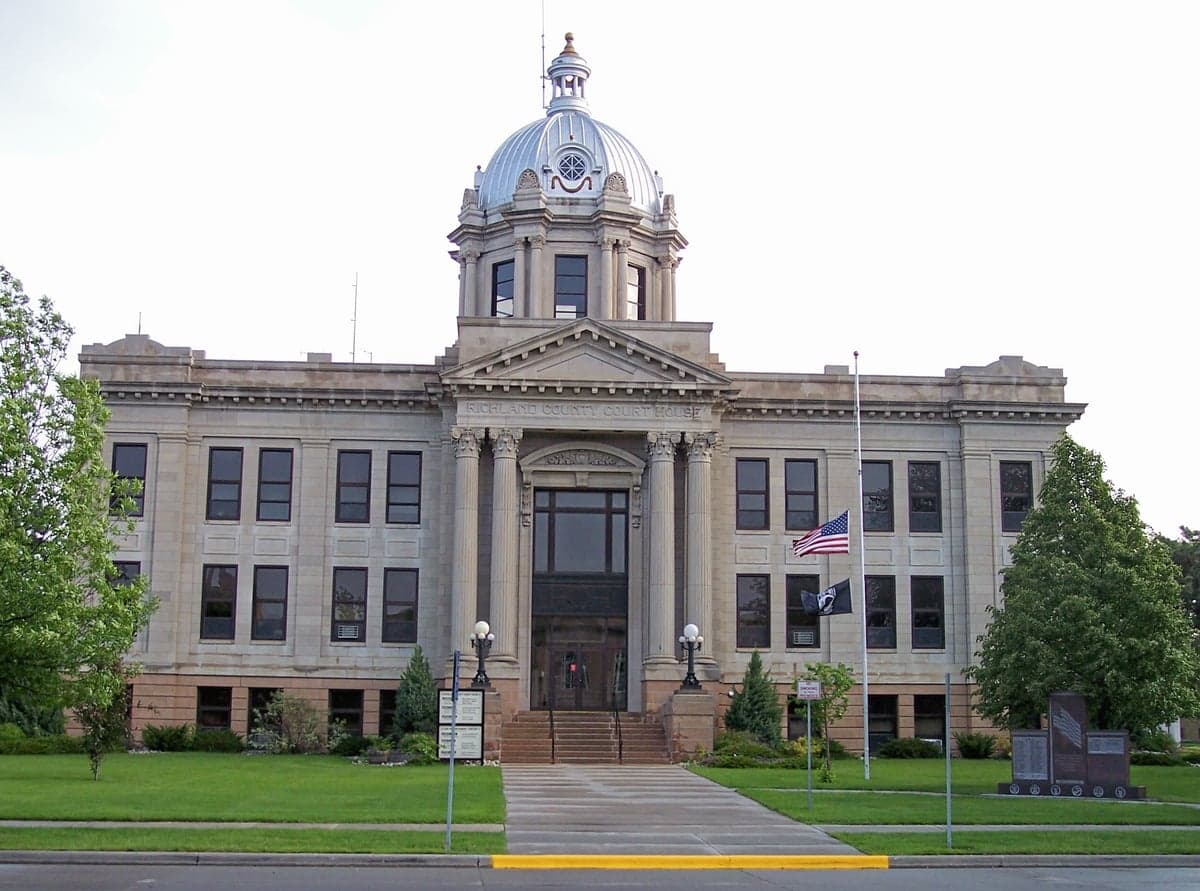
Photo: Wikipedia
Demographics of Richland County
Affluence Level in Richland County
A middle-class area roughly in line with national averages across income, home values, education, and employment.
People of Richland County
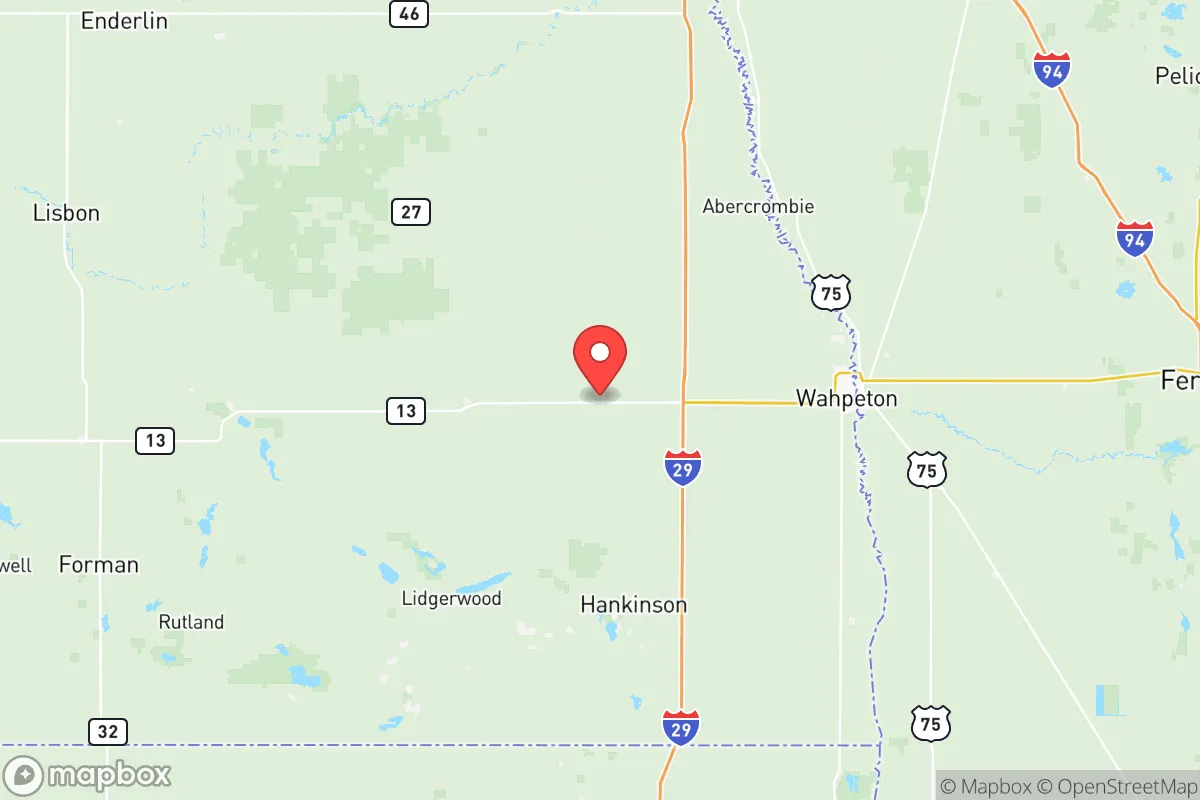
The people of Richland County, North Dakota, today number roughly 16,550, forming a predominantly white, rural population with a distinctly agricultural character. The county is anchored by the city of Wahpeton, which serves as the commercial and cultural hub, while smaller communities like Lidgerwood, Wyndmere, and Hankinson dot the prairie landscape. With a foreign-born population of just 0.5% and a 89.1% white demographic base, Richland County remains one of the least ethnically diverse counties in the state, reflecting its deep roots in Scandinavian and German settlement patterns. The population is older than the national median, with a college attainment rate of 25.0%, and the county's identity is closely tied to the Red River Valley's fertile farmland and the small-town values that have persisted for generations.
Settlement & growth (pre-1960)
Before European settlement, the area that is now Richland County was inhabited by the Dakota (Sioux) people, particularly the Sisseton and Wahpeton bands, who lived along the Red River and its tributaries. The land was part of the vast tallgrass prairie, used for seasonal hunting and gathering. The first European Americans to arrive were fur traders and explorers in the early 19th century, but permanent settlement did not begin until after the 1851 Treaty of Traverse des Sioux and subsequent land cessions opened the region to homesteading.
The major wave of settlement came in the 1870s and 1880s, driven by the Homestead Act of 1862 and the expansion of the railroad. Norwegian immigrants were among the first to arrive, drawn by the promise of cheap, fertile land in the Red River Valley. They established farms and communities throughout the county, with a particularly strong concentration in the area around Wyndmere and Lidgerwood. German immigrants from Russia, often called Germans from Russia, arrived in the 1880s and 1890s, bringing with them wheat-farming expertise adapted to the harsh plains climate. They settled heavily in the southern part of the county, including the towns of Hankinson and Fairmount. Irish and Czech immigrants also arrived in smaller numbers, adding to the ethnic mosaic.
The city of Wahpeton, founded in 1869 as a steamboat landing on the Red River, grew as the county seat and commercial center. Its name is derived from the Dakota word "Wahpeton," meaning "leaf village," a nod to the original inhabitants. The arrival of the Northern Pacific Railway in the 1870s cemented Wahpeton's role as a regional trade hub. By 1900, the county's population had swelled to over 12,000, almost entirely white and overwhelmingly of Northern European descent. The economy was dominated by wheat farming, with the Red River Valley's rich black soil producing some of the highest yields in the nation.
The Dust Bowl and Great Depression of the 1930s hit Richland County hard, as drought and low crop prices drove many farmers off the land. The population declined from a peak of 19,659 in 1930 to 16,080 by 1940. World War II brought some economic recovery through increased agricultural demand, but the post-war period saw continued rural depopulation as mechanization reduced the need for farm labor. Young people left for cities like Fargo and Minneapolis, and the county's population stagnated through the 1950s.
Modern era (post-1965)
The 1965 Hart-Cellar Act, which dramatically reshaped U.S. immigration patterns, had almost no effect on Richland County. The county's foreign-born population today stands at just 0.5%, far below the national average of 13.7%. Unlike many parts of the country that saw waves of immigration from Asia, Latin America, and Africa after 1965, Richland County remained overwhelmingly white and native-born. The small Hispanic population, currently 3.7%, is largely composed of Mexican-American families who arrived in the 1990s and 2000s to work in agriculture, particularly in the sugar beet and potato fields around Wahpeton and Hankinson. These families have established a modest presence, but no large ethnic enclave has formed.
The county's Black population is 0.9%, and the East/Southeast Asian population is 0.2%, both tiny and largely concentrated in Wahpeton, where a few families have moved for employment at the North Dakota State College of Science or at local manufacturing plants like Bobcat Company. The Indian subcontinent population is effectively zero. Domestic migration has been the primary demographic force since 1965, and it has been largely negative: young adults continue to leave for urban centers, while the county attracts few newcomers from other states. The population has hovered around 16,000 to 17,000 for decades, with a slight decline from 17,998 in 2000 to 16,550 today.
Suburbanization has been minimal. Wahpeton has seen some growth in its outskirts, with new housing developments catering to retirees and commuters who work in the city or at nearby farms. However, the county lacks a major metropolitan area to drive suburban expansion. The small towns of Lidgerwood, Wyndmere, and Hankinson have all experienced population loss, with aging populations and shuttered main streets. The county's cultural identity remains rooted in its Scandinavian and German heritage, celebrated through events like the Wyndmere Corn Feed and the Hankinson Threshing Bee.
The future
The demographic trajectory of Richland County points toward continued slow decline and aging. The population is projected to fall to roughly 15,500 by 2040, according to state estimates, as the death rate exceeds the birth rate and out-migration of young adults continues. The county will become slightly more diverse, but only marginally: the Hispanic share may rise to 5-6% as agricultural labor needs persist, and a small number of East/Southeast Asian families may settle in Wahpeton for jobs in manufacturing and healthcare. However, the white share will remain above 85% for the foreseeable future.
New communities are unlikely to form in the county's rural areas. Instead, any population growth will concentrate in Wahpeton, which benefits from its role as a regional service center and the presence of the North Dakota State College of Science, which attracts a small number of out-of-state students. The county's cultural identity will remain strongly tied to its agricultural heritage and Scandinavian-German roots, with little pressure from outside groups to change. The challenge for the county will be retaining young people and attracting new residents, particularly as the farm economy faces pressures from commodity prices and climate change.
For someone moving in now, Richland County offers a stable, safe, and deeply traditional community where neighbors know each other and the pace of life is slow. The trade-off is limited economic opportunity, a lack of ethnic diversity, and a population that is steadily graying. The county is becoming a quieter, older version of itself, with Wahpeton serving as a small but resilient anchor in a region that is slowly emptying out.

* Values derived from national, state, county, city and local statistics and may differ in a specific area. Last updated: 2026-07-02T16:30:03.000Z
Narrative content on this page is AI-generated and may contain mistakes. Verify any details that matter before acting on them.
ReloMaps may earn a commission from affiliate links at no extra cost to you.

