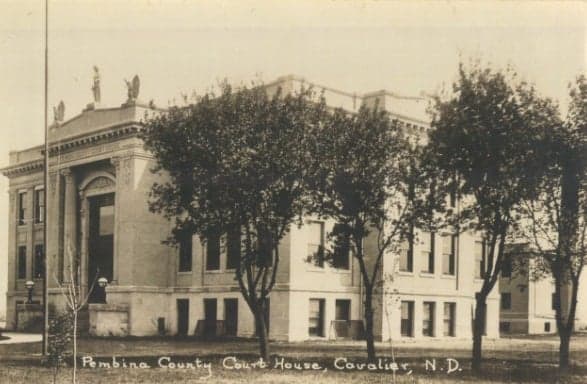
Photo: Wikipedia
Political ClimatePolitical Climate in Pembina County
Showing state-level results — no local-only data available.
Local Political AnalysisPolitical Analysis of Pembina County
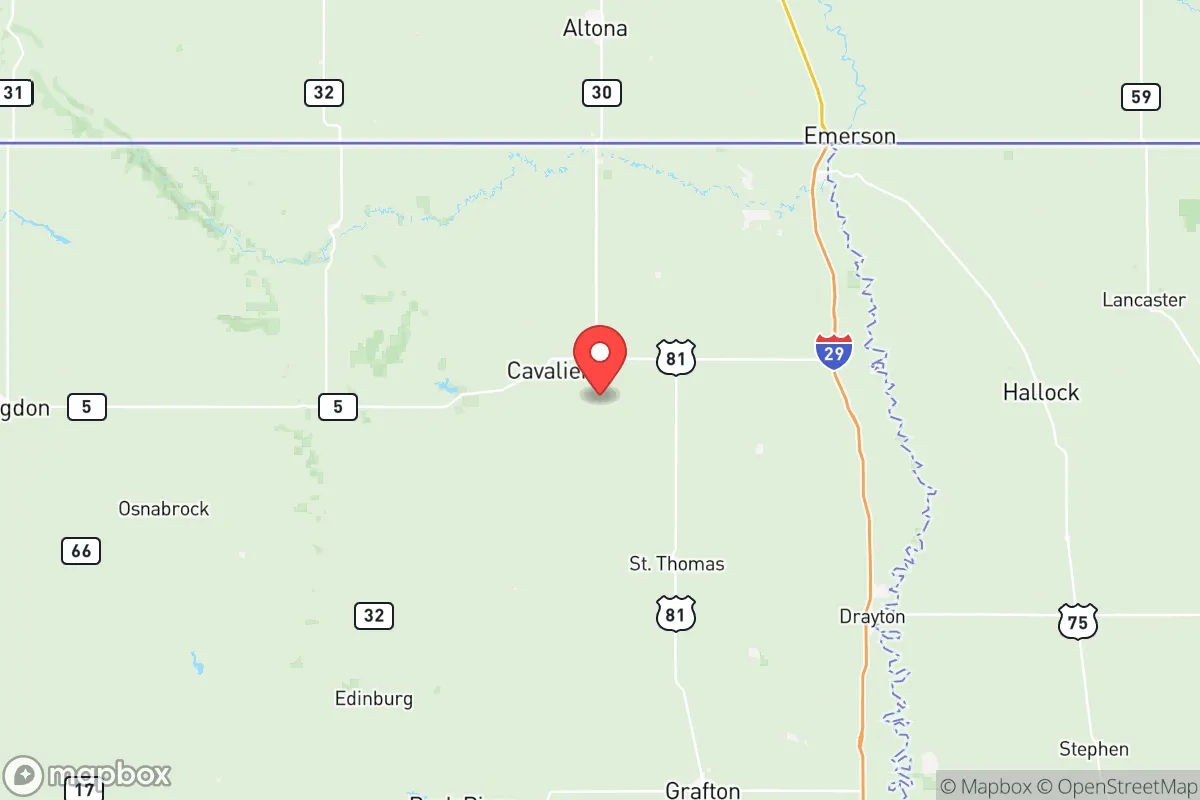
Pembina County, North Dakota, is a deeply Republican stronghold with a Cook Partisan Voting Index (PVI) of R+18, meaning it votes about 18 points more Republican than the national average. This rural county along the Canadian border has been reliably red for decades, with no signs of shifting toward the center. In the 2024 presidential election, Donald Trump carried the county by a margin of roughly 75% to 22%, a spread that mirrors the broader trend across North Dakota's agricultural counties. The county seat, Cavalier, and the largest city, Pembina, both vote heavily Republican, though the small towns of Drayton and St. Thomas occasionally show slightly more moderate tendencies, especially in local races where farm policy and infrastructure funding are top of mind.
How it compares
Compared to North Dakota as a whole, Pembina County is more conservative than the state average. While North Dakota's state-level PVI is not officially calculated, statewide elections typically lean R+20 to R+25, making Pembina County's R+18 slightly less extreme than the most conservative counties in the western part of the state, like Slope or Golden Valley. However, it is significantly more Republican than the state's urban centers: Fargo's Cass County leans R+10, and Grand Forks County is closer to R+8. Within Pembina County itself, the political variation is subtle but real. The town of Neche, near the border, tends to vote the most Republican, often hitting 80% for GOP candidates, while the farming community of Walhalla shows a slightly higher Democratic vote share, typically around 25-28%, driven by a mix of older farmers who remember the state's populist past and a small number of younger residents working in renewable energy. The swing precincts are in the central part of the county around the town of Bathgate, where local school board and county commission races can be competitive, though national elections remain solidly red.
What this means for residents
For conservative residents, Pembina County's political climate means their values are reflected in local governance, from low property taxes to a strong emphasis on Second Amendment rights and agricultural policy. The county commission and school boards are uniformly Republican, so there is little friction on cultural issues. For liberal or moderate residents, the reality is more isolating. There is no organized Democratic Party presence in the county, and progressive viewpoints are rarely voiced in public forums. Socially, it can be difficult to find like-minded neighbors, especially in smaller towns like Mountain or Hamilton. However, the county's small population—roughly 6,800 people—means that personal relationships often transcend political differences in day-to-day life, and most residents prioritize neighborly cooperation over partisan debate.
Culturally, Pembina County stands out for its strong Norwegian and Icelandic heritage, which influences local festivals and community events like the annual Icelandic Festival in Mountain. Policy-wise, the county is notably more skeptical of federal land management and environmental regulations than even the rest of North Dakota, given its proximity to the Pembina Gorge and the Red River Valley's sensitive agricultural lands. Local leaders have pushed back against proposed wind energy projects, arguing they disrupt the rural landscape, while simultaneously supporting oil pipeline easements. This pragmatic, land-use-focused conservatism defines the county's political identity more than national culture war issues, making it a place where a resident's stance on drainage ditches or grain elevator taxes can matter more than their opinion on national politics.

State Political ClimatePolitical Climate in North Dakota
State Political AnalysisPolitical Environment in the State
North Dakota has been a reliably Republican state for decades, but the flavor of that conservatism has shifted noticeably since the 2010s. The state voted for Donald Trump by over 33 points in 2024, and no Democratic presidential candidate has carried it since Lyndon Johnson in 1964. However, the political story here isn't just about red vs. blue — it's about a growing divide between the oil-driven boomtowns of the west, the agricultural east, and the small but concentrated liberal enclaves in Fargo and Grand Forks. Over the last 20 years, the state has moved from a pragmatic, farm-belt conservatism toward a more culturally assertive, freedom-focused Republicanism, driven largely by the Bakken oil boom and the influx of out-of-state workers.
Urban vs. rural divide
The political map of North Dakota is stark. The state's two largest cities — Fargo and Grand Forks — are the only real blue dots on an otherwise deep red map. Cass County, home to Fargo, voted for Joe Biden in 2020 by a slim margin, making it the only county in the state to go blue. Grand Forks County, anchored by the university, is more of a purple swing area, often voting Republican but with a strong Democratic minority. Meanwhile, the western half of the state — places like Williston, Watford City, and Dickinson — has become a Republican stronghold, fueled by oil workers who tend to be culturally conservative and economically libertarian. The rural farm counties in the east and central parts of the state, such as Walsh County and Benson County, still lean Republican but with a more populist, anti-establishment streak. The Native American reservations, including the Turtle Mountain Band and Standing Rock Sioux areas, vote overwhelmingly Democratic, but their populations are small enough that they rarely shift statewide results.
Policy environment
North Dakota's policy environment is defined by low taxes, minimal regulation, and a strong emphasis on energy and agriculture. The state has no personal or corporate income tax — a major draw for relocators — and relies heavily on oil and gas revenue, property taxes, and sales taxes. The regulatory posture is business-friendly, particularly for the energy sector, with fast-track permitting for oil and gas drilling. Education policy is locally controlled, with school choice options including charter schools and a growing homeschool community. Healthcare is a mixed bag: the state expanded Medicaid under the Affordable Care Act in 2013, a move that was controversial among conservatives but has since become broadly accepted. Election laws are relatively straightforward — no voter ID law was in place until 2021, when a law requiring a valid ID with a current address was passed, but same-day registration is still allowed. The state also has a strong tradition of direct democracy, with citizen-initiated ballot measures on everything from marijuana legalization to property tax reform.
Recent policy direction
In the last five years, North Dakota has moved decisively in a culturally conservative and libertarian direction on several fronts. In 2023, the state passed a near-total abortion ban, with exceptions only for rape, incest, and medical emergencies, effectively ending most abortion access. Gun laws are among the most permissive in the country: the state has constitutional carry (no permit needed for concealed carry), no waiting periods, and no magazine capacity limits. In 2021, the legislature passed a "parental rights" bill that requires schools to notify parents before teaching about sexual orientation or gender identity, and in 2023, a law was signed banning transgender girls from participating in K-12 girls' sports. Property rights are strongly protected, with no statewide zoning and a "right to farm" law that shields agricultural operations from nuisance lawsuits. On the privacy and surveillance front, the state has been relatively quiet, but a 2023 law restricted the use of facial recognition technology by law enforcement. Voting access remains fairly open, though the 2021 voter ID law has been criticized by Democrats as a suppression measure. The state also passed a measure in 2022 to allow the legislature to call itself into special session, reducing the governor's power — a move that reflects a broader distrust of executive authority.
Civil unrest & political movements
North Dakota has seen its share of political flashpoints, most notably the Standing Rock protests in 2016-2017, where thousands of activists from across the country gathered to oppose the Dakota Access Pipeline. The protests were a major national story and highlighted tensions between the state government, law enforcement, and Native American tribes. Since then, the state has seen a quieter but persistent activist presence on both sides: left-leaning groups in Fargo and Grand Forks organize around climate and Indigenous rights, while conservative groups in the west focus on gun rights, anti-abortion activism, and election integrity. There have been no major sanctuary city movements — in fact, the state passed a law in 2021 requiring local law enforcement to cooperate with federal immigration authorities. Election integrity has been a recurring theme, with the Republican-controlled legislature passing several bills to tighten voting procedures, though no widespread fraud has ever been documented. The state has also seen a small but vocal secessionist movement in the western oil counties, with some residents floating the idea of forming a new state called "Liberty" — though this remains fringe rhetoric.
Projection
Over the next 5-10 years, North Dakota's political trajectory will be shaped by two forces: the continued growth of the oil and gas industry in the west, and the slow but steady urbanization of Fargo and Grand Forks. The western counties will likely become even more Republican, driven by an influx of out-of-state workers who are culturally conservative and economically libertarian. Meanwhile, Fargo's growth — driven by tech, healthcare, and education — could make Cass County a more durable blue spot, though it's unlikely to flip the state. The Native American population is growing, but remains a small share of the electorate. The biggest wildcard is the state's aging population: North Dakota has one of the oldest median ages in the country, and younger residents tend to be more liberal, especially on social issues. If the state can attract and retain young families — which is a stated goal of economic development efforts — the political center of gravity could shift slightly toward the center over the long term. But for the foreseeable future, North Dakota will remain a deeply red state with a libertarian bent, where the main political fights are between different factions of the right rather than between left and right.
For a new resident, the practical takeaway is straightforward: if you're conservative, you'll find a state that largely aligns with your values on taxes, guns, and regulation, with a government that is responsive to conservative priorities. If you're liberal, you'll find a state where your vote carries less weight, but where the small size of the population means you can still have a real impact at the local level — especially in Fargo or Grand Forks. The political climate is stable, predictable, and unlikely to surprise you, whether you're coming from a blue state or a red one. Just be prepared for long winters and short political seasons.
* Values derived from national, state, county, city and local statistics and may differ in a specific area. Last updated: 2026-06-17T01:15:59.000Z
Narrative content on this page is AI-generated and may contain mistakes. Verify any details that matter before acting on them.
ReloMaps may earn a commission from affiliate links at no extra cost to you.

