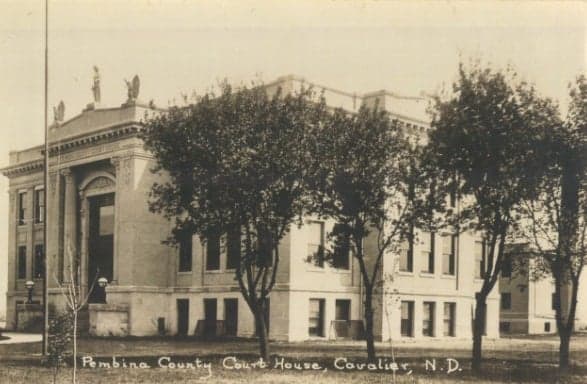
Photo: Wikipedia
Demographics of Pembina County
Affluence Level in Pembina County
A middle-class area roughly in line with national averages across income, home values, education, and employment.
People of Pembina County
Today, Pembina County, North Dakota, is home to approximately 6,787 residents, making it one of the state’s most sparsely populated counties. Its population is overwhelmingly white (89.0%) and native-born (98.2%), with a small Hispanic community (4.0%) and a very low college attainment rate of 22.9%. The county’s character is defined by its deep agricultural roots, its position along the Canadian border, and a quiet, rural identity that has remained remarkably stable even as the broader Red River Valley has seen modest change.
Settlement & growth (pre-1960)
Long before European settlement, the area that is now Pembina County was the homeland of the Ojibwe (Chippewa) and, to a lesser extent, the Dakota Sioux. These nations used the region for hunting and seasonal camps, with the confluence of the Red and Pembina Rivers serving as a key gathering point. The first permanent European presence came with the fur trade: the North West Company established a post near present-day Pembina in 1797, making it one of the oldest continuously inhabited European settlements in North Dakota. French-Canadian and Métis trappers and traders formed the earliest non-Native population, living in close proximity to the Ojibwe.
American settlement began in earnest after the 1823 Treaty of Pembina and the subsequent establishment of a military post at Fort Pembina. The major demographic wave, however, arrived with the Homestead Act of 1862 and the expansion of the railroad in the 1870s and 1880s. The federal government opened the land to homesteaders, and a flood of immigrants from Northern and Eastern Europe poured in. Norwegian and German immigrants were the dominant groups, drawn by the promise of cheap, fertile farmland in the Red River Valley. They established farming communities like Cavalier, the county seat, and Walhalla, named for the Norse mythological hall, reflecting the Scandinavian heritage of its founders. Smaller groups of Polish, Czech, and Icelandic settlers also arrived, though in lesser numbers. The town of Neche became a key port of entry for immigrants crossing the border from Manitoba. By 1900, the county’s population had peaked at over 14,000, built almost entirely on wheat farming and the railroad.
The period from 1900 to 1960 was one of gradual decline. The mechanization of agriculture reduced the need for farm labor, and the Dust Bowl and Great Depression of the 1930s pushed many families off the land. Young people left for cities like Grand Forks or Minneapolis. The county’s population fell steadily, dropping below 10,000 by 1950. The population that remained was almost entirely white, native-born, and of Northern European descent, with a strong Lutheran and Catholic religious character. The small towns of St. Thomas, Drayton, and Hamilton became quiet agricultural service centers, their populations aging as the farm economy consolidated.
Modern era (post-1965)
The 1965 Hart-Cellar Act, which dramatically reshaped immigration to the United States, had almost no effect on Pembina County. The county’s foreign-born population today is just 1.8%, far below the national average. The few immigrants who have arrived since the 1970s have been primarily from Canada (often retirees or dual-citizenship farmers) and, in very small numbers, from Mexico and Central America, drawn by agricultural labor in the sugar beet and potato fields. These Hispanic workers, while still a small share (4.0%), represent the most visible demographic change in the county. They tend to concentrate in Cavalier and Drayton, where food processing plants and larger farms offer seasonal and year-round employment.
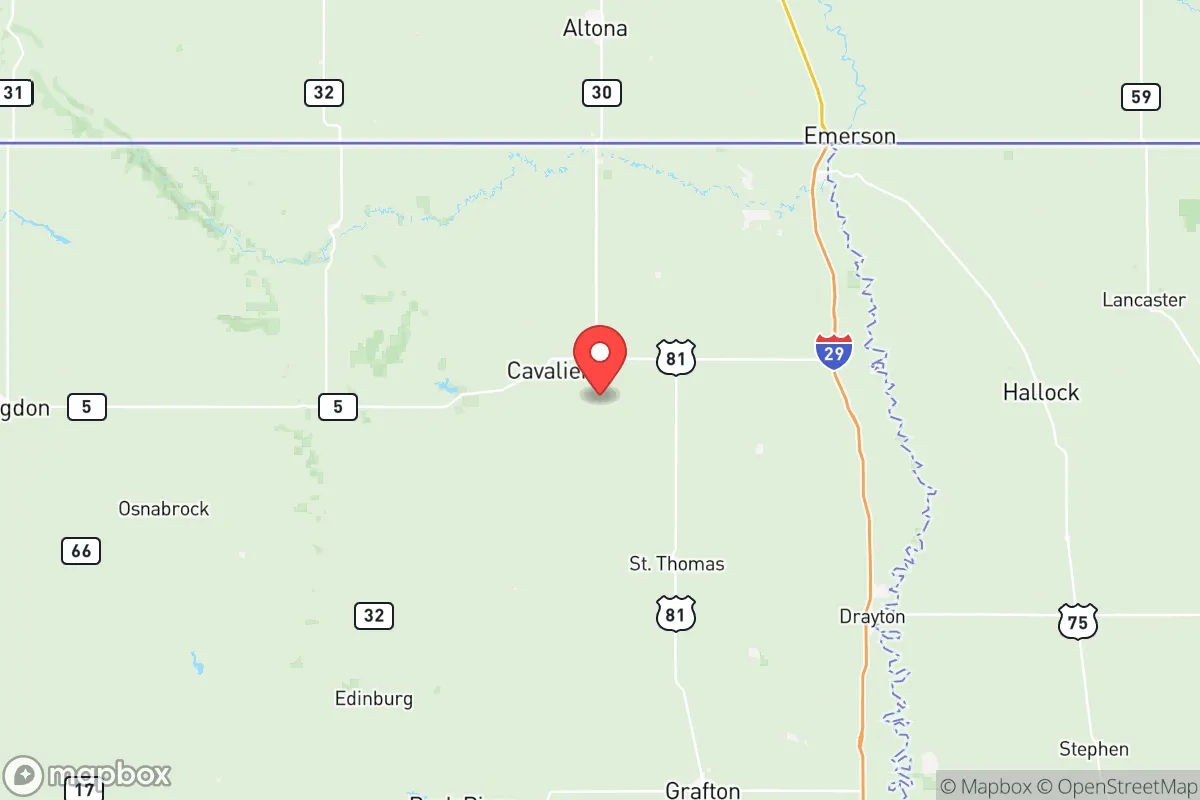
Domestic migration has been a story of net out-migration. The county has lost population in every decade since 1960, with the 2020 census showing a 12% decline from 2010. Young adults continue to leave for college and urban jobs, while the remaining population ages. There has been no significant suburbanization or exurban growth; the county lacks a major city and is too far from Grand Forks (about 80 miles south) to function as a bedroom community. The small Black (1.0%), East/Southeast Asian (0.1%), and Indian-subcontinent (0.3%) populations are almost entirely tied to the few professional roles in the county—teachers, doctors at the Pembina County Memorial Hospital in Cavalier, or workers at the Pembina County Correctional Center. No distinct ethnic enclaves have formed.
The most notable modern development has been the expansion of the Pembina County Correctional Center and the nearby border security infrastructure. This has brought a small number of new residents—corrections officers and border patrol agents—many of whom are younger and more diverse than the general population, though still overwhelmingly white. The town of Pembina itself, the county’s northernmost settlement, has seen a slight stabilization due to its role as a U.S. port of entry.
The future
Pembina County’s population is projected to continue its slow decline. The county’s birth rate is below replacement level, and out-migration of young adults shows no sign of reversing. The Hispanic population is likely to grow modestly, as agricultural employers continue to rely on immigrant labor, but it will remain a small share of the total. The county will become slightly more diverse by default as the older white population shrinks, but it will remain one of the least diverse counties in North Dakota.
The cultural identity of the county is likely to remain rooted in its Scandinavian and German heritage, with annual events like the Icelandic Festival in Mountain and the Pembina County Fair in Cavalier preserving traditions. There is no sign of significant new domestic migration from other parts of the U.S., as the county lacks the job growth or housing stock to attract newcomers. The next 10-20 years will likely see further consolidation of schools and services into Cavalier, with smaller towns like Bathgate and Pittsburgh continuing to depopulate.
For someone moving in now, Pembina County offers a quiet, affordable, and deeply traditional rural lifestyle. It is a place where community ties are strong, crime is low, and the pace of life is slow. The trade-off is clear: limited economic opportunity, a shrinking population, and very little racial or cultural diversity. It is a county that has been shaped by its history of homesteading and agriculture, and that history is unlikely to change course in the foreseeable future.

* Values derived from national, state, county, city and local statistics and may differ in a specific area. Last updated: 2026-06-17T01:15:59.000Z
Narrative content on this page is AI-generated and may contain mistakes. Verify any details that matter before acting on them.
ReloMaps may earn a commission from affiliate links at no extra cost to you.

