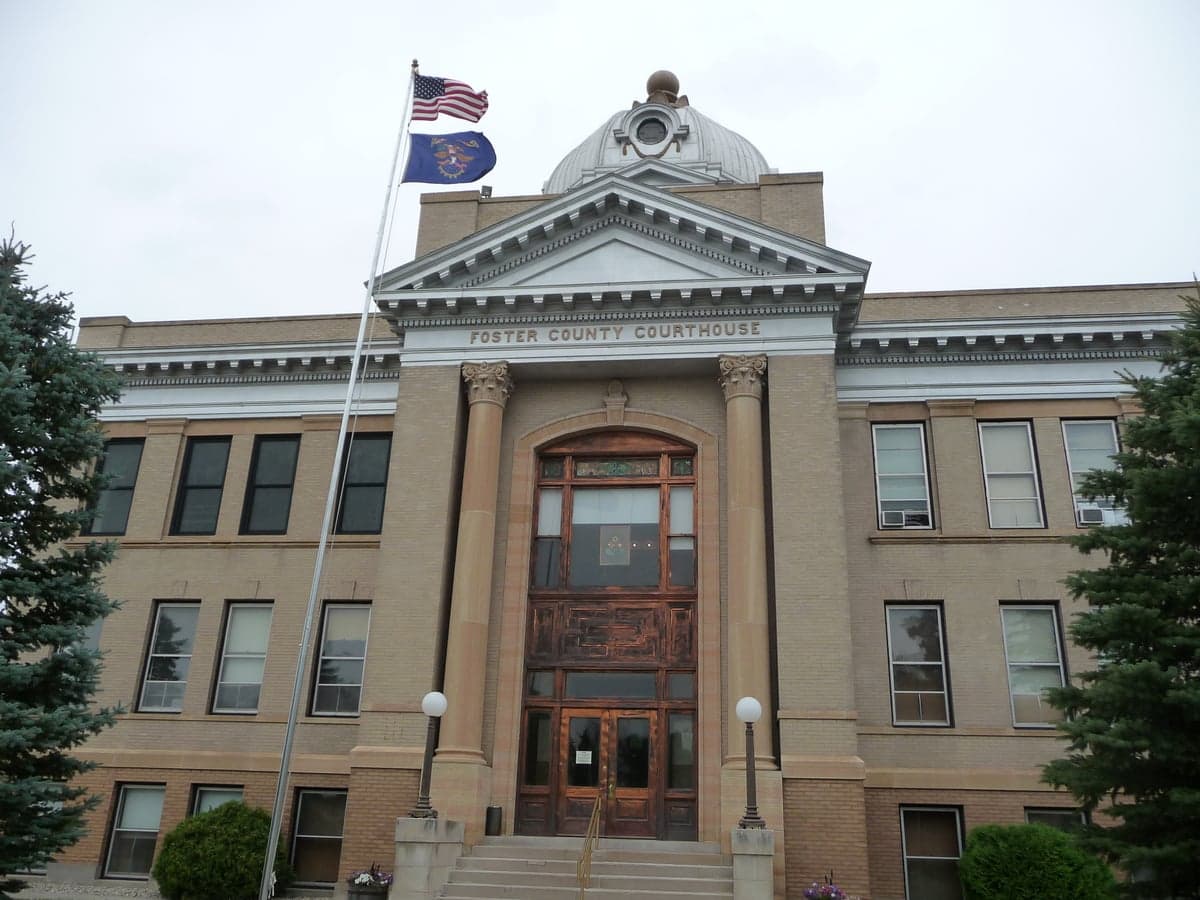
Photo: Wikipedia
Political ClimatePolitical Climate in Foster County
Showing state-level results — no local-only data available.
Local Political AnalysisPolitical Analysis of Foster County
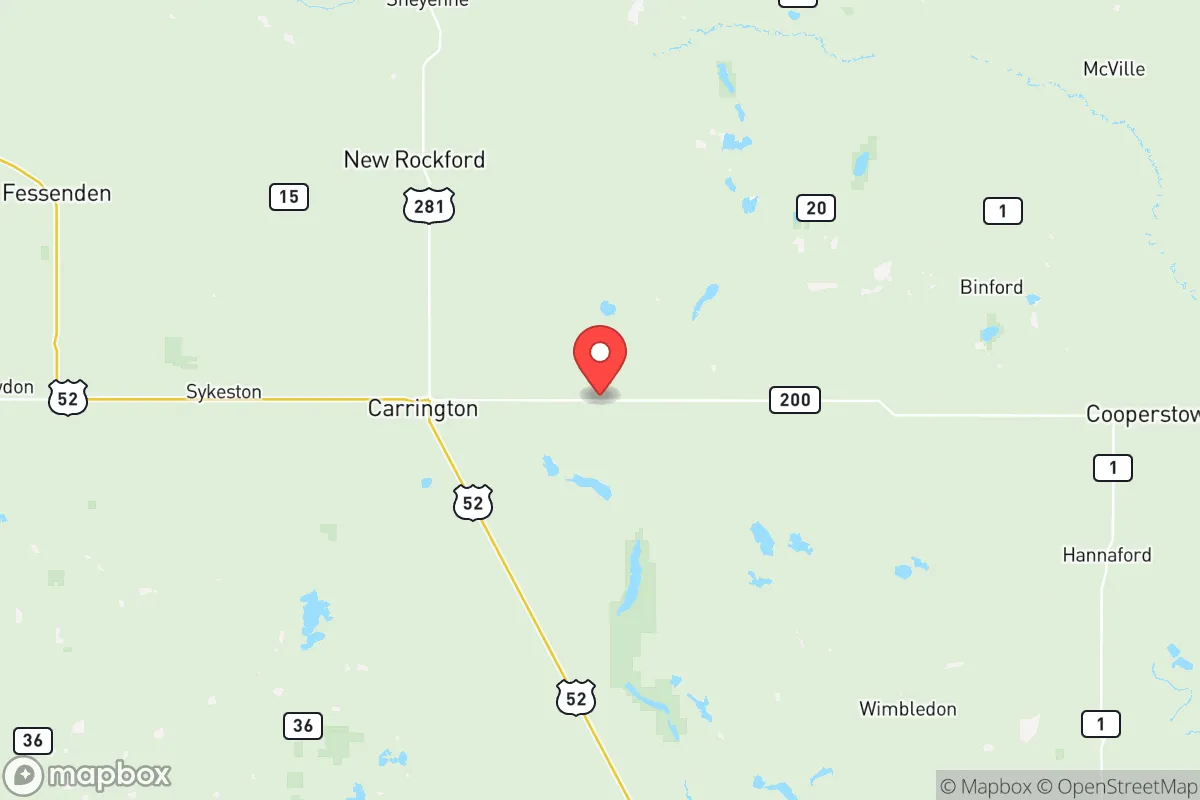
Foster County, North Dakota, is a reliably Republican stronghold with a Cook Partisan Voting Index (PVI) of R+18, meaning it votes about 18 points more Republican than the national average. This isn't a recent shift; the county has been a conservative bedrock for decades, with the city of Carrington, the county seat and largest town, consistently delivering GOP margins of 70% or more in presidential elections. The political trajectory here is stable and deeply entrenched, with no signs of a significant swing toward the left, though local precincts show subtle variations that reflect the area's agricultural and small-town character.
How it compares
Compared to the rest of North Dakota, Foster County is notably more conservative. While the state as a whole is also Republican-leaning—voting for Donald Trump by about 33 points in 2020—Foster County's R+18 PVI places it among the more reliably red counties in the state. For context, neighboring counties like Stutsman (home to Jamestown) and Eddy (New Rockford) are also Republican but with slightly less intensity, often seeing Democratic candidates perform better in local races. Within Foster County itself, the political landscape is fairly uniform, but there are nuances: the rural precincts around the towns of Glenfield and Barlow tend to be the most conservative, often voting 80%+ Republican, while the city of Carrington has a small but persistent Democratic-leaning precinct near the downtown area, driven by union-affiliated workers at the local Cargill sunflower processing plant and the CHS grain elevator. The town of Grace City, with its tiny population, mirrors the county's overall lean but can swing slightly more moderate in local school board races.
What this means for residents
For conservative residents, Foster County offers a political environment where their values are the default. Local government, from the county commission to the school board, is dominated by Republicans, and policy decisions—such as tax rates, land use regulations, and support for agricultural subsidies—tend to align with conservative priorities. There's little friction in daily life for conservatives, as the local culture, church communities, and civic organizations (like the Carrington Lions Club and 4-H) reinforce these views. For liberal residents, the reality is more isolating. While they are a minority, they are not invisible; the Democratic-NPL Party has a small but active presence in Carrington, often focusing on issues like rural healthcare funding and public school support. However, liberal residents may find themselves in the minority in social settings, at town hall meetings, or during local elections, where their views are often politely but firmly sidelined. The key is that political disagreements here are generally civil, rooted in a shared sense of community and mutual reliance, especially during tough winters or harvest seasons.
Culturally, Foster County is defined by its agricultural economy and strong sense of self-reliance. The county's policy distinctions are subtle but meaningful: there is a strong local emphasis on property tax relief for farmers and ranchers, and the county commission has historically resisted state-level mandates on land use and environmental regulations. The area's political climate also shapes its approach to issues like broadband expansion and healthcare access, with a preference for private-sector solutions over government programs. For anyone moving here, understanding that politics is less a daily battleground and more a quiet, consistent backdrop is key. The county's deep-rooted conservatism isn't flashy or confrontational—it's just the way things are, and most residents, regardless of their personal politics, find a way to fit in and contribute to the community's well-being.

State Political ClimatePolitical Climate in North Dakota
State Political AnalysisPolitical Environment in the State
North Dakota is one of the most reliably Republican states in the country, with a deep-rooted conservative tilt that has only solidified over the past two decades. The state hasn't voted for a Democratic presidential candidate since Lyndon B. Johnson in 1964, and in 2024, Donald Trump carried it by over 20 points. The dominant political coalition is a blend of rural populism, oil-patch libertarianism, and traditional social conservatism, with the state GOP holding supermajorities in both legislative chambers. Over the last 10-20 years, the biggest shift has been the collapse of the old "Dem-NPL" (Democratic-Nonpartisan League) coalition, which once held real sway in the agricultural east and union-heavy sectors; today, Democrats are largely confined to a handful of legislative seats in Fargo, Grand Forks, and on tribal reservations.
Urban vs. rural divide
The political map of North Dakota is starkly divided between a few small urban islands and a vast, deeply red rural expanse. Fargo, the largest city, is the state's most competitive area — Cass County has trended closer to purple in recent cycles, with Biden losing it by only about 10 points in 2020, a far cry from the 40-point margins in rural counties like Hettinger or Adams. Grand Forks, home to the University of North Dakota, leans Republican but with a noticeable libertarian streak, especially among younger voters and faculty. Bismarck and Mandan, the capital region, are reliably conservative, driven by state government workers and energy industry professionals. The real outlier is the Oil Patch — cities like Williston, Watford City, and Dickinson — which have become some of the most Republican areas in the nation, fueled by a transient workforce that strongly favors low taxes and minimal regulation. Meanwhile, the state's five tribal reservations (including the Turtle Mountain Band of Chippewa and the Standing Rock Sioux) vote overwhelmingly Democratic, but their populations are small and turnout is inconsistent, limiting their statewide influence.
Policy environment
North Dakota's policy environment is defined by a low-tax, low-regulation posture that appeals strongly to conservative relocators. There is no state income tax on personal wages (though there is a corporate income tax and a modest state sales tax of 5%, with local add-ons). Property taxes are relatively high compared to some Sun Belt states, but the state offers a homestead tax credit for homeowners. The regulatory climate is business-friendly, especially in energy and agriculture, with minimal permitting hurdles for oil and gas development. Education policy is locally controlled, with school choice limited to charter schools and a small but growing private school enrollment; there is no voucher program yet, though it has been debated. Healthcare is a mixed bag: the state expanded Medicaid under the Affordable Care Act in 2013, a decision that was controversial among conservatives but has since become broadly accepted. Election laws are moderately restrictive — voter ID is required, and the state has a strict photo ID law, but same-day registration is available. North Dakota does not have a ballot initiative process for citizens, meaning all policy changes go through the legislature, which keeps the agenda firmly in GOP hands.
Recent policy direction
Over the last few years, North Dakota's legislature has moved aggressively on a range of cultural and liberty issues that matter to relocators. On gun rights, the state passed constitutional carry in 2017, allowing permitless concealed carry, and in 2023, it enacted a "Second Amendment Preservation Act" that purports to nullify federal gun laws — a symbolic but popular move in rural areas. Parental and education rights saw a major win with the 2021 passage of a "Parents' Bill of Rights," which requires schools to notify parents about curriculum changes and medical services. In 2023, the legislature banned transgender girls from participating in K-12 and college women's sports. On medical and bodily autonomy, North Dakota has one of the strictest abortion bans in the nation, triggered in 2022 after Roe v. Wade was overturned, with exceptions only for rape, incest, and life of the mother; a 2023 law further restricted medication abortion. Property rights are strongly protected, with the state having a robust "right to farm" law that limits nuisance lawsuits against agricultural operations. Taxation has been trending downward: in 2023, the legislature cut the corporate income tax rate and expanded the homestead credit. Voting and ballot access remain stable, though the state has resisted mail-in ballot expansions and early voting periods that are common in other states.
Civil unrest & political movements
North Dakota is not known for frequent civil unrest, but it has been the site of one of the most significant protest movements in recent U.S. history: the Standing Rock Sioux Tribe's opposition to the Dakota Access Pipeline in 2016-2017. The protests drew thousands of activists from across the country, leading to clashes with law enforcement and a lasting legacy of tension between tribal nations and state authorities. The state has also seen a quieter but persistent push from the libertarian and "constitutional sheriff" movement, particularly in the Oil Patch, where local officials have occasionally resisted federal land management policies. Immigration politics are relatively low-key, as North Dakota has a small foreign-born population, but there have been debates over refugee resettlement, with Fargo being a major resettlement hub for decades. There is no serious secession or nullification rhetoric beyond the symbolic Second Amendment Preservation Act. Election integrity controversies have been minimal compared to other states, though the 2020 election saw some local GOP figures question mail-in voting procedures. A new resident would likely find the state politically stable, with most activism centered on energy policy and tribal sovereignty rather than street-level protests.
Projection
Over the next 5-10 years, North Dakota's political trajectory points toward continued Republican dominance, but with subtle shifts driven by demographics and in-migration. The Oil Patch is likely to remain deeply red, but as the Bakken boom matures and production stabilizes, the transient workforce may shrink, potentially reducing the intensity of libertarian influence. Fargo and Cass County will continue to trend slightly more competitive as the city grows and diversifies, but they are unlikely to flip blue at the state level anytime soon. The biggest wildcard is the tribal vote: if turnout increases on reservations, Democrats could gain a few legislative seats, but not enough to break the GOP supermajority. In-migration is modest — North Dakota is not a high-growth destination like Texas or Florida — but the people moving in tend to be conservative-leaning, drawn by energy jobs and low taxes. A relocator moving in now should expect to find a state that is politically stable, with a policy environment that is unlikely to swing left in the foreseeable future, but with ongoing debates over education funding, property taxes, and the balance between energy development and environmental protection.
For a new resident, the bottom line is straightforward: if you lean conservative, you will find a state where your values are reflected in law and culture, with low taxes, strong gun rights, and a government that is generally hands-off. If you lean liberal, you will find a state where your political voice is limited, but where the small population means you can still have an outsized impact at the local level, especially in Fargo or on tribal lands. The political climate is stable, predictable, and unlikely to surprise you — which is exactly what many relocators are looking for.
* Values derived from national, state, county, city and local statistics and may differ in a specific area. Last updated: 2026-10-10T16:29:24.000Z
Narrative content on this page is AI-generated and may contain mistakes. Verify any details that matter before acting on them.
ReloMaps may earn a commission from affiliate links at no extra cost to you.

