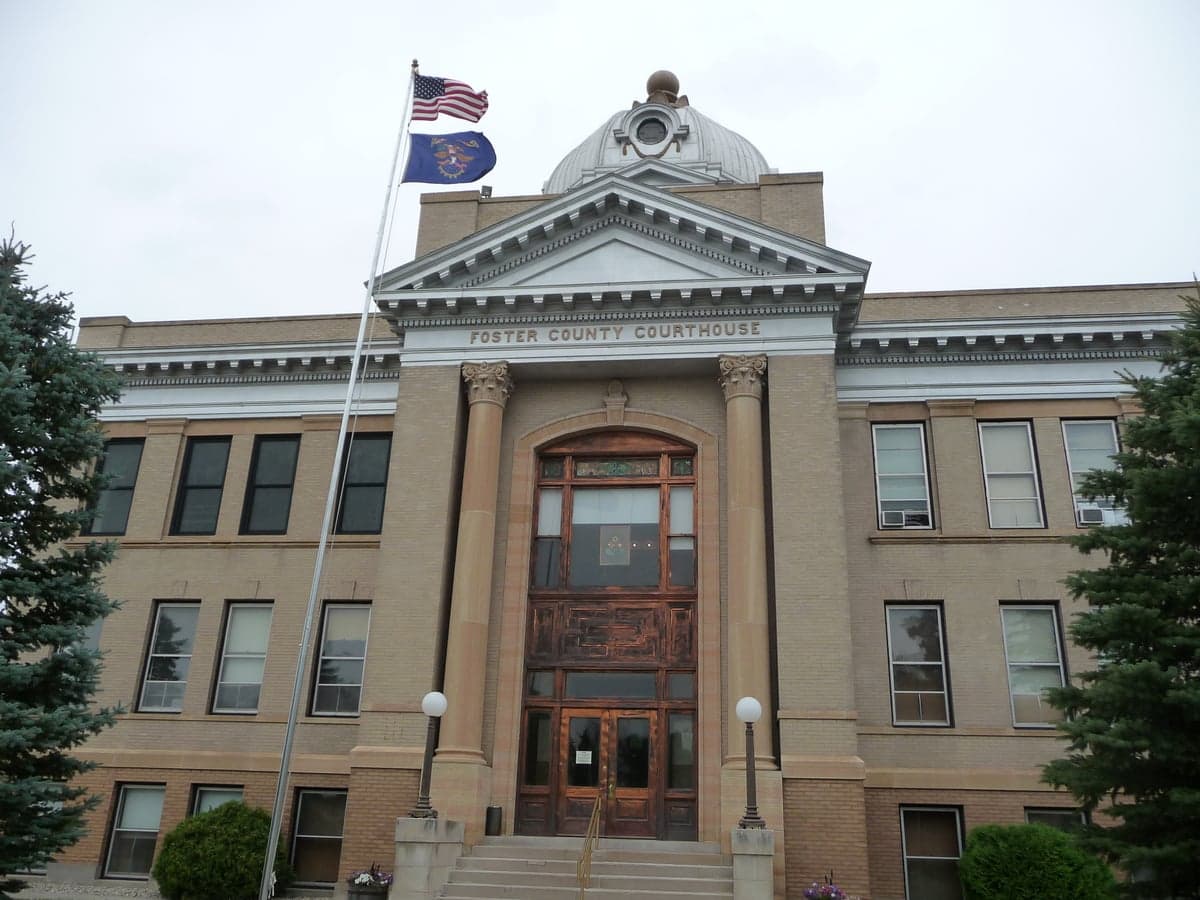
Photo: Wikipedia
Demographics of Foster County
Affluence Level in Foster County
A middle-class area roughly in line with national averages across income, home values, education, and employment.
People of Foster County
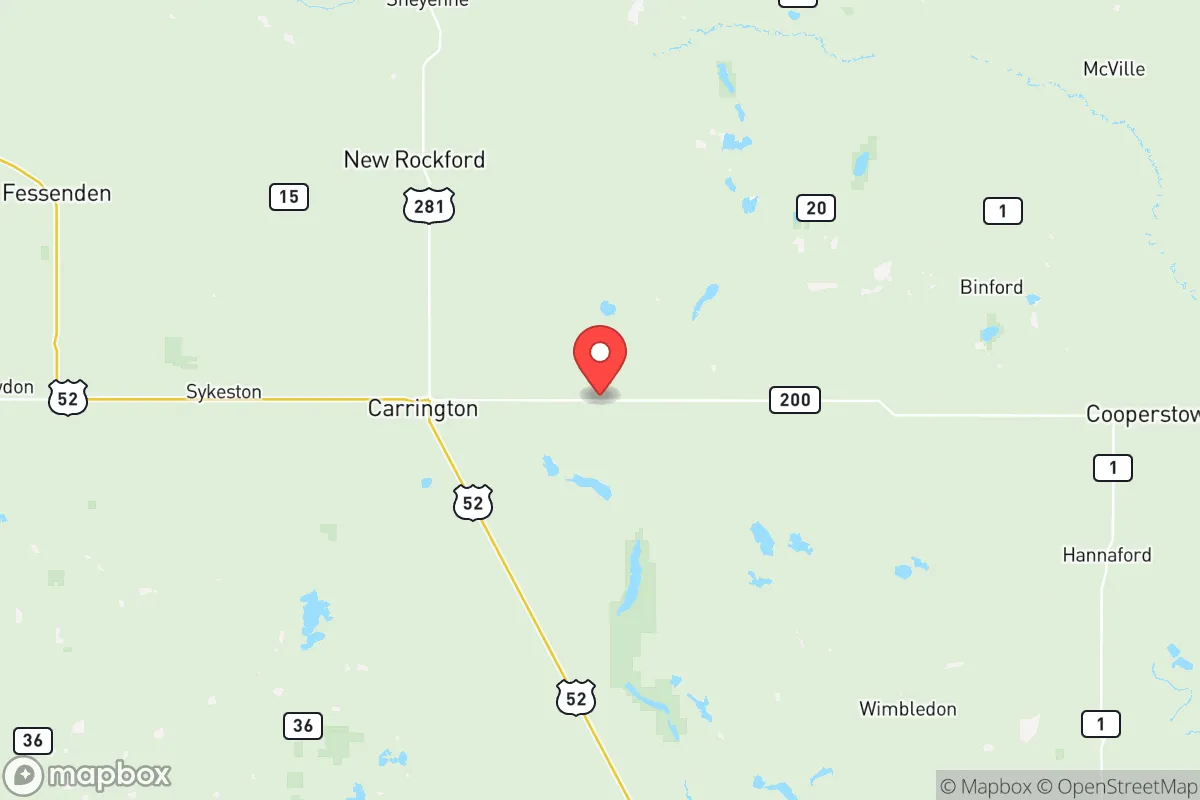
Foster County, North Dakota, is one of the most ethnically homogeneous rural counties in the state, with a population of 3,372 that is 94.0% white and only 1.3% foreign-born. Its people are overwhelmingly descendants of Northern European settlers—primarily Germans from Russia and Norwegians—who arrived in the late 19th and early 20th centuries to homestead the prairie. The county seat of Carrington anchors a tight-knit, agriculturally driven community where Lutheran and Catholic church steeples still define the skyline, and where the population has been slowly declining for decades as younger generations move to larger cities. Foster County today is a place where family roots run deep, where the local economy revolves around farming, oil-field support work, and the state hospital, and where the cultural identity remains firmly tied to its Scandinavian and German-Russian heritage.
Settlement & growth (pre-1960)
Before European settlement, the area that is now Foster County was part of the traditional territory of the Dakota (Sioux) people, specifically the Yanktonai and Sisseton-Wahpeton bands. The land was used for seasonal bison hunting and gathering, with no permanent villages within the county's boundaries. The 1851 Treaty of Fort Laramie and subsequent land cessions opened the region to American settlement, but it was not until the 1880s that homesteaders began arriving in significant numbers.
The first major wave of settlement came between 1882 and 1900, driven by the Northern Pacific Railway's extension through the area. The railroad established the town of Carrington in 1883 as a division point, and it quickly became the county's commercial and transportation hub. Homesteaders were drawn by the promise of 160-acre plots under the Homestead Act, and the fertile black soil of the James River Valley proved ideal for wheat and small grains. The earliest settlers were predominantly Norwegians and Germans from Russia, the latter being ethnic Germans who had lived for generations in the Volga River region of Russia and who brought with them a distinctive dialect, hard-wheat farming techniques, and a strong communal work ethic. Smaller numbers of Irish, English, and Canadian settlers also arrived during this period.
By 1890, the county's population had reached 2,441, and it grew steadily through the early 20th century. The town of Grace City was platted in 1899 as a farming service center, and Barlow (originally Barlow Station) emerged as a grain-shipping point along the railroad. The Glenfield area, settled primarily by Norwegian immigrants, became known for its cooperative creameries and Lutheran church networks. The peak population came in 1930, when Foster County reached 5,353 residents, reflecting both the agricultural boom of the 1910s and the relative stability of the region during the Dust Bowl years compared to the Great Plains farther south.
The post-World War II period saw the beginning of a long demographic decline. Mechanization of farming reduced the need for farm labor, and younger adults began moving to larger cities like Fargo, Bismarck, and Minneapolis for employment. The county's population dropped to 4,304 by 1960, a trend that would continue for the next six decades.
Modern era (post-1965)
The 1965 Hart-Cellar Act, which reshaped U.S. immigration patterns by eliminating national-origin quotas, had almost no effect on Foster County. The county's foreign-born population today stands at just 1.3%, and the overwhelming majority of those are European-born individuals who arrived decades ago. Unlike the booming cities of the Sun Belt or even North Dakota's oil patch counties, Foster County has not experienced significant immigration from Asia, Latin America, or Africa. The county's Hispanic population is 0.8%, its Black population is 0.4%, and its East/Southeast Asian population is effectively 0.0%.
The one notable exception is a small but measurable Indian (subcontinent) population of 1.3%, which is almost entirely concentrated in Carrington. This community consists primarily of professionals employed at the North Dakota State Hospital (a major psychiatric facility located in Carrington) and at the Carrington Research Extension Center, a branch of North Dakota State University. These are typically H-1B visa holders and their families, many of whom have become permanent residents. They represent the only significant non-white, non-European demographic presence in the county, and they are dispersed within the general population rather than forming a distinct ethnic enclave.
Domestic migration patterns have been dominated by out-migration rather than in-migration. The county lost population steadily from 1960 through 2020, with a brief stabilization during the North Dakota oil boom (2008–2014) when some workers commuted to the Bakken fields in western North Dakota but maintained residences in Foster County. The population has since resumed its gradual decline, falling from 3,759 in 2010 to 3,372 in 2020. The college-educated share of the population is 27.2%, slightly below the state average, reflecting the limited white-collar job base outside of the state hospital and the school system.
The future
Foster County's population is projected to continue its slow decline over the next 10–20 years, driven by the same forces that have shaped rural North Dakota for generations: an aging population, low birth rates among long-established families, and the out-migration of young adults to urban centers. The county's median age is well above the national average, and the school district in Carrington has seen enrollment shrink by roughly 15% over the past decade. There is no indication that this trend will reverse, as the county lacks the energy-sector growth that has stabilized some neighboring counties to the west.
The county is not becoming more diverse. The white share of the population has remained above 94% for decades, and the small Indian professional community in Carrington is likely to remain stable or shrink slightly as visa pathways tighten and as remote work allows some professionals to relocate. No new immigrant groups are establishing a presence in the county, and the Hispanic and Black populations are negligible and not growing. The cultural identity of Foster County will remain overwhelmingly Northern European, Lutheran and Catholic, and agriculturally oriented for the foreseeable future.
The one wild card is the potential for climate-driven migration. Some projections suggest that the Northern Plains, including central North Dakota, could see an influx of domestic migrants from drought-prone and wildfire-prone regions of the West over the next 20–30 years. If that materializes, Foster County's affordable land and reliable water supply could attract a new wave of homesteaders—this time from Colorado, California, and the Pacific Northwest. However, this remains speculative, and for the next decade, the county's demographic trajectory is one of gentle contraction and cultural continuity.
For someone moving in now, Foster County offers a stable, safe, and deeply rooted community where neighbors have known each other for generations, where the pace of life is slow, and where the dominant values are self-reliance, church involvement, and hard work. It is not a place of rapid change or growing diversity, and it will not become one soon. It is a place for those who value quiet, space, and tradition over the dynamism and churn of a growing metropolitan area.

* Values derived from national, state, county, city and local statistics and may differ in a specific area. Last updated: 2026-10-10T16:29:24.000Z
Narrative content on this page is AI-generated and may contain mistakes. Verify any details that matter before acting on them.
ReloMaps may earn a commission from affiliate links at no extra cost to you.

