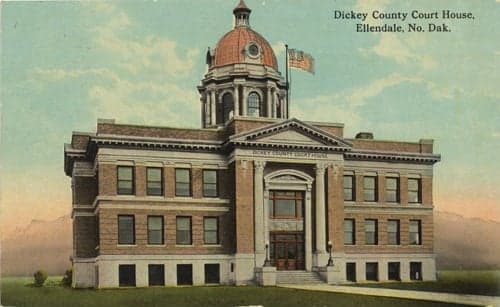
Photo: Wikipedia
Political ClimatePolitical Climate in Dickey County
Showing state-level results — no local-only data available.
Local Political AnalysisPolitical Analysis of Dickey County
Dickey County, North Dakota, is a deeply conservative area with a Cook Partisan Voting Index (PVI) of R+18, meaning it votes about 18 points more Republican than the national average. This isn't a recent shift; the county has been a Republican stronghold for decades, with the last Democratic presidential candidate to carry it being Lyndon B. Johnson in 1964. The county's politics are driven by a mix of agricultural interests, strong gun rights sentiment, and a general distrust of federal overreach, which plays out consistently in local and national elections.
How it compares
While North Dakota as a whole is reliably Republican, Dickey County is noticeably more conservative than the state average. The state's Cook PVI is unknown, but statewide races often see Republicans winning by margins of 20-30 points, meaning Dickey County's R+18 is roughly in line with the state's rightward tilt. However, there are internal variations. The county seat, Ellendale, tends to be the most reliably Republican area, often delivering 75-80% of the vote for GOP candidates. In contrast, Oakes, the largest town, has a small but persistent Democratic-leaning precinct around the hospital and school district, where unionized workers and educators sometimes split tickets. The rural townships outside of these two hubs are overwhelmingly red, with precincts like Ludden and Fullerton regularly hitting 85%+ Republican. The only real swing area is the precinct around the North Dakota State College of Science campus in Wahpeton (technically in Richland County, but its influence spills over), which can lean slightly more moderate, especially in state legislative races.
What this means for residents
For conservative residents, Dickey County is a comfortable environment where their values are the norm. Local government, school boards, and county commissions are dominated by Republicans, meaning policies around taxes, land use, and education tend to align with conservative priorities. For liberal residents, the reality is more isolating. There is no organized Democratic party presence in the county, and social events or community discussions often assume a conservative baseline. However, the small population (roughly 5,000 people) means that political disagreements rarely become personal feuds; most people prioritize neighborly relations over party lines. The biggest practical impact is on state representation: the county's state senator and two representatives are all Republicans, so liberal residents have no direct voice in Bismarck on issues like abortion access or renewable energy mandates.
Culturally, Dickey County is defined by its agricultural roots and a strong sense of self-reliance. The county is a major producer of wheat, soybeans, and cattle, and this shapes policy priorities like property tax relief for farmers and opposition to federal land management. There is a notable distinction from the western part of the state: while the oil boom in the Bakken region has brought rapid change and a more transient population, Dickey County remains stable and slow-growing, with a population that has been declining slowly since the 1930s. This stability reinforces a "slow and steady" political culture, where change is viewed skeptically and incumbents are rarely challenged. The biggest local policy debates revolve around school consolidation (Ellendale and Oakes have fought to keep their own high schools) and the future of the county's aging infrastructure, like the Oakes dam and the local hospital. These are bread-and-butter issues that transcend party labels, but they are always resolved through a conservative lens of fiscal caution and local control.

State Political ClimatePolitical Climate in North Dakota
State Political AnalysisPolitical Environment in the State
North Dakota is a deeply red state, with a Republican lean that has only intensified over the past two decades. In the 2024 presidential election, Donald Trump carried the state by a margin of roughly 20 points, a shift from the 16-point win in 2016 and a stark contrast to the 2000 election when George W. Bush won by just 12 points. The dominant political coalition is a mix of rural conservatives, oil and gas interests, and a growing number of libertarian-leaning independents, while the Democratic-NPL (Nonpartisan League) has been reduced to a rump presence in the legislature, holding fewer than 20 of 47 state senate seats. The trajectory is clear: the state is moving further right, driven by in-migration from blue states and the consolidation of the oil boom's political power in the western counties.
Urban vs. rural divide
The political map of North Dakota is a textbook case of the urban-rural split, but with a twist. The state's two major metros, Fargo and Bismarck, are both conservative, but with different flavors. Fargo, in Cass County, is the state's largest city and a growing economic hub; it voted for Trump by about 10 points in 2024, a narrower margin than the rest of the state, but still solidly red. The city's politics are dominated by a pragmatic, business-friendly conservatism, with a notable libertarian streak on issues like marijuana legalization and land use. Bismarck, the state capital, is even more conservative, with Burleigh County voting for Trump by nearly 20 points. The rural areas, especially the oil patch counties like McKenzie and Williams in the northwest, are the state's most Republican strongholds, with margins exceeding 40 points. The only significant blue dot is the city of Grand Forks, home to the University of North Dakota, where Grand Forks County voted for Trump by just 5 points, reflecting the influence of a younger, more educated population. The Red River Valley, including the cities of Wahpeton and Valley City, is a mix of agricultural conservatism and small-town Democratic holdouts, but those are fading fast.
Policy environment
North Dakota's policy environment is a conservative's dream. The state has no personal or corporate income tax, a flat property tax rate that is among the lowest in the nation, and a regulatory posture that is aggressively pro-business, especially in the energy sector. The state's oil and gas industry is lightly regulated, with the Department of Mineral Resources prioritizing rapid permitting. Education policy is a mixed bag: the state has a strong tradition of local control, with school boards setting curriculum, but there is a growing push for school choice, including a 2023 law that expanded charter schools and created a tax credit for private school donations. Healthcare is dominated by a few large systems, like Sanford Health and Essentia Health, and the state has not expanded Medicaid under the Affordable Care Act, leaving a coverage gap for low-income adults. Election laws are among the most restrictive in the nation: North Dakota is the only state without voter registration, requiring only a valid ID to vote, but it has also passed laws limiting absentee voting and requiring a witness signature for mail ballots. The state's legislative sessions are biennial, meaning major policy changes come in bursts every two years.
Recent policy direction
Recent legislation in North Dakota points toward a sharpening of conservative priorities across the board. On gun rights, the state passed a constitutional carry law in 2021, allowing concealed carry without a permit, and in 2023, it passed a law prohibiting local governments from enacting gun-free zones. On parental and education rights, the 2023 legislative session saw the passage of a "Parents' Bill of Rights" that requires schools to notify parents of any changes to a student's health or well-being, including gender identity, and a law banning instruction on gender identity and sexual orientation in K-3 classrooms. On speech and privacy, the state has no shield law for journalists, but it has passed laws limiting the collection of biometric data by private companies. On medical and bodily autonomy, North Dakota has one of the most restrictive abortion bans in the country, with no exceptions for rape or incest, only for the life of the mother; the ban was triggered by the 2022 Dobbs decision and has been upheld by the state supreme court. On property rights, the state has a strong tradition of eminent domain protections, but the oil and gas industry has successfully lobbied for laws that limit landowners' ability to challenge pipeline easements. On taxation, the state has been cutting income taxes, with a 2023 law reducing the top rate from 2.9% to 1.95%, and there is a growing movement to eliminate the property tax entirely. On voting and ballot access, the state has tightened absentee voting rules and passed a law requiring a photo ID for all in-person voting, which has been challenged in court but upheld.
Civil unrest & political movements
North Dakota has seen its share of political flashpoints, most notably the Standing Rock protests in 2016-2017, where thousands of activists from across the country gathered to oppose the Dakota Access Pipeline. The protests were a major moment of civil unrest, with clashes between protesters and law enforcement, and they left a lasting legacy of distrust between the state government and Native American communities, particularly the Standing Rock Sioux Tribe. The state has also seen a rise in organized conservative activism, including the North Dakota Freedom Caucus, which has pushed for more aggressive legislation on immigration and election integrity. Immigration politics are relatively quiet, as the state has a small immigrant population, but there have been local controversies over refugee resettlement, particularly in Fargo, where a 2023 city council resolution to declare the city a "sanctuary city" was defeated after a heated debate. Election integrity has been a hot-button issue, with the state's Republican secretary of state, Michael Howe, pushing for stricter voter ID laws and a purge of inactive voters, which has been criticized by voting rights groups. There is no serious secession or nullification movement, but there is a strong strain of anti-federal sentiment, especially in the oil patch, where residents often complain about federal land management and environmental regulations.
Projection
Over the next 5-10 years, North Dakota's political trajectory is likely to continue its rightward shift, driven by demographic changes and in-migration. The state's population is growing slowly, but the growth is concentrated in the oil patch and the Fargo metro, both of which are attracting conservative-leaning migrants from blue states like California and Minnesota. The Democratic-NPL is unlikely to recover, as its base in rural areas continues to shrink and its urban strongholds, like Grand Forks, are becoming more competitive for Republicans. The state's policy environment will likely become even more conservative, with potential moves toward a flat tax, further restrictions on abortion, and expanded school choice. However, there are countervailing trends: the state's aging population is becoming more reliant on Medicaid and Social Security, which could create pressure for a more moderate approach to healthcare and social services. The oil and gas industry, which drives much of the state's economy, is facing long-term uncertainty due to the global energy transition, which could lead to economic diversification and a shift in political priorities. For a new resident, the state will remain a deeply conservative place, but with a growing libertarian streak that values individual freedom and limited government.
For a new resident, the bottom line is this: North Dakota is a state where conservative values are not just dominant but are becoming more entrenched. If you are a conservative, you will find a welcoming environment with low taxes, strong gun rights, and a government that is responsive to your concerns. If you are a liberal, you will find a state where your views are in the minority, and where you may face challenges in areas like healthcare access and reproductive rights. The state's political climate is stable and predictable, but it is also dynamic, with a growing libertarian influence that can sometimes surprise. The key takeaway is to understand the local dynamics: the oil patch is different from the Red River Valley, and Fargo is different from Bismarck. Do your homework on the specific community you are considering, and you will find a place that fits your values.
* Values derived from national, state, county, city and local statistics and may differ in a specific area. Last updated: 2026-07-13T16:51:03.000Z
Narrative content on this page is AI-generated and may contain mistakes. Verify any details that matter before acting on them.
ReloMaps may earn a commission from affiliate links at no extra cost to you.

