
Photo: Wikipedia
Strategic Assessment of Dickey County
Deep buffer from population centers and strategic targets. Low natural disaster risk and minimal exposure to border or coastal threats.
What does the Strategic Assessment tell us?
Our Strategic Assessment grades tactical survivability of an area. Major population centers, military targets, fallout zones, natural disasters, and border exposure all drive risk — lower exposure means a more defensible position in a crisis.
This is heavily inspired by Joel Skousen's Strategic Relocation book. Highly recommended you checkout the book ($)What does this tell us?
Our Strategic Assessment grades tactical survivability of an area. Major population centers, military targets, fallout zones, natural disasters, and border exposure all drive risk — lower exposure means a more defensible position in a crisis.
This is heavily inspired by Joel Skousen's Strategic Relocation book. Highly recommended you checkout the book ($)Strategic Pillars

Key Distances
Strategic Assessment Analysis
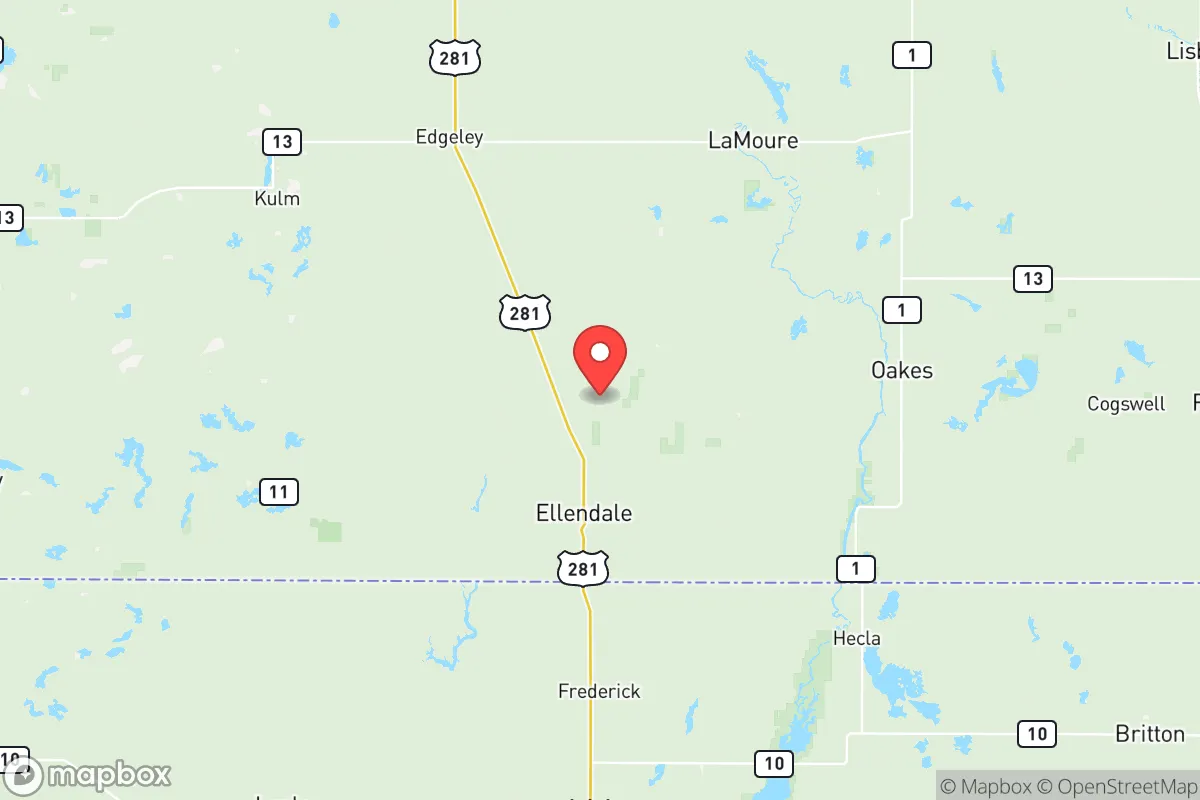
Dickey County, North Dakota, offers a strategic relocation option for those prioritizing resilience and self-sufficiency, anchored by its remote position in the southeastern part of the state. The county seat, Ellendale, and the largest town, Oakes, sit roughly 100 miles southwest of Fargo and 150 miles northwest of Sioux Falls, South Dakota, placing them well outside the immediate fallout zones of major metropolitan targets. This geographic buffer, combined with a sparse population density of roughly 5 people per square mile, provides a foundational layer of security for individuals and families assessing long-term preparedness.
Geographic position and natural advantages for long-term security
Dickey County's location in the James River Valley offers a blend of flat, fertile farmland and subtle topographic variation that supports both agriculture and defensible siting. The James River itself runs north-south through the county, providing a reliable surface water source that is less contested than in more arid western states. The county's position in the Upper Great Plains means it is far removed from coastal storm surges, seismic zones, and major floodplains—though localized flooding along the James River does occur during spring snowmelt. The area's cold continental climate, with average January lows near 0°F, acts as a natural deterrent to large-scale population displacement, which is a resilience advantage in a crisis scenario. The county's agricultural base, dominated by wheat, soybeans, and corn, means that local food production capacity is high, and the presence of grain elevators in towns like Ellendale and Oakes provides bulk storage infrastructure that could be repurposed for long-term food security.
Risk exposure and proximity to potential fallout-relevant landmarks
While Dickey County is distant from major metropolitan centers, it is not entirely free of risk exposure. The county lies roughly 200 miles northwest of the Minneapolis-St. Paul metropolitan area, a likely target in a major conflict, but prevailing westerly winds would carry fallout eastward, away from the county. More proximate concerns include the Grand Forks Air Force Base (about 120 miles north), which houses unmanned aerial vehicle operations and could be a secondary target, and the Minot Air Force Base (about 200 miles northwest), a primary nuclear-capable bomber and missile base. Fallout from a strike on Minot would likely track east or southeast, potentially affecting the northwestern edge of the state but sparing Dickey County under typical wind patterns. The county itself contains no major industrial or military targets—no refineries, ports, or large-scale energy infrastructure—which is a net positive for a relocator seeking to avoid primary or secondary blast zones. The nearest significant rail hub is in Aberdeen, South Dakota, about 90 miles south, which carries some risk of disruption but not direct targeting.
Practical resilience for a relocator: food, water, energy, and defensibility
For a family or individual serious about self-sufficiency, Dickey County offers strong fundamentals. Water access is a key advantage: the James River and numerous smaller creeks provide surface water, and the underlying Dakota Aquifer offers reliable groundwater at moderate depths (typically 100-300 feet). Most rural properties already have private wells, and the county's agricultural extension office provides free well-testing services. Energy resilience is moderate: the county is served by the Otter Tail Power Company grid, but rural properties commonly have backup propane or diesel generators. Solar potential is good, with roughly 200 sunny days per year, though winter generation is limited by short daylight hours. Food production is the county's strongest suit: the agricultural economy means local farmers' markets in Ellendale and Oakes operate from June through October, and the county's 4-H programs and FFA chapters in the local high schools indicate a culture of small-scale animal husbandry and gardening. Defensibility is aided by the county's low population density and wide-open sightlines across the prairie, though the flat terrain offers limited natural cover. The county's law enforcement presence is thin—the Dickey County Sheriff's Office has roughly 5-7 deputies on duty at any time—so community-based security arrangements would be essential in a prolonged crisis. The local hospital, Oakes Community Hospital, is a critical access facility with 15 beds and basic emergency services, but serious medical evacuation would require transport to Fargo or Aberdeen.
Overall, Dickey County presents a balanced strategic picture for the resilience-minded relocator. Its primary strengths are its distance from high-value targets, abundant agricultural land, reliable water resources, and low population density—all of which support a long-term self-sufficiency strategy. Its weaknesses include a harsh winter climate that complicates off-grid energy and transportation, limited local medical capacity, and a flat terrain that offers little natural defensibility. For a family willing to invest in winterized infrastructure, deep-cycle battery storage, and community-building with neighbors, Dickey County offers a defensible, resource-rich base of operations that is unlikely to be a primary or secondary target in any foreseeable conflict scenario. The county's culture of self-reliance, rooted in its agricultural heritage, aligns well with the preparedness mindset, and its relative obscurity on the national stage is itself a strategic asset.

* Values derived from national, state, county, city and local statistics and may differ in a specific area. Last updated: 2026-07-13T16:51:03.000Z
Narrative content on this page is AI-generated and may contain mistakes. Verify any details that matter before acting on them.
ReloMaps may earn a commission from affiliate links at no extra cost to you.

