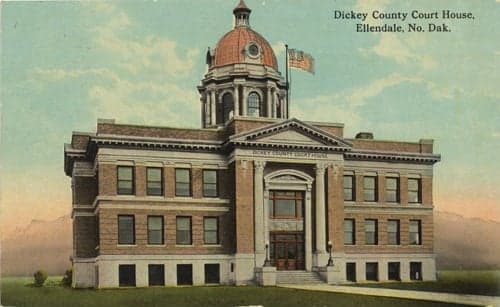
Photo: Wikipedia
Demographics of Dickey County
Affluence Level in Dickey County
A middle-class area roughly in line with national averages across income, home values, education, and employment.
People of Dickey County
The people of Dickey County, North Dakota today number just under 5,000 residents, a population that has been shrinking slowly for decades. The county is overwhelmingly white (91.0%) and native-born (97.5% U.S.-born), with a small but growing Hispanic community (3.9%) and a tiny East/Southeast Asian presence (1.1%). Its identity is rooted in the agricultural heritage of the Great Plains — a place of German-Russian and Scandinavian ancestry, small towns like Oakes, Ellendale, and Forbes, and a quiet, self-reliant character shaped by the railroad era and the Homestead Act.
Settlement & growth (pre-1960)
Before European settlement, the area that is now Dickey County was part of the traditional territory of the Dakota (Sioux) people, particularly the Yanktonai and Sisseton-Wahpeton bands. The land was used for seasonal bison hunting and gathering. The first permanent non-Native presence came with the U.S. military and railroad surveys in the 1870s, followed by the formal opening of the region to homesteading under the Homestead Act of 1862. The county was officially organized in 1882, named after George H. Dickey, a territorial legislator.
The first major wave of settlers were German-Russian immigrants, who began arriving in the 1880s and 1890s. These were ethnic Germans who had lived for generations in the Volga River region of Russia, recruited by Tsarina Catherine the Great to farm the Russian steppes. When their land grants and exemptions expired in the late 19th century, they emigrated en masse to the Great Plains. In Dickey County, they founded the town of Forbes (originally called "German Settlement") and spread into the farming communities around Oakes and Ellendale. They brought with them a distinctive dialect, a strong Lutheran faith, and a communal farming tradition that emphasized large families and hard work.
Simultaneously, Norwegian and Swedish immigrants arrived in the 1880s and 1890s, drawn by the promise of cheap land and the presence of earlier Scandinavian settlements in the Red River Valley. They concentrated in the northern part of the county, around Ludden and Fullerton, and in the town of Monango. The Norwegians, in particular, established Lutheran churches and mutual-aid societies that became the social backbone of their communities.
A smaller but significant wave of Irish immigrants came in the 1880s, many of them railroad workers who stayed to farm. They settled in and around Oakes, which became the county's largest town and commercial hub. The Irish were more likely to be Catholic, and St. Charles Catholic Church in Oakes became a focal point for the county's Catholic minority.
The railroad — the Chicago, Milwaukee & St. Paul Railway — was the engine of growth. It reached Oakes in 1886 and Ellendale in 1887, turning both into grain-shipping centers. The county's population peaked at 9,839 in 1920, then began a long, slow decline as farms mechanized and young people left for cities. The Dust Bowl and Great Depression of the 1930s accelerated the exodus, though Dickey County was less severely affected than counties farther west. By 1950, the population had fallen to 7,878.
Modern era (post-1965)
The post-1965 period in Dickey County is defined not by new immigration but by continued outmigration and demographic aging. The Hart-Cellar Act of 1965, which dramatically reshaped U.S. immigration patterns, had almost no effect here. The county's foreign-born population today is just 2.5%, and the overwhelming majority of those are European-born, not from Asia, Africa, or Latin America. The county did not participate in the post-1965 wave of Asian or Indian immigration that transformed urban and suburban America.
The most notable demographic shift since 1965 has been the growth of the Hispanic population, though from a very small base. Hispanics now make up 3.9% of the county, up from near zero in 1990. This growth is driven by Mexican-American and Central American workers drawn to the region's meatpacking plants and agricultural labor. The largest concentration is in Oakes, where a Tyson Foods beef plant (opened in the 1970s) has attracted a small but stable Hispanic workforce. The community is dispersed rather than concentrated in a single enclave, and many families have settled permanently, sending their children to local schools.
The East/Southeast Asian population (1.1%) is a very recent phenomenon, consisting primarily of Filipino and Vietnamese healthcare workers recruited to fill positions at the Ellendale nursing home and the Oakes hospital. This is a tiny, professional cohort, not a family-reunification chain migration.
Domestic migration has been almost entirely outward. Young adults leave for college and rarely return; retirees who stay are aging in place. The county's population dropped from 5,757 in 2000 to 4,959 in 2020, a decline of 14%. The towns of Forbes (population 42) and Fullerton (population 54) are now essentially ghost towns, with most buildings empty and services gone. Ellendale (population 1,125) and Oakes (population 1,798) remain functional but have lost their grocery stores, hardware stores, and many churches.
The future
The demographic trajectory of Dickey County is one of continued slow decline and gradual diversification. The county is not projected to grow; the North Dakota state demographer forecasts a population of roughly 4,500 by 2040, assuming current trends hold. The white population will continue to shrink through outmigration and natural decrease (more deaths than births). The Hispanic share will likely rise to 6-8% over the next two decades, driven by continued recruitment for meatpacking and dairy work. The East/Southeast Asian population may grow slightly as healthcare facilities recruit more foreign-trained nurses, but it will remain a very small share.
The county is not becoming more diverse in the way that urban America is. There is no Indian-subcontinent population (0.0%), no significant Black population (0.3%), and no Arab population. The diversification that is happening is almost entirely Hispanic, and it is happening slowly. The cultural identity of the county — German-Russian and Scandinavian, Lutheran, conservative, agricultural — is likely to persist, though it will become slightly more Catholic and Spanish-speaking over time.
For a newcomer moving in now, Dickey County offers a place that is stable, safe, and deeply rooted, but also shrinking and aging. The schools in Oakes and Ellendale are small but well-regarded. The cost of living is low. The social life revolves around church, high school sports, and the county fair. The county is not growing or changing rapidly, and for someone seeking a quiet, predictable, rural life, that is precisely the appeal.

* Values derived from national, state, county, city and local statistics and may differ in a specific area. Last updated: 2026-07-13T16:51:03.000Z
Narrative content on this page is AI-generated and may contain mistakes. Verify any details that matter before acting on them.
ReloMaps may earn a commission from affiliate links at no extra cost to you.

