Photo: Wikipedia
Political ClimatePolitical Climate in Transylvania County
Showing district-level results — no local-only data available.
Local Political AnalysisPolitical Analysis of Transylvania County
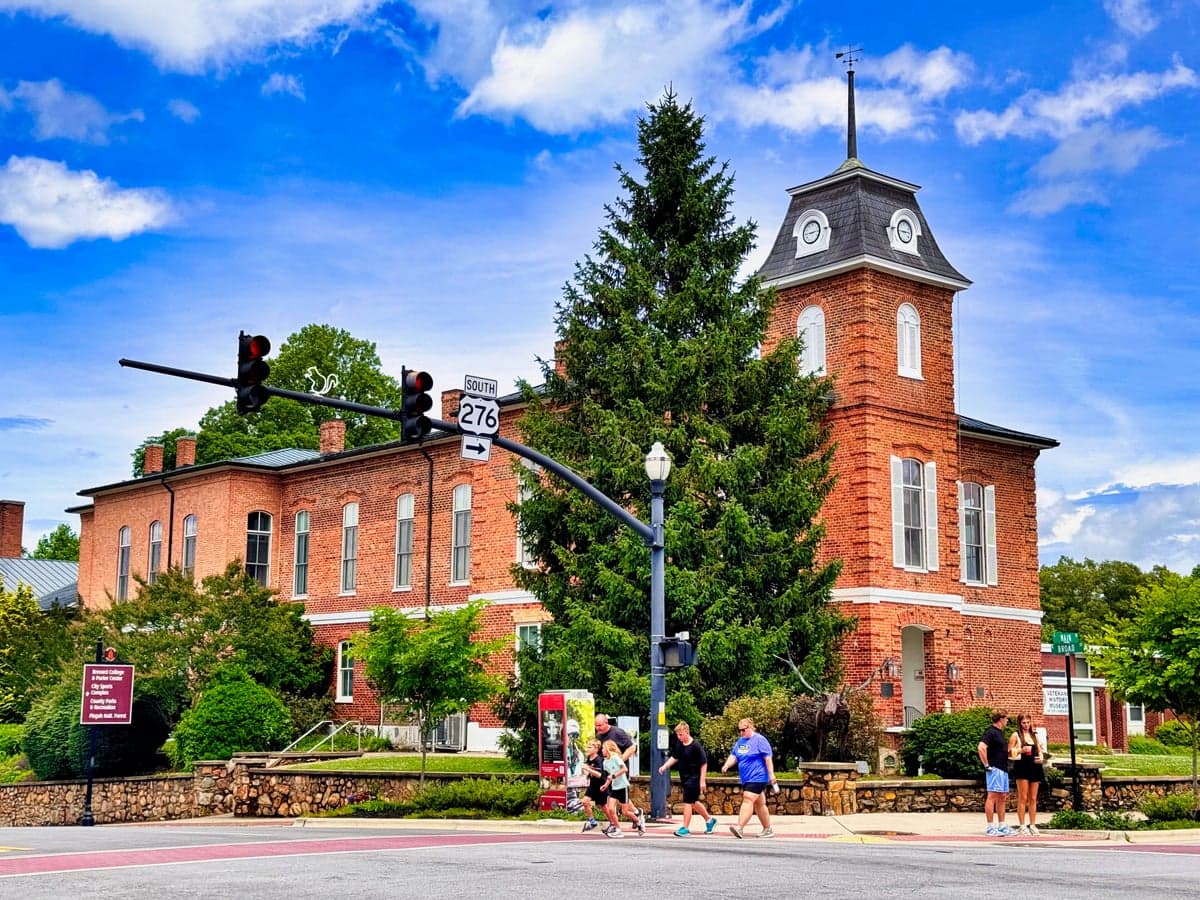
Transylvania County, North Carolina, leans reliably Republican, with a Cook Partisan Voting Index of R+5, making it significantly more conservative than the state of North Carolina as a whole, which sits at R+1. This isn't a new development; the county has been trending red for decades, though the margins have tightened slightly in recent years as newcomers, particularly from Asheville and other parts of the Northeast, have settled in the area. The county's political heart is in the rural stretches and the town of Rosman, where conservative values and a strong distrust of federal overreach are the norm. Meanwhile, the county seat of Brevard is the real battleground, with its college-educated population and artsy downtown creating a visible blue island that often votes Democratic, especially in presidential years. The precincts around the college and the historic district can swing the county's overall results, but the outlying areas consistently deliver enough Republican votes to keep the county solidly red.
How it compares
Compared to the rest of North Carolina, Transylvania County is a more pronounced version of the state's rural-conservative vs. urban-liberal divide. While the state as a whole is a true swing state, with the R+1 PVI reflecting a near-even split, Transylvania's R+5 rating places it in the same league as neighboring Henderson County or the deeply red counties to the east. The key difference is the presence of Brevard, which functions as a mini-Asheville in terms of its political culture. In a statewide election, Transylvania's votes are reliably Republican, but the margin is rarely as wide as in counties like Mitchell or Yancey. For example, in the 2020 presidential election, Donald Trump won Transylvania by about 12 points, while he won the state by only 1.3 points. This means that while the county is a safe bet for Republicans in most races, it's not a lock for the most conservative primary candidates, as the Brevard precincts can sometimes tip a close local race toward a more moderate Republican or even a Democrat in a wave year.
What this means for residents
For conservative residents, this political climate means their values are broadly reflected in local governance, from the county commission to the school board. You'll find a general resistance to new taxes, a strong emphasis on property rights, and a cultural environment where conservative social views are the default. For liberal residents, especially those in Brevard, life is a bit more of a balancing act. While you can find like-minded neighbors and a thriving progressive community centered around the arts and the college, you'll also encounter a lot of "Trump 2024" signs on the way to the grocery store. The practical effect is that local policy debates—over land use, development, and school funding—tend to be more contentious than in a uniformly blue or red area. The county's political lean also influences its relationship with the state government; Transylvania often aligns with the Republican majority in Raleigh, which can be an advantage when seeking state funding for infrastructure or disaster relief, but it also means that state-level progressive policies, like expanded Medicaid or environmental regulations, are often met with local skepticism.
Culturally, the political divide in Transylvania County is less about shouting matches and more about a quiet, lived-in difference of perspective. The area's strong libertarian streak, common in the mountain South, means that many residents, regardless of party, value personal freedom and a hands-off approach from government. This creates a unique dynamic where you might find a conservative gun owner and a liberal environmentalist agreeing on a local land-use issue, even if they'd never vote for the same presidential candidate. The biggest policy distinction you'll notice is in the approach to growth and tourism: conservatives tend to favor less regulation and more development to boost the economy, while liberals push for stricter environmental protections and affordable housing mandates. As the county continues to attract retirees and remote workers, this tension is likely to intensify, potentially nudging the county's overall political lean slightly toward the center over the next decade, even if it remains a reliably Republican stronghold for the foreseeable future.

State Political ClimatePolitical Climate in North Carolina
State Political AnalysisPolitical Environment in the State
North Carolina is a classic swing state that has been trending rightward in presidential elections over the past decade, even as its state-level politics remain deeply competitive. With a Cook Partisan Voting Index of R+1, the state is a true purple battleground, but the trajectory has been notably Republican-leaning in recent cycles: Donald Trump carried the state in both 2016 and 2024, while narrowly losing it in 2020. The dominant political coalition is a mix of rural and small-town conservatives, suburban moderates, and a growing but geographically concentrated Democratic base in the urban crescent. Over the last 10-20 years, the state has shifted from a reliably red stronghold to a toss-up, driven by massive in-migration to the Charlotte and Raleigh-Durham metros, while the rural east and mountain west have hardened their Republican lean.
Urban vs. rural divide
The political map of North Carolina is defined by a stark urban-rural split. The Democratic base is concentrated in the state's major metros: Charlotte (Mecklenburg County), the Raleigh-Durham-Chapel Hill Research Triangle (Wake, Durham, and Orange counties), and to a lesser extent Greensboro and Winston-Salem (Guilford and Forsyth counties). These areas are growing fast, fueled by tech, finance, and biotech jobs, and they vote overwhelmingly Democratic — Mecklenburg and Wake counties alone account for roughly a quarter of the state's vote. In contrast, the rural east — places like Robeson County and the coastal plain — and the western mountain counties, including Buncombe County (Asheville) which is a blue island in a red region, lean heavily Republican. The suburban ring counties around Charlotte and Raleigh, such as Union County and Johnston County, have shifted rightward as well, offsetting some of the urban gains. The result is a state that is perpetually close at the presidential level but where Republicans have maintained control of the General Assembly through aggressive gerrymandering, even when Democrats win statewide races like governor.
Policy environment
North Carolina's policy environment reflects its divided government. The state has a flat income tax rate of 4.5%, which is scheduled to decline further to 3.99% by 2027, making it increasingly attractive for conservative relocators. There is no state-level estate tax, and the corporate income tax is being phased out entirely by 2030. On education, the state has a robust school choice landscape: the Opportunity Scholarship Program provides vouchers for private school tuition, and the state has one of the largest charter school sectors in the South. Higher education is anchored by the UNC system, which remains a moderate institution but has seen conservative pushback on diversity, equity, and inclusion initiatives. Healthcare policy is a mixed bag: the state did not expand Medicaid under the Affordable Care Act until 2023, when a bipartisan deal finally passed, expanding coverage to roughly 600,000 low-income adults. Election laws have been a flashpoint: the state requires photo ID to vote, has strict absentee ballot rules, and has seen repeated legal battles over redistricting and voter access. The regulatory posture is generally business-friendly, with right-to-work laws and limited union influence, though local governments in blue cities have pushed their own progressive ordinances on minimum wage and housing.
Recent policy direction
The last few years have seen North Carolina move decisively in a conservative direction on several fronts. In 2023, the Republican supermajority passed a 12-week abortion ban, overriding Governor Roy Cooper's veto, a significant shift from the state's previous 20-week limit. On gun policy, the state enacted permitless carry of concealed handguns in 2023, making it a constitutional carry state. Parental rights in education have been a major theme: the 2023 Parents' Bill of Rights law requires schools to notify parents about changes in a child's health or well-being and restricts instruction on gender identity and sexual orientation in K-4 classrooms. On property rights, the state has strong eminent domain protections and has resisted local rent control ordinances. Privacy and surveillance law is relatively undeveloped, with no comprehensive state data privacy law, though a 2024 law restricts the use of facial recognition by law enforcement without a warrant. Voting access has tightened: the 2023 voter ID law was upheld by the state Supreme Court after a partisan flip, and same-day registration during early voting was eliminated. The overall direction is toward more individual liberty on guns and education choice, but with tighter restrictions on abortion and voting.
Civil unrest & political movements
North Carolina has a history of visible political activism on both sides. The 2020 protests following George Floyd's murder were particularly intense in Raleigh and Charlotte, with property damage and clashes with police that led to a National Guard deployment. The state has also been a focal point for the "Moms for Liberty" movement, which has been active in school board races, particularly in suburban counties like Wake and Union. On the left, the Moral Monday movement, led by the NAACP, has staged regular protests at the General Assembly since 2013 against voting restrictions and social policy. Immigration politics are less heated than in border states, but Charlotte and Durham have declared themselves sanctuary cities, refusing to cooperate with ICE detainers, which has drawn backlash from state lawmakers who have attempted to ban such policies. Election integrity controversies have been persistent: the 2020 election saw Trump's campaign challenge results in the state, and the 2024 election was again close, with ongoing litigation over voter ID and absentee ballot rules. A new resident would notice the political polarization in yard signs, bumper stickers, and local news coverage, but the state has not seen the kind of sustained civil unrest seen in Portland or Seattle.
Projection
Over the next 5-10 years, North Carolina is likely to remain a competitive swing state, but the demographic trends favor a slow rightward drift. The influx of out-of-state movers — primarily from the Northeast and California — is concentrated in the blue metros, but many of these newcomers are moderate or conservative-leaning professionals who may not vote as reliably Democratic as the existing urban base. Meanwhile, rural counties continue to depopulate, but their Republican margins are so large that they still carry weight. The state's in-migration pattern is similar to Texas: fast-growing suburbs like Holly Springs and Waxhaw are trending red, while the urban cores stay blue. The wild card is the state Supreme Court, which flipped to a 5-2 Republican majority in 2023 and will shape redistricting and election law for the rest of the decade. Expect continued Republican control of the General Assembly, with periodic Democratic wins in gubernatorial and Council of State races. The abortion ban and permitless carry laws are likely to remain in place, and further restrictions on voting access are possible. A relocator moving in now should expect a state that is politically competitive but increasingly conservative on social and cultural issues, with a business-friendly tax climate and a growing economy.
For a new resident, the bottom line is that North Carolina offers a low-tax, business-friendly environment with strong school choice and gun rights, but with a political landscape that is constantly contested. Conservatives will find a state that has moved their way on abortion, guns, and education, while liberals will find blue cities with progressive local governments and a vibrant activist scene. The practical takeaway is that your experience will depend heavily on where you live: the Research Triangle and Charlotte feel like blue islands in a red state, while the suburbs and rural areas are solidly conservative. If you're moving for economic opportunity and lower taxes, the state delivers; if you're looking for a stable political environment, be prepared for perpetual campaign season and shifting policy winds.
* Values derived from national, state, county, city and local statistics and may differ in a specific area. Last updated: 2026-08-08T12:55:44.000Z
Narrative content on this page is AI-generated and may contain mistakes. Verify any details that matter before acting on them.
ReloMaps may earn a commission from affiliate links at no extra cost to you.

