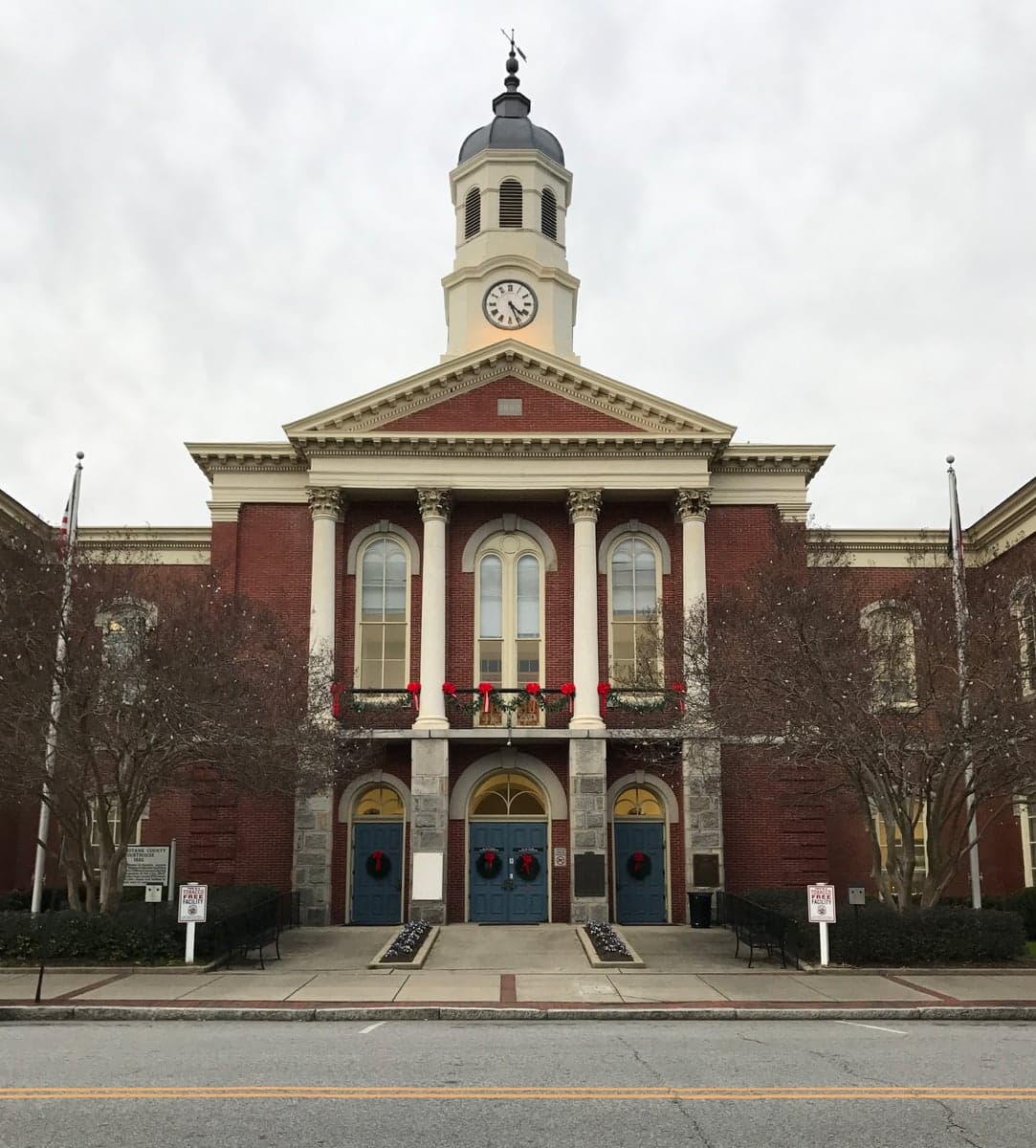
Photo: Wikipedia
Political ClimatePolitical Climate in Pasquotank County
Showing county-level results — no local-only data available.
Lean and PVI are calculated from this county’s 2020 and 2024 presidential results, Cook-style.
Political rankings in North Carolina
- Most Conservative Cities in North Carolina
- Most Liberal Cities in North Carolina
- Best Liberal-Leaning Towns in the South
- Best Liberal-Leaning Towns in Appalachia
- Safest Liberal-Leaning Towns in the South
- Safest Conservative-Leaning Towns in the South
- Safest Conservative-Leaning Towns on the East Coast
- Affordable Small Towns for Conservatives
- Most Conservative Counties in North Carolina
- Most Liberal Counties in North Carolina
Local Political AnalysisPolitical Analysis of Pasquotank County
Pasquotank County sits in a genuinely competitive political position, carrying a Cook PVI of R+1 that mirrors the statewide North Carolina rating exactly. This is not a deep-red or deep-blue county; it is a place where elections are decided by narrow margins and where the urban-rural divide within the county itself tells the real story. The county has trended slightly more Republican in recent presidential cycles, but the shift is modest, and local races often flip between parties depending on turnout in the county seat of Elizabeth City.
How it compares
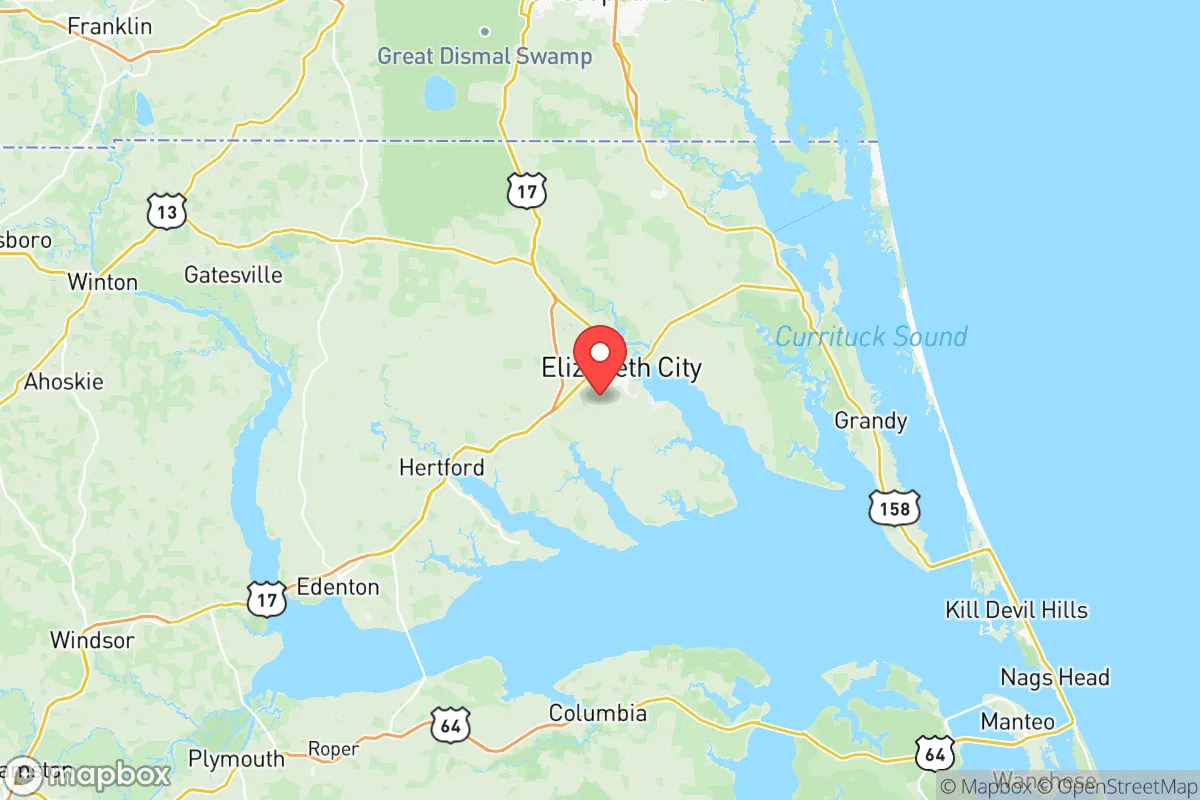
At first glance, Pasquotank County and North Carolina are statistical twins — both sit at R+1 on the Cook Political Report's index. But that single number hides a more nuanced reality. North Carolina's R+1 is an average of deeply conservative rural western counties, fast-growing suburban exurbs around Charlotte and Raleigh, and urban Democratic strongholds. Pasquotank's R+1 is driven by a different mix: the city of Elizabeth City, home to roughly 18,000 of the county's 40,000 residents, leans Democratic, while the unincorporated areas and smaller communities like Weeksville, Nixonton, and Mount Hermon lean Republican. The swing precincts are in the middle — neighborhoods just outside Elizabeth City's historic downtown, around the Elizabeth City State University campus, and along the U.S. 17 corridor heading south toward Hertford County. In 2020, Donald Trump won the county by a few hundred votes, but in 2016 he lost it to Hillary Clinton by a similar margin. That back-and-forth is the defining feature of Pasquotank politics.
What this means for residents
For conservative residents, the R+1 lean means their votes genuinely matter. A Republican candidate who runs well in Weeksville and the rural eastern precincts can offset Democratic margins in Elizabeth City proper, which keeps the county competitive in state legislative races. The 1st Congressional District, which includes Pasquotank, has flipped between parties in recent cycles, and local Republicans have found success by focusing on economic development, the Port of Elizabeth City, and opposition to overregulation of agriculture and the fishing industry. For liberal residents, the picture is similarly practical. Elizabeth City's African American community, which makes up roughly 37% of the county population, is the backbone of Democratic turnout, and Elizabeth City State University adds a steady stream of younger, progressive voters. Democrats hold several county commission seats and the mayor's office, and they have been effective at mobilizing around public education funding and coastal environmental protections. Neither side can afford to sit out an election — that is the practical reality of living in a county this evenly divided.
Culturally, Pasquotank County is a place where the political divide is real but not paralyzing. The county is part of the historic Albemarle region, and there is a shared identity rooted in the water — the Pasquotank River, the Dismal Swamp Canal, and the fishing and farming economies that predate the partisan era. You will find conservative gun owners and liberal environmentalists both complaining about state highway funding and both supporting the local volunteer fire departments. The biggest policy fights in recent years have been over the proposed Mid-Currituck Bridge, which would bring development to the Outer Banks and is supported by many business interests but opposed by environmental groups, and over the future of the Elizabeth City waterfront, where a mix of public and private investment has created rare bipartisan consensus. The county's political trajectory over the next decade will likely hinge on whether Elizabeth City continues to grow and diversify, which would push the county leftward, or whether the rural precincts continue to turn out at higher rates, which would keep it red. For now, it remains one of the few places in eastern North Carolina where both parties have a realistic path to victory in any given cycle.

State Political ClimatePolitical Climate in North Carolina
State Political AnalysisPolitical Environment in the State
North Carolina sits as one of the most closely divided states in the country, with a Cook PVI of R+1 that reflects a genuine 50/50 toss-up in presidential elections. The state has voted Republican in 10 of the last 12 presidential contests, but the margins have been razor-thin since 2008, with Donald Trump winning by 1.3 points in 2024 and Barack Obama carrying the state in 2008. The real story is a decade-long demographic transformation: rapid in-migration to the Charlotte and Raleigh metros is pulling the state leftward, while the rural east and mountain west remain deeply conservative, creating a political tug-of-war that defines every statewide race.
Urban vs. rural divide
The political map of North Carolina is a study in contrasts. Mecklenburg County (Charlotte) and Wake County (Raleigh) are the Democratic anchors, together casting roughly 20% of the state's votes and delivering margins of 30-40 points for Democrats. These metros have absorbed most of the state's population growth over the past decade, fueled by transplants from the Northeast and West Coast drawn to banking, tech, and research jobs. The Research Triangle — Raleigh, Durham, and Chapel Hill — is the intellectual engine of the state's left, anchored by three major universities and a booming biotech sector.
Outside those corridors, the map turns sharply red. The rural east, stretching from Fayetteville down through Goldsboro and Greenville, is reliably Republican, driven by agricultural interests, military families, and evangelical voters. The western mountain counties like Asheville's home county of Buncombe are a notable exception — Asheville is a liberal enclave surrounded by deep-red rural territory. The suburban counties are where elections are actually decided: Cabarrus County (northeast of Charlotte), Johnston County (southeast of Raleigh), and Union County (south of Charlotte) have all trended Republican but are seeing margins shrink as metro sprawl pushes outward. These exurban battlegrounds, not the cities or the countryside, will determine the state's political future.
Policy environment
North Carolina's policy landscape is a mixed bag that reflects its divided government. The state has a flat income tax of 4.5%, which is scheduled to drop to 3.99% by 2027, and a sales tax rate of 4.75% that local governments can supplement. The corporate tax rate sits at 2.5%, among the lowest in the nation, making the state attractive to relocating businesses. The regulatory posture is generally business-friendly, with a right-to-work law on the books and a tort reform regime that caps non-economic damages in medical malpractice cases.
Education policy has been a flashpoint. The state funds a private school voucher program (the Opportunity Scholarship Program) that has expanded significantly since 2023, now serving over 70,000 students. Charter schools are plentiful, and homeschooling regulations are among the most permissive in the country. On healthcare, North Carolina expanded Medicaid in 2023 under a Republican legislature and Democratic governor — a rare bipartisan compromise that extended coverage to roughly 600,000 low-income adults. Election laws are moderately restrictive: voter ID is required, early voting runs 17 days, and same-day registration is available during early voting but not on Election Day itself.
Recent policy direction
The last five years have seen a clear conservative shift on several fronts, even as the state's demographics move left. The legislature overrode Governor Roy Cooper's veto to pass the Parents' Bill of Rights in 2023, requiring schools to notify parents about instructional materials involving gender identity and sexuality. The same year, the General Assembly passed a 12-week abortion ban with exceptions, replacing the previous 20-week limit. Gun laws remain permissive — the state is shall-issue for concealed carry, and permitless carry became law in 2023, allowing adults to carry concealed firearms without a permit.
On taxation, the state has been on a steady path of rate reduction since 2013, with the flat income tax falling from 5.8% to 4.5% and further cuts scheduled. Property taxes are set locally, and there is no state-level property tax. The state has also moved to restrict Chinese ownership of agricultural land and has passed election integrity measures including stricter voter ID requirements and limits on absentee ballot drop boxes. The 2024 session saw the legislature override the governor's veto on a bill requiring sheriffs to cooperate with federal immigration authorities — a significant shift on immigration enforcement that puts the state at odds with sanctuary jurisdictions.
Civil unrest & political movements
North Carolina has seen its share of political flashpoints. The 2020 protests following George Floyd's death were concentrated in Charlotte, Raleigh, and Wilmington, with property damage and curfews in the urban cores. The state has an active and organized conservative movement, particularly around education and parental rights, with groups like Moms for Liberty maintaining strong chapters in suburban counties. The immigration debate has intensified since the 2024 sheriffs' cooperation law, with some urban sheriffs — notably in Wake County — publicly resisting full compliance while rural sheriffs embrace it.
The state has not seen serious secession or nullification rhetoric, but there is a persistent rural-urban cultural tension. The "Silent Sam" Confederate monument controversy at UNC-Chapel Hill in 2018 drew national attention and remains a sore point. Election integrity has been a recurring theme: the state conducted a full forensic audit of the 2020 election in 2021, which found no evidence of widespread fraud, but the legislature has nonetheless tightened voting laws in each subsequent session. New residents will notice the political energy — yard signs, bumper stickers, and active local party organizations are far more visible here than in many other states.
Projection
Looking ahead five to ten years, North Carolina is on a trajectory toward becoming a true swing state, possibly leaning Democratic in presidential years. The population growth is overwhelmingly concentrated in the urban metros and their suburbs, and the in-migration is disproportionately college-educated and moderate-to-liberal. The 2024 election saw the state's margin shrink to 1.3 points, down from 1.3 in 2020 and 3.7 in 2016. If current trends hold, the state could flip blue in a presidential election within the next two cycles, though the state legislature's Republican majority is likely to persist longer due to district lines and the concentration of Democratic voters in urban areas.
However, the rural vote is not shrinking — it's just being outpaced. The eastern and western counties remain deeply conservative, and the exurban counties are still voting Republican, just by smaller margins. The state's political future will hinge on whether the suburbs of Charlotte and Raleigh continue their leftward drift or stabilize. A new resident moving in now should expect a state that remains competitive in every statewide race, with policy outcomes that swing depending on which party controls the governorship and legislature in any given cycle.
For a new resident, the practical takeaway is that North Carolina offers a genuinely competitive political environment where your vote matters. If you're conservative, you'll find a state that has delivered Republican governance on taxes, gun rights, and education policy, but you'll need to accept that the urban centers are firmly Democratic and that statewide races will be close. If you're liberal, you'll find growing strength in the metros and a realistic path to statewide power within a decade, but you'll be living under conservative state policy in the meantime. The state's divided government means policy swings with each election — no single party has a permanent grip on power, and that's precisely what makes North Carolina politically interesting to watch and to live in.
* Values derived from national, state, county, city and local statistics and may differ in a specific area. Last updated: 2026-10-28T00:27:26.000Z
Narrative content on this page is AI-generated and may contain mistakes. Verify any details that matter before acting on them.
ReloMaps may earn a commission from affiliate links at no extra cost to you.

