Photo: Wikipedia
Demographics of Pasquotank County
Affluence Level in Pasquotank County
A middle-class area roughly in line with national averages across income, home values, education, and employment.
People of Pasquotank County
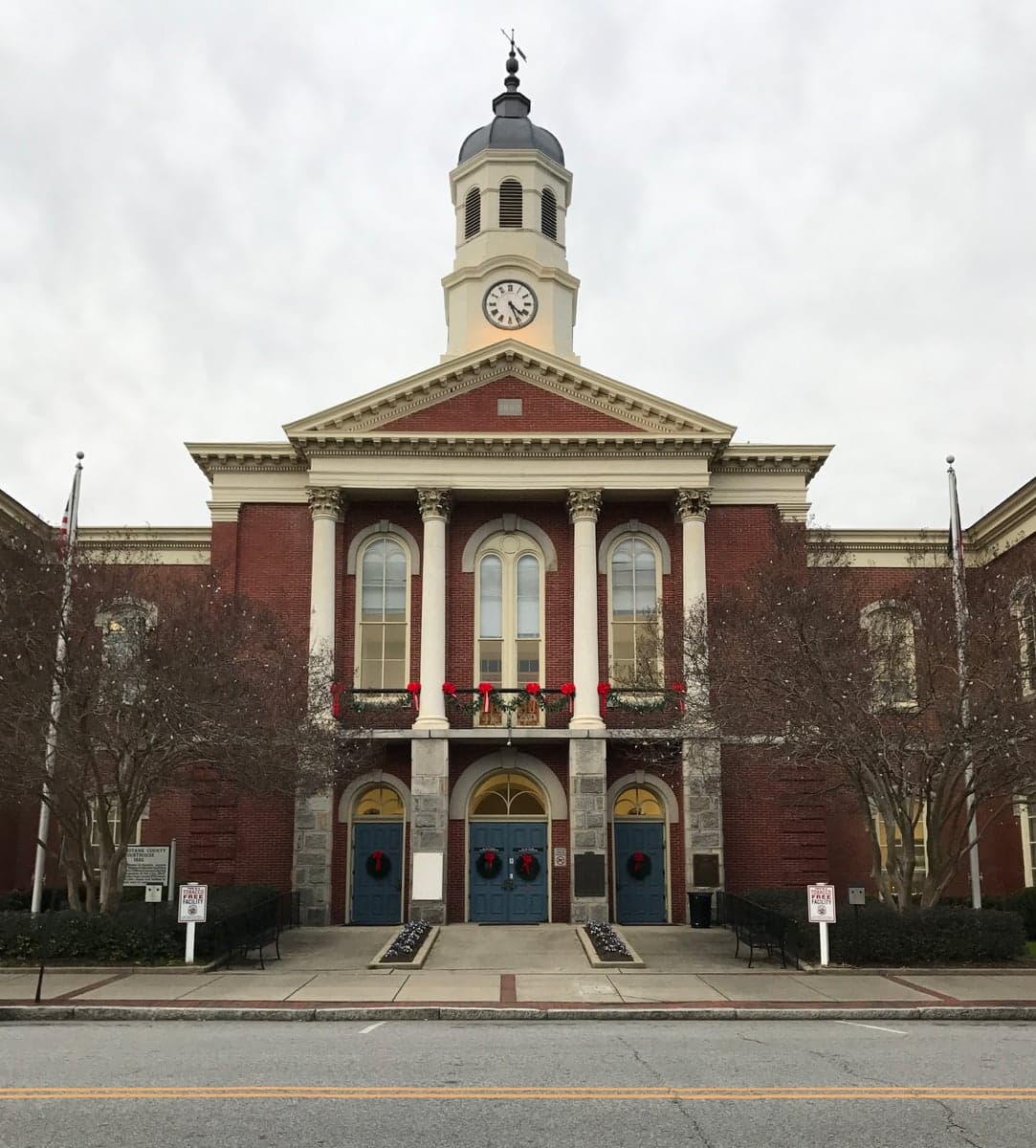
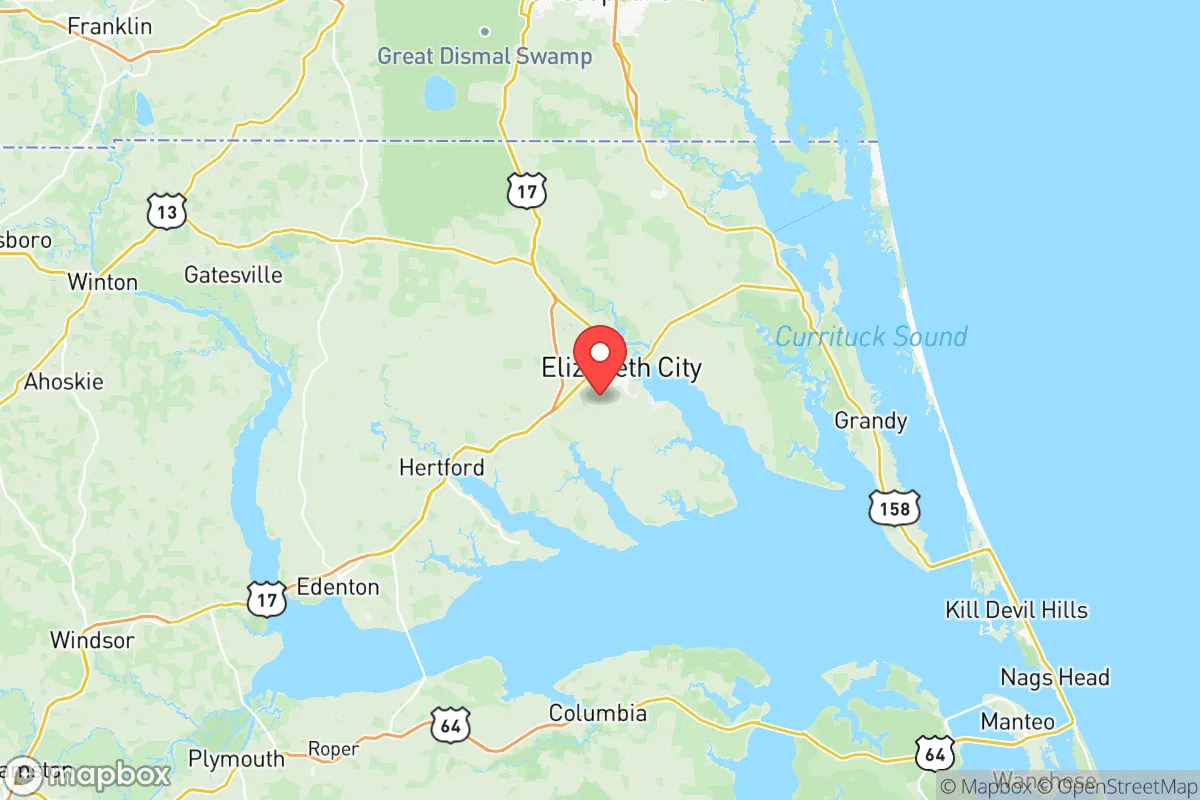
Pasquotank County, North Carolina, is home to roughly 40,830 residents, a population shaped by centuries of coastal commerce, agricultural labor, and the presence of Elizabeth City State University. The county’s identity is distinctly biracial — about 53.7% White and 34.6% Black — with a very small foreign-born share of just 1.0%, making it one of the least ethnically diverse counties in the state by immigration metrics. Its people are concentrated in the county seat of Elizabeth City, with smaller communities spread across the rural northeastern corner of the state, and the area carries a quiet, historically rooted character that blends Tidewater Southern traditions with a growing public-sector and university influence.
Settlement & growth (pre-1960)
Long before European settlement, the region was home to the Algonquian-speaking Weapemeoc people, who lived along the rivers and sounds of what is now Pasquotank County. The county itself was formed in 1668 as one of the original precincts of the Albemarle Settlements, the first permanent English colony in what became North Carolina. These early settlers were primarily English and Virginia-born migrants moving south from the Jamestown area, drawn by the promise of cheap land along the Pasquotank River and the sheltered waters of Albemarle Sound.
Through the 1700s and 1800s, the population grew slowly but steadily. The economy revolved around the Dismal Swamp Canal (completed in 1805), which linked the county to the Virginia ports of Norfolk and Portsmouth, and around the region’s timber, shingle, and agricultural products. The county’s enslaved Black population grew alongside this economy, and by 1860, enslaved people made up a substantial portion of the county’s residents, working on small farms and in the naval stores industry. After the Civil War, the freed Black population remained in place, forming the foundation of the county’s large African American community that persists today. The town of Elizabeth City, incorporated in 1793, became the commercial and political hub, while smaller settlements like Weeksville, Nixonton, and Mount Hermon developed as rural crossroads and ferry landings.
The early 20th century brought modest industrial growth — sawmills, cotton mills, and the establishment of the State Normal School for Negroes in 1891, which later became Elizabeth City State University. This institution became a major anchor for the Black professional class in northeastern North Carolina. The Great Migration (roughly 1915–1970) saw many Black residents leave Pasquotank for northern cities like Philadelphia and New York, reducing the county’s Black share from a post-Reconstruction majority to a large minority. White population growth during this period came primarily from natural increase and some migration from surrounding counties, but Pasquotank never experienced the large-scale European immigration waves that reshaped northern and midwestern counties. The county’s population remained overwhelmingly native-born, rural, and split between White and Black residents through the 1950s.
Modern era (post-1965)
The 1965 Hart-Cellar Act, which opened U.S. immigration to non-European countries, had almost no direct effect on Pasquotank County. With a foreign-born population of just 1.0% today — far below the national average of roughly 14% — the county has remained largely untouched by the post-1965 immigration wave. The small Hispanic population, now about 5.9% of the county, began arriving in the 1990s and 2000s, primarily as migrant agricultural workers in the region’s soybean, corn, and cotton fields, with some settling permanently in Elizabeth City and the unincorporated community of Weeksville. East and Southeast Asian residents, at about 1.1%, are largely connected to Elizabeth City State University and the U.S. Coast Guard’s Elizabeth City base, which brings in a rotating population of service members and their families. The Indian-subcontinent population is negligible at 0.1%.
The most significant demographic shift since 1965 has been domestic, not international. The closure of local textile mills and the decline of the timber industry in the 1980s and 1990s pushed some younger residents to seek work in the Research Triangle or the Hampton Roads area of Virginia. At the same time, the expansion of Elizabeth City State University, the U.S. Coast Guard Air Station (the largest in the nation), and the state’s Department of Transportation and prison system brought a steady stream of White and Black professionals into the county. Suburbanization has been modest and concentrated around Elizabeth City, with new residential developments spreading along U.S. Highway 17 toward the Virginia border and along the waterfront east of the city. The county’s Black population has remained stable in share — about 34.6% — reflecting a community that is deeply rooted and not subject to the rapid gentrification or displacement seen in larger metro areas.
The future
Pasquotank County is likely to remain one of North Carolina’s least diverse counties by immigration metrics over the next 10–20 years. The Hispanic share is expected to grow slowly, perhaps reaching 8–10% by 2040, as agricultural labor needs persist and some workers transition to permanent residence. The East and Southeast Asian population will likely remain small and tied to the university and Coast Guard rotations. The county’s overall population growth is projected to be modest — roughly 0.5–1% annually — driven by natural increase and some domestic migration from the Hampton Roads area, where housing costs are significantly higher.
The cultural identity of the county is likely to remain anchored in its Black and White Southern heritage, with Elizabeth City State University continuing to serve as a stabilizing institution for the Black community. The county is not on a trajectory toward becoming a diverse, immigrant-rich area; instead, it is a place where demographic change is slow, incremental, and largely domestic. The most visible change may be the continued suburbanization of the Elizabeth City area, with new subdivisions and retail corridors along the U.S. 17 bypass drawing in retirees and telecommuters from Virginia.
For someone moving to Pasquotank County today, the bottom line is this: you are entering a stable, biracial Southern community with deep historical roots, a modest but growing Hispanic presence, and very little international immigration. The county offers a low-cost, low-density lifestyle centered on Elizabeth City, with a strong public-sector employment base and a historically Black university at its heart. It is not a place of rapid demographic transformation — it is a place where the population is slowly aging, slowly suburbanizing, and slowly diversifying, but where the essential character of the Tidewater South remains firmly intact.

* Values derived from national, state, county, city and local statistics and may differ in a specific area. Last updated: 2026-10-28T00:27:26.000Z
Narrative content on this page is AI-generated and may contain mistakes. Verify any details that matter before acting on them.
ReloMaps may earn a commission from affiliate links at no extra cost to you.

