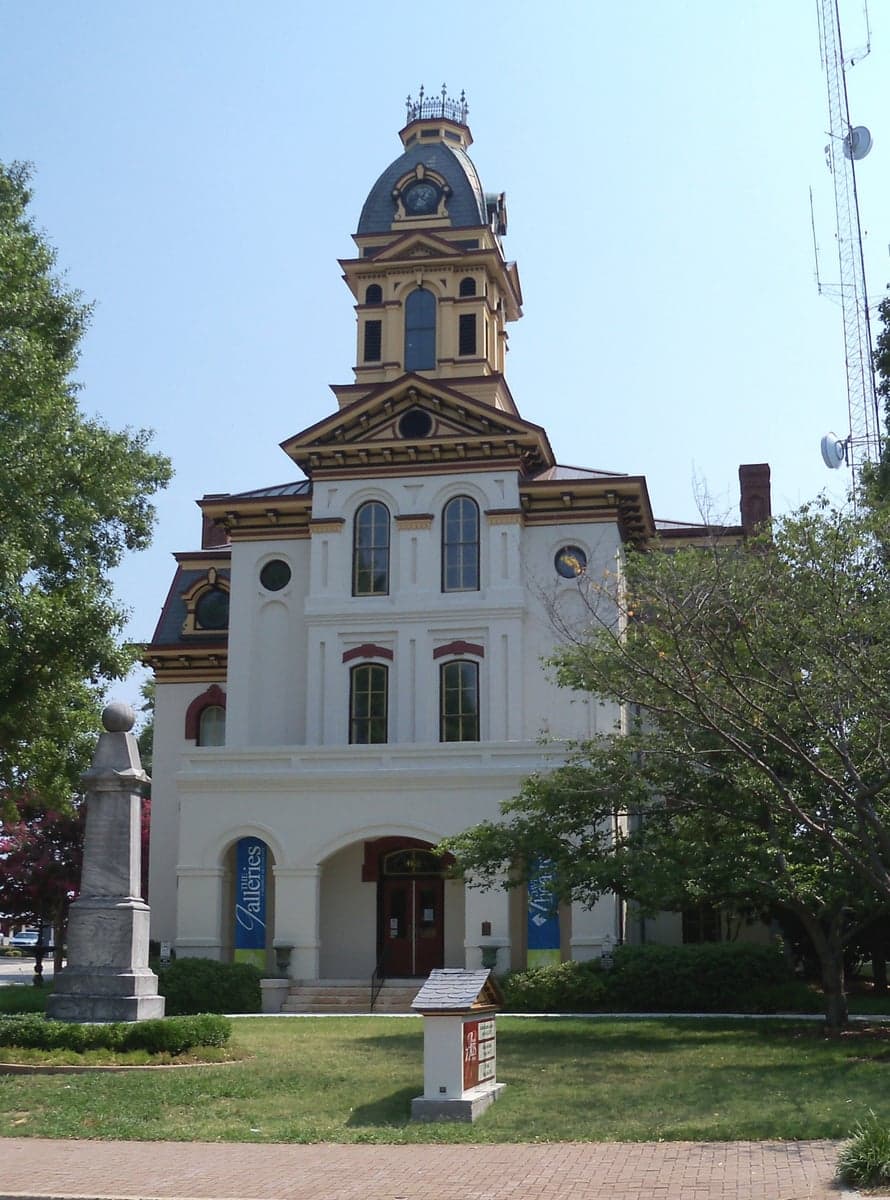
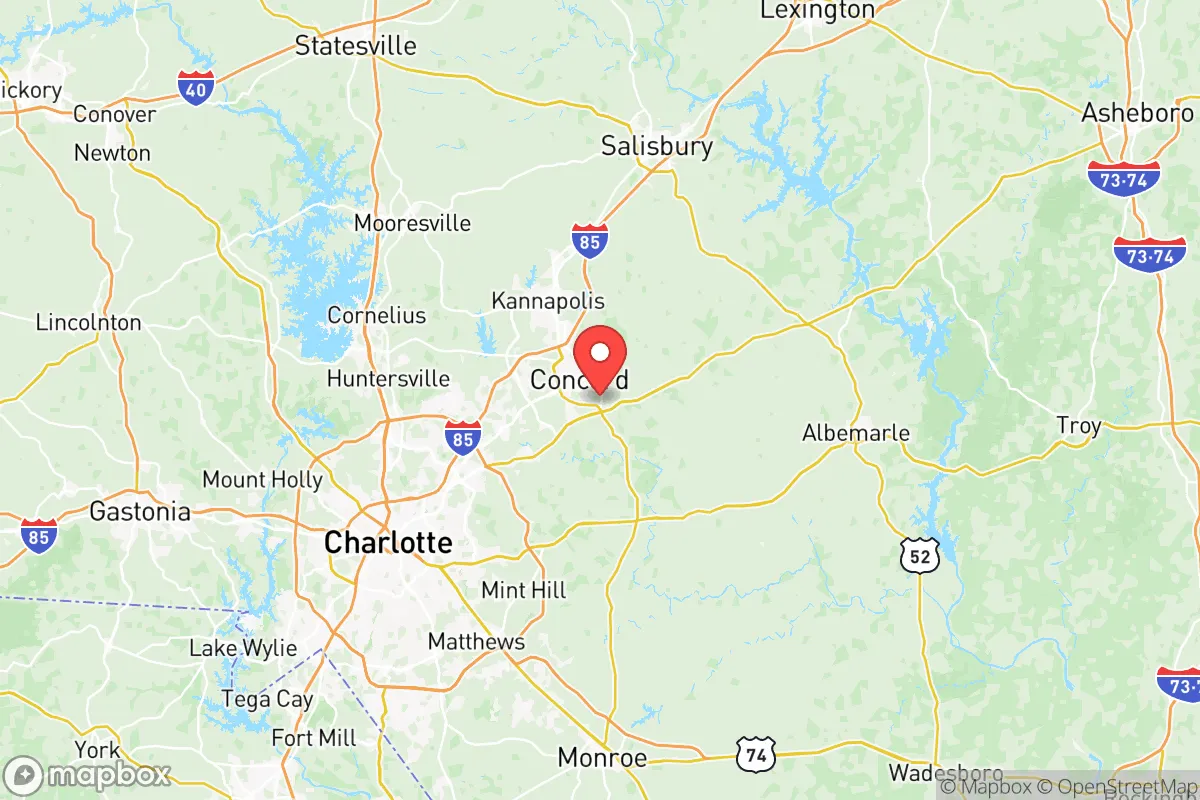
Photo: Wikipedia
Political ClimatePolitical Climate in Cabarrus County
Showing state-level results — no local-only data available.
Local Political AnalysisPolitical Analysis of Cabarrus County
Cabarrus County, part of the fast-growing Charlotte metro, has shifted from a solidly conservative stronghold to a reliably Republican but competitive county over the past decade. In the 2024 presidential race, the county voted for Donald Trump by about 15 points, a noticeably tighter margin than the 20+ point leads Republicans enjoyed here in 2012 and 2016. This rightward-but-narrowing trend mirrors the broader suburban realignment seen across North Carolina, where the statewide Cook PVI sits at R+1, making it one of the most politically balanced states in the country. The story of Cabarrus politics isn't a simple red-blue divide, but a tale of two distinct zones: the old rural-conservative core and the newer, more moderate suburban spillover from Charlotte.
How it compares to North Carolina
Cabarrus County is consistently more Republican than North Carolina as a whole. While the state as a whole is a true toss-up at the presidential level (Trump won it by roughly 1.5 points in 2024), Cabarrus leans about 13-15 points to the right of the state average. This makes it comparable to other exurban counties like Union County (east of Charlotte), though Cabarrus has a more pronounced rural-urban political split within its borders. The county's internal geography reveals a clear pattern: the town of Concord, especially its older, denser downtown core and the rapidly developing southwestern neighborhoods near the Charlotte border, shows the most Democratic-leaning precincts, often voting blue by single-digit margins. In contrast, the outlying towns of Harrisburg, Mount Pleasant, and Midland remain deeply red, with Republican margins often exceeding 30 points. Kannapolis, the county's other major city, is a true swingbellwether — its working-class precincts have been moving leftward since 2020, but it still leans slightly to the right of the county average.
What this means for residents
For conservative residents, living in Cabarrus means their votes are rarely wasted; local school board, county commission, and state legislative races tend to align with their views. The county has passed several bond referendums for school construction in recent years, but tax rates remain among the lowest in the Charlotte region, a direct reflection of the Republican-dominated Board of Commissioners. For liberal residents, the picture is more nuanced: you'll find like-minded neighbors in the newer subdivisions near Afton Ridge and in Concord's historic district, but you'll also feel the political headwinds at the county level. Socially progressive policies on issues like affordable housing mandates or sanctuary city designations have little chance of passing. However, the political trajectory offers some hope — the county's Democratic margin has improved by about 3-5 points in each of the last two presidential cycles, meaning the local conversation is slowly shifting toward issues like transit expansion and environmental regulations that were once nonstarters.
Cultural and policy distinctions
One of the most telling cultural indicators in Cabarrus is the debate over land use and development. In areas like southwestern Concord and the Harrisburg corridor, the arrival of Charlotte-style mixed-use developments (think The Farm at Afton Ridge or the new Kannapolis Gateway project) is often championed by moderate Republicans and Democrats as a way to attract young families and tax revenue, while more traditional conservative residents in Midland and Mount Pleasant resist zoning changes, preferring to preserve the area's equestrian and agricultural character. This tension plays out in county commission meetings and local elections. Another distinction: gun rights are fiercely protected here — the county is home to numerous gun ranges and retail outlets, and open carry is common at rural convenience stores and even some suburban hardware stores, something that would draw attention in Charlotte proper but is unremarkable here. For residents, this means understanding that Cabarrus is a place where political identity is often tied to one's physical address — the closer you are to the Charlotte line, the more likely you are to hear friendly debates over growth; the further out you go, the more settled the conservative consensus becomes.

State Political ClimatePolitical Climate in North Carolina
State Political AnalysisPolitical Environment in the State
North Carolina is a classic purple state that has drifted rightward over the past decade, with a Cook PVI of R+1 that understates how competitive it actually is. The state is a genuine toss-up at the presidential level — Trump won it by just 1.3 points in 2024 and by 1.4 points in 2020 — but at the state level, Republicans have held the General Assembly since 2011 and the governorship flipped to Democrat Josh Stein in 2025 after a decade of Roy Cooper. The long arc has been a slow but steady creep rightward in legislative power, even as the urban crescent continues to swell with new arrivals from the Northeast and California who keep the presidential races razor-thin.
Urban vs. rural divide
The political geography of North Carolina is a textbook case of the urban-rural chasm in American politics. Charlotte-Mecklenburg, the Triangle (Raleigh-Durham-Chapel Hill), and the Triad (Greensboro-Winston-Salem-High Point) are solidly Democratic, with Mecklenburg and Wake counties alone delivering a quarter-million-vote margin for Democratic candidates. The bottom falls out fast as you move outward: Union County, just southeast of Charlotte, is deep red and growing fast as families flee Mecklenburg for lower taxes and larger lots. Farther east, Fayetteville and Cumberland County lean Democratic thanks to a large military and minority population, but the surrounding Sandhills counties are deep red. The rural east, from the coastal plain through the Piedmont, is overwhelmingly Republican and has been getting redder as older, white populations age in place and younger residents leave for the cities. The mountain counties in the west — Buncombe County (Asheville) is an island of blue surrounded by deep red Avery, Mitchell, and Watauga counties. The net effect is a state where Democrats can win the governorship and close statewide races but rarely crack a supermajority-proof legislative map drawn by Republicans after the 2020 census.
Policy environment
The state has a tax-friendly posture that appeals to conservative relocators. Corporate income tax is a flat 2.5% and on a glide path to zero by 2031; the personal income tax rate is a flat 4.5% (down from over 7% a decade ago) and will drop to 3.99% by 2027. There is no state-level property tax — that's handled by counties, which average around 0.7% of assessed value. Sales tax tops out at 7.5% in most counties. The regulatory environment is broadly business-friendly, with right-to-work laws and a low unionization rate (under 3% in the private sector). Education policy has been a flashpoint: the state has a robust school-choice program with Opportunity Scholarships that now have no income cap, letting any family use public funds for private school tuition. The legislature passed a Parents' Bill of Rights (HB 755) in 2023 requiring schools to notify parents about changes in students' health or well-being, including gender-related issues. Healthcare is a mixed bag: the state did expand Medicaid in 2023 under the Cooper administration with bipartisan support, covering roughly 600,000 newly eligible adults, but the General Assembly has not expanded access to abortion beyond a 12-week ban (with exceptions for rape, incest, and life of the mother) passed in 2023 after the Dobbs decision. Election laws have tightened: the state requires photo ID to vote, in-person early voting runs for 17 days, and same-day registration is available only during early voting (not on Election Day).
Recent policy direction
Over the last four years, the Republican-controlled General Assembly has pushed a distinctly conservative agenda while Governor Cooper used vetoes to moderate it. With Democrat Josh Stein in the governor's mansion as of 2025, the dynamic remains similar — expect more veto battles. In 2024, the legislature passed SB 54, which codified the 12-week abortion ban and added restrictions on medication abortion, then overrode Cooper's veto. On guns, North Carolina is a shall-issue state with no permit required for open carry; in 2023, the legislature passed HB 69, eliminating the permit requirement for concealed carry, though it was vetoed by Cooper and the override fell a few votes short — expect that issue back in 2025. On property rights, the state has strong homeowners' association regulations and limits on local zoning preemptions, with a 2024 law restricting counties from regulating lot sizes too aggressively. On parental rights and speech, the aforementioned Parents' Bill of Rights and a 2024 law banning mask mandates in public settings (except for health reasons) reflect a sensitivity to COVID-era overreach. Privacy and surveillance: the state has no broad data privacy law, but law enforcement body-camera footage is generally public record. On voting, the 2023 omnibus election bill (SB 747) shortened the mail-in ballot receipt window to 3 days post-election and codified the ballot ID requirement. The net effect: a state where taxation and regulation tilt right, social policy is mixed but increasingly conservative, and gubernatorial vetoes are the only brake on legislative momentum.
Civil unrest & political movements
North Carolina has seen its share of high-profile protests and organizing. The HB2 "bathroom bill" fight in 2016 produced massive boycotts from the NBA, NCAA, and corporate America, costing the state an estimated $3.76 billion in lost business and events. The legislature partially repealed HB2 in 2017, and then in 2023 replaced it with a compromise that banned cities from passing their own anti-discrimination ordinances while preempting bathroom policies statewide — a typical North Carolina solution where the state preempts local action to set a uniform (and more conservative) baseline. The 2020 protests in Charlotte and Raleigh over George Floyd's death were large but non-violent relative to other cities; the state has not seen the kind of sustained civil unrest seen in Portland or Seattle. Immigration politics are relatively moderate: there are no sanctuary cities (the state preempts that in law), but the Charlotte Mecklenburg Police Department does not routinely ask about immigration status during traffic stops. The "Audit the Vote" movement has been active in rural counties since 2020, with Republican activist groups challenging voter rolls, but no major scandals have emerged. A notable flashpoint is the Mount Olive pickle plant immigration raid of 2019, which netted over 200 undocumented workers and sparked local tensions in the eastern part of the state. The "Third Friday" protests in Raleigh have become a regular fixture of the political landscape, with conservative groups staging small but persistent demonstrations at the legislature.
Projection
Over the next 5-10 years, expect North Carolina to continue its slow rightward drift on state policy even as the presidential vote stays competitive. The in-migration from blue states — particularly New York, New Jersey, and California — is concentrated in the urban crescent (Charlotte, the Triangle, and the Triad), which keeps those areas blue but does not change the legislative map drawn to minimize Democratic seats. The legislature's map gives Republicans a built-in advantage of roughly 10-12 seats in the 120-member House, even when Democrats win statewide. Meanwhile, the rural east and small-town Piedmont are losing population, and those seats are being redistricted away — but not fast enough to flip the chamber. The flat income tax glide path to 3.99% is baked into law, and the corporate tax phase-out to zero is similarly locked, so the tax burden will keep dropping regardless of who holds the governorship. On social issues, expect the legislature to push further: a bill for "universal school choice" (already essentially the case) and a possible return of permitless carry. The minimum wage is still $7.25, tied to federal law, and there is no serious push for a state increase. A practical consequence: a family moving to Wake Forest, just north of Raleigh, or Waxhaw, south of Charlotte, will find right-leaning county commissions and school boards, even as the big cities stay blue. A decade out, the state will likely be more polarized than it is now — with urban corridors and rural expanses pulling apart — but the overall partisan split will remain close to 50-50, with the legislative majority remaining Republican.
For a conservative relocator, North Carolina offers affordable living, low and falling taxes, a competitive school-choice environment, and a state government controlled by Republicans for the foreseeable future. A liberal relocator will find vibrant social communities in the urban areas, a governor who can block the most aggressive legislation, and a state party that remains competitive in federal races. The practical takeaway: pick your locality carefully. Your experience in Mecklenburg County will be completely different from what you find in Union or Iredell County, even though you pay the same state income tax rate. The state is not a monolith — it's a patchwork of political realities stitched together by a highway system and a legislative map that guarantees neither side ever gets exactly what it wants.
* Values derived from national, state, county, city and local statistics and may differ in a specific area. Last updated: 2026-06-22T04:26:14.000Z
Narrative content on this page is AI-generated and may contain mistakes. Verify any details that matter before acting on them.
ReloMaps may earn a commission from affiliate links at no extra cost to you.

