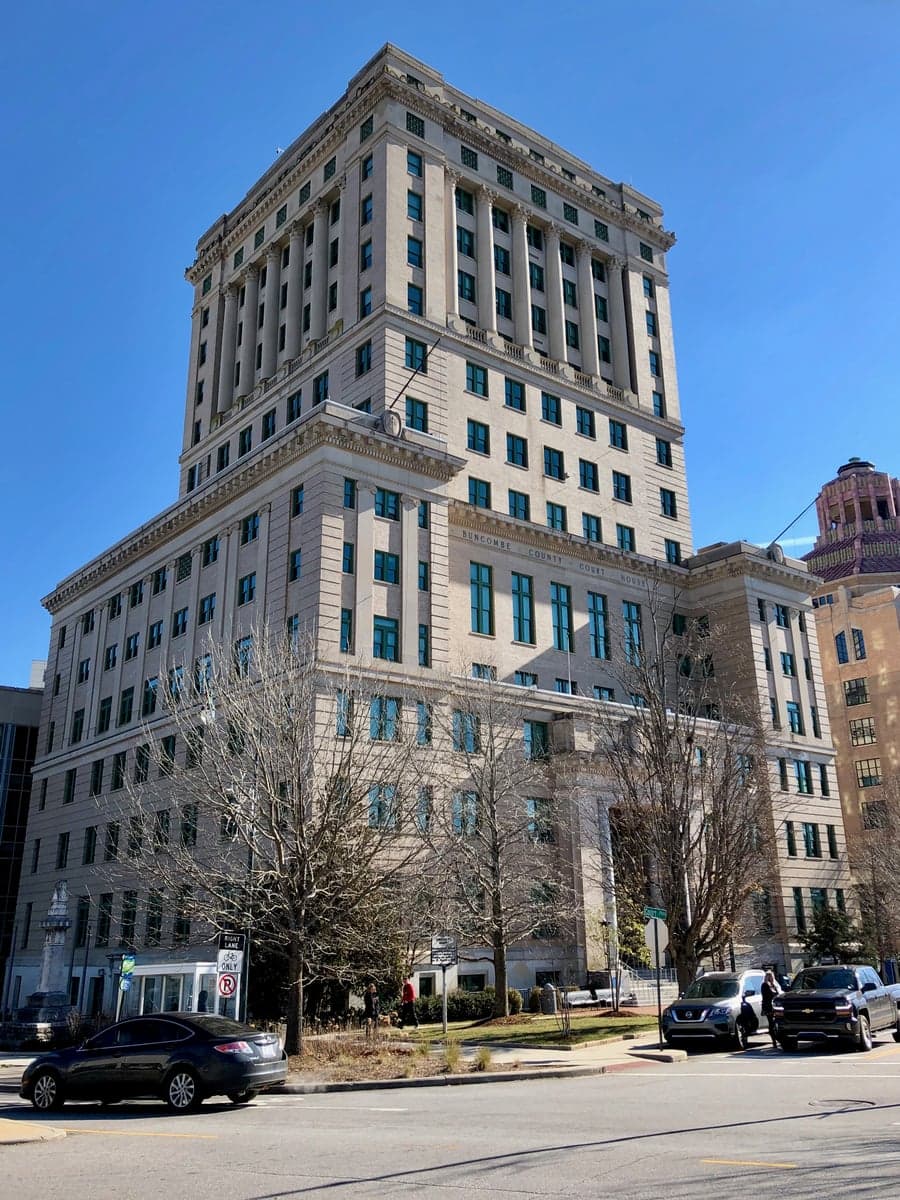
Photo: Wikipedia
Demographics of Buncombe County
Affluence Level in Buncombe County
A middle-class area roughly in line with national averages across income, home values, education, and employment.
People of Buncombe County
The people of Buncombe County today number 271,790, forming a predominantly white (81.2%) population that is notably well-educated, with 44.6% holding a college degree. The county is anchored by the city of Asheville, a regional hub known for its liberal-leaning culture, but the broader county includes a mix of small towns and rural areas with more conservative leanings. A relatively small foreign-born population of 3.9% and a Hispanic share of 8.3% point to a region that is less ethnically diverse than the national average, though its character is increasingly shaped by domestic in-migration from other parts of the country.
Settlement & growth (pre-1960)
Before European settlement, the area now known as Buncombe County was part of the homeland of the Cherokee people, who had established towns and trails throughout the Southern Blue Ridge Mountains. The Cherokee were forcibly removed via the Trail of Tears in the 1830s, though a small number remained in the region, and their descendants are now concentrated in the Qualla Boundary, which lies just north of the county line in Swain and Jackson counties.
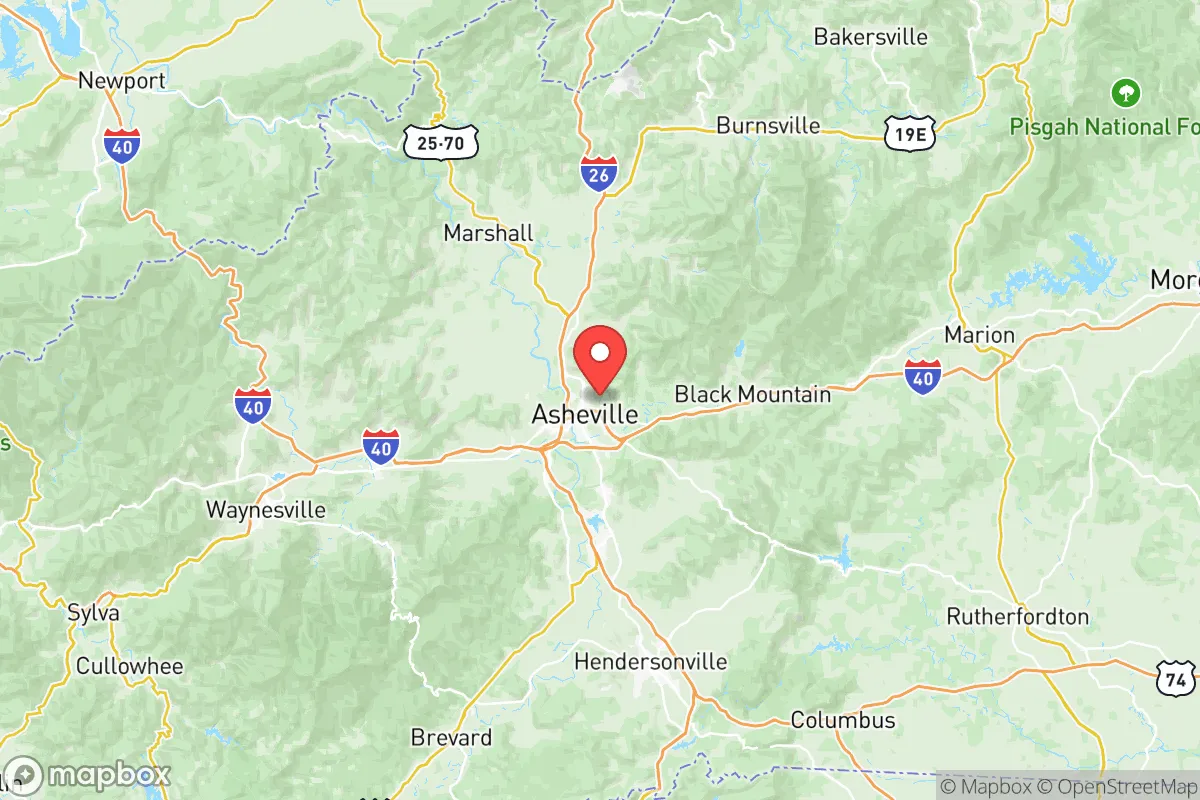
European-American settlement began in earnest after the American Revolution, with the first wave of settlers arriving in the 1790s. These were predominantly Scots-Irish and English migrants moving westward from the Piedmont region of North Carolina and Virginia, drawn by the promise of cheap land in the fertile mountain valleys. They established small farms and communities, and the county was officially formed in 1791, named for Edward Buncombe, a Revolutionary War officer. The town of Asheville, founded in 1797, quickly became the county seat and commercial center, situated at the confluence of the Swannanoa and French Broad rivers.
The 19th century saw a slow but steady population increase, driven by subsistence agriculture and the rise of the Buncombe Turnpike, which connected the region to markets in South Carolina. A distinct wave of German-speaking settlers, many of them Lutheran, arrived in the 1840s and 1850s, establishing communities in the northern part of the county, particularly around the town of Weaverville. The Civil War and Reconstruction era brought economic hardship, but the arrival of the railroad in the 1880s transformed Asheville into a resort destination for wealthy Northerners and a center for tuberculosis treatment, attracting both visitors and new residents.
The early 20th century saw the growth of the timber and textile industries, which drew a small number of African American workers from the surrounding region. The Black population in Buncombe County peaked at around 15% in the early 1900s, concentrated in the East End and Southside neighborhoods of Asheville, as well as in the mill villages of Biltmore Village. However, the decline of the textile industry and the broader Great Migration saw many African Americans leave the county for Northern industrial cities, reducing the Black share to its current 5.4%.
Modern era (post-1965)
The post-1965 era in Buncombe County has been defined less by international immigration and more by a sustained wave of domestic migration from other parts of the United States. The 1965 Hart-Cellar Act, which reshaped immigration nationally, had a relatively muted effect here; the county's foreign-born population remains low at 3.9%, compared to the national average of roughly 14%. The most significant new international arrivals have been Hispanic immigrants, primarily from Mexico and Central America, who began settling in the county in the 1990s and 2000s. They were drawn by jobs in construction, landscaping, hospitality, and agriculture, particularly in the nursery and Christmas tree industries. Today, the Hispanic population stands at 8.3%, with notable concentrations in Asheville's western neighborhoods and in the town of Candler, where many work in the agricultural sector.
The dominant demographic story of the last 50 years, however, has been the arrival of domestic migrants from the Rust Belt, the Northeast, and Florida. These newcomers, often retirees or remote workers, have been attracted by the region's natural beauty, mild climate, lower cost of living (historically), and the cultural amenities of Asheville. This influx has driven rapid population growth, with the county adding roughly 50,000 residents since 2000. The new arrivals tend to be whiter and more educated than the existing population, reinforcing the county's high college attainment rate of 44.6%. They have concentrated in Asheville itself, as well as in the suburban towns of Arden, Fletcher, and Fairview, where new housing developments have proliferated.
The East/Southeast Asian population remains very small at 0.8%, with a small community of Vietnamese and Korean families concentrated in Asheville. The Indian subcontinent population is even smaller at 0.4%, with most employed in the healthcare and technology sectors in Asheville. The Black population, at 5.4%, has remained relatively stable in share, though its geographic concentration has shifted; the historic Black neighborhoods of East End and Southside in Asheville have seen significant gentrification and displacement as property values have risen, pushing some Black residents to the county's more affordable outskirts.
The future
Buncombe County is projected to continue growing, driven by domestic in-migration, but at a potentially slower pace as housing affordability becomes a major constraint. The median home price in Asheville has more than doubled since 2015, pricing out many lower-income residents and shifting new development to the more affordable towns of Swannanoa and Black Mountain in the eastern part of the county. The population is likely to become slightly more diverse, as the Hispanic share continues to grow through both immigration and higher birth rates, and as the county attracts a more diverse mix of remote workers. However, the overall character will remain predominantly white and highly educated, with a growing divide between the liberal, urban core of Asheville and the more conservative, rural and suburban periphery. For someone moving in now, Buncombe County offers a vibrant cultural scene and stunning natural surroundings, but also a competitive housing market and a population that is increasingly shaped by the preferences and values of affluent newcomers.
Buncombe County is becoming a place of two distinct populations: a well-educated, largely white, and politically progressive urban core in Asheville, and a more traditionally minded, less dense suburban and rural periphery. The county's future will be defined by how these groups navigate growth, affordability, and cultural change, making it a dynamic but increasingly expensive place to call home.

* Values derived from national, state, county, city and local statistics and may differ in a specific area. Last updated: 2026-06-17T17:12:44.000Z
Narrative content on this page is AI-generated and may contain mistakes. Verify any details that matter before acting on them.
ReloMaps may earn a commission from affiliate links at no extra cost to you.

