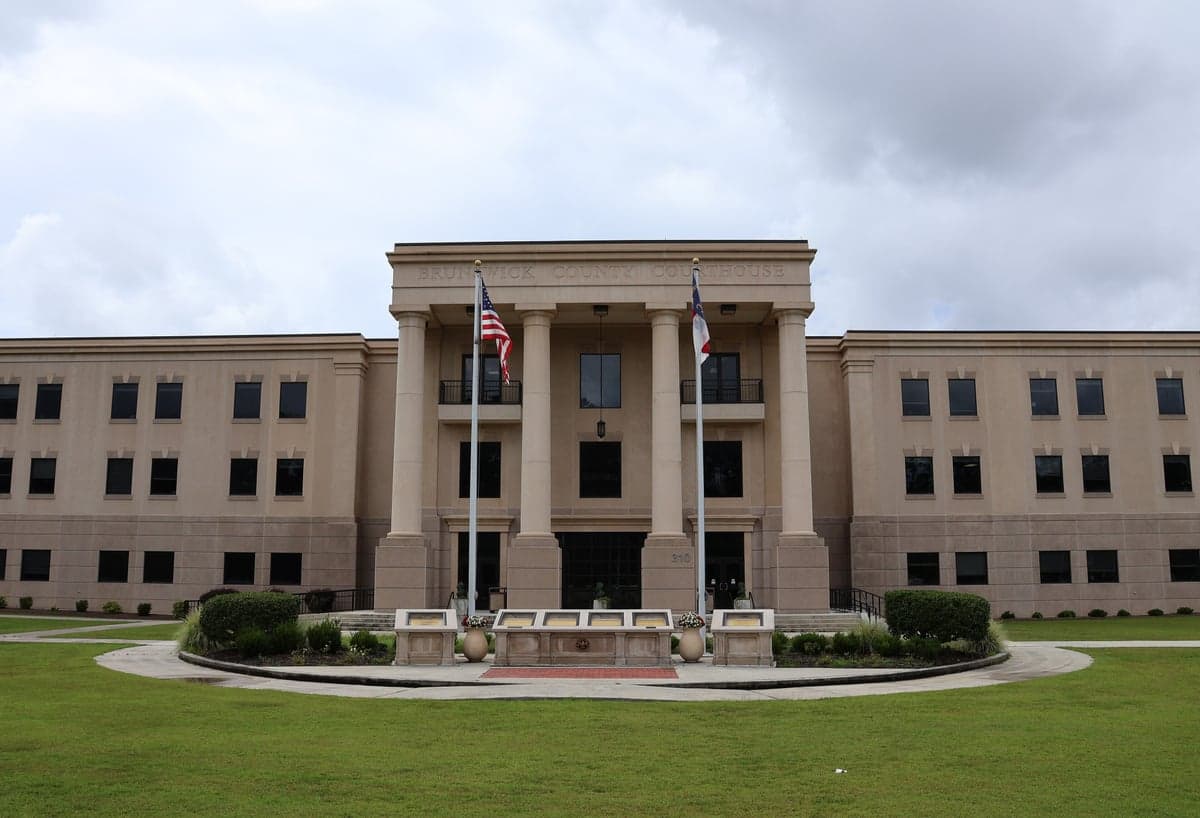
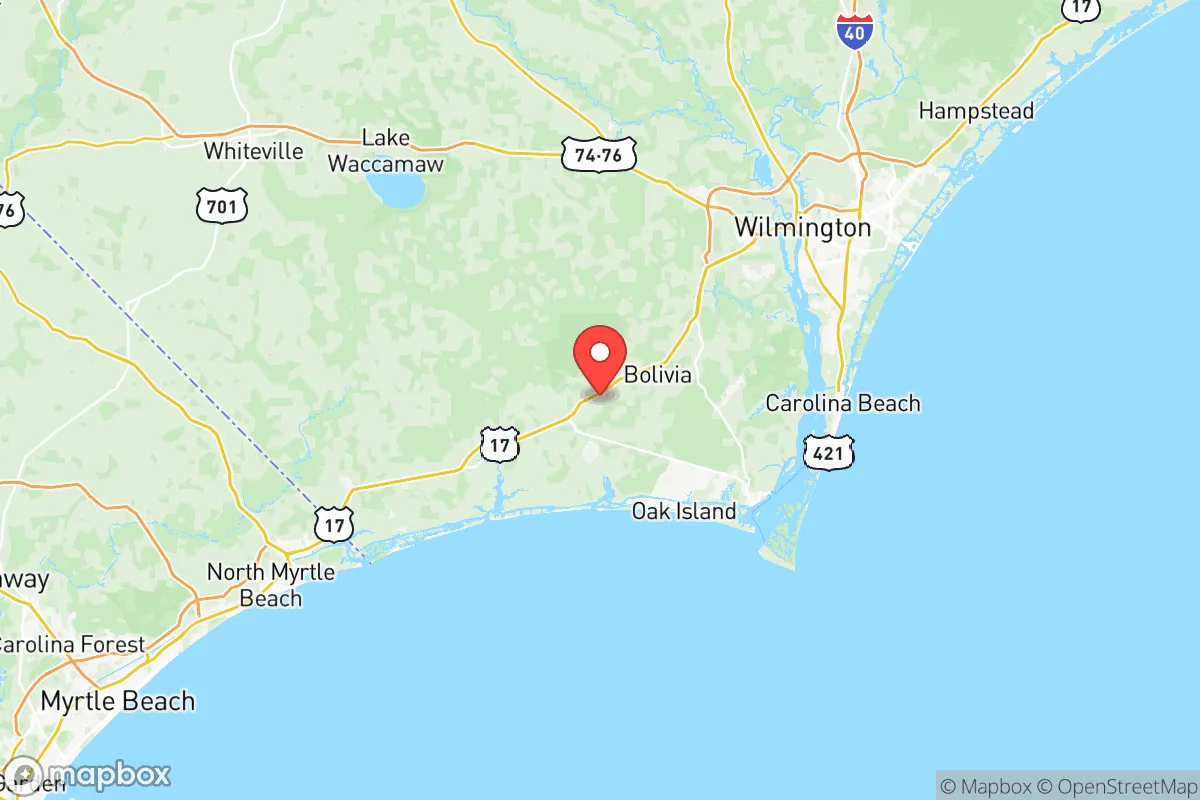
Photo: Wikipedia
Political ClimatePolitical Climate in Brunswick County
Showing district-level results — no local-only data available.
Local Political AnalysisPolitical Analysis of Brunswick County
Brunswick County, North Carolina, is a reliably conservative area that has been shifting rightward even as the state as a whole has become more competitive. With a Cook Partisan Voting Index (PVI) of R+7, the county votes about seven points more Republican than the national average, a stark contrast to North Carolina’s overall R+1 rating. This isn’t a new trend—the county has voted for the Republican presidential candidate in every election since 2000, and the margins have only grown wider. In 2024, Donald Trump carried Brunswick County by roughly 20 points, while he won the state by just over 3 points. The political center of gravity here is distinctly red, and it’s getting redder.
How it compares
Brunswick County’s R+7 PVI places it among the most Republican-leaning counties in southeastern North Carolina, but it’s not a monolith. The county’s political geography is split between its coastal towns and its inland communities. Sunset Beach, Ocean Isle Beach, and Holden Beach tend to vote more moderately, with some precincts swinging within 5 points of the statewide average—these are the areas where retirees and second-home owners from blue states have settled, creating pockets of Democratic votes. In contrast, Leland, Bolivia, and Shallotte are reliably red, often delivering 65-70% of the vote for Republican candidates. The swing precincts are in the fast-growing corridor along Highway 17 between Leland and Shallotte, where new subdivisions are attracting a mix of families and remote workers. These areas are still conservative, but they’re less entrenched than the rural precincts further inland. Compared to the state, Brunswick County is about 6 points more Republican than North Carolina as a whole, a gap that has widened since 2016 as the state’s urban centers like Charlotte and Raleigh have trended blue.
What this means for residents
For conservative residents, the county’s lean means local elections are rarely competitive, and Republican primaries often decide the outcome. The Brunswick County Board of Commissioners has been all-Republican since 2018, and the county’s state legislative delegation is uniformly GOP. This translates into low property tax rates—the county’s rate of $0.495 per $100 of assessed value is among the lowest in the state—and a hands-off approach to development, with minimal zoning restrictions outside of coastal areas. For liberal residents, the political reality is more challenging. Democratic candidates rarely invest in county-level races, and progressive policy proposals—like expanding public transit or increasing school funding—face an uphill battle. However, the growing population in Leland and the beach towns has created a small but vocal Democratic minority, and local Democratic Party chapters are active in voter registration. The cultural divide is most visible in debates over growth: conservatives tend to favor minimal regulation, while liberals push for environmental protections and managed development, especially along the coast.
One cultural distinction that sets Brunswick County apart from the rest of North Carolina is its strong sense of local identity rooted in the fishing and tourism industries. The county’s politics are shaped by a deep skepticism of state government intervention, particularly from Raleigh. This was evident in the 2020 debate over beach driving permits, where local officials fought state efforts to restrict vehicle access on the beaches. For both conservatives and liberals, the county’s political climate means that local issues—like beach access, hurricane preparedness, and school funding—often matter more than national partisan battles. The trajectory is clear: Brunswick County will remain a Republican stronghold for the foreseeable future, but the influx of new residents from across the country is slowly diversifying its political landscape, making it a place where the old guard and newcomers are learning to coexist.

State Political ClimatePolitical Climate in North Carolina
State Political AnalysisPolitical Environment in the State
North Carolina is the quintessential swing state, with a Cook PVI of R+1 that barely hints at the political knife-fight happening on the ground. Over the past 20 years, the state has shifted from a reliably Republican stronghold in presidential elections to a true battleground, driven by explosive growth in the Research Triangle and Charlotte metros. The dominant coalition is a split: a culturally conservative, rural and small-town base that delivers wins for Republicans in state legislative races, versus a rapidly growing, diverse, and college-educated urban and suburban bloc that keeps Democrats competitive statewide. The 10-20 year arc is a slow, grinding leftward drift in the metro cores, but the rural areas have hardened their Republican allegiance, creating a state that is both deeply divided and perpetually up for grabs.
Urban vs. rural divide
The political map of North Carolina is a story of three distinct regions. Charlotte (Mecklenburg County) and Raleigh-Durham-Chapel Hill (Wake, Durham, and Orange Counties) are the Democratic engines, delivering massive margins that can swing a statewide race. These metros are home to major universities, large financial and tech sectors, and a diverse, transplant-heavy population. In contrast, the rural eastern counties like Robeson and the western mountain counties like Watauga are more mixed, but the vast majority of rural and exurban counties—places like Gaston County west of Charlotte, Johnston County east of Raleigh, and Catawba County in the foothills—vote Republican by wide margins. The suburbs are the true battlegrounds: Mecklenburg County itself is deep blue, but its northern suburbs in Iredell County (Mooresville, Statesville) remain reliably red, while the southern suburbs in Union County are shifting from deep red to light red. The key takeaway: if you live in a city center or an inner-ring suburb, you're in a blue bubble; drive 20 minutes out, and you're in deep red territory.
Policy environment
North Carolina’s policy environment is a study in contrasts. The state has a flat income tax rate of 4.5%, which is scheduled to decline further to 3.99% by 2027, making it one of the more tax-friendly states in the Southeast. There is no state tax on Social Security benefits, and the standard deduction is generous. The regulatory posture is generally business-friendly, with a right-to-work law and a relatively low corporate income tax rate of 2.5%. On education, the state has a robust charter school sector and a growing school choice program, including Opportunity Scholarships that can be used for private school tuition. Healthcare is a mixed bag: the state did not expand Medicaid until 2023, and while it has now done so, the system remains heavily reliant on large hospital systems like Atrium Health and Duke Health. Election laws are a perennial flashpoint: the state has voter ID requirements, a strict absentee ballot process, and has seen repeated legal battles over redistricting and same-day registration. For a conservative relocator, the tax and regulatory environment is a clear draw; for a liberal relocator, the social policies and voting access may feel restrictive.
Recent policy direction
The last five years have seen a clear conservative tilt in state-level policy, driven by a Republican-controlled General Assembly that has been able to override Democratic Governor Roy Cooper’s vetoes with a supermajority. Gun and self-defense law: North Carolina is a shall-issue state for concealed carry, and in 2023, the legislature passed a law eliminating the requirement for a permit to purchase a handgun (permitless purchase), though a court challenge has temporarily blocked it. Parental and education rights: The state passed the “Parents’ Bill of Rights” in 2023, requiring schools to notify parents about instructional materials involving sexuality and to get parental consent before a child’s name or pronouns can be changed at school. Speech and privacy: There is no broad state-level privacy law akin to California’s, but the state does have a data breach notification law. Medical and bodily autonomy: Abortion is currently legal up to 12 weeks, with a 72-hour waiting period and a requirement for an in-person consultation. A 2023 law also banned most abortions after 12 weeks, with exceptions for rape, incest, and fetal anomalies. Property rights: The state has strong eminent domain protections, and there is no statewide rent control. Taxation: The flat tax is being phased down, and the state has no estate or inheritance tax. Voting and ballot access: The 2023 omnibus election law tightened voter ID requirements, shortened the absentee ballot return window, and gave more power to partisan poll observers. For a conservative, this is a state that has been moving in a favorable direction on most fronts; for a liberal, it feels like a steady erosion of rights.
Civil unrest & political movements
North Carolina has a history of visible political activism. The Moral Monday protests of 2013, led by the NAACP, drew thousands to the state legislature to protest Republican policies on voting rights, education, and healthcare. More recently, the 2020 protests in Charlotte and Raleigh over George Floyd’s death were large but largely peaceful, though there were isolated incidents of property damage. On the right, the “We the People” movement and local Tea Party groups remain active, particularly in rural counties. Immigration politics are a hot-button issue: while there are no major sanctuary cities, Orange County (Chapel Hill) and Durham County have declared themselves “welcoming” jurisdictions, and the state has seen legal battles over local policies that limit cooperation with ICE. Election integrity remains a live issue: the 2020 election in North Carolina was close but not as contentious as in some other states, though the state’s voter ID law and redistricting maps have been the subject of ongoing litigation. A new resident will notice that political signs are ubiquitous, especially in the suburbs, and that local news is heavily focused on the state legislature’s battles with the governor.
Projection
Over the next 5-10 years, North Carolina is likely to become even more competitive, but the direction of that competition is uncertain. The in-migration from blue states like New York, California, and New Jersey is accelerating, particularly in the Raleigh-Durham and Charlotte metros. These newcomers tend to be more moderate or liberal, which could slowly shift the statewide balance. However, the rural and exurban areas are not shrinking as fast as in some other states, and the Republican base remains deeply entrenched. The key variable is the state legislature: if Republicans maintain their supermajority, they will continue to push conservative policies on education, abortion, and voting. If Democrats break the supermajority, the state could see a more moderate or even progressive turn on some issues. For someone moving in now, expect a state that will remain a political battleground for the foreseeable future, with the policy pendulum swinging based on which party controls the legislature after the 2024 and 2026 elections.
For a new resident, the bottom line is that North Carolina offers a low-tax, business-friendly environment with a strong economy, but the political climate is intensely polarized and will affect your daily life in tangible ways—from the quality of your local schools to the availability of healthcare services. If you lean conservative, you’ll find a state that largely aligns with your values on taxes, education, and gun rights. If you lean liberal, you’ll find vibrant blue cities and a growing activist community, but you’ll need to be prepared for state-level policies that may feel out of step with your views. Either way, you’re moving to a state where your vote truly matters, and where the political conversation is never far from the surface.
* Values derived from national, state, county, city and local statistics and may differ in a specific area. Last updated: 2026-09-29T07:51:12.000Z
Narrative content on this page is AI-generated and may contain mistakes. Verify any details that matter before acting on them.
ReloMaps may earn a commission from affiliate links at no extra cost to you.

