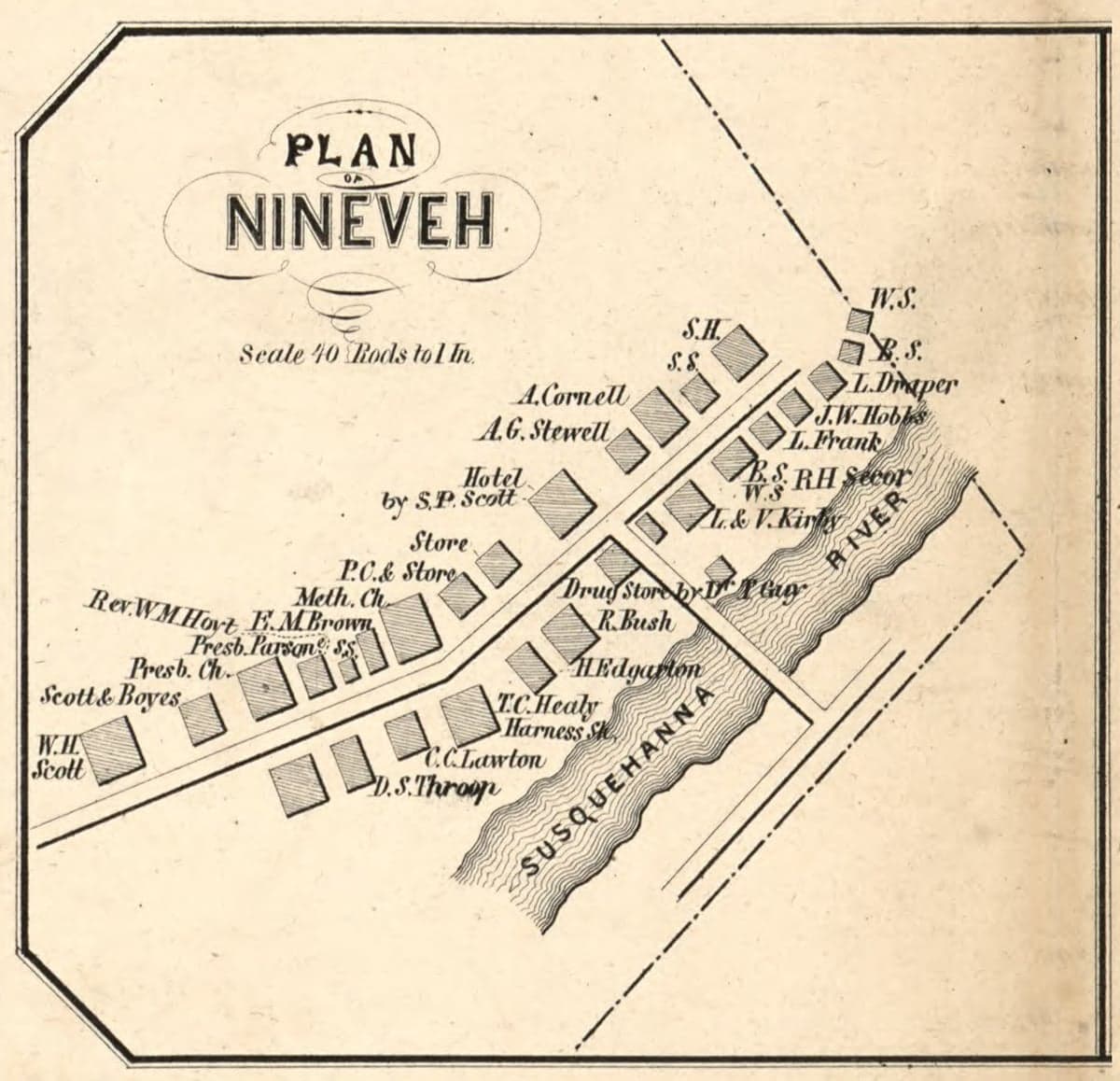
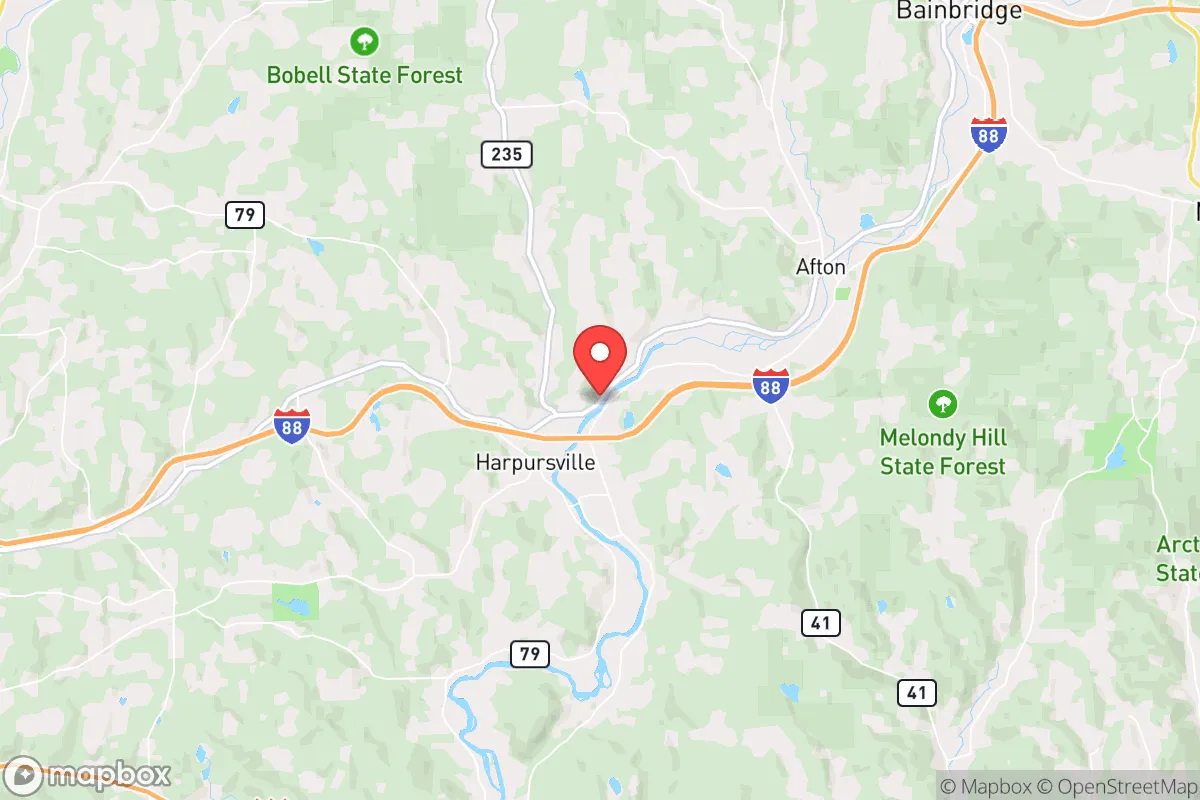
Photo: Wikipedia
Political ClimatePolitical Climate in Nineveh, NY
District shown is the primary district for this city’s centroid. Cities may span multiple districts.
Local Political AnalysisPolitical Analysis of Nineveh, NY
Nineveh, New York, sits in a political sweet spot that’s shifted noticeably over the past decade. Tucked in Broome County, this small town leans slightly Democratic, with a Cook PVI of D+1, but it’s not a deep-blue stronghold. The area has been trending leftward since the 2010s, driven by an influx of remote workers from Binghamton and even some spillover from the Ithaca area, but it still holds a strong conservative undercurrent, especially among long-time farming families. You’ll see a mix of Trump signs and Harris yard signs on the same rural road, which tells you everything about the local balance.
How it compares
Compared to New York City, Nineveh is a different political planet. New York, NY, with its dense urban core, is overwhelmingly Democratic—likely a D+30 or more if it had a Cook PVI—while Nineveh’s D+1 means it’s a genuine swing town. In the 2024 presidential race, Broome County as a whole voted for Trump by about 10 points, but Nineveh’s precincts were closer to a 50-50 split. Nearby towns like Deposit and Windsor lean more Republican, while Binghamton, just 20 minutes west, is solidly blue. This creates a patchwork where a conservative resident might feel comfortable at the local diner but outnumbered in county government, while a liberal resident might find the school board meetings more contentious than in the city. The contrast is stark: in NYC, you can go blocks without hearing a dissenting political opinion; in Nineveh, you’ll hear both sides at the same gas station.
What this means for residents
For conservatives, the D+1 lean means they’re not marginalized—they have real representation on the town board and in the county legislature. Property taxes here are lower than in NYC, and gun rights are broadly respected, with few local restrictions beyond state law. For liberals, the area’s trajectory is encouraging: the town has passed a few small sustainability initiatives, like a community solar program, and the local Democratic committee is active. But neither side gets everything they want. A conservative might grumble about state-level mandates on energy or education, while a liberal might wish for more public transit or affordable housing funding. The practical reality is that Nineveh’s politics are about compromise—you’ll see a Republican highway superintendent and a Democratic town clerk working the same potluck. The trajectory suggests the D+1 could become D+3 or D+4 by 2030 as more people move from Binghamton and Ithaca, but the rural character will keep it from ever feeling like a suburb of NYC.
Culturally, Nineveh is distinct from New York City in ways that go beyond voting. The local school district, which includes nearby Harpursville, emphasizes agricultural education and FFA programs, while NYC schools focus on diversity and urban issues. Policy-wise, Nineveh residents are more concerned with road maintenance and broadband access than with subway funding or rent control. The town’s zoning is minimal, allowing for larger lots and home-based businesses, which contrasts sharply with NYC’s dense regulations. If you’re moving from the city, expect a place where political conversations happen over coffee at the Nineveh Country Store, not on Twitter, and where your vote genuinely feels like it could swing a local election.

State Political ClimatePolitical Climate in New York
State Political AnalysisPolitical Environment in the State
New York State has been a solidly Democratic stronghold for decades, but the political reality is far more nuanced than the state’s overall blue hue suggests. Since the early 2000s, the Democratic grip has tightened in presidential elections—Hillary Clinton won by 22 points in 2016, Joe Biden by 23 in 2020, and Kamala Harris by 12 in 2024—driven almost entirely by New York City’s five boroughs and a handful of downstate suburbs. Meanwhile, the rest of the state has shifted rightward, with many rural and exurban counties flipping from purple to deep red. For a conservative-leaning relocator, the key takeaway is that your experience will depend almost entirely on whether you settle in Manhattan, Buffalo, or somewhere in between.
Urban vs. rural divide
The political map of New York is a tale of two states. New York City, with its 8.5 million residents, is the engine of Democratic dominance—Bronx and Brooklyn routinely deliver 80%+ Democratic margins. The immediate suburbs of Westchester, Nassau, and Suffolk counties have historically been swing territory but have trended blue since 2016, driven by educated professionals and growing minority populations. In contrast, the vast upstate region—from the Hudson Valley north to the Adirondacks and west to Lake Erie—is overwhelmingly Republican. Counties like Allegany, Wyoming, and Orleans routinely vote 65-70% Republican. The city of Buffalo is a Democratic island in Erie County, but its suburbs and the surrounding rural areas are solidly red. Rochester and Syracuse follow a similar pattern: blue urban cores surrounded by red exurbs. The most politically distinct suburb is Nassau County on Long Island, which flipped from reliably Republican to narrowly Democratic in the Trump era, while Staten Island remains the only NYC borough where Republicans can win local races.
Policy environment
New York’s policy environment is among the most progressive in the nation, with high taxes, heavy regulation, and expansive social programs. The state has a progressive income tax with rates from 4% to 10.9% on income over $25 million, and property taxes are among the highest in the country—the median effective rate is 1.62% of home value, compared to the national average of 0.99%. Sales tax varies by county but typically lands around 8-9%. The regulatory posture is business-friendly in name only for many industries; the state’s strict environmental regulations, labor laws (including a $15 minimum wage that adjusts for inflation), and rent stabilization laws in NYC create a high-cost environment. Education policy is dominated by the state’s powerful teachers unions, and school funding is heavily skewed toward downstate districts. Healthcare is a mix: the state expanded Medicaid under the ACA and runs its own health insurance exchange, but rural hospitals have been closing at an alarming rate. Election laws are among the most accessible in the country—no-excuse absentee voting, early voting, and same-day registration are all in place, though voter ID is not required.
Recent policy direction
The last five years have seen New York accelerate leftward on nearly every front. In 2022, the state passed the Clean Slate Act, automatically sealing most criminal records after a set period. Gun laws have tightened significantly: the 2022 Concealed Carry Improvement Act (CCIA) requires a "proper cause" showing for a permit, bans guns in "sensitive locations" like Times Square and subways, and mandates 18 hours of training. This law is being challenged in court but remains in effect. Parental and education rights have been a flashpoint: the state banned religious exemptions for school vaccine mandates in 2019 and has resisted parental notification laws around gender identity. On speech and privacy, New York passed a strong biometric privacy law in 2021 and expanded data breach notification requirements. Medical and bodily autonomy is fully protected—abortion is legal up to viability, and the state has a "shield law" protecting providers who treat out-of-state patients. Property rights are constrained by rent stabilization in NYC and strict land-use regulations statewide. On voting, the state passed the John R. Lewis Voting Rights Act in 2022, which requires pre-clearance for changes to voting procedures in jurisdictions with a history of discrimination.
Civil unrest & political movements
New York has been a hotbed of political activism on both sides. The 2020 Black Lives Matter protests in NYC were among the largest in the country, with sustained demonstrations for months. The state’s sanctuary policies—New York is a "sanctuary state" under the 2017 New York State DREAM Act and subsequent executive orders—mean local law enforcement generally does not cooperate with federal immigration enforcement. This has created tension in upstate communities like Utica and Buffalo, where refugee resettlement has been significant. On the right, the "Second Amendment sanctuary" movement has spread to dozens of upstate counties, with local sheriffs refusing to enforce parts of the CCIA. Election integrity controversies have been muted compared to swing states, but the 2020 and 2024 elections saw scattered allegations of ballot harvesting in NYC. The most visible flashpoint for a new resident would be the stark contrast in political signage and discourse between downstate and upstate—you’ll see far more Trump flags in Oneonta than in Brooklyn.
Projection
Over the next 5-10 years, New York’s political trajectory points toward continued Democratic dominance at the state level, but with growing internal friction. Demographic trends favor the Democrats: NYC continues to attract young, diverse, and educated newcomers, while upstate’s population is aging and slowly declining. However, the 2024 election results showed a slight rightward shift in downstate suburbs, particularly among Latino and Asian voters in Queens and Long Island. If this trend continues, the state could become more competitive in statewide races—but the state legislature is likely to remain firmly Democratic due to gerrymandering and the concentration of Democratic voters. In-migration patterns are a wild card: New York lost population for three consecutive years (2020-2023), with many relocating to Florida and Texas, but the outflow has slowed. For a conservative moving in now, expect the state’s policy direction to remain progressive, but with more internal pushback from upstate and suburban moderates. The biggest practical change will be the continued erosion of local control—Albany has been preempting local zoning and land-use decisions, which could reshape housing and development patterns.
For a new resident, the bottom line is that New York offers a stark choice. If you settle in NYC or its immediate suburbs, you’ll be in a deep-blue environment with high taxes, strong regulations, and progressive social policies. If you choose an upstate community like Geneva or Plattsburgh, you’ll find a more conservative local culture, lower cost of living, and a political climate that feels more like the Midwest than the Northeast. The state’s policies will affect you regardless—your income taxes, property taxes, and gun rights are determined in Albany, not your county. For a conservative-leaning family, the best bet is a small city or rural town in the Finger Lakes or Southern Tier, where you can enjoy the natural beauty and lower costs while voting against the state’s direction. Just don’t expect the state government to change course anytime soon.
* Values derived from national, state, county, city and local statistics and may differ in a specific area. Last updated: 2026-09-20T21:52:39.000Z
Narrative content on this page is AI-generated and may contain mistakes. Verify any details that matter before acting on them.
ReloMaps may earn a commission from affiliate links at no extra cost to you.

