Photo: Wikipedia
Demographics of Nineveh, NY
Affluence Level in Nineveh, NY
A low-income area with significant economic hardship. Household wealth and educational attainment are well below national averages.
People of Nineveh, NY
The people of Nineveh, New York, today form a small, tightly-knit community of just over 1,000 residents, characterized by its overwhelming racial and ethnic homogeneity. With a population that is 97.4% White and a foreign-born share of only 0.6%, Nineveh is one of the least diverse municipalities in Broome County. Its identity is rooted in rural, working-class traditions, with a notably low college attainment rate of 12.4% reflecting a population historically tied to local industry and agriculture rather than professional or knowledge-economy sectors.
How the city was settled and grew
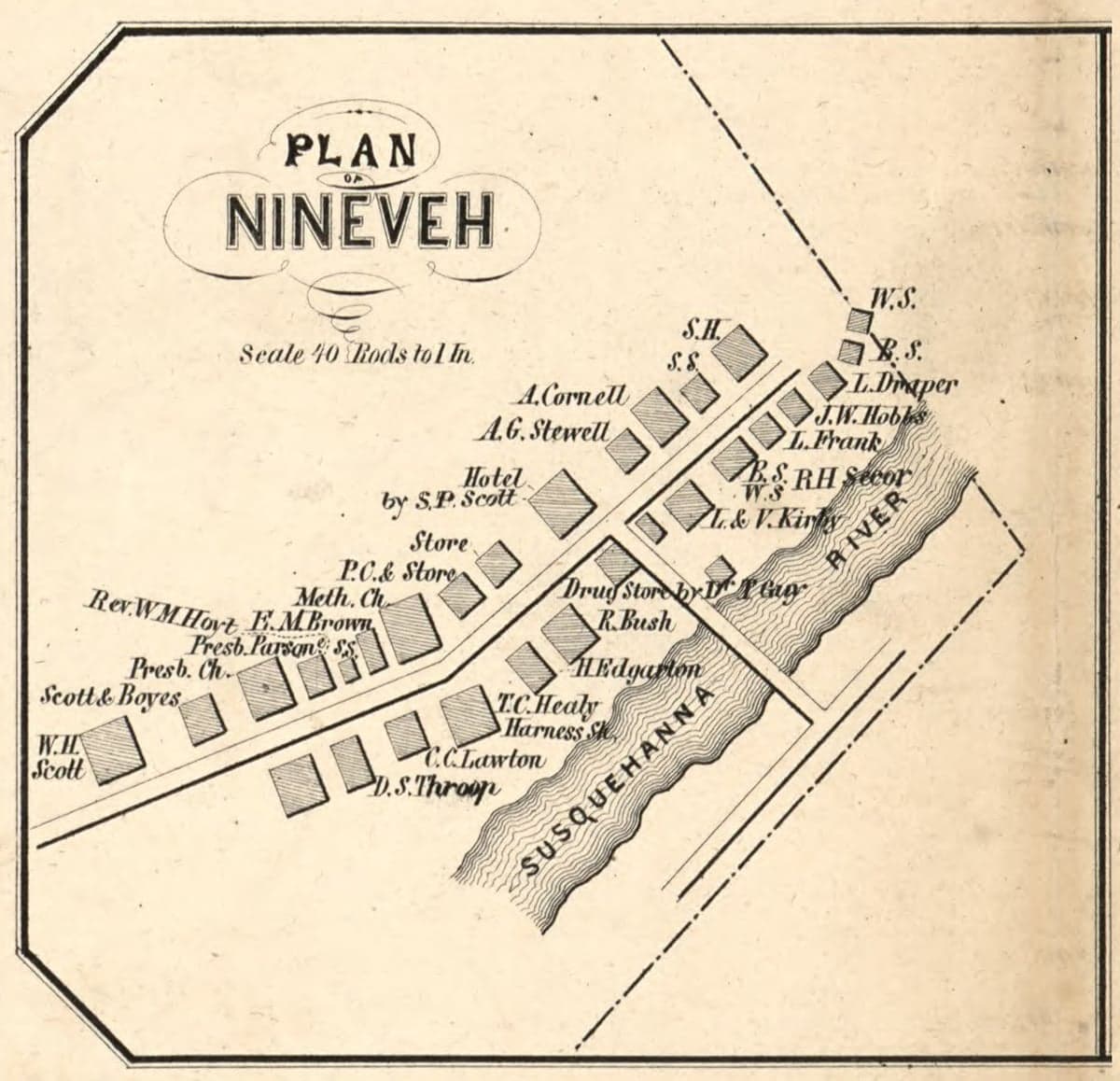
Nineveh’s settlement began in the late 18th century, shortly after the American Revolution, when the area was part of the vast Military Tract set aside to compensate New York veterans. The first permanent European settlers, primarily of English and Scottish descent, arrived around 1791, drawn by the promise of fertile land along the Susquehanna River. They established a small farming hamlet that was formally named Nineveh in 1824, after the ancient Assyrian capital, reflecting a common 19th-century fashion for biblical place names. The original settlement clustered around what is now the Nineveh Corners district, where the main crossroads and early gristmills were located. A second wave of growth came in the mid-19th century with the arrival of the railroad, which spurred a small industrial base. Irish immigrants, fleeing the Great Famine, came to work on the railroad and in local tanneries, settling in a low-lying area near the tracks that became known informally as Depot Row. These two neighborhoods—Nineveh Corners, the civic and commercial heart, and Depot Row, the working-class rail corridor—defined the town’s early social geography.
Modern era (post-1965)
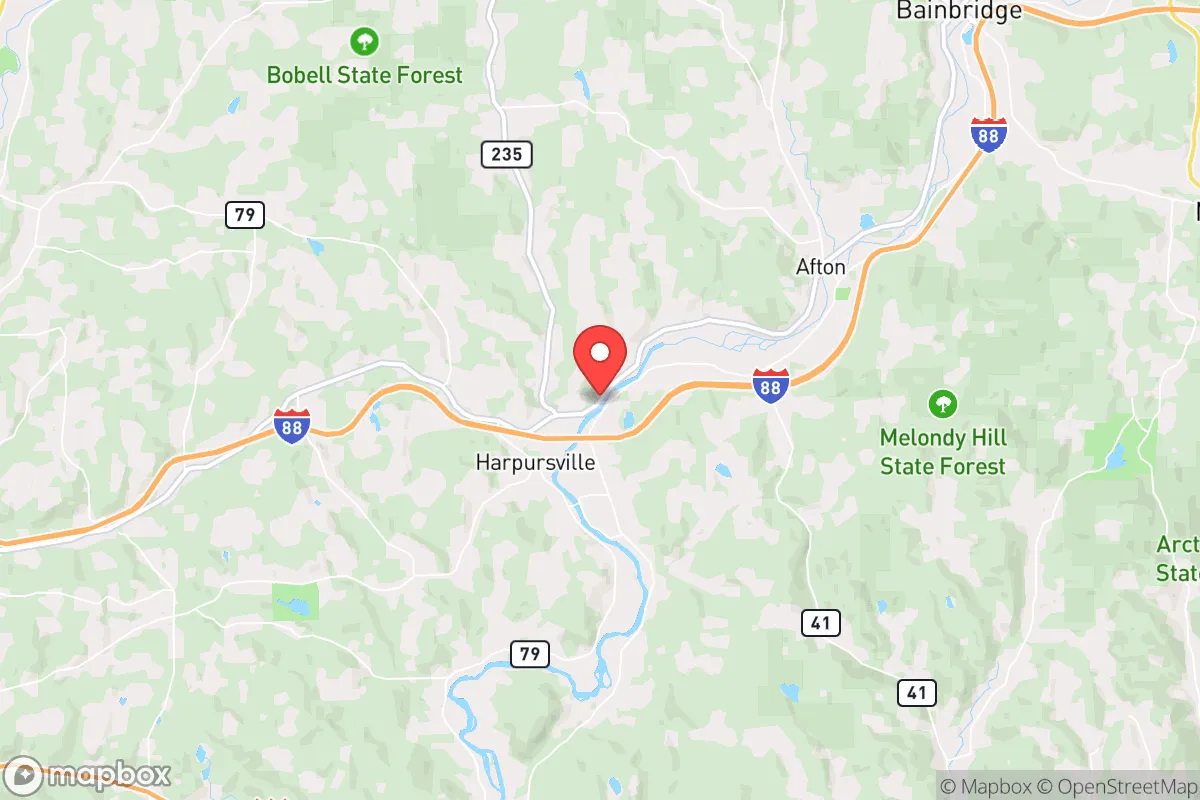
The post-1965 era brought little demographic change to Nineveh, in stark contrast to national trends. The 1965 Hart-Cellar Act, which dramatically increased immigration from Asia and Latin America, had virtually no impact here. The town’s foreign-born population remains negligible at 0.6%, and its Hispanic share is just 2.3%, with no recorded Black, East/Southeast Asian, or Indian-subcontinent residents. Domestic in-migration has been the primary driver of change, but it has been modest and largely White. The construction of Interstate 88 in the 1970s made Nineveh a viable bedroom community for commuters working in Binghamton (15 miles west) and Oneonta (25 miles east). This led to the development of a newer residential area, Riverbend Estates, a small subdivision of single-family homes built in the 1980s and 1990s along the Susquehanna. Unlike the older neighborhoods, Riverbend Estates attracted middle-class families—many of them second- or third-generation descendants of the original English and Irish settlers—who sought larger lots and a rural lifestyle while retaining access to urban jobs. Meanwhile, the historic core of Nineveh Corners saw gradual population loss as younger residents moved away for college or employment, leaving an aging population in the original village center. The West Side, a cluster of older homes along Route 7 west of the Corners, has remained a stable, lower-income area where many long-time working-class families still reside.
The future
Nineveh’s demographic trajectory points toward continued stability, not transformation. The population has hovered around 1,000 for decades, and no major shifts are anticipated. The town’s low housing stock—fewer than 500 units—and lack of rental apartments or new construction projects limit the potential for significant in-migration. The Hispanic share, while small, may grow slightly as agricultural labor demand in the broader region attracts some seasonal workers, but this is unlikely to alter the town’s overall character. The most notable trend is the aging of the population: the median age in Nineveh is approximately 47, well above the national average, and the school-age population has been declining. Younger families who do move in tend to gravitate toward Riverbend Estates or the newer lots along Hickory Hill Road, a semi-rural area with newer homes that offers more space than the older neighborhoods. The historic districts of Nineveh Corners and Depot Row are likely to continue their slow decline in population density, as older residents pass away or move to senior facilities in Binghamton. No new subdivisions or large-scale developments are planned, and the town’s zoning remains oriented toward preserving its rural character.
For someone moving in now, Nineveh offers a stable, predictable environment where the population is not changing rapidly. It is a place where the community’s identity remains firmly rooted in its 19th-century origins—White, working-class, and rural—and where the next decade will likely look much like the last. New residents should expect a quiet, low-diversity setting with limited services but strong local ties, particularly in the established neighborhoods of Nineveh Corners and the West Side.

* Values derived from national, state, county, city and local statistics and may differ in a specific area. Last updated: 2026-09-20T21:52:39.000Z
Narrative content on this page is AI-generated and may contain mistakes. Verify any details that matter before acting on them.
ReloMaps may earn a commission from affiliate links at no extra cost to you.

