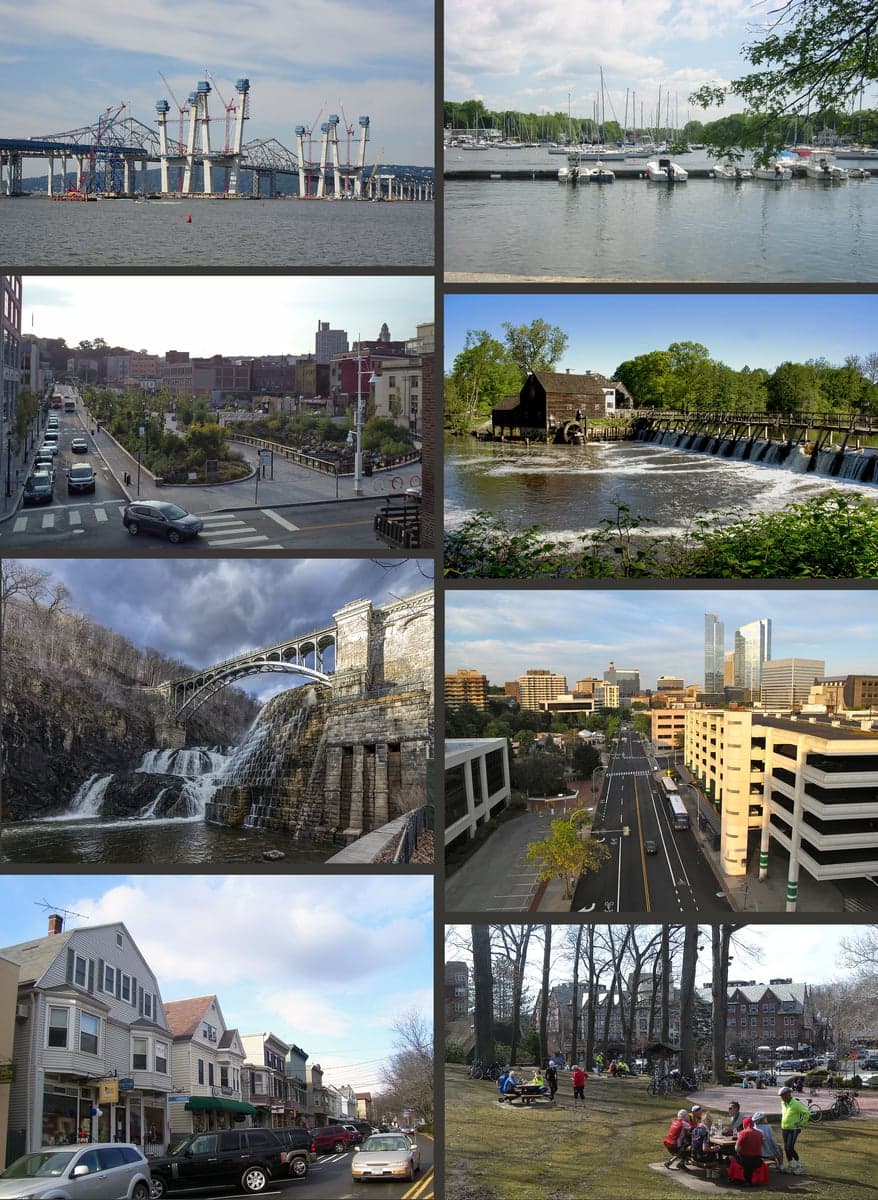
Photo: Wikipedia
Demographics of Westchester County
Affluence Level in Westchester County
An upper-middle-class area. Household wealth, education levels, and homeownership run ahead of national benchmarks.
People of Westchester County
Westchester County, with a population of 996,888, is a densely settled suburban powerhouse immediately north of New York City, characterized by a mix of affluent commuter towns, older industrial cities, and significant racial and ethnic diversity. Its population is 50.0% White, 27.0% Hispanic, 12.9% Black, 3.7% East/Southeast Asian, and 2.3% Indian (subcontinent), with 52.5% of adults holding a college degree. The county’s identity is shaped by deep historical layers—from Dutch and English settlement through successive waves of European immigration, followed by post-1965 diversification—making it a place where old-money estates, working-class enclaves, and vibrant immigrant communities coexist within a single county line.
Settlement & growth (pre-1960)
Before European contact, the region was home to the Munsee-speaking Lenape people, who lived in seasonal villages along the Hudson River and Long Island Sound. Dutch traders established the first European foothold in the 1620s, purchasing land from the Lenape and founding settlements like Yonkers (named after Adriaen van der Donck, the "Jonkheer") and Tarrytown. The English took control in 1664, and Westchester was formally organized as one of New York’s original counties in 1683. During the colonial period, the population remained sparse—mostly English and Dutch farmers working manorial estates like the Philipsburg Manor in what is now Sleepy Hollow.
The American Revolution brought devastation and division; Westchester was a "neutral ground" between British-held New York City and the Continental Army, with families often torn between loyalist and patriot causes. After independence, the county grew slowly as a farming and milling region. The opening of the Erie Canal in 1825 and the arrival of the Hudson River Railroad in 1849 transformed the county into a commuter suburb for New York City’s wealthy elite. Towns like Bronxville, Scarsdale, and Rye developed as exclusive railroad suburbs, attracting Anglo-Saxon Protestant families of means.
The great wave of European immigration between 1880 and 1920 reshaped Westchester’s population. Irish immigrants, fleeing the Great Famine, arrived first, settling in Port Chester and Mount Vernon to work on railroad construction and in factories. Italians followed in large numbers after 1900, concentrating in Yonkers, New Rochelle, and White Plains, where they found work in construction, stonecutting, and the building trades. Eastern European Jews, escaping pogroms, established communities in Mount Vernon and New Rochelle, often starting as peddlers and small shopkeepers. By 1930, Westchester was a patchwork of ethnic enclaves—Irish in Port Chester, Italians in Yonkers’ southwest, Jews in Mount Vernon—alongside the WASP-dominated commuter towns. The Great Migration of Black Americans from the South began during World War I, with families settling in Mount Vernon and New Rochelle, where industrial jobs were available. By 1960, Westchester’s population had reached roughly 800,000, with a White share above 90%.
Modern era (post-1965)
The 1965 Hart-Cellar Immigration Act fundamentally altered Westchester’s demographics. The county’s foreign-born population stands at 10.2% today, but the origins of immigrants have shifted dramatically. The largest post-1965 wave has been from Latin America, particularly from Mexico, Guatemala, El Salvador, and the Dominican Republic. Hispanic residents now make up 27.0% of the population, with major concentrations in Yonkers (where they are roughly 40% of the city), Port Chester (over 60%), and Ossining. These communities are anchored by service-sector jobs in landscaping, construction, restaurants, and domestic work, and they have established vibrant commercial corridors along South Broadway in Yonkers and Westchester Avenue in Port Chester.
East/Southeast Asian communities, at 3.7% of the population, have grown steadily since the 1980s, with Chinese and Korean families settling in Scarsdale, Edgemont, and Chappaqua—drawn by top-ranked public schools. Indian (subcontinent) residents, at 2.3%, have concentrated in Yorktown Heights and Somers, where tech and pharmaceutical jobs in the county’s corporate parks (PepsiCo, IBM, Regeneron) provide employment. The Black population, at 12.9%, has become more suburbanized since 1970, with significant communities in Mount Vernon (where Black residents are roughly 60% of the city), New Rochelle, and Greenburgh. Domestic migration from New York City has also been a constant: families seeking better schools and larger homes have moved north, particularly to White Plains and Yonkers, while some empty-nesters have returned to the city.
Suburbanization in the post-1965 era has been uneven. The county’s northern towns—Bedford, Lewisboro, North Salem—remain overwhelmingly White and wealthy, with large-lot zoning that limits density. Southern and central cities like Yonkers, Mount Vernon, and New Rochelle have become majority-minority, with higher poverty rates and older housing stock. The county’s overall White share has fallen from 90% in 1960 to 50.0% today, while the Hispanic share has risen from under 5% to 27.0%.
The future
Westchester is becoming more diverse, but the pace of change is slowing. The Hispanic share is projected to reach 30-32% by 2035, driven by both immigration and higher birth rates. The East/Southeast Asian and Indian populations are growing steadily, particularly in the northern and central school districts, as professional families seek suburban space. The White population is aging and declining in absolute numbers, though it remains dominant in the wealthiest towns. The Black population is stable, with some out-migration to more affordable counties in the Hudson Valley and the South. New immigrant communities are dispersing rather than forming dense enclaves: Guatemalan families are moving into Peekskill and Port Chester, while Indian families are buying homes in Yorktown and Somers. The county’s cultural identity is evolving from a binary of "old-money WASP" and "ethnic Catholic" to a multi-ethnic, multi-faith mosaic, with Spanish spoken widely in public spaces and Hindu temples appearing in former churches.
For someone moving in now, Westchester offers a rare combination: top-tier public schools, proximity to New York City, and genuine diversity—but also high housing costs, persistent segregation by town, and a tax burden that ranks among the highest in the nation. The county is becoming a place where a Guatemalan landscaper, a Korean doctor, a Black teacher, and a White investment banker may all live within the same school district, but rarely on the same block. That tension between integration and separation defines Westchester’s present and will shape its future.

* Values derived from national, state, county, city and local statistics and may differ in a specific area. Last updated: 2026-06-20T16:20:27.000Z
Narrative content on this page is AI-generated and may contain mistakes. Verify any details that matter before acting on them.
ReloMaps may earn a commission from affiliate links at no extra cost to you.

