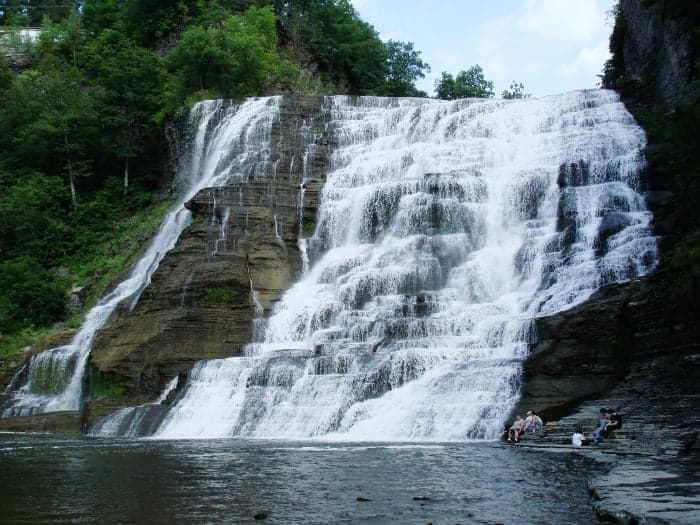
Photo: Wikipedia
Political ClimatePolitical Climate in Tompkins County
Showing district-level results — no local-only data available.
Local Political AnalysisPolitical Analysis of Tompkins County
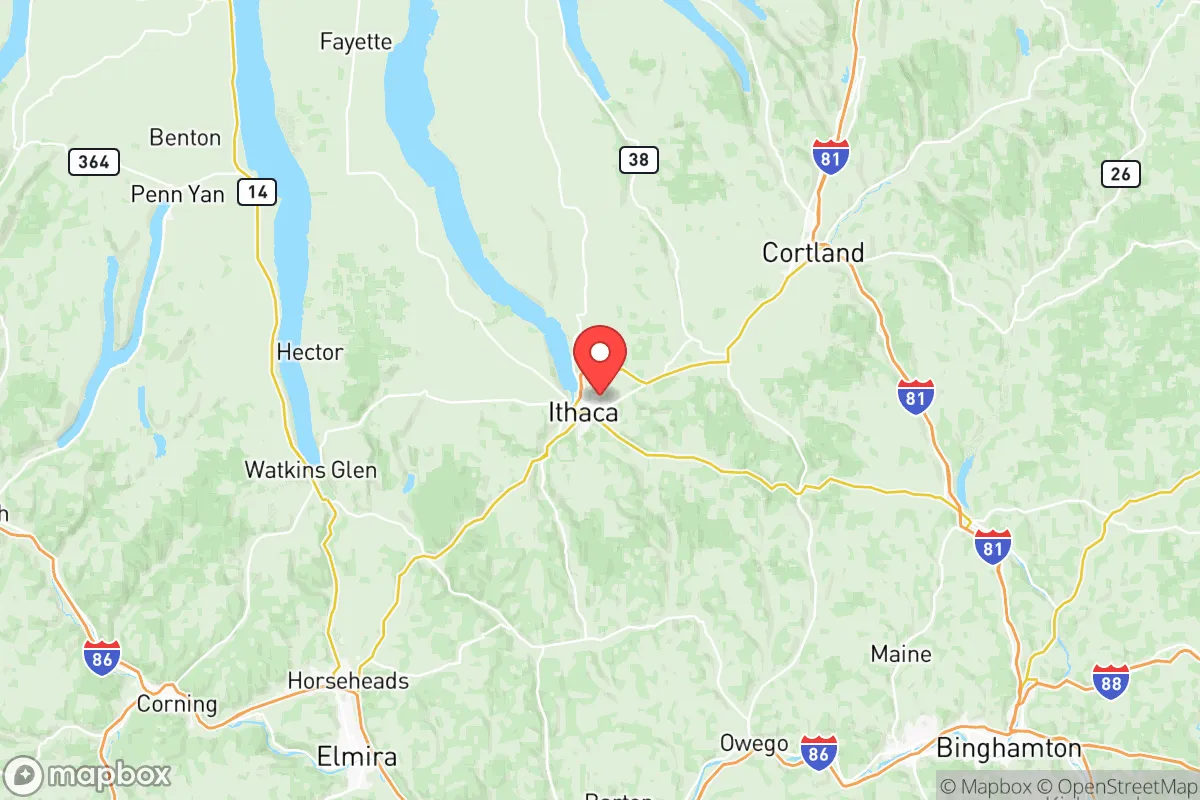
Tompkins County is a deep blue island in a sea of red upstate New York, anchored by Ithaca and Cornell University. The county’s Cook Partisan Voting Index (PVI) of D+1 actually understates its Democratic dominance in presidential elections — in 2020, Joe Biden carried the county by a 40-point margin over Donald Trump, a gap that has widened steadily since 2000. The real political story here is the stark urban-rural divide within the county itself: the City of Ithaca and the town of Ithaca vote overwhelmingly Democratic (often 80%+), while the more rural towns like Dryden, Lansing, and Caroline are competitive swing areas, and the eastern towns of Groton and Danby lean noticeably more conservative, sometimes voting Republican in local races.
How it compares
Compared to New York City, Tompkins County is both more uniformly liberal in its voting patterns and less economically stratified by politics. In New York City, you see a massive Democratic majority citywide, but with sharp internal divides — Staten Island is a Republican stronghold, parts of Brooklyn and Queens have competitive swing districts, and the outer boroughs have sizable conservative voting blocs. Tompkins County lacks that kind of internal partisan friction; the conservative vote is concentrated in small, low-density towns that don't shift the countywide outcome. The real contrast is cultural: New York City’s politics are shaped by dense urban issues like housing costs, transit, and immigration, while Tompkins County’s political debates center on land use, agricultural preservation, and the tension between university expansion and small-town character. The county’s D+1 PVI is misleading because it reflects a statewide average that includes New York City’s massive Democratic turnout — in reality, Tompkins County is one of the most reliably Democratic counties in the state outside of the NYC metro area.
What this means for residents
For liberal residents, Tompkins County offers a political environment where progressive policies on climate, housing, and social services are generally mainstream, and local government is responsive to left-leaning advocacy. The county legislature has been Democratic-controlled for decades, and Ithaca’s city council often pushes policies like universal basic income pilots and community land trusts. For conservative residents, the reality is more isolating: they are a clear minority in countywide elections, and their views on taxes, development, and gun rights are rarely reflected in local policy. However, the rural towns do have real influence on school boards, town planning boards, and county-level decisions about road maintenance and agricultural zoning — so conservative voices are not entirely absent. The political climate is generally civil, but there is a palpable tension between the university-driven, transient population of Ithaca and the long-term rural residents who feel their way of life is being marginalized.
One cultural distinction that sets Tompkins County apart from New York City is the prominence of local food systems and land-use politics. The county has a strong agricultural heritage, and debates over solar farms, wind turbines, and farmland preservation are front-burner issues that rarely make headlines in NYC. The presence of Cornell University also creates a unique political dynamic: the university is the largest employer and a major landowner, and its institutional priorities — from sustainability goals to housing development — often clash with the preferences of both Ithaca residents and rural town boards. This means that even in a heavily Democratic county, local politics can be surprisingly contentious, with progressive factions splitting over development versus preservation, and rural conservatives forming unlikely alliances with environmentalists to block large-scale projects. The trajectory is toward continued Democratic dominance, but with growing internal fractures over growth and affordability that could reshape local elections in the next decade.

State Political ClimatePolitical Climate in New York
State Political AnalysisPolitical Environment in the State
New York State has been a solidly Democratic stronghold for decades, but the reality is far more nuanced than a simple blue label. The state’s overall partisan lean is driven overwhelmingly by New York City and its immediate suburbs, which deliver massive Democratic margins. Outside the five boroughs, much of the state—particularly Upstate—is competitive or even reliably Republican. Over the last 10-20 years, the political trajectory has been one of deepening polarization: the NYC metro has grown more liberal, while rural and exurban areas have shifted rightward, creating a state that feels like two different countries under one capitol dome.
Urban vs. rural divide
The political map of New York is a textbook case of the urban-rural split. New York City alone accounts for roughly 40% of the state’s vote, and it delivers margins of 70-80% for Democrats. Buffalo, Rochester, Syracuse, and Albany are also reliably blue, though with smaller margins. The real action is in the suburbs and exurbs. Nassau County on Long Island has flipped from a Republican stronghold to a Democratic-leaning swing county in the last decade, driven by shifting demographics and suburban discomfort with Trump-era GOP. Meanwhile, Staten Island remains a Republican outlier within the city, often voting 55-60% for GOP candidates. Upstate, counties like Oneida, Rensselaer, and Niagara are competitive, while the North Country (Jefferson, St. Lawrence counties) and the Southern Tier (Steuben, Chemung) are solidly red. The divide is stark: drive 90 minutes north of Manhattan and you’re in Trump country.
Policy environment
New York’s policy environment is among the most progressive in the nation, with a tax structure that reflects it. The state has a progressive income tax with rates up to 10.9% for top earners, plus some of the highest property taxes in the country—averaging over $5,000 annually, and exceeding $10,000 in many Westchester and Long Island suburbs. Sales tax varies by county, typically 8-8.875%. The regulatory posture is heavy: strict environmental rules, rent control in NYC, and a robust labor-friendly legal framework. Education policy is centralized, with the state’s Board of Regents setting curriculum standards, and school funding heavily skewed toward NYC. Healthcare is dominated by large systems like Northwell Health and NYC Health + Hospitals, and the state expanded Medicaid under the ACA. Election laws are among the most accessible: no-excuse absentee voting, early voting, and automatic voter registration. Gun laws are among the strictest in the country, requiring a permit to purchase a handgun and a license to carry, with a 2013 SAFE Act that banned assault weapons and high-capacity magazines.
Recent policy direction
Over the past five years, New York has moved decisively left on several fronts. Gun and self-defense law: The 2022 Concealed Carry Improvement Act (CCIA) tightened restrictions after the Supreme Court’s Bruen decision, requiring “good moral character” for permits and banning firearms in “sensitive locations” like Times Square and subways. Parental and education rights: The state has expanded LGBTQ+ inclusive curriculum and banned conversion therapy, while also passing a 2023 law requiring parental notification for certain health services—a rare bipartisan compromise. Speech and privacy: New York passed a 2023 law restricting social media algorithms for minors, and has a strong biometric privacy law. Medical and bodily autonomy: Abortion is codified up to 24 weeks, and the state has a “shield law” protecting providers who treat out-of-state patients. Property rights: Rent stabilization laws were strengthened in 2019, limiting landlords’ ability to deregulate units. Taxation: The 2021 budget raised the top income tax rate to 10.9% for earners over $25 million, and a 2023 law capped local property tax increases at 2% annually. Voting and ballot access: Early voting was expanded to 10 days, and same-day registration was enacted in 2023. For a conservative relocator, the net effect is a state that is highly regulated, expensive, and protective of individual rights in ways that may conflict with traditional values.
Civil unrest & political movements
New York has been a flashpoint for political activism on both sides. The Black Lives Matter protests in summer 2020 were massive, particularly in NYC and Buffalo, leading to police reform laws like the repeal of 50-a (which had shielded police disciplinary records). The sanctuary city movement is strong: NYC, Albany, and Ithaca have “sanctuary” policies limiting cooperation with federal immigration enforcement, and a 2023 state law barred local jails from holding immigrants for ICE. On the right, the Second Amendment movement is active, with groups like the New York State Rifle & Pistol Association challenging the CCIA in court. The anti-vaccine mandate protests of 2021-2022 were significant, particularly among healthcare workers and first responders. Election integrity controversies have been muted compared to swing states, but the 2020 and 2022 elections saw GOP lawsuits over absentee ballot counting. A notable flashpoint is the secession movement in parts of Upstate—some counties have passed symbolic resolutions to explore leaving the state, though no serious legislative effort has emerged. A new resident would notice the visible presence of activist groups on both sides, especially in college towns like Ithaca and New Paltz.
Projection
Over the next 5-10 years, New York’s political trajectory points toward continued Democratic dominance at the state level, but with growing internal friction. Demographic shifts are key: the NYC metro is losing population to the Sun Belt, while Upstate is aging and shrinking. This means the state’s electoral map will likely become even more NYC-centric, reinforcing progressive policies. However, in-migration from other states is minimal—New York has a net domestic out-migration of about 200,000 people per year, many of them conservative-leaning families moving to Florida, Texas, or the Carolinas. The remaining population is increasingly polarized: liberal urbanites and conservative ruralites, with fewer swing voters. Expect continued battles over gun laws, education curriculum, and taxes. A new resident moving in now should expect that the state’s political direction will remain firmly left-of-center, with periodic conservative pushback in the courts and at the local level. The practical reality is that if you’re conservative, you’ll find like-minded communities in the suburbs and Upstate, but you’ll be outvoted on most statewide issues.
For a conservative relocator, the bottom line is this: New York offers a high quality of life in many respects—world-class cities, excellent schools, and natural beauty—but it comes with a political price tag. You’ll pay higher taxes, navigate stricter regulations, and live under laws that may conflict with your values on guns, education, and speech. If you’re willing to accept that trade-off, you can find a comfortable niche in places like Staten Island, the Hudson Valley exurbs, or the North Country. If not, you’ll likely be frustrated by a state government that consistently moves in a direction you oppose. The key is knowing what you’re signing up for—and New York doesn’t hide its colors.
* Values derived from national, state, county, city and local statistics and may differ in a specific area. Last updated: 2026-07-16T01:02:28.000Z
Narrative content on this page is AI-generated and may contain mistakes. Verify any details that matter before acting on them.
ReloMaps may earn a commission from affiliate links at no extra cost to you.

